Topic: Water
Class: 7th
Age: 14
Medium: English
Let’s start module
1
Programmed Instructional material
Objectives
At the end of this module you will be able to-
1. To enable the pupils to know the meaning of
water
2. To enable pupil to know about the uses of
water
3. To help pupil to know the process of water
cycle
Let’s start module
2
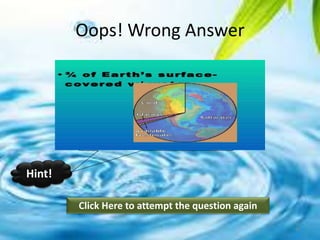
Water is a vital renewable natural resource. Three fourth of the
earth’s surface is covered with water. The earth is, therefore,
appropriately called the ‘water planet’. It was in the primitive
oceans that life began almost 3.5 billion years ago. The ocean
water is however saline is not fit for human consumption.
Fresh water is the most precious substance on earth. Its
abundance only seems to vary because it is in constant motion,
a cycling through the oceans, the air, the land and back again,
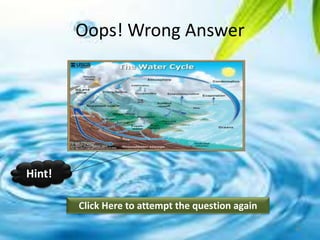
through the process of evaporation, precipitation and run-off
this as already know, is referred to as the ‘water cycle’.
3Next Page
4
The sun’s heat causes evaporation of water vapour. When the water
vapour cools down, it condenses and forms clouds. From there it may
fall on the land or sea in the form of rain, snow or sleet. The process by
which water continually changes its form and circulates between oceans,
atmosphere and land is known as the water cycle. Our earth is like a
terrarium. The same water that existed centuries ago still exists today.
The water used to irrigate a field in Haryana may have flowed down the
Amazon River a hundred years ago. The major sources of fresh water are
the rivers, ponds, springs and glaciers. The ocean bodies and the seas
contain salty water. The water of the oceans is salty or saline as it
contains large amount of dissolved salts.
Next Page
5
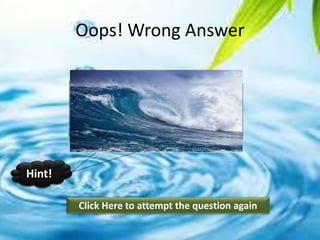
• Tides The rhythmic rise and fall of ocean water twice
in a day is called a tide. It is high tide when water
covers much of the shore by rising to its highest level.
It is low tide when water falls to its lowest level and
recedes from the shore.
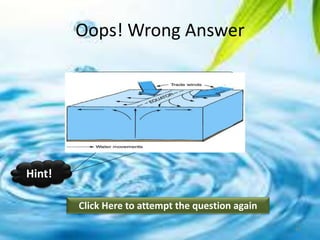
• OCEAN CURRENTS Ocean currents are streams of
water flowing constantly on the ocean surface in
definite directions. The ocean currents may be warm
or cold.
Next Page
Q1: . What is the vital renewable
resource on earth?
-Air
- Water
- Soil
-Food
6
Oops! Wrong Answer
Click Here to attempt the question again
Hint!
7
Oops! Wrong Answer
Click Here to attempt the question again
Hint!
8
Congratulations you have selected
Right Answer!
Click Here to go the next question …
9
Q2: How much earth’s surface is
covered with water?
- 1/2nd
- 4/5th
- 3/4th
- 2/3rd
10
Oops! Wrong Answer
Click Here to attempt the question again
Hint!
11
Oops! Wrong Answer
Click Here to attempt the question again
Hint!
12
Congratulations you have selected
Right Answer!
Click Here to go the next question …
13
Q3: The rythmic rise and fall of ocean
water twice in a day is called
- Tide
- Ocean current
- Wave
- Water cycle
14
Oops! Wrong Answer
Click Here to attempt the question again
Hint!
15
Oops! Wrong Answer
Click Here to attempt the question again
Hint!
16
Congratulations you have selected
Right Answer!
Click Here to go the next question …
17
Q4:The process of evaporation
precipitation and run-off is called as
- Nature cycle
- Life cycle
- Water cycle
-Ocean cycle
18
Oops! Wrong Answer
Click Here to attempt the question again
Hint!
19
Oops! Wrong Answer
Click Here to attempt the question again
Hint!
20
Congratulations you have selected
Right Answer!
Click Here to go the next question …
21
Q5: Generally the warm ocean
currents originate near
- Poles
- Equator
- Tides
- None of these
22
Oops! Wrong Answer
Click Here to attempt the question again
Hint!
23
Oops! Wrong Answer
Click Here to attempt the question again
Hint!
24
Congratulations you have selected
Right Answer!
Click Here to know the results…
25
Congratulations you have Scored
50/50 marks!
26

Programed instructional material: Water

  • 1.
    Topic: Water Class: 7th Age:14 Medium: English Let’s start module 1 Programmed Instructional material
  • 2.
    Objectives At the endof this module you will be able to- 1. To enable the pupils to know the meaning of water 2. To enable pupil to know about the uses of water 3. To help pupil to know the process of water cycle Let’s start module 2
  • 3.
    Water is avital renewable natural resource. Three fourth of the earth’s surface is covered with water. The earth is, therefore, appropriately called the ‘water planet’. It was in the primitive oceans that life began almost 3.5 billion years ago. The ocean water is however saline is not fit for human consumption. Fresh water is the most precious substance on earth. Its abundance only seems to vary because it is in constant motion, a cycling through the oceans, the air, the land and back again, through the process of evaporation, precipitation and run-off this as already know, is referred to as the ‘water cycle’. 3Next Page
  • 4.
    4 The sun’s heatcauses evaporation of water vapour. When the water vapour cools down, it condenses and forms clouds. From there it may fall on the land or sea in the form of rain, snow or sleet. The process by which water continually changes its form and circulates between oceans, atmosphere and land is known as the water cycle. Our earth is like a terrarium. The same water that existed centuries ago still exists today. The water used to irrigate a field in Haryana may have flowed down the Amazon River a hundred years ago. The major sources of fresh water are the rivers, ponds, springs and glaciers. The ocean bodies and the seas contain salty water. The water of the oceans is salty or saline as it contains large amount of dissolved salts. Next Page
  • 5.
    5 • Tides Therhythmic rise and fall of ocean water twice in a day is called a tide. It is high tide when water covers much of the shore by rising to its highest level. It is low tide when water falls to its lowest level and recedes from the shore. • OCEAN CURRENTS Ocean currents are streams of water flowing constantly on the ocean surface in definite directions. The ocean currents may be warm or cold. Next Page
  • 6.
    Q1: . Whatis the vital renewable resource on earth? -Air - Water - Soil -Food 6
  • 7.
    Oops! Wrong Answer ClickHere to attempt the question again Hint! 7
  • 8.
    Oops! Wrong Answer ClickHere to attempt the question again Hint! 8
  • 9.
    Congratulations you haveselected Right Answer! Click Here to go the next question … 9
  • 10.
    Q2: How muchearth’s surface is covered with water? - 1/2nd - 4/5th - 3/4th - 2/3rd 10
  • 11.
    Oops! Wrong Answer ClickHere to attempt the question again Hint! 11
  • 12.
    Oops! Wrong Answer ClickHere to attempt the question again Hint! 12
  • 13.
    Congratulations you haveselected Right Answer! Click Here to go the next question … 13
  • 14.
    Q3: The rythmicrise and fall of ocean water twice in a day is called - Tide - Ocean current - Wave - Water cycle 14
  • 15.
    Oops! Wrong Answer ClickHere to attempt the question again Hint! 15
  • 16.
    Oops! Wrong Answer ClickHere to attempt the question again Hint! 16
  • 17.
    Congratulations you haveselected Right Answer! Click Here to go the next question … 17
  • 18.
    Q4:The process ofevaporation precipitation and run-off is called as - Nature cycle - Life cycle - Water cycle -Ocean cycle 18
  • 19.
    Oops! Wrong Answer ClickHere to attempt the question again Hint! 19
  • 20.
    Oops! Wrong Answer ClickHere to attempt the question again Hint! 20
  • 21.
    Congratulations you haveselected Right Answer! Click Here to go the next question … 21
  • 22.
    Q5: Generally thewarm ocean currents originate near - Poles - Equator - Tides - None of these 22
  • 23.
    Oops! Wrong Answer ClickHere to attempt the question again Hint! 23
  • 24.
    Oops! Wrong Answer ClickHere to attempt the question again Hint! 24
  • 25.
    Congratulations you haveselected Right Answer! Click Here to know the results… 25
  • 26.
    Congratulations you haveScored 50/50 marks! 26