TEACHER’S PROFESSIONAL ETHICS AND
ACCOUNTABILITY
PRESENTED BY
AJAY TRIPURA
M.ED, 2ND SEMESTER
PROFESSIONAL ETHICS FOR TEACHERS
Professional ethics:-
 Every profession has it own professional ethics
 The professional ethics signify the code of conduct to be adopted by the persons who
profess that profession.
 Like every profession, in teacher education also teacher educator should develop professional
ethics and code of ethics to correct himself and get self satisfaction by developing his
conduct behaviour, and personality .
 Teachers and teacher educator develop professional ethics by imposing responsibility on
himself by showing obligation towards students, parents, society, higher authority and
profession .
 The teacher should idealist in thinking, possess professional morality and conscience and has
high standard of behavior. The teacher must transmit all his learning to the pupil etc.
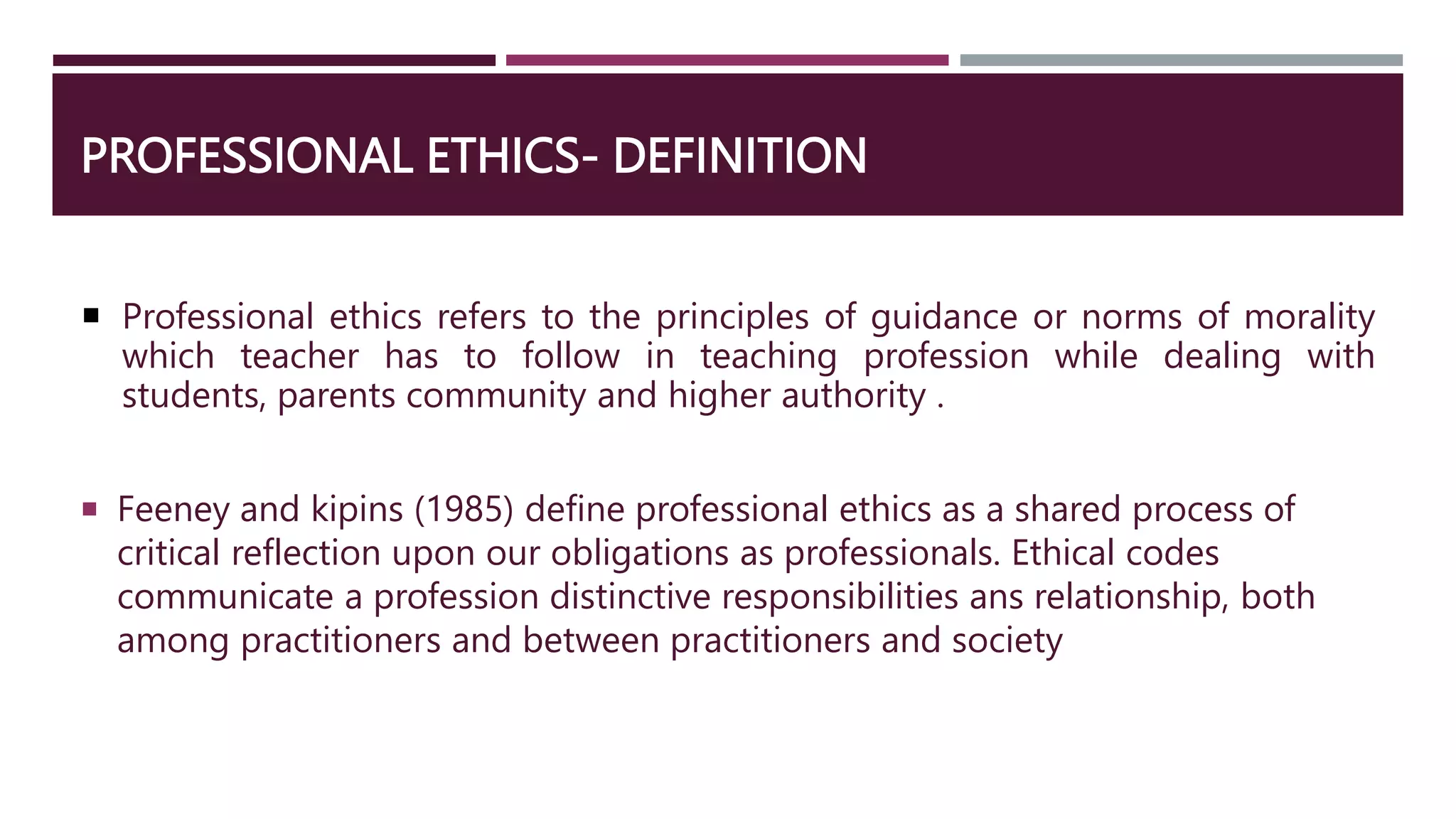
PROFESSIONAL ETHICS- DEFINITION
 Professional ethics refers to the principles of guidance or norms of morality
which teacher has to follow in teaching profession while dealing with
students, parents community and higher authority .
 Feeney and kipins (1985) define professional ethics as a shared process of
critical reflection upon our obligations as professionals. Ethical codes
communicate a profession distinctive responsibilities ans relationship, both
among practitioners and between practitioners and society
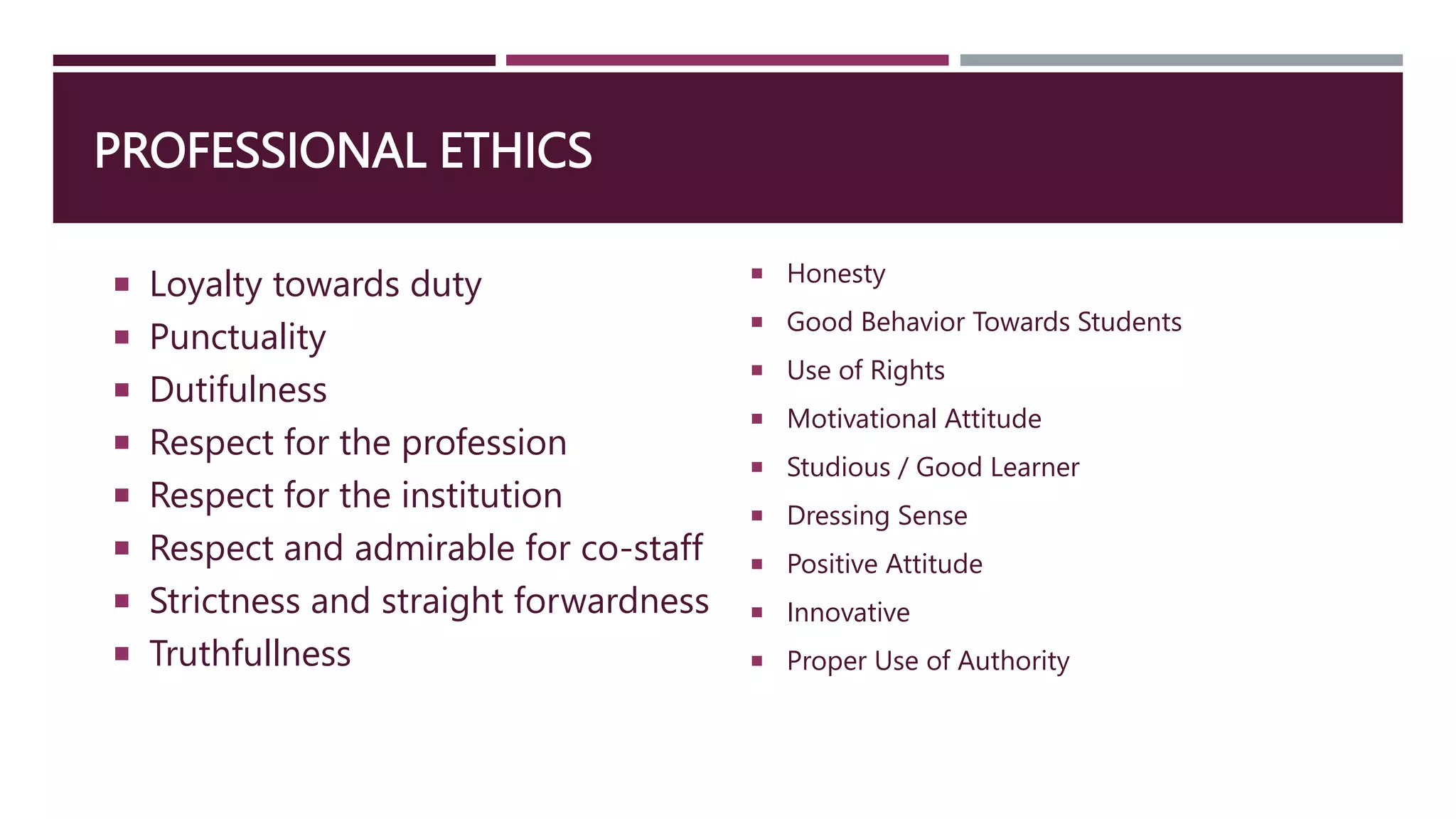
PROFESSIONAL ETHICS
 Loyalty towards duty
 Punctuality
 Dutifulness
 Respect for the profession
 Respect for the institution
 Respect and admirable for co-staff
 Strictness and straight forwardness
 Truthfullness
 Honesty
 Good Behavior Towards Students
 Use of Rights
 Motivational Attitude
 Studious / Good Learner
 Dressing Sense
 Positive Attitude
 Innovative
 Proper Use of Authority
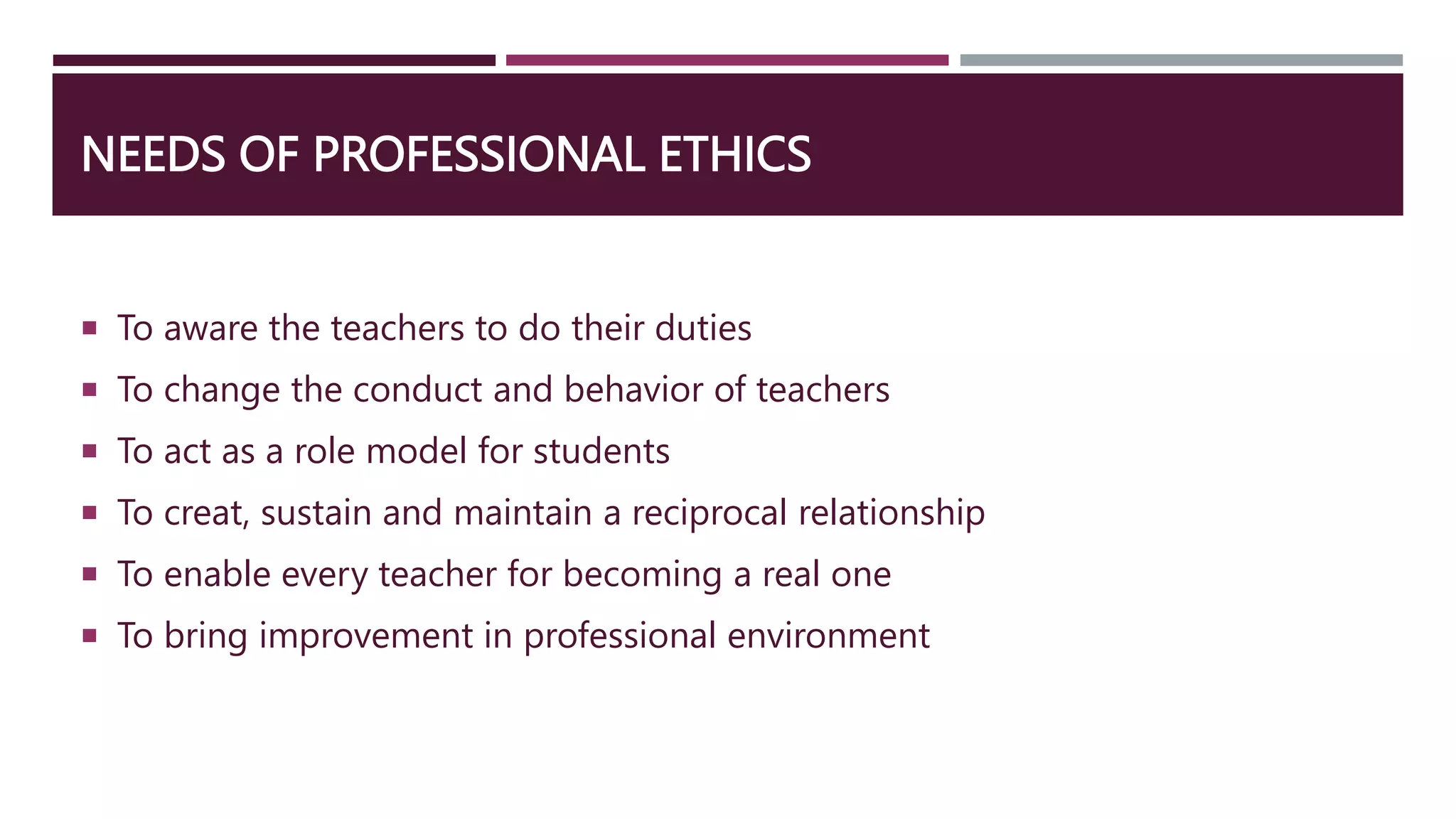
NEEDS OF PROFESSIONAL ETHICS
 To aware the teachers to do their duties
 To change the conduct and behavior of teachers
 To act as a role model for students
 To creat, sustain and maintain a reciprocal relationship
 To enable every teacher for becoming a real one
 To bring improvement in professional environment
IMPORTANCE OF TEACHER’S PROFESSIONAL ETHICS
 It brings about deeper understanding about his variety of role perceptions
 It develops positive attitude towards work
 It develops in him the sense of duty commitment and accountability
towards his work
 It makes effort to define the duties and obligations of the teacher of leading
an ideal life
 It helps to bring about the qualitative improvement in the field of education
 It helps to change the social, moral and ethical atmosphere in the
educational institutions and in the society at large
DIMENSIONS OF PROFESSIONAL ETHICS
 Teachers and their responsibilities
 Teachers and the students
 Teachers and colleagues
 Teachers and authorities
 Teachers and non- teaching staff
 Teachers and guardians
 Teachers and society
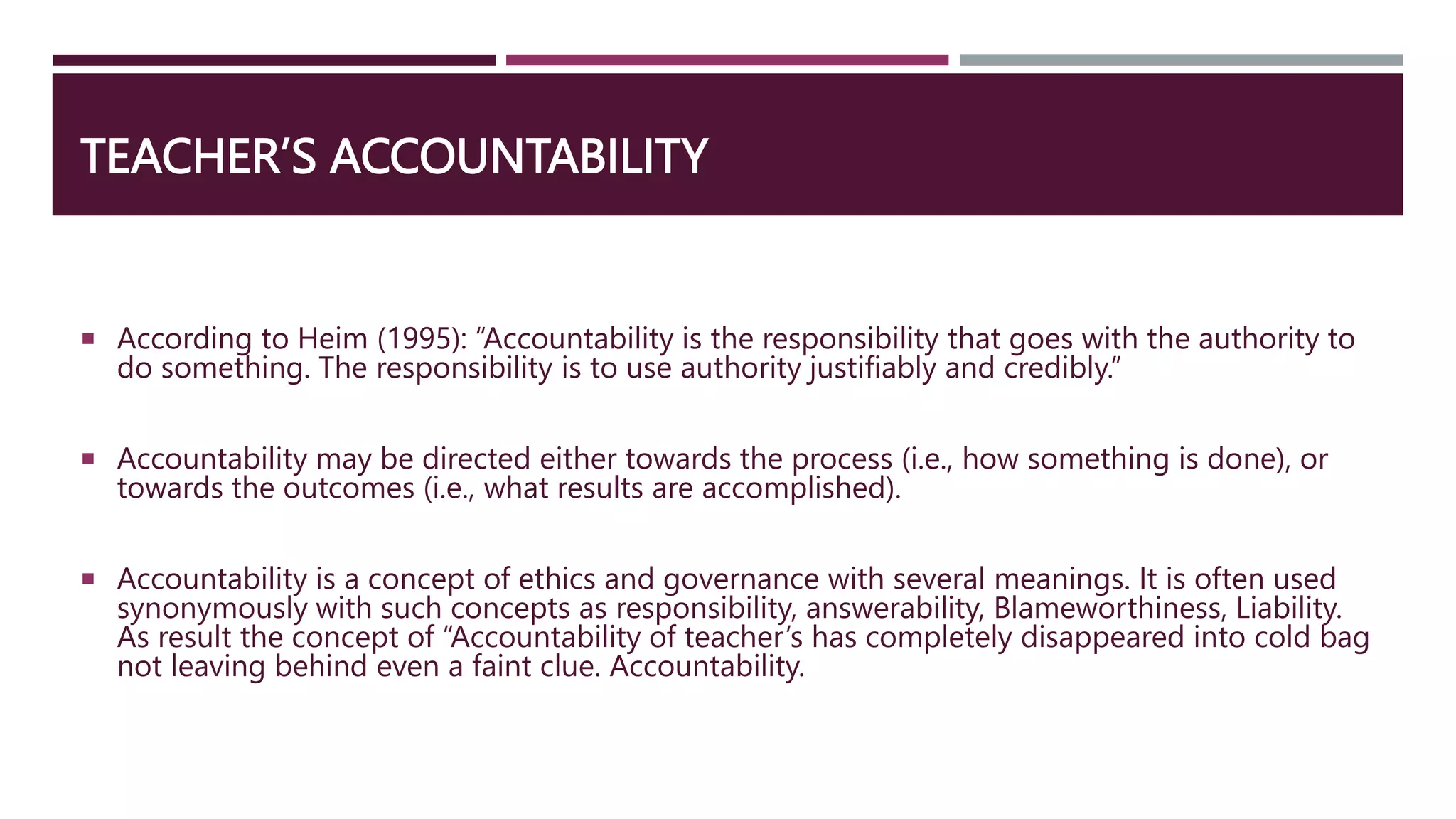
TEACHER’S ACCOUNTABILITY
 According to Heim (1995): “Accountability is the responsibility that goes with the authority to
do something. The responsibility is to use authority justifiably and credibly.”
 Accountability may be directed either towards the process (i.e., how something is done), or
towards the outcomes (i.e., what results are accomplished).
 Accountability is a concept of ethics and governance with several meanings. It is often used
synonymously with such concepts as responsibility, answerability, Blameworthiness, Liability.
As result the concept of “Accountability of teacher’s has completely disappeared into cold bag
not leaving behind even a faint clue. Accountability.
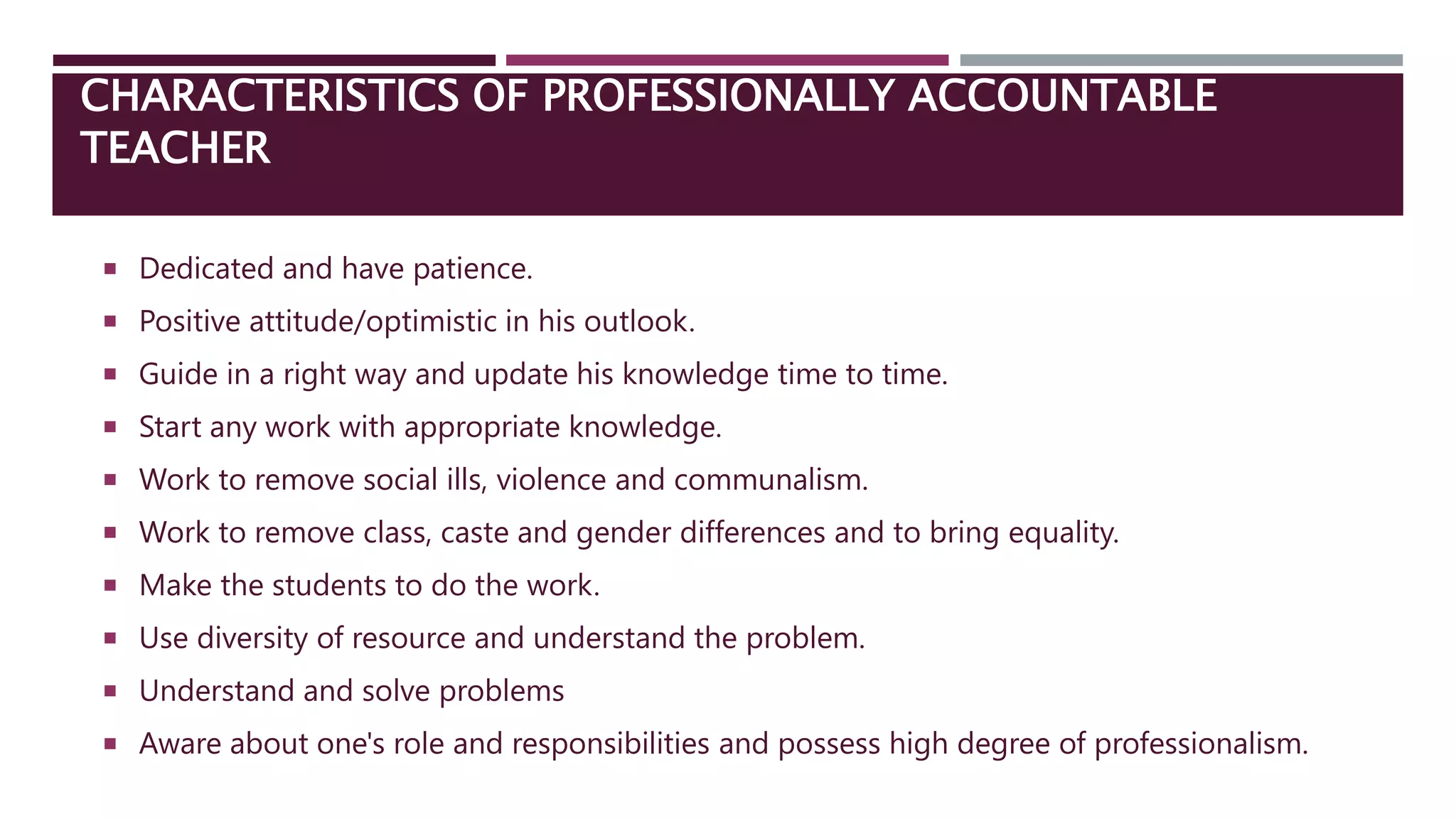
CHARACTERISTICS OF PROFESSIONALLY ACCOUNTABLE
TEACHER
 Dedicated and have patience.
 Positive attitude/optimistic in his outlook.
 Guide in a right way and update his knowledge time to time.
 Start any work with appropriate knowledge.
 Work to remove social ills, violence and communalism.
 Work to remove class, caste and gender differences and to bring equality.
 Make the students to do the work.
 Use diversity of resource and understand the problem.
 Understand and solve problems
 Aware about one's role and responsibilities and possess high degree of professionalism.
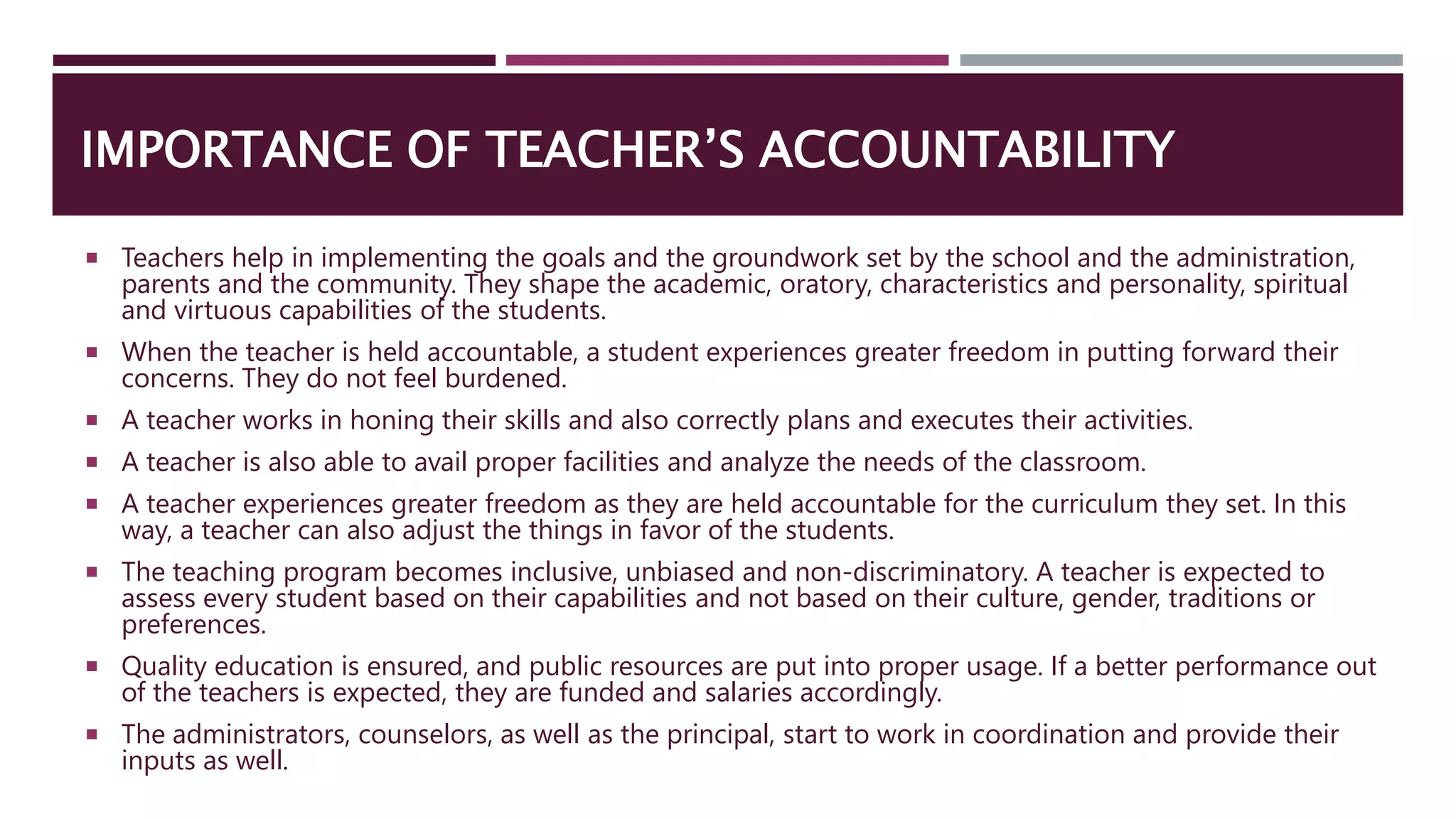
IMPORTANCE OF TEACHER’S ACCOUNTABILITY
 Teachers help in implementing the goals and the groundwork set by the school and the administration,
parents and the community. They shape the academic, oratory, characteristics and personality, spiritual
and virtuous capabilities of the students.
 When the teacher is held accountable, a student experiences greater freedom in putting forward their
concerns. They do not feel burdened.
 A teacher works in honing their skills and also correctly plans and executes their activities.
 A teacher is also able to avail proper facilities and analyze the needs of the classroom.
 A teacher experiences greater freedom as they are held accountable for the curriculum they set. In this
way, a teacher can also adjust the things in favor of the students.
 The teaching program becomes inclusive, unbiased and non-discriminatory. A teacher is expected to
assess every student based on their capabilities and not based on their culture, gender, traditions or
preferences.
 Quality education is ensured, and public resources are put into proper usage. If a better performance out
of the teachers is expected, they are funded and salaries accordingly.
 The administrators, counselors, as well as the principal, start to work in coordination and provide their
inputs as well.
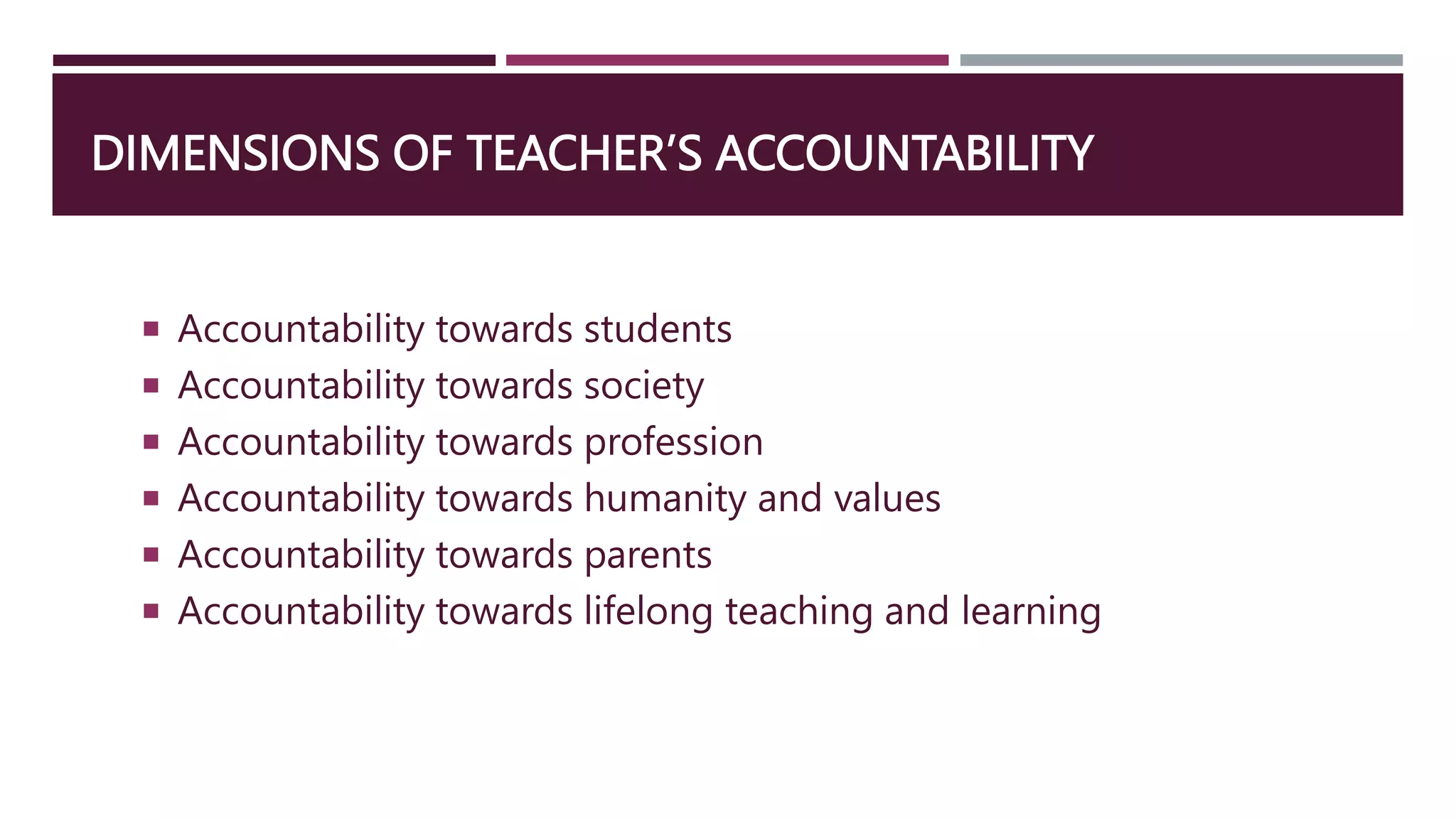
DIMENSIONS OF TEACHER’S ACCOUNTABILITY
 Accountability towards students
 Accountability towards society
 Accountability towards profession
 Accountability towards humanity and values
 Accountability towards parents
 Accountability towards lifelong teaching and learning
Thank you!

Teacher's professional ethics and accountability.pptx

  • 1.
    TEACHER’S PROFESSIONAL ETHICSAND ACCOUNTABILITY PRESENTED BY AJAY TRIPURA M.ED, 2ND SEMESTER
  • 2.
    PROFESSIONAL ETHICS FORTEACHERS Professional ethics:-  Every profession has it own professional ethics  The professional ethics signify the code of conduct to be adopted by the persons who profess that profession.  Like every profession, in teacher education also teacher educator should develop professional ethics and code of ethics to correct himself and get self satisfaction by developing his conduct behaviour, and personality .  Teachers and teacher educator develop professional ethics by imposing responsibility on himself by showing obligation towards students, parents, society, higher authority and profession .  The teacher should idealist in thinking, possess professional morality and conscience and has high standard of behavior. The teacher must transmit all his learning to the pupil etc.
  • 3.
    PROFESSIONAL ETHICS- DEFINITION Professional ethics refers to the principles of guidance or norms of morality which teacher has to follow in teaching profession while dealing with students, parents community and higher authority .  Feeney and kipins (1985) define professional ethics as a shared process of critical reflection upon our obligations as professionals. Ethical codes communicate a profession distinctive responsibilities ans relationship, both among practitioners and between practitioners and society
  • 4.
    PROFESSIONAL ETHICS  Loyaltytowards duty  Punctuality  Dutifulness  Respect for the profession  Respect for the institution  Respect and admirable for co-staff  Strictness and straight forwardness  Truthfullness  Honesty  Good Behavior Towards Students  Use of Rights  Motivational Attitude  Studious / Good Learner  Dressing Sense  Positive Attitude  Innovative  Proper Use of Authority
  • 5.
    NEEDS OF PROFESSIONALETHICS  To aware the teachers to do their duties  To change the conduct and behavior of teachers  To act as a role model for students  To creat, sustain and maintain a reciprocal relationship  To enable every teacher for becoming a real one  To bring improvement in professional environment
  • 6.
    IMPORTANCE OF TEACHER’SPROFESSIONAL ETHICS  It brings about deeper understanding about his variety of role perceptions  It develops positive attitude towards work  It develops in him the sense of duty commitment and accountability towards his work  It makes effort to define the duties and obligations of the teacher of leading an ideal life  It helps to bring about the qualitative improvement in the field of education  It helps to change the social, moral and ethical atmosphere in the educational institutions and in the society at large
  • 7.
    DIMENSIONS OF PROFESSIONALETHICS  Teachers and their responsibilities  Teachers and the students  Teachers and colleagues  Teachers and authorities  Teachers and non- teaching staff  Teachers and guardians  Teachers and society
  • 8.
    TEACHER’S ACCOUNTABILITY  Accordingto Heim (1995): “Accountability is the responsibility that goes with the authority to do something. The responsibility is to use authority justifiably and credibly.”  Accountability may be directed either towards the process (i.e., how something is done), or towards the outcomes (i.e., what results are accomplished).  Accountability is a concept of ethics and governance with several meanings. It is often used synonymously with such concepts as responsibility, answerability, Blameworthiness, Liability. As result the concept of “Accountability of teacher’s has completely disappeared into cold bag not leaving behind even a faint clue. Accountability.
  • 9.
    CHARACTERISTICS OF PROFESSIONALLYACCOUNTABLE TEACHER  Dedicated and have patience.  Positive attitude/optimistic in his outlook.  Guide in a right way and update his knowledge time to time.  Start any work with appropriate knowledge.  Work to remove social ills, violence and communalism.  Work to remove class, caste and gender differences and to bring equality.  Make the students to do the work.  Use diversity of resource and understand the problem.  Understand and solve problems  Aware about one's role and responsibilities and possess high degree of professionalism.
  • 10.
    IMPORTANCE OF TEACHER’SACCOUNTABILITY  Teachers help in implementing the goals and the groundwork set by the school and the administration, parents and the community. They shape the academic, oratory, characteristics and personality, spiritual and virtuous capabilities of the students.  When the teacher is held accountable, a student experiences greater freedom in putting forward their concerns. They do not feel burdened.  A teacher works in honing their skills and also correctly plans and executes their activities.  A teacher is also able to avail proper facilities and analyze the needs of the classroom.  A teacher experiences greater freedom as they are held accountable for the curriculum they set. In this way, a teacher can also adjust the things in favor of the students.  The teaching program becomes inclusive, unbiased and non-discriminatory. A teacher is expected to assess every student based on their capabilities and not based on their culture, gender, traditions or preferences.  Quality education is ensured, and public resources are put into proper usage. If a better performance out of the teachers is expected, they are funded and salaries accordingly.  The administrators, counselors, as well as the principal, start to work in coordination and provide their inputs as well.
  • 11.
    DIMENSIONS OF TEACHER’SACCOUNTABILITY  Accountability towards students  Accountability towards society  Accountability towards profession  Accountability towards humanity and values  Accountability towards parents  Accountability towards lifelong teaching and learning
  • 12.