GROUP FACTOR
THURSTON’S GROUP FACTOR
THEORY
• Louis Thurston came out with the group
factor theory(1937) saying that Intelligence
is a cluster of abilities.
• Thurston proposed that certain mental
operations have common primary factor
which gives them psychological and
functional unity which differentiates them
from other mental operations
•These mental operations constitute a
group factor. So there are a number of
groups of mental abilities and each of these
groups has its own primary factor.
•Thurston and his associates have identified
nine such factors. They are as follows:
1. Verbal factor
Concerns comprehension of verbal relations,
words and ideas.
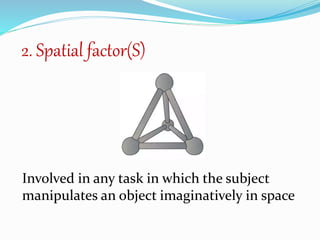
2. Spatial factor(S)
Involved in any task in which the subject
manipulates an object imaginatively in space
3. Numerical factor (N)
Ability to do numerical calculations, rapidly
and accurately.
4. Memory factor (M)
Involving the ability to memorize quickly.
5. Word Fluency Factor (W)
It is involved whenever the subject is asked to
think of isolated words at a rapid rate.
6. Inductive reasoning factor (RI)
It is the ability to draw inferences or conclusions
on the basis of specific instances.
7. Deductive reasoning factor (RD)
It is the ability to make use of generalized
results.
8. Perceptual factor (P)
It is the ability to perceive objects accurately.
9. Problem-solving ability factor (PS)
It is the ability to solve problems with
independent efforts.
EDUCATIONAL SIGNIFICANCE
AND IMPLICATIONS
 Contributed greatly to the measurement of attitudes.
‘Thurston scale’ developed in 1928 was the first formal
techniques for measuring of attitudes
 Thurston’s theory of intelligence was a major influence
on later theories of multiple intelligences, such as
those of Guilford, Gardner, and Sternberg.
Limitation
 The weakest aspect of the group factor
theory was that it discarded the concept of
the common factor.
THANK YOU

Group factor

  • 1.
  • 2.
    THURSTON’S GROUP FACTOR THEORY •Louis Thurston came out with the group factor theory(1937) saying that Intelligence is a cluster of abilities. • Thurston proposed that certain mental operations have common primary factor which gives them psychological and functional unity which differentiates them from other mental operations
  • 3.
    •These mental operationsconstitute a group factor. So there are a number of groups of mental abilities and each of these groups has its own primary factor. •Thurston and his associates have identified nine such factors. They are as follows:
  • 4.
    1. Verbal factor Concernscomprehension of verbal relations, words and ideas.
  • 5.
    2. Spatial factor(S) Involvedin any task in which the subject manipulates an object imaginatively in space
  • 6.
    3. Numerical factor(N) Ability to do numerical calculations, rapidly and accurately.
  • 7.
    4. Memory factor(M) Involving the ability to memorize quickly.
  • 8.
    5. Word FluencyFactor (W) It is involved whenever the subject is asked to think of isolated words at a rapid rate.
  • 9.
    6. Inductive reasoningfactor (RI) It is the ability to draw inferences or conclusions on the basis of specific instances.
  • 10.
    7. Deductive reasoningfactor (RD) It is the ability to make use of generalized results.
  • 11.
    8. Perceptual factor(P) It is the ability to perceive objects accurately.
  • 12.
    9. Problem-solving abilityfactor (PS) It is the ability to solve problems with independent efforts.
  • 13.
    EDUCATIONAL SIGNIFICANCE AND IMPLICATIONS Contributed greatly to the measurement of attitudes. ‘Thurston scale’ developed in 1928 was the first formal techniques for measuring of attitudes  Thurston’s theory of intelligence was a major influence on later theories of multiple intelligences, such as those of Guilford, Gardner, and Sternberg.
  • 14.
    Limitation  The weakestaspect of the group factor theory was that it discarded the concept of the common factor.
  • 15.