Multi-Factor Theory
Presented by Rustam
Intelligence
Intelligence is a concept
that refers to individual
differences in the ability
to acquire knowledge to
reason effectively and to
deal adequately with the
environment.
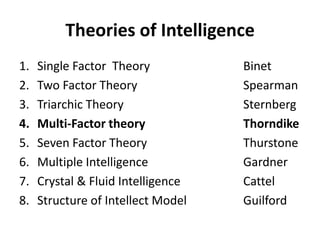
Theories of Intelligence
1. Single Factor Theory Binet
2. Two Factor Theory Spearman
3. Triarchic Theory Sternberg
4. Multi-Factor theory Thorndike
5. Seven Factor Theory Thurstone
6. Multiple Intelligence Gardner
7. Crystal & Fluid Intelligence Cattel
8. Structure of Intellect Model Guilford
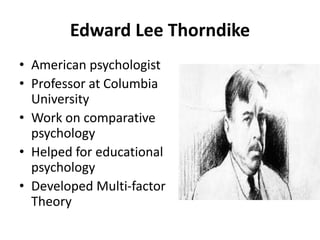
Edward Lee Thorndike
• American psychologist
• Professor at Columbia
University
• Work on comparative
psychology
• Helped for educational
psychology
• Developed Multi-factor
Theory
Multi-factor Theory
• Multi-factor or Anarchic Theory
• He proposed that there are specific stimuli
and specific response
• He believed that there was nothing like
General ability
• Thorndike found all factors in Intelligence
represent a specific mental ability which are
different from each other but associated too
like breaks on a wall.
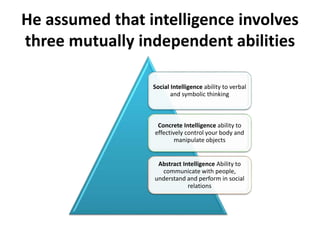
He assumed that intelligence involves
three mutually independent abilities
Social Intelligence ability to verbal
and symbolic thinking
Concrete Intelligence ability to
effectively control your body and
manipulate objects
Abstract Intelligence Ability to
communicate with people,
understand and perform in social
relations
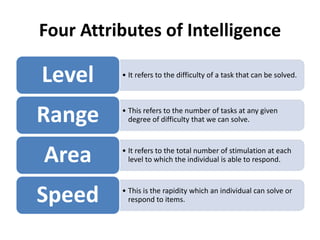
Four Attributes of Intelligence
• It refers to the difficulty of a task that can be solved.
Level
• This refers to the number of tasks at any given
degree of difficulty that we can solve.
Range
• It refers to the total number of stimulation at each
level to which the individual is able to respond.
Area
• This is the rapidity which an individual can solve or
respond to items.
Speed

Multi factor theory

  • 1.
  • 2.
    Intelligence Intelligence is aconcept that refers to individual differences in the ability to acquire knowledge to reason effectively and to deal adequately with the environment.
  • 3.
    Theories of Intelligence 1.Single Factor Theory Binet 2. Two Factor Theory Spearman 3. Triarchic Theory Sternberg 4. Multi-Factor theory Thorndike 5. Seven Factor Theory Thurstone 6. Multiple Intelligence Gardner 7. Crystal & Fluid Intelligence Cattel 8. Structure of Intellect Model Guilford
  • 4.
    Edward Lee Thorndike •American psychologist • Professor at Columbia University • Work on comparative psychology • Helped for educational psychology • Developed Multi-factor Theory
  • 5.
    Multi-factor Theory • Multi-factoror Anarchic Theory • He proposed that there are specific stimuli and specific response • He believed that there was nothing like General ability • Thorndike found all factors in Intelligence represent a specific mental ability which are different from each other but associated too like breaks on a wall.
  • 6.
    He assumed thatintelligence involves three mutually independent abilities Social Intelligence ability to verbal and symbolic thinking Concrete Intelligence ability to effectively control your body and manipulate objects Abstract Intelligence Ability to communicate with people, understand and perform in social relations
  • 7.
    Four Attributes ofIntelligence • It refers to the difficulty of a task that can be solved. Level • This refers to the number of tasks at any given degree of difficulty that we can solve. Range • It refers to the total number of stimulation at each level to which the individual is able to respond. Area • This is the rapidity which an individual can solve or respond to items. Speed