Guilford’s structure of Intellect
By
Monika Sharma
Assistant Professor
Bhutta College of Education
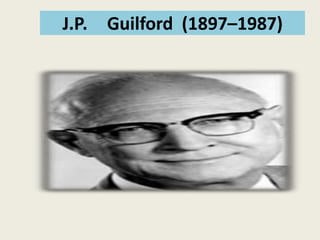
J.P. Guilford (1897–1987)
J.P. Guilford
(1897–1987)
He was a United States psychologist, best
remembered for his psychometric study of
human intelligence, including the
distinction between convergent and
divergent production.
Structure of intellect
Guilford Proposed the concept of divergent thinking,
ability to find several solutions to one problem, as a
quality of creative people
–Fluency (great number of ideas in a short period of
time)
–Flexibility (simultaneously propose a variety of
approaches to a specific problem)
–Originality (produce new, original ideas);
–Elaboration (systematize and organize the details of
an idea in a head and carry it out)
J.P. Guilford developed the idea of specific
intelligence factors into a very detailed model
beginning in the 1950s. Guilford(1967)
conceives of intelligence as being a
combination of three dimensions, shown in
the below model:
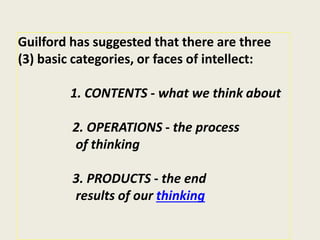
Guilford has suggested that there are three
(3) basic categories, or faces of intellect:
1. CONTENTS - what we think about
2. OPERATIONS - the process
of thinking
3. PRODUCTS - the end
results of our thinking
Structure of intellect
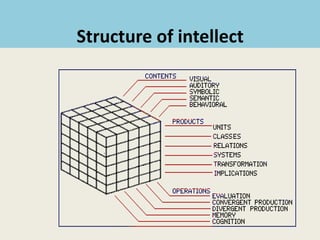
The Figure in previous slide gives us the
comprehensive idea of the primary mental
abilities included in intelligence. However,
Guilford (1967) has expanded his cube-shaped
model of intellect to include 150 factors,
which includes 5 contents, 6 products and 5
operations (5x6x5=150).
Content dimension
Guilford meant that different people seemed to pay
more attention to and think more effectively
about different kinds of information, such as
1.Visual is information in visual form such
as are shape or color.
For example: triangle, cubes, parabola, etc.
2.Auditory involves information in auditory
form, such as spoken words or music
3.Symbolic : are symbol or codes representing
concrete object or abstract concepts.
E.g. + is the mathematical symbol for the
Operation of addition.
4.Semantic of learning are those words and ideas
which evoke a mental image when they are
presented as stimuli.
E.g. sun, car, white, moon, etc. are word which
evoke image in people’s minds when they hear or
read them.
Content dimension
5. Behavioral contents of learning are the
manifestation of stimuli and responses in
people can be also obtained through facial
expression or voice.
Content dimension
Operations dimension
This dimension describes what the brain does
with and to these types of information :
1.Cognition : is the ability to recognize various
forms of information and to understand
information.
E.g: A child who can separate a mixedpile of
squares and triangles into separate piles of
squares and triangles is exercising a degree of
cognition.
2. Memory is the ability to store information in
the mind and to call out stored information in
response to certain stimuli.
E.g. A student who immediately answer 1when
asked to give the sine of 90° is using his or her
memory.
Operations dimension
3.Divergent is the ability to view given
information in a new way so that unique and
unexpected conclusions are the consequence.
E.g. A mathematician who discovers and proves
a new and important mathematical theorem is
exhibiting considerable ability in divergent
production.
Operations dimension
4.Convergent is the ability to take a
specified set of information and draw a
universally accepted conclusion or response
based upon the given information.
E.g. In algebra lesson, student who finds the
correct solution to a set of three linear
equations have used his or her convergent
production ability.
Operations dimension
5. Evaluation is the ability to process information
in order to make judgments, draw
conclusion and arrive at decisions.
E.g.If we want to solve mathematics problem
we think hard to solve it by simple
method
Operations
This dimension relates to the kinds of information we
process from the content types. These are:
1.Unit is a single symbol, figure, word, object, or idea.
E.g: each real number.
2.Classes is sets of items grouped by virtue of their
common properties
E.g: set of real numbers.
3.Relations are connections between items of
information
E.g: equality and inequality are relation in the set of real
numbers.
Product dimension
4. Systems :is a composition of units, classes,
and relationship into a larger and more
meaningful structure.
E.g: the set of real numbers together with the
operations of addition, subs traction,
multiplication, and division and the algebraic
properties of these operations.
Product dimension
5.Transformation : is the process of
modifying , reinterpreting, and restructuring
existing information into new information.
The transformation ability is usually thought
to be characteristic of creative people.
E.g: functions defined on the real number
system.
Product dimension
6.Implication is a prediction or a conjecture
about the consequences of interactions
among units, classes, relations, systems, and
transformations.
E.g: each theorem about function on the real
numbers.
Product dimension
Example to understand the SI
A child is asked to determine the day of the week on a
particular date with the help of a calendar. The task
involves operations like convergent thinking, memory
and cognition.
In carrying out these operations, he has to make use of
the contents. In this particular case, he will make use of
semantics, i.e. reading and understanding of the
printed words and figures indicating days and dates of
a particular month in the calendar.
By carrying out mental operations with the help of the
contents he will finally arrive at the products. The day
of the week to which the date in question refers
represents the factor known as ‘relations’.
Educational implications
1. intelligence is not fixed.
2. Intelligence can be learnt.
3. IQ tests implements narrow abilities where the SI
measures a wide variety of abilities.
4. Need to consider all students are different.
5. Knowledge of specific ability
6. Reasons of unsatisfactory progress
7. Modification in curriculum and methodology
8. Attention towards intellectual abilities
9. New ideas to school practice
10. Basis for future learning
11. Corrective teaching
Bibliography
 Gardner, H. (1983). Frames of Mind: The Theory of Multiple
Intelligences. New York: Basic Books.
 Guilford, J. (1950). Creativity. American Psychologist , 5, 444454.
 Mangal, S. K. (2002). Advanced educational psychology. PHI
Learning Pvt. Ltd.
Retrieved from :
 https://www.slideshare.net/Mishi23/guilford-31976652
 http://www.instructionaldesign.org/theories/intellect.html
 http://www.lifecircles inc.com/Learningtheories/guilford.html
 http://www.youtube.com/watch?v=DR-lAzk66YU
 http://www.youtube.com/watch?v=OsxqOIR9mzA&feature=relate
Thank You

Guilford's Structure of intellect

  • 1.
    Guilford’s structure ofIntellect By Monika Sharma Assistant Professor Bhutta College of Education
  • 2.
  • 3.
    J.P. Guilford (1897–1987) He wasa United States psychologist, best remembered for his psychometric study of human intelligence, including the distinction between convergent and divergent production.
  • 4.
    Structure of intellect GuilfordProposed the concept of divergent thinking, ability to find several solutions to one problem, as a quality of creative people –Fluency (great number of ideas in a short period of time) –Flexibility (simultaneously propose a variety of approaches to a specific problem) –Originality (produce new, original ideas); –Elaboration (systematize and organize the details of an idea in a head and carry it out)
  • 5.
    J.P. Guilford developedthe idea of specific intelligence factors into a very detailed model beginning in the 1950s. Guilford(1967) conceives of intelligence as being a combination of three dimensions, shown in the below model:
  • 6.
    Guilford has suggestedthat there are three (3) basic categories, or faces of intellect: 1. CONTENTS - what we think about 2. OPERATIONS - the process of thinking 3. PRODUCTS - the end results of our thinking
  • 7.
  • 8.
    The Figure inprevious slide gives us the comprehensive idea of the primary mental abilities included in intelligence. However, Guilford (1967) has expanded his cube-shaped model of intellect to include 150 factors, which includes 5 contents, 6 products and 5 operations (5x6x5=150).
  • 9.
    Content dimension Guilford meantthat different people seemed to pay more attention to and think more effectively about different kinds of information, such as 1.Visual is information in visual form such as are shape or color. For example: triangle, cubes, parabola, etc. 2.Auditory involves information in auditory form, such as spoken words or music
  • 10.
    3.Symbolic : aresymbol or codes representing concrete object or abstract concepts. E.g. + is the mathematical symbol for the Operation of addition. 4.Semantic of learning are those words and ideas which evoke a mental image when they are presented as stimuli. E.g. sun, car, white, moon, etc. are word which evoke image in people’s minds when they hear or read them. Content dimension
  • 11.
    5. Behavioral contentsof learning are the manifestation of stimuli and responses in people can be also obtained through facial expression or voice. Content dimension
  • 12.
    Operations dimension This dimensiondescribes what the brain does with and to these types of information : 1.Cognition : is the ability to recognize various forms of information and to understand information. E.g: A child who can separate a mixedpile of squares and triangles into separate piles of squares and triangles is exercising a degree of cognition.
  • 13.
    2. Memory isthe ability to store information in the mind and to call out stored information in response to certain stimuli. E.g. A student who immediately answer 1when asked to give the sine of 90° is using his or her memory. Operations dimension
  • 14.
    3.Divergent is theability to view given information in a new way so that unique and unexpected conclusions are the consequence. E.g. A mathematician who discovers and proves a new and important mathematical theorem is exhibiting considerable ability in divergent production. Operations dimension
  • 15.
    4.Convergent is theability to take a specified set of information and draw a universally accepted conclusion or response based upon the given information. E.g. In algebra lesson, student who finds the correct solution to a set of three linear equations have used his or her convergent production ability. Operations dimension
  • 16.
    5. Evaluation isthe ability to process information in order to make judgments, draw conclusion and arrive at decisions. E.g.If we want to solve mathematics problem we think hard to solve it by simple method Operations
  • 17.
    This dimension relatesto the kinds of information we process from the content types. These are: 1.Unit is a single symbol, figure, word, object, or idea. E.g: each real number. 2.Classes is sets of items grouped by virtue of their common properties E.g: set of real numbers. 3.Relations are connections between items of information E.g: equality and inequality are relation in the set of real numbers. Product dimension
  • 18.
    4. Systems :isa composition of units, classes, and relationship into a larger and more meaningful structure. E.g: the set of real numbers together with the operations of addition, subs traction, multiplication, and division and the algebraic properties of these operations. Product dimension
  • 19.
    5.Transformation : isthe process of modifying , reinterpreting, and restructuring existing information into new information. The transformation ability is usually thought to be characteristic of creative people. E.g: functions defined on the real number system. Product dimension
  • 20.
    6.Implication is aprediction or a conjecture about the consequences of interactions among units, classes, relations, systems, and transformations. E.g: each theorem about function on the real numbers. Product dimension
  • 21.
    Example to understandthe SI A child is asked to determine the day of the week on a particular date with the help of a calendar. The task involves operations like convergent thinking, memory and cognition. In carrying out these operations, he has to make use of the contents. In this particular case, he will make use of semantics, i.e. reading and understanding of the printed words and figures indicating days and dates of a particular month in the calendar. By carrying out mental operations with the help of the contents he will finally arrive at the products. The day of the week to which the date in question refers represents the factor known as ‘relations’.
  • 22.
    Educational implications 1. intelligenceis not fixed. 2. Intelligence can be learnt. 3. IQ tests implements narrow abilities where the SI measures a wide variety of abilities. 4. Need to consider all students are different. 5. Knowledge of specific ability 6. Reasons of unsatisfactory progress 7. Modification in curriculum and methodology 8. Attention towards intellectual abilities 9. New ideas to school practice 10. Basis for future learning 11. Corrective teaching
  • 23.
    Bibliography  Gardner, H.(1983). Frames of Mind: The Theory of Multiple Intelligences. New York: Basic Books.  Guilford, J. (1950). Creativity. American Psychologist , 5, 444454.  Mangal, S. K. (2002). Advanced educational psychology. PHI Learning Pvt. Ltd. Retrieved from :  https://www.slideshare.net/Mishi23/guilford-31976652  http://www.instructionaldesign.org/theories/intellect.html  http://www.lifecircles inc.com/Learningtheories/guilford.html  http://www.youtube.com/watch?v=DR-lAzk66YU  http://www.youtube.com/watch?v=OsxqOIR9mzA&feature=relate
  • 24.