NPE 1968 & 1986
(Education of Students with Disability)
Dr.G.Jaganmohana Rao
Faculty of Education
MITE, Kohima
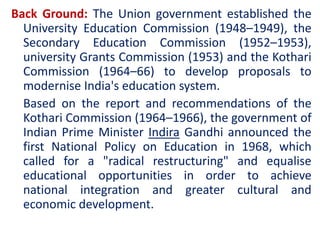
Back Ground: The Union government established the
University Education Commission (1948–1949), the
Secondary Education Commission (1952–1953),
university Grants Commission (1953) and the Kothari
Commission (1964–66) to develop proposals to
modernise India's education system.
Based on the report and recommendations of the
Kothari Commission (1964–1966), the government of
Indian Prime Minister Indira Gandhi announced the
first National Policy on Education in 1968, which
called for a "radical restructuring" and equalise
educational opportunities in order to achieve
national integration and greater cultural and
economic development.
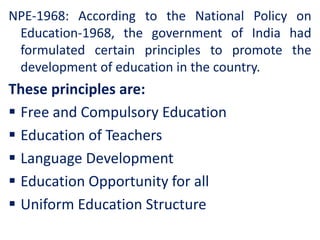
NPE-1968: According to the National Policy on
Education-1968, the government of India had
formulated certain principles to promote the
development of education in the country.
These principles are:
 Free and Compulsory Education
 Education of Teachers
 Language Development
 Education Opportunity for all
 Uniform Education Structure
The Prime Minister of India, Rajiv Gandhi
introduced a new National Policy on
Education in May, 1986. The new policy
called for "special emphasis on the removal
of disparities and to equalise educational
opportunity,”
Objective of NPE-86:
To establish a national system of education
implies that all students irrespective of cast,
creed, sex and religion have access to
education of a comparable quality.
At elementary level:
Universal access and enrolment
Universal retention of children up to 14 yrs
A sustainable improvement in the quality
education as per the level of learning
At secondary level:
 To provide computer literacy in as many
secondary level institutions to make the students
equipped with necessary computer skills
At higher education level:
To provide the people with an opportunity to reflect
on the critical social, economical, cultural, moral and
spiritual issues.
Education must play a positive and interventionist
role in correcting social and regional imbalance,
empowering women and in-securing rightful place
for the disadvantaged group (Minories, SC, ST,
CWSN).
Enhancing and promoting the vocationalization of
education, adult education, education for mentally
and physically challenged persons, non formal
education (ODL, ECCE)
NPE Advocates:
 Integrated education in general school for
locomotor impaired children and the mildly
disabled children
 Children with severe disabilities will be in special
schools with hostel facilities in district headquarter
 Orientation and pre-service training for general
teachers on disability management
 Vocationalization of education will be initiated
 Develop psychological services for the assessment
of disability
 NCERT to undertake responsibility to develop
psychological and educational assessment and
diagnosis tools for identifying learning problems
Implications of NPE:
In relation to education of PWD for the first time
after the independence, it include a section on
disability (section 4.9)
Recognizing the holistic nature of child
development viz, nutrition, health, mental,
physical, social, moral and emotional
development
Early Childhood Care and Education (ECCE) will
receive high priority and be suitably integrated
with the Integrated Child Development Services
Programme.

NPE-68 & 86 recommendations for PWD

  • 1.
    NPE 1968 &1986 (Education of Students with Disability) Dr.G.Jaganmohana Rao Faculty of Education MITE, Kohima
  • 2.
    Back Ground: TheUnion government established the University Education Commission (1948–1949), the Secondary Education Commission (1952–1953), university Grants Commission (1953) and the Kothari Commission (1964–66) to develop proposals to modernise India's education system. Based on the report and recommendations of the Kothari Commission (1964–1966), the government of Indian Prime Minister Indira Gandhi announced the first National Policy on Education in 1968, which called for a "radical restructuring" and equalise educational opportunities in order to achieve national integration and greater cultural and economic development.
  • 3.
    NPE-1968: According tothe National Policy on Education-1968, the government of India had formulated certain principles to promote the development of education in the country. These principles are:  Free and Compulsory Education  Education of Teachers  Language Development  Education Opportunity for all  Uniform Education Structure
  • 4.
    The Prime Ministerof India, Rajiv Gandhi introduced a new National Policy on Education in May, 1986. The new policy called for "special emphasis on the removal of disparities and to equalise educational opportunity,” Objective of NPE-86: To establish a national system of education implies that all students irrespective of cast, creed, sex and religion have access to education of a comparable quality.
  • 5.
    At elementary level: Universalaccess and enrolment Universal retention of children up to 14 yrs A sustainable improvement in the quality education as per the level of learning At secondary level:  To provide computer literacy in as many secondary level institutions to make the students equipped with necessary computer skills
  • 6.
    At higher educationlevel: To provide the people with an opportunity to reflect on the critical social, economical, cultural, moral and spiritual issues. Education must play a positive and interventionist role in correcting social and regional imbalance, empowering women and in-securing rightful place for the disadvantaged group (Minories, SC, ST, CWSN). Enhancing and promoting the vocationalization of education, adult education, education for mentally and physically challenged persons, non formal education (ODL, ECCE)
  • 7.
    NPE Advocates:  Integratededucation in general school for locomotor impaired children and the mildly disabled children  Children with severe disabilities will be in special schools with hostel facilities in district headquarter  Orientation and pre-service training for general teachers on disability management  Vocationalization of education will be initiated  Develop psychological services for the assessment of disability  NCERT to undertake responsibility to develop psychological and educational assessment and diagnosis tools for identifying learning problems
  • 8.
    Implications of NPE: Inrelation to education of PWD for the first time after the independence, it include a section on disability (section 4.9) Recognizing the holistic nature of child development viz, nutrition, health, mental, physical, social, moral and emotional development Early Childhood Care and Education (ECCE) will receive high priority and be suitably integrated with the Integrated Child Development Services Programme.