CHAPTER 8
CONCEPTS OF INDIVIDUAL DIFFERENCES IN LEARNING
THIS CHAPTER PRESENTS THE VARIOUS
DEFINITIONS AND CONCEPTS RELATED TO
INTELLIGENCE AND TO INDIVIDUAL
DIFFERENCES. IT ALSO TRIES TO EXPLAIN
WHAT INTELLIGENCE IS ALL ABOUT, USING
THE THEORIES ADVANCED BY THE EXPERTS.
Introduction
Intended Learning
Outcome
Analyze concepts of individual differences
in learning according to different theories of
intelligence:
1. Structural
2. Process
LEARNING POINT: INTELLIGENCE AND
INDIVIDUAL DIFFERENCES
We, people belong to a group called human beings. Be as it may, each person has his
own unique characteristics, different from others and has his own individuality contributing to
variations or differences within and among individuals, and these are called individual
differences.
INDIVIDUALS MAY HAVE DIFFERENCES ALONG THE FOLLOWING:
Physiological
Psychological
Intellectual differences
Motor Ability differences
Academic Performance
• Emotional differences
Temperament
Aptitudes and Interests
Self-concept
Learning Styles
Study Habits
• Social and Moral Development
HEREDITY AND ENVIRONMENT ARE THE 2 MAIN FACTORS THAT EXPLAIN INDIVIDUAL
DIFFERENCES, AND INTELLIGENCE, IT IS A SIGNIFICANT SOURCE OF VARIATION AMONG
INDIVIDUALS.
• Emotional Intelligence
• Learning Styles
• Academic Performance
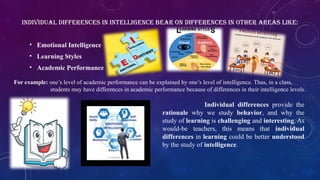
INDIVIDUAL DIFFERENCES IN INTELLIGENCE BEAR ON DIFFERENCES IN OTHER AREAS LIKE:
For example: one’s level of academic performance can be explained by one’s level of intelligence. Thus, in a class,
students may have differences in academic performance because of differences in their intelligence levels.
Individual differences provide the
rationale why we study behavior, and why the
study of learning is challenging and interesting. As
would-be teachers, this means that individual
differences in learning could be better understood
by the study of intelligence.
The earlier theories about the nature of intelligence involved any or more of the following themes:
• The capacity to learn
• The total knowledge a person has acquired
• Ability to adapt to new situations and the environment in general
LEARNING POINT: CONCEPTS ABOUT INTELLIGENCE
Understanding the nature of intelligence is a complex endeavor. The study of intelligence has been
done by various researchers and psychologists for a long time now, dating as far back as Plato.
Intelligence is such a complex concept and
there has been much argument and debate about it.
Research findings show that there are moderate to
high correlations among different mental tests and
because of this, some psychologists believe that
intelligence is a basic ability that affects
performance in all cognitively – oriented tasks.
There is no clear agreement as to what constitutes intelligence, nor a consensus on how to
measure it. There are as many definitions of intelligence as there are theories that attempt to explain its
nature. Be as it may there are certain behaviors which will indicate and lead one to believe that a
person is “intelligent” and based on studies, the following are components of what many experts and
theorists understand intelligence to be:
• It is adaptive. It involves modifying and adjusting one’s behaviors to accomplish
new tasks carefully.
• It is related to learning ability. Intelligent people learn information more quickly
and easily than the less intelligent ones.
• It involves use of prior knowledge to understand and analyze new situations
effectively.
• It involves the complex interaction and coordination of many different mental
processes.
• It may be seen in different arenas – for example, on academic tasks or in social
situations.
• It is “culture-specific”. What is intelligent behavior in one culture, may not
necessarily be intelligent behavior in another culture.
Sternberg (1986) contends that there are 2 general classifications of the definition of intelligence:
1. the “operational” definition
2. and the “real” definition
Operational intelligence – Defines through the measure of the test that was used.
Real intelligence – looks into the “true” nature of the characteristic being defined.
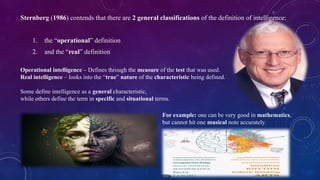
Some define intelligence as a general characteristic,
while others define the term in specific and situational terms.
For example: one can be very good in mathematics,
but cannot hit one musical note accurately.
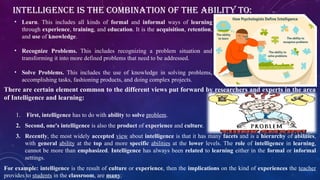
INTELLIGENCE IS THE COMBINATION OF THE ABILITY TO:
There are certain element common to the different views put forward by researchers and experts in the area
of Intelligence and learning:
1. First, intelligence has to do with ability to solve problem.
2. Second, one's intelligence is also the product of experience and culture.
3. Recently, the most widely accepted view about intelligence is that it has many facets and is a hierarchy of abilities,
with general ability at the top and more specific abilities at the lower levels. The role of intelligence in learning,
cannot be more than emphasized. Intelligence has always been related to learning either in the formal or informal
settings.
For example: intelligence is the result of culture or experience, then the implications on the kind of experiences the teacher
provides to students in the classroom, are many.
• Learn. This includes all kinds of formal and informal ways of learning
through experience, training, and education. It is the acquisition, retention,
and use of knowledge.
• Recognize Problems. This includes recognizing a problem situation and
transforming it into more defined problems that need to be addressed.
• Solve Problems. This includes the use of knowledge in solving problems,
accomplishing tasks, fashioning products, and doing complex projects.
Faculty Theory
It is the oldest theory regarding the nature of intelligence. It espouses that the mind is made up of
different faculties, like reasoning, memory, discrimination, imagination, and the likes. These faculties are
independent of each other, and can be developed by training. However, many psychologist have maintained
that independent faculties in the brain do not exist.
LEARNING POINT: THEORIES ABOUT INTELLIGENCE
One-factor or Uni-factor Theory
This theory asserts that all abilities are reduced to a single capacity of general intelligence or
“common sense.” It assumes that the different abilities are correlated and that they share many things in
common. It does not recognize differences among people. It does not recognize that an individual possesses
different abilities of different levels.
Following are the attributes of intelligence:
• Level – It is the level of difficulty of the task that can be solved.
• Range – Refers to a number of tasks at any given degree or level of difficulty.
• Area – The total number of situations at each level to which the individual is able to respond.
• Speed – The rapidity at which the individual responds to the situation or stimulus.
Charles Spearman's Two-factor Theory
This theory asserts that intellectual abilities comprise two factors – one, general ability
or the G factor, and the specific abilities, also known as the S factor. The G factor is a
universal inborn ability, while the S factor is acquired from the environment.
Edward Thorndike's Multi-factor Theory
This theory asserts that there is no such thing as general ability. It says that each mental ability
requires an aggregate of different sets of abilities.
The 7 primary factors are:
• Number Factor (N) – Ability to do numerical/Mathematical calculations rapidly and accurately.
• Verbal Factor (V) – Ability to do tasks involving verbal comprehension/define and understand words.
• Space Factor (S) – Ability to manipulate imaginary objects in space/ability to visualize relationships.
• Memory Factor (M) – Ability to memorize material quickly and recall (associative memory).
• Word Fluency Factor – Ability to think of isolated words at a rapid rate/to produce words correctly.
• Reasoning Factor (E) – Ability to discover a rule of principle governing a series or group of materials.
• Perception – Ability to see differences and similarities among objects.
Louis L. Thurstone's Primary Mental Abilities/Group Factor Theory
This theory asserts that intelligent activities are not an expression of many highly specific factors
as espoused by Thorndike nor is it the expression of general factor that pervades all mental abilities as
asserted by Spearman.
Thurstone’s theory claims that certain mental operations have in common a “primary factor” that
gives them functional unity and that differentiates them from other mental operations.
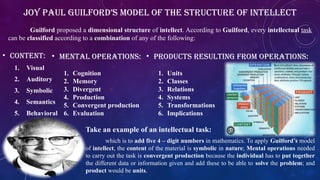
• Content:
1. Visual
2. Auditory
3. Symbolic
4. Semantics
5. Behavioral
• Mental operations:
1. Cognition
2. Memory
3. Divergent
4. Production
5. Convergent production
6. Evaluation
• Products resulting from operations:
1. Units
2. Classes
3. Relations
4. Systems
5. Transformations
6. Implications
Joy Paul Guilford’s Model of the Structure of Intellect
Guilford proposed a dimensional structure of intellect. According to Guilford, every intellectual task
can be classified according to a combination of any of the following:
Take an example of an intellectual task:
which is to add five 4 – digit numbers in mathematics. To apply Guilford’s model
of intellect, the content of the material is symbolic in nature; Mental operations needed
to carry out the task is convergent production because the individual has to put together
the different data or information given and add these to be able to solve the problem; and
product would be units.
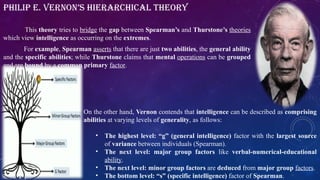
Philip E. Vernon’s Hierarchical Theory
This theory tries to bridge the gap between Spearman’s and Thurstone’s theories
which view intelligence as occurring on the extremes.
For example, Spearman asserts that there are just two abilities, the general ability
and the specific abilities; while Thurstone claims that mental operations can be grouped
and are bound by a common primary factor.
On the other hand, Vernon contends that intelligence can be described as comprising
abilities at varying levels of generality, as follows:
• The highest level: “g” (general intelligence) factor with the largest source
of variance between individuals (Spearman).
• The next level: major group factors like verbal-numerical-educational
ability.
• The next level: minor group factors are deduced from major group factors.
• The bottom level: “s” (specific intelligence) factor of Spearman.
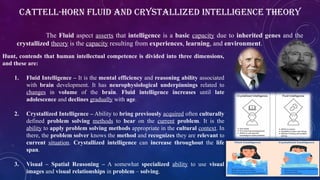
Cattell-Horn Fluid and Crystallized Intelligence Theory
The Fluid aspect asserts that intelligence is a basic capacity due to inherited genes and the
crystallized theory is the capacity resulting from experiences, learning, and environment.
Hunt, contends that human intellectual competence is divided into three dimensions,
and these are:
1. Fluid Intelligence – It is the mental efficiency and reasoning ability associated
with brain development. It has neurophysiological underpinnings related to
changes in volume of the brain. Fluid intelligence increases until late
adolescence and declines gradually with age.
2. Crystallized Intelligence – Ability to bring previously acquired often culturally
defined problem solving methods to bear on the current problem. It is the
ability to apply problem solving methods appropriate in the cultural context. In
there, the problem solver knows the method and recognizes they are relevant to
current situation. Crystallized intelligence can increase throughout the life
span.
3. Visual – Spatial Reasoning – A somewhat specialized ability to use visual
images and visual relationships in problem – solving.
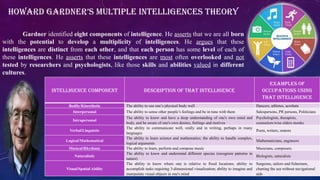
Howard Gardner’s Multiple Intelligences Theory
Gardner identified eight components of intelligence. He asserts that we are all born
with the potential to develop a multiplicity of intelligences. He argues that these
intelligences are distinct from each other, and that each person has some level of each of
these intelligences. He asserts that these intelligences are most often overlooked and not
tested by researchers and psychologists, like those skills and abilities valued in different
cultures.
Intelligence Component Description of that Intelligence
Examples of
Occupations Using
that Intelligence
Bodily/Kinesthetic The ability to use one’s physical body well Dancers, athletes, acrobats
Interpersonal The ability to sense other people’s feelings and be in tune with them Salespersons, PR persons, Politicians
Intrapersonal
The ability to know and have a deep understanding of one's own mind and
body, and be aware of one's own desires, feelings and motives
Psychologists, therapists,
counselors/wise elders monks
Verbal/Linguistic
The ability to communicate well, orally and in writing, perhaps in many
languages
Poets, writers, orators
Logical/Mathematical
The ability to learn science and mathematics; the ability to handle complex,
logical arguments
Mathematicians, engineers
Musical/Rhythmic The ability to learn, perform and compose music Musicians, composers
Naturalistic
The ability to know and understand different species (recognize patterns in
nature)
Biologists, naturalists
Visual/Spatial Ability
The ability to know where one is relative to fixed locations; ability to
accomplish tasks requiring 3-dimensional visualization; ability to imagine and
manipulate visual objects in one's mind
Surgeons, sailors and fishermen,
charting the sea without navigational
aids
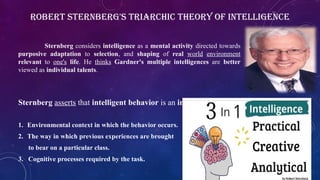
ROBERT STERNBERG'S TRIARCHIC THEORY OF INTELLIGENCE
Sternberg asserts that intelligent behavior is an interplay of three factors, namely:
1. Environmental context in which the behavior occurs.
2. The way in which previous experiences are brought
to bear on a particular class.
3. Cognitive processes required by the task.
Sternberg considers intelligence as a mental activity directed towards
purposive adaptation to selection, and shaping of real world environment
relevant to one's life. He thinks Gardner's multiple intelligences are better
viewed as individual talents.
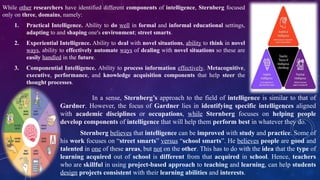
While other researchers have identified different components of intelligence, Sternberg focused
only on three, domains, namely:
1. Practical Intelligence. Ability to do well in formal and informal educational settings,
adapting to and shaping one's environment; street smarts.
2. Experiential Intelligence. Ability to deal with novel situations, ability to think in novel
ways, ability to effectively automate ways of dealing with novel situations so these are
easily handled in the future.
3. Componential Intelligence. Ability to process information effectively. Metacognitive,
executive, performance, and knowledge acquisition components that help steer the
thought processes.
In a sense, Sternberg’s approach to the field of intelligence is similar to that of
Gardner. However, the focus of Gardner lies in identifying specific intelligences aligned
with academic disciplines or occupations, while Sternberg focuses on helping people
develop components of intelligence that will help them perform best in whatever they do.
Sternberg believes that intelligence can be improved with study and practice. Some of
his work focuses on “street smarts” versus “school smarts”. He believes people are good and
talented in one of these areas, but not on the other. This has to do with the idea that the type of
learning acquired out of school is different from that acquired in school. Hence, teachers
who are skillful in using project-based approach to teaching and learning, can help students
design projects consistent with their learning abilities and interests.
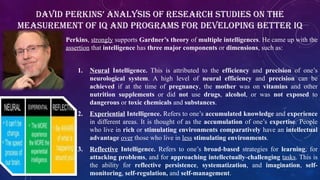
Perkins, strongly supports Gardner’s theory of multiple intelligences. He came up with the
assertion that intelligence has three major components or dimensions, such as:
1. Neural Intelligence. This is attributed to the efficiency and precision of one’s
neurological system. A high level of neural efficiency and precision can be
achieved if at the time of pregnancy, the mother was on vitamins and other
nutrition supplements or did not use drugs, alcohol, or was not exposed to
dangerous or toxic chemicals and substances.
2. Experiential Intelligence. Refers to one’s accumulated knowledge and experience
in different areas. It is thought of as the accumulation of one’s expertise. People
who live in rich or stimulating environments comparatively have an intellectual
advantage over those who live in less stimulating environments.
3. Reflective Intelligence. Refers to one’s broad-based strategies for learning, for
attacking problems, and for approaching intellectually-challenging tasks. This is
the ability for reflective persistence, systematization, and imagination, self-
monitoring, self-regulation, and self-management.
David Perkins’ Analysis of Research Studies on the
Measurement of IQ and Programs for Developing Better IQ
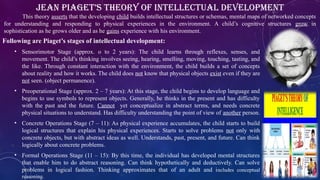
Following are Piaget’s stages of intellectual development:
• Sensorimotor Stage (approx. o to 2 years): The child learns through reflexes, senses, and
movement. The child’s thinking involves seeing, hearing, smelling, moving, touching, tasting, and
the like. Through constant interaction with the environment, the child builds a set of concepts
about reality and how it works. The child does not know that physical objects exist even if they are
not seen. (object permanence).
• Preoperational Stage (approx. 2 – 7 years): At this stage, the child begins to develop language and
begins to use symbols to represent objects. Generally, he thinks in the present and has difficulty
with the past and the future. Cannot yet conceptualize in abstract terms, and needs concrete
physical situations to understand. Has difficulty understanding the point of view of another person.
• Concrete Operations Stage (7 – 11): As physical experience accumulates, the child starts to build
logical structures that explain his physical experiences. Starts to solve problems not only with
concrete objects, but with abstract ideas as well. Understands, past, present, and future. Can think
logically about concrete problems.
• Formal Operations Stage (11 – 15): By this time, the individual has developed mental structures
that enable him to do abstract reasoning. Can think hypothetically and deductively. Can solve
problems in logical fashion. Thinking approximates that of an adult and includes conceptual
reasoning.
Jean Piaget’s Theory of Intellectual Development
This theory asserts that the developing child builds intellectual structures or schemas, mental maps of networked concepts
for understanding and responding to physical experiences in the environment. A child’s cognitive structures grow in
sophistication as he grows older and as he gains experience with his environment.
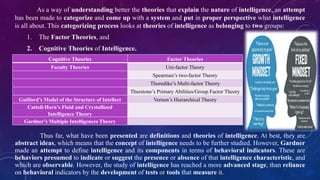
As a way of understanding better the theories that explain the nature of intelligence, an attempt
has been made to categorize and come up with a system and put in proper perspective what intelligence
is all about. This categorizing process looks at theories of intelligence as belonging to two groups:
1. The Factor Theories, and
2. Cognitive Theories of Intelligence.
Cognitive Theories Factor Theories
Faculty Theories Uni-factor Theory
Spearman’s two-factor Theory
Thorndike’s Multi-factor Theory
Thurstone’s Primary Abilities/Group Factor Theory
Guilford’s Model of the Structure of Intellect Vernon’s Hierarchical Theory
Cattell-Horn’s Fluid and Crystallized
Intelligence Theory
Gardner’s Multiple Intelligences Theory
Thus far, what have been presented are definitions and theories of intelligence. At best, they are
abstract ideas, which means that the concept of intelligence needs to be further studied. However, Gardner
made an attempt to define intelligence and its components in terms of behavioral indicators. These are
behaviors presumed to indicate or suggest the presence or absence of that intelligence characteristic, and
which are observable. However, the study of intelligence has reached a more advanced stage, than reliance
on behavioral indicators by the development of tests or tools that measure it.
Thus, intelligence tests, whose validity have been established by their
developers, should be a more reliable and scientific way of measuring intelligence.
However, such tools or tests are not readily available in schools. So in the absence of
these tools, the teacher can use behavioral indicators of intelligence to get a feel as to
where their students are, since these indicators are grounded on the corresponding
theories developed.
In many ways, intelligence provides the “foundation” for the thinking
processes in learning like, thinking, knowing, and problem-solving. It defines what
one can or cannot learn. In other words, how learners approach and deal with
various learning materials depends to a certain extent on their level of intelligence.
These make up for individual differences in how learners learn. To emphasize a
point, all these theories of intelligence attempt to explain the nature of intelligence,
and its importance should not be overlooked because it impacts on the teaching
learning process.
A teacher should be able to consider the abilities of his students
when planning for instructional materials and experiences; and in
implementing them in the classroom. Knowing that there is such a
concept as individual differences, teachers would be able to adjust, and
address different needs and abilities of students with appropriate
classroom experiences, and learning materials.
FACILITATING-LEARNER-CENTERED-TEACHING-REPORT.pptx

FACILITATING-LEARNER-CENTERED-TEACHING-REPORT.pptx

  • 1.
    CHAPTER 8 CONCEPTS OFINDIVIDUAL DIFFERENCES IN LEARNING
  • 2.
    THIS CHAPTER PRESENTSTHE VARIOUS DEFINITIONS AND CONCEPTS RELATED TO INTELLIGENCE AND TO INDIVIDUAL DIFFERENCES. IT ALSO TRIES TO EXPLAIN WHAT INTELLIGENCE IS ALL ABOUT, USING THE THEORIES ADVANCED BY THE EXPERTS. Introduction Intended Learning Outcome Analyze concepts of individual differences in learning according to different theories of intelligence: 1. Structural 2. Process
  • 3.
    LEARNING POINT: INTELLIGENCEAND INDIVIDUAL DIFFERENCES We, people belong to a group called human beings. Be as it may, each person has his own unique characteristics, different from others and has his own individuality contributing to variations or differences within and among individuals, and these are called individual differences.
  • 4.
    INDIVIDUALS MAY HAVEDIFFERENCES ALONG THE FOLLOWING: Physiological Psychological Intellectual differences Motor Ability differences Academic Performance • Emotional differences Temperament Aptitudes and Interests Self-concept Learning Styles Study Habits • Social and Moral Development HEREDITY AND ENVIRONMENT ARE THE 2 MAIN FACTORS THAT EXPLAIN INDIVIDUAL DIFFERENCES, AND INTELLIGENCE, IT IS A SIGNIFICANT SOURCE OF VARIATION AMONG INDIVIDUALS.
  • 5.
    • Emotional Intelligence •Learning Styles • Academic Performance INDIVIDUAL DIFFERENCES IN INTELLIGENCE BEAR ON DIFFERENCES IN OTHER AREAS LIKE: For example: one’s level of academic performance can be explained by one’s level of intelligence. Thus, in a class, students may have differences in academic performance because of differences in their intelligence levels. Individual differences provide the rationale why we study behavior, and why the study of learning is challenging and interesting. As would-be teachers, this means that individual differences in learning could be better understood by the study of intelligence.
  • 6.
    The earlier theoriesabout the nature of intelligence involved any or more of the following themes: • The capacity to learn • The total knowledge a person has acquired • Ability to adapt to new situations and the environment in general LEARNING POINT: CONCEPTS ABOUT INTELLIGENCE Understanding the nature of intelligence is a complex endeavor. The study of intelligence has been done by various researchers and psychologists for a long time now, dating as far back as Plato. Intelligence is such a complex concept and there has been much argument and debate about it. Research findings show that there are moderate to high correlations among different mental tests and because of this, some psychologists believe that intelligence is a basic ability that affects performance in all cognitively – oriented tasks.
  • 7.
    There is noclear agreement as to what constitutes intelligence, nor a consensus on how to measure it. There are as many definitions of intelligence as there are theories that attempt to explain its nature. Be as it may there are certain behaviors which will indicate and lead one to believe that a person is “intelligent” and based on studies, the following are components of what many experts and theorists understand intelligence to be: • It is adaptive. It involves modifying and adjusting one’s behaviors to accomplish new tasks carefully. • It is related to learning ability. Intelligent people learn information more quickly and easily than the less intelligent ones. • It involves use of prior knowledge to understand and analyze new situations effectively. • It involves the complex interaction and coordination of many different mental processes. • It may be seen in different arenas – for example, on academic tasks or in social situations. • It is “culture-specific”. What is intelligent behavior in one culture, may not necessarily be intelligent behavior in another culture.
  • 8.
    Sternberg (1986) contendsthat there are 2 general classifications of the definition of intelligence: 1. the “operational” definition 2. and the “real” definition Operational intelligence – Defines through the measure of the test that was used. Real intelligence – looks into the “true” nature of the characteristic being defined. Some define intelligence as a general characteristic, while others define the term in specific and situational terms. For example: one can be very good in mathematics, but cannot hit one musical note accurately.
  • 9.
    INTELLIGENCE IS THECOMBINATION OF THE ABILITY TO: There are certain element common to the different views put forward by researchers and experts in the area of Intelligence and learning: 1. First, intelligence has to do with ability to solve problem. 2. Second, one's intelligence is also the product of experience and culture. 3. Recently, the most widely accepted view about intelligence is that it has many facets and is a hierarchy of abilities, with general ability at the top and more specific abilities at the lower levels. The role of intelligence in learning, cannot be more than emphasized. Intelligence has always been related to learning either in the formal or informal settings. For example: intelligence is the result of culture or experience, then the implications on the kind of experiences the teacher provides to students in the classroom, are many. • Learn. This includes all kinds of formal and informal ways of learning through experience, training, and education. It is the acquisition, retention, and use of knowledge. • Recognize Problems. This includes recognizing a problem situation and transforming it into more defined problems that need to be addressed. • Solve Problems. This includes the use of knowledge in solving problems, accomplishing tasks, fashioning products, and doing complex projects.
  • 10.
    Faculty Theory It isthe oldest theory regarding the nature of intelligence. It espouses that the mind is made up of different faculties, like reasoning, memory, discrimination, imagination, and the likes. These faculties are independent of each other, and can be developed by training. However, many psychologist have maintained that independent faculties in the brain do not exist. LEARNING POINT: THEORIES ABOUT INTELLIGENCE One-factor or Uni-factor Theory This theory asserts that all abilities are reduced to a single capacity of general intelligence or “common sense.” It assumes that the different abilities are correlated and that they share many things in common. It does not recognize differences among people. It does not recognize that an individual possesses different abilities of different levels.
  • 11.
    Following are theattributes of intelligence: • Level – It is the level of difficulty of the task that can be solved. • Range – Refers to a number of tasks at any given degree or level of difficulty. • Area – The total number of situations at each level to which the individual is able to respond. • Speed – The rapidity at which the individual responds to the situation or stimulus. Charles Spearman's Two-factor Theory This theory asserts that intellectual abilities comprise two factors – one, general ability or the G factor, and the specific abilities, also known as the S factor. The G factor is a universal inborn ability, while the S factor is acquired from the environment. Edward Thorndike's Multi-factor Theory This theory asserts that there is no such thing as general ability. It says that each mental ability requires an aggregate of different sets of abilities.
  • 12.
    The 7 primaryfactors are: • Number Factor (N) – Ability to do numerical/Mathematical calculations rapidly and accurately. • Verbal Factor (V) – Ability to do tasks involving verbal comprehension/define and understand words. • Space Factor (S) – Ability to manipulate imaginary objects in space/ability to visualize relationships. • Memory Factor (M) – Ability to memorize material quickly and recall (associative memory). • Word Fluency Factor – Ability to think of isolated words at a rapid rate/to produce words correctly. • Reasoning Factor (E) – Ability to discover a rule of principle governing a series or group of materials. • Perception – Ability to see differences and similarities among objects. Louis L. Thurstone's Primary Mental Abilities/Group Factor Theory This theory asserts that intelligent activities are not an expression of many highly specific factors as espoused by Thorndike nor is it the expression of general factor that pervades all mental abilities as asserted by Spearman. Thurstone’s theory claims that certain mental operations have in common a “primary factor” that gives them functional unity and that differentiates them from other mental operations.
  • 13.
    • Content: 1. Visual 2.Auditory 3. Symbolic 4. Semantics 5. Behavioral • Mental operations: 1. Cognition 2. Memory 3. Divergent 4. Production 5. Convergent production 6. Evaluation • Products resulting from operations: 1. Units 2. Classes 3. Relations 4. Systems 5. Transformations 6. Implications Joy Paul Guilford’s Model of the Structure of Intellect Guilford proposed a dimensional structure of intellect. According to Guilford, every intellectual task can be classified according to a combination of any of the following: Take an example of an intellectual task: which is to add five 4 – digit numbers in mathematics. To apply Guilford’s model of intellect, the content of the material is symbolic in nature; Mental operations needed to carry out the task is convergent production because the individual has to put together the different data or information given and add these to be able to solve the problem; and product would be units.
  • 14.
    Philip E. Vernon’sHierarchical Theory This theory tries to bridge the gap between Spearman’s and Thurstone’s theories which view intelligence as occurring on the extremes. For example, Spearman asserts that there are just two abilities, the general ability and the specific abilities; while Thurstone claims that mental operations can be grouped and are bound by a common primary factor. On the other hand, Vernon contends that intelligence can be described as comprising abilities at varying levels of generality, as follows: • The highest level: “g” (general intelligence) factor with the largest source of variance between individuals (Spearman). • The next level: major group factors like verbal-numerical-educational ability. • The next level: minor group factors are deduced from major group factors. • The bottom level: “s” (specific intelligence) factor of Spearman.
  • 15.
    Cattell-Horn Fluid andCrystallized Intelligence Theory The Fluid aspect asserts that intelligence is a basic capacity due to inherited genes and the crystallized theory is the capacity resulting from experiences, learning, and environment. Hunt, contends that human intellectual competence is divided into three dimensions, and these are: 1. Fluid Intelligence – It is the mental efficiency and reasoning ability associated with brain development. It has neurophysiological underpinnings related to changes in volume of the brain. Fluid intelligence increases until late adolescence and declines gradually with age. 2. Crystallized Intelligence – Ability to bring previously acquired often culturally defined problem solving methods to bear on the current problem. It is the ability to apply problem solving methods appropriate in the cultural context. In there, the problem solver knows the method and recognizes they are relevant to current situation. Crystallized intelligence can increase throughout the life span. 3. Visual – Spatial Reasoning – A somewhat specialized ability to use visual images and visual relationships in problem – solving.
  • 16.
    Howard Gardner’s MultipleIntelligences Theory Gardner identified eight components of intelligence. He asserts that we are all born with the potential to develop a multiplicity of intelligences. He argues that these intelligences are distinct from each other, and that each person has some level of each of these intelligences. He asserts that these intelligences are most often overlooked and not tested by researchers and psychologists, like those skills and abilities valued in different cultures. Intelligence Component Description of that Intelligence Examples of Occupations Using that Intelligence Bodily/Kinesthetic The ability to use one’s physical body well Dancers, athletes, acrobats Interpersonal The ability to sense other people’s feelings and be in tune with them Salespersons, PR persons, Politicians Intrapersonal The ability to know and have a deep understanding of one's own mind and body, and be aware of one's own desires, feelings and motives Psychologists, therapists, counselors/wise elders monks Verbal/Linguistic The ability to communicate well, orally and in writing, perhaps in many languages Poets, writers, orators Logical/Mathematical The ability to learn science and mathematics; the ability to handle complex, logical arguments Mathematicians, engineers Musical/Rhythmic The ability to learn, perform and compose music Musicians, composers Naturalistic The ability to know and understand different species (recognize patterns in nature) Biologists, naturalists Visual/Spatial Ability The ability to know where one is relative to fixed locations; ability to accomplish tasks requiring 3-dimensional visualization; ability to imagine and manipulate visual objects in one's mind Surgeons, sailors and fishermen, charting the sea without navigational aids
  • 17.
    ROBERT STERNBERG'S TRIARCHICTHEORY OF INTELLIGENCE Sternberg asserts that intelligent behavior is an interplay of three factors, namely: 1. Environmental context in which the behavior occurs. 2. The way in which previous experiences are brought to bear on a particular class. 3. Cognitive processes required by the task. Sternberg considers intelligence as a mental activity directed towards purposive adaptation to selection, and shaping of real world environment relevant to one's life. He thinks Gardner's multiple intelligences are better viewed as individual talents.
  • 18.
    While other researchershave identified different components of intelligence, Sternberg focused only on three, domains, namely: 1. Practical Intelligence. Ability to do well in formal and informal educational settings, adapting to and shaping one's environment; street smarts. 2. Experiential Intelligence. Ability to deal with novel situations, ability to think in novel ways, ability to effectively automate ways of dealing with novel situations so these are easily handled in the future. 3. Componential Intelligence. Ability to process information effectively. Metacognitive, executive, performance, and knowledge acquisition components that help steer the thought processes. In a sense, Sternberg’s approach to the field of intelligence is similar to that of Gardner. However, the focus of Gardner lies in identifying specific intelligences aligned with academic disciplines or occupations, while Sternberg focuses on helping people develop components of intelligence that will help them perform best in whatever they do. Sternberg believes that intelligence can be improved with study and practice. Some of his work focuses on “street smarts” versus “school smarts”. He believes people are good and talented in one of these areas, but not on the other. This has to do with the idea that the type of learning acquired out of school is different from that acquired in school. Hence, teachers who are skillful in using project-based approach to teaching and learning, can help students design projects consistent with their learning abilities and interests.
  • 19.
    Perkins, strongly supportsGardner’s theory of multiple intelligences. He came up with the assertion that intelligence has three major components or dimensions, such as: 1. Neural Intelligence. This is attributed to the efficiency and precision of one’s neurological system. A high level of neural efficiency and precision can be achieved if at the time of pregnancy, the mother was on vitamins and other nutrition supplements or did not use drugs, alcohol, or was not exposed to dangerous or toxic chemicals and substances. 2. Experiential Intelligence. Refers to one’s accumulated knowledge and experience in different areas. It is thought of as the accumulation of one’s expertise. People who live in rich or stimulating environments comparatively have an intellectual advantage over those who live in less stimulating environments. 3. Reflective Intelligence. Refers to one’s broad-based strategies for learning, for attacking problems, and for approaching intellectually-challenging tasks. This is the ability for reflective persistence, systematization, and imagination, self- monitoring, self-regulation, and self-management. David Perkins’ Analysis of Research Studies on the Measurement of IQ and Programs for Developing Better IQ
  • 20.
    Following are Piaget’sstages of intellectual development: • Sensorimotor Stage (approx. o to 2 years): The child learns through reflexes, senses, and movement. The child’s thinking involves seeing, hearing, smelling, moving, touching, tasting, and the like. Through constant interaction with the environment, the child builds a set of concepts about reality and how it works. The child does not know that physical objects exist even if they are not seen. (object permanence). • Preoperational Stage (approx. 2 – 7 years): At this stage, the child begins to develop language and begins to use symbols to represent objects. Generally, he thinks in the present and has difficulty with the past and the future. Cannot yet conceptualize in abstract terms, and needs concrete physical situations to understand. Has difficulty understanding the point of view of another person. • Concrete Operations Stage (7 – 11): As physical experience accumulates, the child starts to build logical structures that explain his physical experiences. Starts to solve problems not only with concrete objects, but with abstract ideas as well. Understands, past, present, and future. Can think logically about concrete problems. • Formal Operations Stage (11 – 15): By this time, the individual has developed mental structures that enable him to do abstract reasoning. Can think hypothetically and deductively. Can solve problems in logical fashion. Thinking approximates that of an adult and includes conceptual reasoning. Jean Piaget’s Theory of Intellectual Development This theory asserts that the developing child builds intellectual structures or schemas, mental maps of networked concepts for understanding and responding to physical experiences in the environment. A child’s cognitive structures grow in sophistication as he grows older and as he gains experience with his environment.
  • 21.
    As a wayof understanding better the theories that explain the nature of intelligence, an attempt has been made to categorize and come up with a system and put in proper perspective what intelligence is all about. This categorizing process looks at theories of intelligence as belonging to two groups: 1. The Factor Theories, and 2. Cognitive Theories of Intelligence. Cognitive Theories Factor Theories Faculty Theories Uni-factor Theory Spearman’s two-factor Theory Thorndike’s Multi-factor Theory Thurstone’s Primary Abilities/Group Factor Theory Guilford’s Model of the Structure of Intellect Vernon’s Hierarchical Theory Cattell-Horn’s Fluid and Crystallized Intelligence Theory Gardner’s Multiple Intelligences Theory Thus far, what have been presented are definitions and theories of intelligence. At best, they are abstract ideas, which means that the concept of intelligence needs to be further studied. However, Gardner made an attempt to define intelligence and its components in terms of behavioral indicators. These are behaviors presumed to indicate or suggest the presence or absence of that intelligence characteristic, and which are observable. However, the study of intelligence has reached a more advanced stage, than reliance on behavioral indicators by the development of tests or tools that measure it.
  • 22.
    Thus, intelligence tests,whose validity have been established by their developers, should be a more reliable and scientific way of measuring intelligence. However, such tools or tests are not readily available in schools. So in the absence of these tools, the teacher can use behavioral indicators of intelligence to get a feel as to where their students are, since these indicators are grounded on the corresponding theories developed. In many ways, intelligence provides the “foundation” for the thinking processes in learning like, thinking, knowing, and problem-solving. It defines what one can or cannot learn. In other words, how learners approach and deal with various learning materials depends to a certain extent on their level of intelligence. These make up for individual differences in how learners learn. To emphasize a point, all these theories of intelligence attempt to explain the nature of intelligence, and its importance should not be overlooked because it impacts on the teaching learning process. A teacher should be able to consider the abilities of his students when planning for instructional materials and experiences; and in implementing them in the classroom. Knowing that there is such a concept as individual differences, teachers would be able to adjust, and address different needs and abilities of students with appropriate classroom experiences, and learning materials.