ADVANCE 
ORGANIZER 
MODEL 
By David Ausubel
ACCORDING TO AUSUBEL 
 Goal of learning subject matter and 
improvement of presentational methods of 
teaching is important. 
 His theory of meaningful verbal learning deals 
with three concerns- 
* how knowledge(curriculum content) is 
organised. 
* how mind works to process new 
information(learning). 
* how teachers can apply these ideas about 
curriculum and learning when they present 
new material to students(instruction).
GOALS AND ASSUMPTIONS 
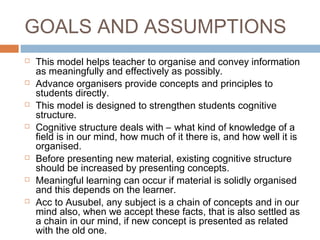
 This model helps teacher to organise and convey information 
as meaningfully and effectively as possibly. 
 Advance organisers provide concepts and principles to 
students directly. 
 This model is designed to strengthen students cognitive 
structure. 
 Cognitive structure deals with – what kind of knowledge of a 
field is in our mind, how much of it there is, and how well it is 
organised. 
 Before presenting new material, existing cognitive structure 
should be increased by presenting concepts. 
 Meaningful learning can occur if material is solidly organised 
and this depends on the learner. 
 Acc to Ausubel, any subject is a chain of concepts and in our 
mind also, when we accept these facts, that is also settled as 
a chain in our mind, if new concept is presented as related 
with the old one.
IMPLICATIONS FOR 
CURRICULUM 
 To guide the oraganisation of content and 
make students cognitive structure there are 
two principles- 
1) Principle of Progressive Differentiation- means 
most general ideas of disciplines are 
presented first and followed by gradual 
increase in detail and specificity. 
2) Principle of Integrative 
Reconciliation(satisfying opposing facts) – 
means new ideas should be consciously 
related to previously learned content.
ELEMENTS OF AOM 
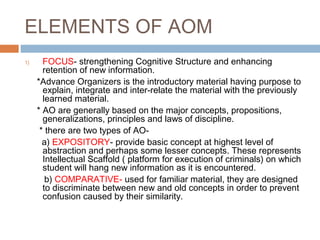
1) FOCUS- strengthening Cognitive Structure and enhancing 
retention of new information. 
*Advance Organizers is the introductory material having purpose to 
explain, integrate and inter-relate the material with the previously 
learned material. 
* AO are generally based on the major concepts, propositions, 
generalizations, principles and laws of discipline. 
* there are two types of AO-a) 
EXPOSITORY- provide basic concept at highest level of 
abstraction and perhaps some lesser concepts. These represents 
Intellectual Scaffold ( platform for execution of criminals) on which 
student will hang new information as it is encountered. 
b) COMPARATIVE- used for familiar material, they are designed 
to discriminate between new and old concepts in order to prevent 
confusion caused by their similarity.
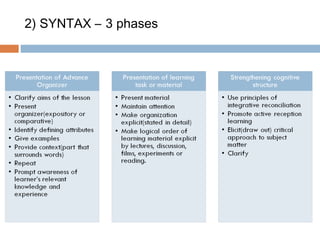
2) SYNTAX – 3 phases
3) SOCIAL SYSTEM – highly structured and teacher 
more active. 
* active collaboration between teacher and student 
* teacher retain control of intellectual structure 
* third phase interactive 
* acquisition depend on learner desire to integrate it 
with prior knowledge. 
4) PRINCIPLES OF REACTION – 
* teacher solicited(friendly) or unsolicited(unfriendly) 
responses will be guided by purpose of clarifying the 
meaning of new material, differentiating it from 
reconciling it with existing knowledge for personally 
relevant to students and to promote critical approach. 
* student initiate their own questions in response to 
their drive for meaning.
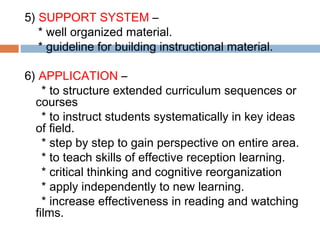
5) SUPPORT SYSTEM – 
* well organized material. 
* guideline for building instructional material. 
6) APPLICATION – 
* to structure extended curriculum sequences or 
courses 
* to instruct students systematically in key ideas 
of field. 
* step by step to gain perspective on entire area. 
* to teach skills of effective reception learning. 
* critical thinking and cognitive reorganization 
* apply independently to new learning. 
* increase effectiveness in reading and watching 
films.

Advance Organizer Model

  • 1.
    ADVANCE ORGANIZER MODEL By David Ausubel
  • 2.
    ACCORDING TO AUSUBEL  Goal of learning subject matter and improvement of presentational methods of teaching is important.  His theory of meaningful verbal learning deals with three concerns- * how knowledge(curriculum content) is organised. * how mind works to process new information(learning). * how teachers can apply these ideas about curriculum and learning when they present new material to students(instruction).
  • 3.
    GOALS AND ASSUMPTIONS  This model helps teacher to organise and convey information as meaningfully and effectively as possibly.  Advance organisers provide concepts and principles to students directly.  This model is designed to strengthen students cognitive structure.  Cognitive structure deals with – what kind of knowledge of a field is in our mind, how much of it there is, and how well it is organised.  Before presenting new material, existing cognitive structure should be increased by presenting concepts.  Meaningful learning can occur if material is solidly organised and this depends on the learner.  Acc to Ausubel, any subject is a chain of concepts and in our mind also, when we accept these facts, that is also settled as a chain in our mind, if new concept is presented as related with the old one.
  • 4.
    IMPLICATIONS FOR CURRICULUM  To guide the oraganisation of content and make students cognitive structure there are two principles- 1) Principle of Progressive Differentiation- means most general ideas of disciplines are presented first and followed by gradual increase in detail and specificity. 2) Principle of Integrative Reconciliation(satisfying opposing facts) – means new ideas should be consciously related to previously learned content.
  • 5.
    ELEMENTS OF AOM 1) FOCUS- strengthening Cognitive Structure and enhancing retention of new information. *Advance Organizers is the introductory material having purpose to explain, integrate and inter-relate the material with the previously learned material. * AO are generally based on the major concepts, propositions, generalizations, principles and laws of discipline. * there are two types of AO-a) EXPOSITORY- provide basic concept at highest level of abstraction and perhaps some lesser concepts. These represents Intellectual Scaffold ( platform for execution of criminals) on which student will hang new information as it is encountered. b) COMPARATIVE- used for familiar material, they are designed to discriminate between new and old concepts in order to prevent confusion caused by their similarity.
  • 6.
    2) SYNTAX –3 phases
  • 7.
    3) SOCIAL SYSTEM– highly structured and teacher more active. * active collaboration between teacher and student * teacher retain control of intellectual structure * third phase interactive * acquisition depend on learner desire to integrate it with prior knowledge. 4) PRINCIPLES OF REACTION – * teacher solicited(friendly) or unsolicited(unfriendly) responses will be guided by purpose of clarifying the meaning of new material, differentiating it from reconciling it with existing knowledge for personally relevant to students and to promote critical approach. * student initiate their own questions in response to their drive for meaning.
  • 8.
    5) SUPPORT SYSTEM– * well organized material. * guideline for building instructional material. 6) APPLICATION – * to structure extended curriculum sequences or courses * to instruct students systematically in key ideas of field. * step by step to gain perspective on entire area. * to teach skills of effective reception learning. * critical thinking and cognitive reorganization * apply independently to new learning. * increase effectiveness in reading and watching films.