Intelligence
wechsler has defined
intelligence as the aggregate
or global capacity of the
individual to think
rationally, to act
purposefully and to deal
effectively with the
environment
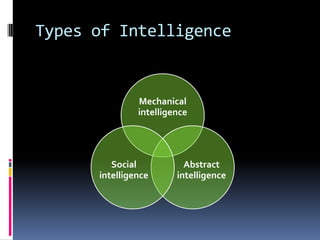
Types of Intelligence


               Mechanical
               intelligence


         Social           Abstract
      intelligence      intelligence
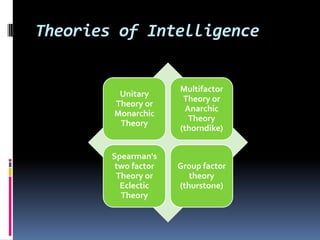
Theories of Intelligence


                      Multifactor
         Unitary
                       Theory or
        Theory or
                        Anarchic
        Monarchic
                         Theory
         Theory
                      (thorndike)


        Spearman's
         two factor   Group factor
         Theory or       theory
          Eclectic    (thurstone)
          Theory
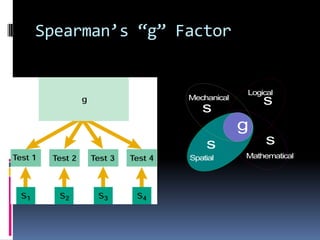
Spearman’s “g” Factor


                             Logical
                Mechanical
                                 s
                   s
                             g
                    s            s
                Spatial      Mathematical


             Each ability combines
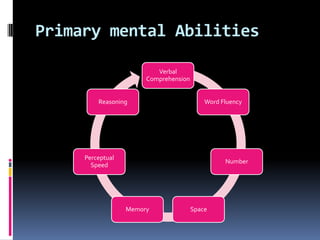
Primary mental Abilities

                          Verbal
                       Comprehension


         Reasoning                         Word Fluency


     Perceptual
                                                 Number
       Speed


                  Memory               Space
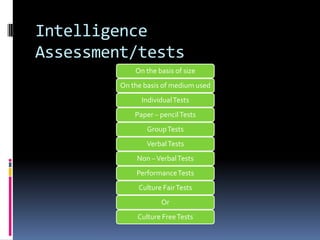
Intelligence
Assessment/tests
             On the basis of size
         On the basis of medium used
               Individual Tests
             Paper – pencil Tests
                 Group Tests
                 Verbal Tests
              Non – Verbal Tests
             Performance Tests
              Culture Fair Tests
                     Or
              Culture Free Tests
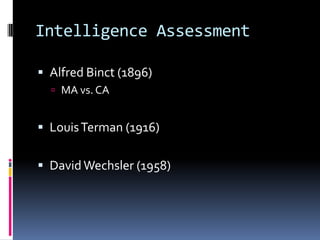
Intelligence Assessment

 Alfred Binct (1896)
   MA vs. CA


 Louis Terman (1916)


 David Wechsler (1958)
The Stanford-Binet

 Alfred Binet(1875-1911)
 Intelligence scale in 1905 which involved
  attention, memory, discrimination and some
  other simple psychological processes
 Scale consisted of 30 items arranged in order
  of difficulty or complexity
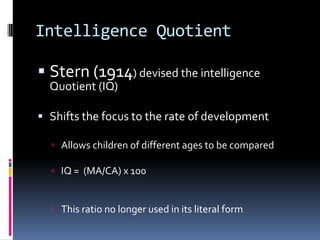
Intelligence Quotient

 Stern (1914) devised the intelligence
  Quotient (IQ)

 Shifts the focus to the rate of development

   Allows children of different ages to be compared

   IQ = (MA/CA) x 100


   This ratio no longer used in its literal form
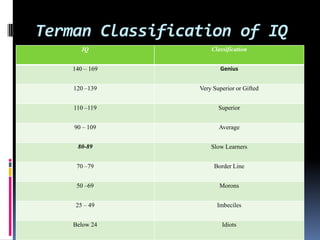
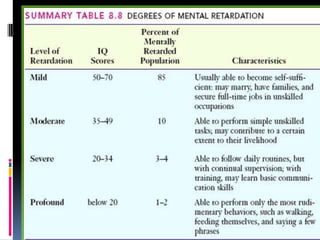
Terman Classification of IQ
       IQ            Classification


    140 – 169            Genius


    120 –139     Very Superior or Gifted


    110 –119            Superior


    90 – 109            Average


     80-89           Slow Learners


     70 –79           Border Line


     50 –69             Morons


     25 – 49           Imbeciles


    Below 24             Idiots
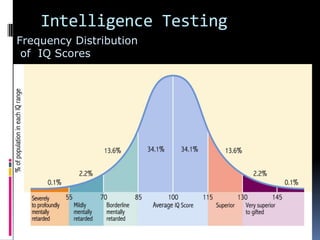
Intelligence Testing
Frequency Distribution
 of IQ Scores


              (Figure adapted from Anastasi & Urbina, 1997)


       .
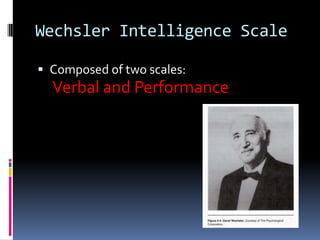
Wechsler Intelligence Scale

 Composed of two scales:
  Verbal and Performance
Subtests


         • Five Mandatory Subtests
           • Information
           • Similarities
           • Arithmetic

Verbal     • Vocabulary
           • Comprehension
         • One Supplementary Test

Scale      • Digit Span
             • This test can be substituted for one of the other tests if
               and only if the data from a mandatory subtest is
               missing or invalidated.


                                              (Kamphaus, 1993)
Subtests


              • Five Mandatory Subtests
                • Picture Completion
                • Picture Arrangement
                • Block Design
                • Object Assembly

Performance     • Coding
              • Two Supplementary Subtests

    Scale       • Mazes
                • Symbol Search
                  • The Mazes subtest can be substituted for any of the
                    mandatory subtest if the data is missing or invalidated. The
                    Symbol Search can only be substituted for the Coding
                    subtest.


                                                   (Kamphaus, 1993)
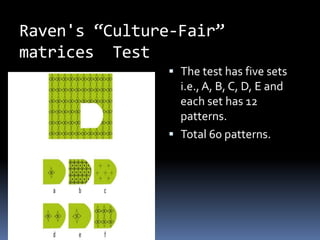
Raven's “Culture-Fair”
matrices Test
                The test has five sets
                 i.e., A, B, C, D, E and
                 each set has 12
                 patterns.
                Total 60 patterns.
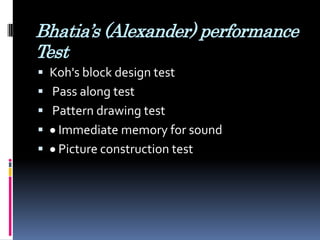
Bhatia’s (Alexander) performance
Test
 Koh's block design test
 Pass along test
 Pattern drawing test
   Immediate memory for sound
   Picture construction test
Intelligence

Intelligence

  • 1.
    Intelligence wechsler has defined intelligenceas the aggregate or global capacity of the individual to think rationally, to act purposefully and to deal effectively with the environment
  • 2.
    Types of Intelligence Mechanical intelligence Social Abstract intelligence intelligence
  • 3.
    Theories of Intelligence Multifactor Unitary Theory or Theory or Anarchic Monarchic Theory Theory (thorndike) Spearman's two factor Group factor Theory or theory Eclectic (thurstone) Theory
  • 4.
    Spearman’s “g” Factor Logical Mechanical s s g s s Spatial Mathematical Each ability combines
  • 5.
    Primary mental Abilities Verbal Comprehension Reasoning Word Fluency Perceptual Number Speed Memory Space
  • 6.
    Intelligence Assessment/tests On the basis of size On the basis of medium used Individual Tests Paper – pencil Tests Group Tests Verbal Tests Non – Verbal Tests Performance Tests Culture Fair Tests Or Culture Free Tests
  • 7.
    Intelligence Assessment  AlfredBinct (1896)  MA vs. CA  Louis Terman (1916)  David Wechsler (1958)
  • 8.
    The Stanford-Binet  AlfredBinet(1875-1911)  Intelligence scale in 1905 which involved attention, memory, discrimination and some other simple psychological processes  Scale consisted of 30 items arranged in order of difficulty or complexity
  • 9.
    Intelligence Quotient  Stern(1914) devised the intelligence Quotient (IQ)  Shifts the focus to the rate of development  Allows children of different ages to be compared  IQ = (MA/CA) x 100  This ratio no longer used in its literal form
  • 10.
    Terman Classification ofIQ IQ Classification 140 – 169 Genius 120 –139 Very Superior or Gifted 110 –119 Superior 90 – 109 Average 80-89 Slow Learners 70 –79 Border Line 50 –69 Morons 25 – 49 Imbeciles Below 24 Idiots
  • 11.
    Intelligence Testing Frequency Distribution of IQ Scores (Figure adapted from Anastasi & Urbina, 1997) .
  • 12.
    Wechsler Intelligence Scale Composed of two scales: Verbal and Performance
  • 13.
    Subtests • Five Mandatory Subtests • Information • Similarities • Arithmetic Verbal • Vocabulary • Comprehension • One Supplementary Test Scale • Digit Span • This test can be substituted for one of the other tests if and only if the data from a mandatory subtest is missing or invalidated. (Kamphaus, 1993)
  • 14.
    Subtests • Five Mandatory Subtests • Picture Completion • Picture Arrangement • Block Design • Object Assembly Performance • Coding • Two Supplementary Subtests Scale • Mazes • Symbol Search • The Mazes subtest can be substituted for any of the mandatory subtest if the data is missing or invalidated. The Symbol Search can only be substituted for the Coding subtest. (Kamphaus, 1993)
  • 15.
    Raven's “Culture-Fair” matrices Test  The test has five sets i.e., A, B, C, D, E and each set has 12 patterns.  Total 60 patterns.
  • 16.
    Bhatia’s (Alexander) performance Test Koh's block design test  Pass along test  Pattern drawing test  Immediate memory for sound  Picture construction test