TRIARCHIC THEORY
OF INTELLIGENCE
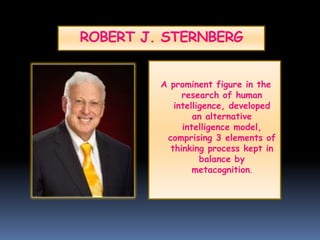
ROBERT J. STERNBERG
A prominent figure in the
research of human
intelligence, developed
an alternative
intelligence model,
comprising 3 elements of
thinking process kept in
balance by
metacognition.
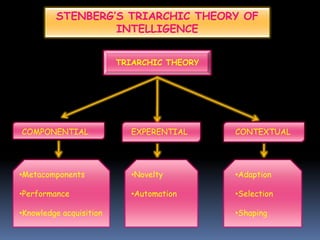
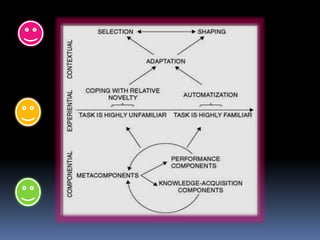
STENBERG’S TRIARCHIC THEORY OF
INTELLIGENCE
TRIARCHIC THEORY
COMPONENTIAL EXPERENTIAL CONTEXTUAL
•Metacomponents
•Performance
•Knowledge acquisition
•Novelty
•Automation
•Adaption
•Selection
•Shaping
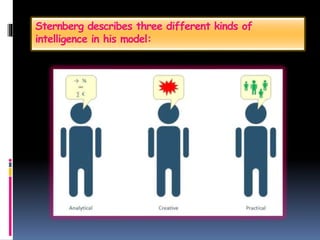
Sternberg describes three different kinds of
intelligence in his model:
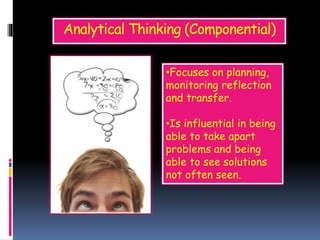
Analytical Thinking (Componential)
•Focuses on planning,
monitoring reflection
and transfer.
•Is influential in being
able to take apart
problems and being
able to see solutions
not often seen.
*Analytical Thinking
 METACOMPONENTS – Control, monitor
and evaluate cognitive processing.
 PERFORMANCE – Execute strategies
assembled by the metacomponents . They
are the basic operations involved in any
cognitive act.
 KNOWLEDGE ACQUISITION – Are the
process used in gaining and storing new
knowledge.
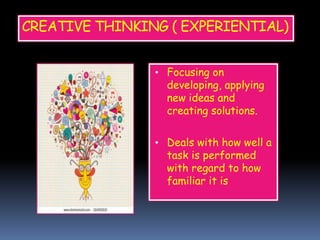
CREATIVE THINKING ( EXPERIENTIAL)
• Focusing on
developing, applying
new ideas and
creating solutions.
• Deals with how well a
task is performed
with regard to how
familiar it is
*Creative thinking
 NOVELTY - situation that you have
never experienced.
 AUTOMATION – has been performed
multiple times and can now be done with
little or more extra thoughts.
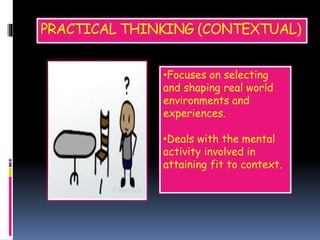
PRACTICAL THINKING (CONTEXTUAL)
•Focuses on selecting
and shaping real world
environments and
experiences.
•Deals with the mental
activity involved in
attaining fit to context.
*Practical Thinking
 ADAPTATION – Occurs when one makes
a change within oneself in order to better
adjust to one’s surroundings.
 SHAPING – Occurring when one’s changes
their environment to better suit one’s
needs.
 SELECTION – Replace the previous,
unsatisfying undertaken when a
completely new alternate environment is
found to meet individual’s goals.
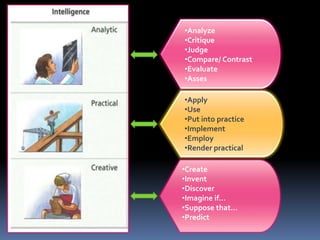
•Analyze
•Critique
•Judge
•Compare/ Contrast
•Evaluate
•Asses
•Create
•Invent
•Discover
•Imagine if…
•Suppose that…
•Predict
•Apply
•Use
•Put into practice
•Implement
•Employ
•Render practical
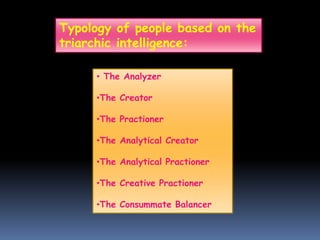
Typology of people based on the
triarchic intelligence:
• The Analyzer
•The Creator
•The Practioner
•The Analytical Creator
•The Analytical Practioner
•The Creative Practioner
•The Consummate Balancer
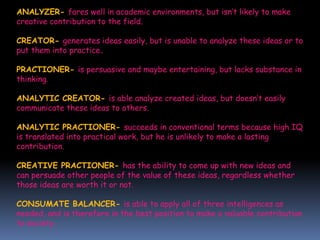
ANALYZER- fares well in academic environments, but isn’t likely to make
creative contribution to the field.
CREATOR- generates ideas easily, but is unable to analyze these ideas or to
put them into practice.
PRACTIONER- is persuasive and maybe entertaining, but lacks substance in
thinking.
ANALYTIC CREATOR- is able analyze created ideas, but doesn’t easily
communicate these ideas to others.
ANALYTIC PRACTIONER- succeeds in conventional terms because high IQ
is translated into practical work, but he is unlikely to make a lasting
contribution.
CREATIVE PRACTIONER- has the ability to come up with new ideas and
can persuade other people of the value of these ideas, regardless whether
those ideas are worth it or not.
CONSUMATE BALANCER- is able to apply all of three intelligences as
needed, and is therefore in the best position to make a valuable contribution
to society.

TRIARCHIC THEORY OF INTELLIGENCE

  • 1.
  • 2.
    ROBERT J. STERNBERG Aprominent figure in the research of human intelligence, developed an alternative intelligence model, comprising 3 elements of thinking process kept in balance by metacognition.
  • 3.
    STENBERG’S TRIARCHIC THEORYOF INTELLIGENCE TRIARCHIC THEORY COMPONENTIAL EXPERENTIAL CONTEXTUAL •Metacomponents •Performance •Knowledge acquisition •Novelty •Automation •Adaption •Selection •Shaping
  • 4.
    Sternberg describes threedifferent kinds of intelligence in his model:
  • 5.
    Analytical Thinking (Componential) •Focuseson planning, monitoring reflection and transfer. •Is influential in being able to take apart problems and being able to see solutions not often seen.
  • 6.
    *Analytical Thinking  METACOMPONENTS– Control, monitor and evaluate cognitive processing.  PERFORMANCE – Execute strategies assembled by the metacomponents . They are the basic operations involved in any cognitive act.  KNOWLEDGE ACQUISITION – Are the process used in gaining and storing new knowledge.
  • 7.
    CREATIVE THINKING (EXPERIENTIAL) • Focusing on developing, applying new ideas and creating solutions. • Deals with how well a task is performed with regard to how familiar it is
  • 8.
    *Creative thinking  NOVELTY- situation that you have never experienced.  AUTOMATION – has been performed multiple times and can now be done with little or more extra thoughts.
  • 9.
    PRACTICAL THINKING (CONTEXTUAL) •Focuseson selecting and shaping real world environments and experiences. •Deals with the mental activity involved in attaining fit to context.
  • 10.
    *Practical Thinking  ADAPTATION– Occurs when one makes a change within oneself in order to better adjust to one’s surroundings.  SHAPING – Occurring when one’s changes their environment to better suit one’s needs.  SELECTION – Replace the previous, unsatisfying undertaken when a completely new alternate environment is found to meet individual’s goals.
  • 11.
    •Analyze •Critique •Judge •Compare/ Contrast •Evaluate •Asses •Create •Invent •Discover •Imagine if… •Supposethat… •Predict •Apply •Use •Put into practice •Implement •Employ •Render practical
  • 13.
    Typology of peoplebased on the triarchic intelligence: • The Analyzer •The Creator •The Practioner •The Analytical Creator •The Analytical Practioner •The Creative Practioner •The Consummate Balancer
  • 14.
    ANALYZER- fares wellin academic environments, but isn’t likely to make creative contribution to the field. CREATOR- generates ideas easily, but is unable to analyze these ideas or to put them into practice. PRACTIONER- is persuasive and maybe entertaining, but lacks substance in thinking. ANALYTIC CREATOR- is able analyze created ideas, but doesn’t easily communicate these ideas to others. ANALYTIC PRACTIONER- succeeds in conventional terms because high IQ is translated into practical work, but he is unlikely to make a lasting contribution. CREATIVE PRACTIONER- has the ability to come up with new ideas and can persuade other people of the value of these ideas, regardless whether those ideas are worth it or not. CONSUMATE BALANCER- is able to apply all of three intelligences as needed, and is therefore in the best position to make a valuable contribution to society.