By: Asmaa El-sayed
Shaimaa Mohammed
Eman Mustafa Mustafa
The role of the teacher
Planning
At the planning stage, teachers play multiple roles.
1) They are learners, taking classes and attending professional
development sessions to learn the latest best strategies for effective
teaching.
2) Many teachers regularly collaborate with one another to gain new
ideas for teaching and combining subjects to enhance the learning
experience.
3) They analyze test results and other data to help determine the
course of their instruction and make changes in their classrooms.
4) Teachers also design lesson plans to teach the standards and
provide engaging activities, while taking into account each student's
interests and instructional needs.
Instruction
* Instead of just lecturing in the classroom, teachers are facilitators of
learning, providing students with the information and tools they need
to master a subject.
* At times, teachers act like tutors, working with small groups of students
or individual students within the classroom or after it.
Characteristics of Learner-centered Teaching
1. Learner-centered teaching engages students in the hard, messy work
of learning.
2. Learner-centered teaching includes explicit skill instruction.
3. Learner-centered teaching encourages students to reflect on what they
are learning and how they are learning it.
4. Learner-centered teaching motivates students by giving them some
control over learning processes.
5. Learner-centered teaching encourages collaboration
Defining the Role by Sampling a Collection
of Metaphors
◄ As a Gardener:
Teachers similarly plant seeds of truth and wisdom inside of their
students. We do everything we can to ensure that the seed we
plant today will blossom tomorrow.
◄ As a Tour Guide:
Teachers help students see what is mesmerizing in the world.
They expose them to new delights and adventures, and then let
them decide what they’d like to pursue further.
◄ As a Coach:
Coaches can scream at athletes and push them to exhaustion.
They can express disappointment when teams fail and joy when
they succeed. Doesn’t that sound like teaching, too? We thrive
when students collaborate and succeed, and push them when
they’re on the verge of failing.
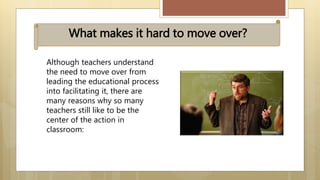
Although teachers understand
the need to move over from
leading the educational process
into facilitating it, there are
many reasons why so many
teachers still like to be the
center of the action in
classroom:
What makes it hard to move over?
1. Teachers like having the main role.
2. Teachers see the role of standing alongside learners as less important than
standing in front of them.
3. Students may resist teacher’s attempt to move into facilitative role
4. Many teachers think that their students cannot handle this responsibility.
5. Many teachers don’t know how to do the new role.
◄ The new role requires a complex interaction of skills and enormous
patience
◄ The new role is time-consuming. It requires patience, persistence and
quality of being determined to take something of marginal quality and
work with the students to make it better.
◄ A teacher must be able to tolerate messiness that may happen in
classroom.
◄ Its difficult for the teacher to predict if the students will perform poorly or
they will be able to do the task.
The role is difficult to do
Principle 1 :Teachers do learning tasks less
A teacher should gradually stop doing learning tasks. If a
teacher did, this will be the exception not the rule.
Learning tasks are like:
◄ Organizing the content
◄ Summarizing the discussion
◄ Solving problems
◄ Constructing diagrams
General principles that can
ground the action used to
perform the new role
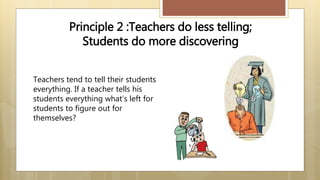
Teachers tend to tell their students
everything. If a teacher tells his
students everything what’s left for
students to figure out for
themselves?
Principle 2 :Teachers do less telling;
Students do more discovering
Principle 3 : Teachers do more design work
 Activities and assignments has become the vehicles through which
learning occurs
 These activities accomplish one or two of the following four goals:
1. The assignment and learning activity take students from their
current knowledge and skill level to a new one without being too
easy or too difficult.
2. They should motivate students involvement and participation
3. They need to get students doing the authentic and legitimate
work of the discipline.
4. They develop content knowledge, learning skills and awareness
Faculty assume the role of master learner and
demonstrate for students how skillful learners tasks
Principle 4:faculty do more modeling
There are two ways to do this:
◄ by doing some legitimate learning in the class ,
but with an entry-level course that you have
taught from the dawn of time .
◄ By making sure that we are learning new
things and not just more content in our fields.
You can model learning processes by
doing simple things like talking through
the problem-solving processes.
◄ Faculty underestimate the potential value of students working
together .
◄ Group work , most often under the collaborative learning rubric,
has gained popularity and much wider use .
◄ Good group learning experiences don’t happen automatically this
shouldn’t surprise us , given the experiences most of us have on
faculty committees.
Principle 5: faculty do more to get students learning
from and with each other
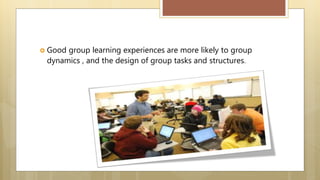
 Good group learning experiences are more likely to group
dynamics , and the design of group tasks and structures.
Principle 6: faculty work to create climates for
learning
 Learner centered teaching environments have climates known to
affect learning outcomes positively .
 Teachers are much more involved in designing and implementing
activities that first create and then maintain conditions conducive
to learning.
Principle 7:faculty do more with feedback
 This principle doesn’t say that faculty do less grading
.grading responsibilities remain intact in learner-centered
environments . More time ,energy ,and creativity are
devoted to finding and using mechanisms that allow the
constructive delivery of feedback to students.
 These principles will help teachers serve as facilitator ,
resource person ,mentor , instructional designer , and master
learner.
Questions that emerge when the teaching role
changes
The Questions associated with implementing more facilitative
approaches to teaching all became clear during one group
activity. Do you intervene , and if so , when? What do you do?
when you intervene?
25

The role of_the_teacher

  • 1.
    By: Asmaa El-sayed ShaimaaMohammed Eman Mustafa Mustafa The role of the teacher
  • 3.
    Planning At the planningstage, teachers play multiple roles. 1) They are learners, taking classes and attending professional development sessions to learn the latest best strategies for effective teaching. 2) Many teachers regularly collaborate with one another to gain new ideas for teaching and combining subjects to enhance the learning experience.
  • 4.
    3) They analyzetest results and other data to help determine the course of their instruction and make changes in their classrooms. 4) Teachers also design lesson plans to teach the standards and provide engaging activities, while taking into account each student's interests and instructional needs.
  • 5.
    Instruction * Instead ofjust lecturing in the classroom, teachers are facilitators of learning, providing students with the information and tools they need to master a subject. * At times, teachers act like tutors, working with small groups of students or individual students within the classroom or after it.
  • 6.
    Characteristics of Learner-centeredTeaching 1. Learner-centered teaching engages students in the hard, messy work of learning. 2. Learner-centered teaching includes explicit skill instruction. 3. Learner-centered teaching encourages students to reflect on what they are learning and how they are learning it.
  • 7.
    4. Learner-centered teachingmotivates students by giving them some control over learning processes. 5. Learner-centered teaching encourages collaboration
  • 8.
    Defining the Roleby Sampling a Collection of Metaphors ◄ As a Gardener: Teachers similarly plant seeds of truth and wisdom inside of their students. We do everything we can to ensure that the seed we plant today will blossom tomorrow. ◄ As a Tour Guide: Teachers help students see what is mesmerizing in the world. They expose them to new delights and adventures, and then let them decide what they’d like to pursue further.
  • 9.
    ◄ As aCoach: Coaches can scream at athletes and push them to exhaustion. They can express disappointment when teams fail and joy when they succeed. Doesn’t that sound like teaching, too? We thrive when students collaborate and succeed, and push them when they’re on the verge of failing.
  • 10.
    Although teachers understand theneed to move over from leading the educational process into facilitating it, there are many reasons why so many teachers still like to be the center of the action in classroom: What makes it hard to move over?
  • 11.
    1. Teachers likehaving the main role. 2. Teachers see the role of standing alongside learners as less important than standing in front of them. 3. Students may resist teacher’s attempt to move into facilitative role 4. Many teachers think that their students cannot handle this responsibility. 5. Many teachers don’t know how to do the new role.
  • 12.
    ◄ The newrole requires a complex interaction of skills and enormous patience ◄ The new role is time-consuming. It requires patience, persistence and quality of being determined to take something of marginal quality and work with the students to make it better. ◄ A teacher must be able to tolerate messiness that may happen in classroom. ◄ Its difficult for the teacher to predict if the students will perform poorly or they will be able to do the task. The role is difficult to do
  • 13.
    Principle 1 :Teachersdo learning tasks less A teacher should gradually stop doing learning tasks. If a teacher did, this will be the exception not the rule. Learning tasks are like: ◄ Organizing the content ◄ Summarizing the discussion ◄ Solving problems ◄ Constructing diagrams General principles that can ground the action used to perform the new role
  • 14.
    Teachers tend totell their students everything. If a teacher tells his students everything what’s left for students to figure out for themselves? Principle 2 :Teachers do less telling; Students do more discovering
  • 15.
    Principle 3 :Teachers do more design work  Activities and assignments has become the vehicles through which learning occurs  These activities accomplish one or two of the following four goals: 1. The assignment and learning activity take students from their current knowledge and skill level to a new one without being too easy or too difficult.
  • 16.
    2. They shouldmotivate students involvement and participation 3. They need to get students doing the authentic and legitimate work of the discipline. 4. They develop content knowledge, learning skills and awareness
  • 17.
    Faculty assume therole of master learner and demonstrate for students how skillful learners tasks Principle 4:faculty do more modeling
  • 18.
    There are twoways to do this: ◄ by doing some legitimate learning in the class , but with an entry-level course that you have taught from the dawn of time . ◄ By making sure that we are learning new things and not just more content in our fields.
  • 19.
    You can modellearning processes by doing simple things like talking through the problem-solving processes.
  • 20.
    ◄ Faculty underestimatethe potential value of students working together . ◄ Group work , most often under the collaborative learning rubric, has gained popularity and much wider use . ◄ Good group learning experiences don’t happen automatically this shouldn’t surprise us , given the experiences most of us have on faculty committees. Principle 5: faculty do more to get students learning from and with each other
  • 21.
     Good grouplearning experiences are more likely to group dynamics , and the design of group tasks and structures.
  • 22.
    Principle 6: facultywork to create climates for learning  Learner centered teaching environments have climates known to affect learning outcomes positively .  Teachers are much more involved in designing and implementing activities that first create and then maintain conditions conducive to learning.
  • 23.
    Principle 7:faculty domore with feedback  This principle doesn’t say that faculty do less grading .grading responsibilities remain intact in learner-centered environments . More time ,energy ,and creativity are devoted to finding and using mechanisms that allow the constructive delivery of feedback to students.  These principles will help teachers serve as facilitator , resource person ,mentor , instructional designer , and master learner.
  • 24.
    Questions that emergewhen the teaching role changes The Questions associated with implementing more facilitative approaches to teaching all became clear during one group activity. Do you intervene , and if so , when? What do you do? when you intervene?
  • 25.