2
Welcome to
The Education Foundation
Two Days Workshop
on
Student–centered Teaching Strategies
Organized by
The Education Foundation Karachi3
Two Days Workshop on
Student –centered Teaching
Strategies
Conducted by
Syed Saghir Hussain
B.Sc.(H), M.Sc.(Math), M.Ed.(KU), M.Phil.(Hamdard),
M.Ed. Leadership(ACU, Australia) & Ph. D Scholar (KU)
Program Coordinator
R&D and Universal Education Department
The Education Foundation
Thursday , May 07, 2020 at 12:00pm 4
5
In 1999, The Education Foundation (TEF) surveyed
400 schools in Jamshed Town and found that :
1. 70% teachers from 400 schools were Matric,
Intermediate or Graduates
2. Over 70% are untrained
3. Teaching without professional education
4. No culture of pre-service teacher education
Establishment of TEF
The Education Foundation
6
The Education
Foundation
Vision
An enlightened, healthy and
prosperous Pakistani nation
Departments
a. R&D and Universal Education Department
b. Special Education Department
Objective of the
Workshop
To enable teachers about student-centered
teaching strategies by:
a. explaining student-centered setting in a class
b. highlighting student-centered-teaching-
learning environment
c. comparing student –centered and teacher –
centered teaching strategies
d. discussing various types of strategies 7
Importance of Teaching
Strategies
When teachers think about:
only,
best,
most important,
appropriate,
effective,
interactive and
participatory way;
to teach knowledge of sophisticated topic only in
simplest way to achieve learning outcomes as given in
the national curriculum.
8
The Constructivism in
Education
Constructivism founded by Jean Piaget, which
emphasizes the importance of the active role of
learners in constructing knowledge for themselves.
Students are thought to use background knowledge
and concepts to assist them in their acquisition of
new information.
•
9
The Constructivism:
foundation of constructivist
theory of learning
The learning theories of John Dewey, Maria Montessori and
David A. Kolb also served as the foundation of
constructivist learning theory in the classroom.
Constructivism has many varieties such as:
 active learning,
discovery learning,
experiential learning,
authentic learning and knowledge building, but all
versions promote a student's free exploration within a
given framework or structure.
10
The teacher acts as a facilitator who
encourages students to discover principles for
themselves and to construct knowledge by
working answering open-ended questions and
solving real-world problems.
As a facilitator, a teacher should encourage
curiosity and discussion among his/her
students as well as promoting their
autonomy.
The Constructivism:
Role of Teacher as a
facilitator
11
Constructivist Learning
environment
12
Criteria of Student–
centered Teaching
1) High degree of student engagement; challenge,
enthusiasm, joy.
2) Students know what they are learning and why.
3) Blend of individual, collaborative team and group
work.
4) Students use personalized technology to produce
as well as consume.
5) Students have opportunity to work at their own
pace and explore their own interests.
13
Criteria of Student–
centered Teaching
6) Students are doing the bulk of the work and the
talking.
7) There are multiple forms of assessment, feedback
and demonstrations of learning.
8) Instruction, culture and environment reflect and
include student and staff diversity.
By Emily Liebtag, 2017
14
Student–centered
Environment
15
Student–
centered
Teaching
16
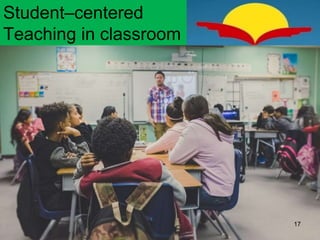
Student–centered
Teaching in classroom
17
Student–centered
Teaching
Teacher–centered
Teaching
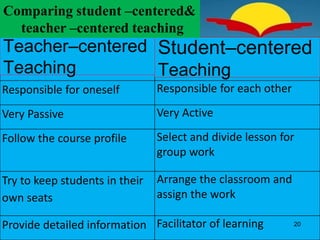
Comparing student –centered&
teacher –centered teaching
18
Comparison of student –centered
& teacher –centered teaching
Student-centered
Teaching
Teacher-centered
Teaching
19
Teacher –centered Teaching Student –centered Teaching
No individual accountability individual accountability
Responsible for oneself Responsible for each other
Very Passive Very Active
Follow the course profile Select and divide lesson for
group work
Try to keep students in their
own seats
Arrange the classroom and
assign the work
Provide detailed information Facilitator of learning
Student–centered
Teaching
Teacher–centered
Teaching
Comparing student –centered&
teacher –centered teaching
20
Teachers are the main
authority figure
Teachers and students are
playing equally active role in
learning process.
Primary role of a teacher is to
pass knowledge to students
Teachers are coaches and
facilitator of learning
Student learning is measured
through objectively scored
tests
Student learning is authentic
assessment using formative
and summative tools
Students are viewed as
“empty vessels”
End goal is testing/assessment
Student–centered TeachingTeacher–centered Teaching
Comparison of student –centered
& teacher –centered teaching
21
Classroom setting for Students
–centered Teaching
22
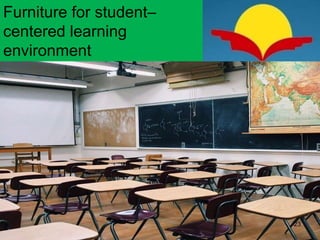
Furniture for student–
centered learning
environment
23
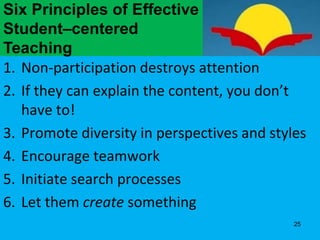
Six Principles
for
Effective
Student –centered Teaching
Six Principles of Effective
Student–centered Teaching
24
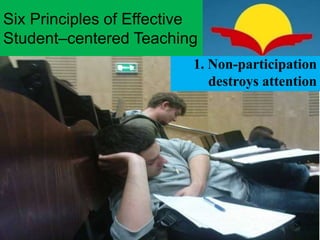
1. Non-participation destroys attention
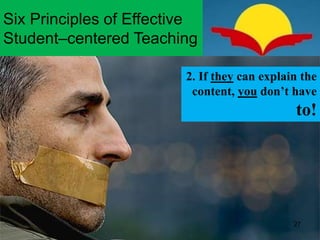
2. If they can explain the content, you don’t
have to!
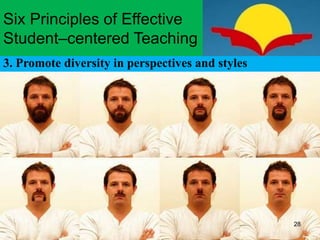
3. Promote diversity in perspectives and styles
4. Encourage teamwork
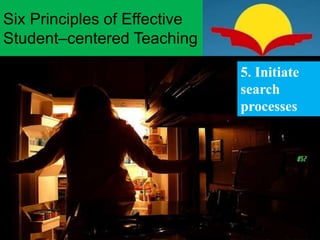
5. Initiate search processes
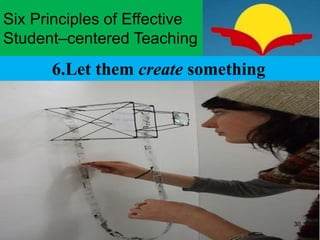
6. Let them create something
Six Principles of Effective
Student–centered
Teaching
25
1. Non-participation
destroys attention
Six Principles of Effective
Student–centered Teaching
26
2. If they can explain the
content, you don’t have
to!
Six Principles of Effective
Student–centered Teaching
27
3. Promote diversity in perspectives and styles
Six Principles of Effective
Student–centered Teaching
28
4.Encourage teamwork
Six Principles of Effective
Student–centered Teaching
29
6.Let them create something
Six Principles of Effective
Student–centered Teaching
30
5. Initiate
search
processes
Six Principles of Effective
Student–centered Teaching
31
1. Picture sort,
2. Think-Pair Shair,
3. Connect Two,
4. Go-Mo-Go,
5. Inside-outside Circle,
6. Reciprocal Teaching/ Say Something (reading strategy),
7. Round Robin,
8. Round Table and
9. Stand & Share,
10. Cooperative learning,
11. Inductive teaching,
12. Role Play,
13. Brain Storming,
14. Open Learning,
15. Projects,
16. Case Study and others.
Application of Student-
centered Teaching Strategies:
32
Q & A
33
Thank you!
34