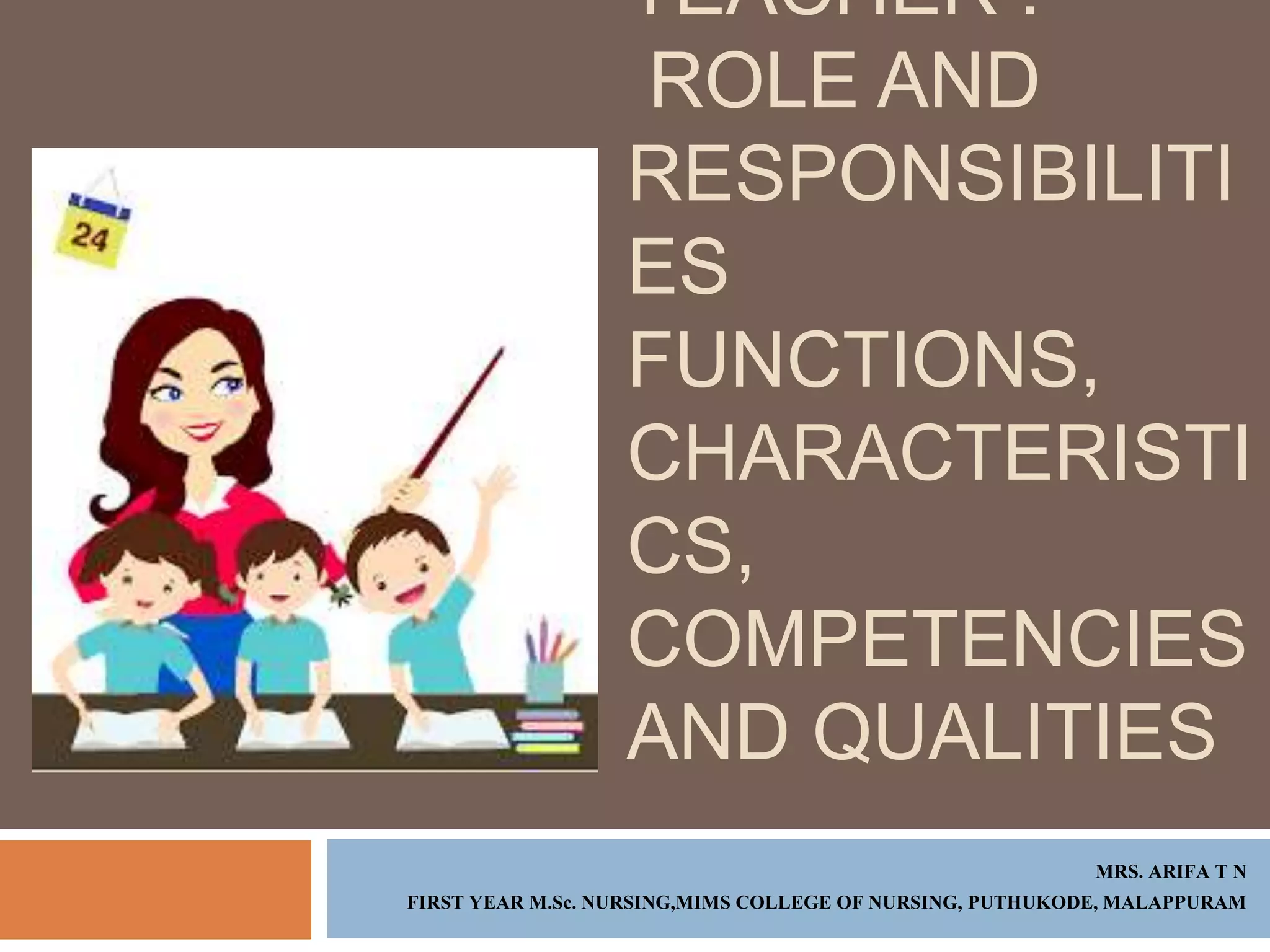
TEACHER :
ROLE AND
RESPONSIBILITI
ES
FUNCTIONS,
CHARACTERISTI
CS,
COMPETENCIES
AND QUALITIES
MRS. ARIFA T N
FIRST YEAR M.Sc. NURSING,MIMS COLLEGE OF NURSING, PUTHUKODE, MALAPPURAM
INTRODUCTION
Teacher
 A teacher is a person who provides education to
pupils (children) and students (adults).
 The role of a teacher is formal and ongoing, carried
out at school or other place of formal education.
 The role of teacher in society is both significant and
valuable
 Students are deeply affected by the teachers , they
will try to follow their teacher.
 An effective teacher understands that teaching
involves performing multiple tasks to ensure that the
school runs smoothly and all students receives quality
education
Definitions of teacher
According to Dr. S. Radhakrishnan ‘the
teacher’s place in society is of vital
importance. He acts as the pivot for the
transmission of intellectual traditions and
technical skills from generation to generation
and helps to keep the lamp of civilization
burning’
Definitions of teacher
According to secondary education
commission, “ every teacher and
educationalist of experience knows that even
the best curriculum and the most perfect
syllabus remains dead unless quickened into
life by the right method of teaching and the
right kind of teacher
According to Manu, “ A teacher is the image of
Brahma”
According to Sir John Adams, “ The teacher is
the maker of man”
Role and responsibilities of a
teacher
Role and responsibilities
 Role is the part played by somebody in a given
social context, with any characteristics
expected patterns of behaviour that it entails.
 The variety of roles can ensure that teachers
can find ways to lead that fit their talents and
interests
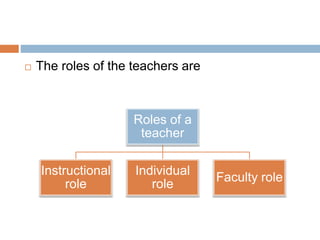
 The roles of the teachers are
Roles of a
teacher
Instructional
role
Individual
role
Faculty role
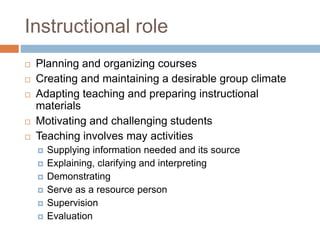
Instructional role
 Planning and organizing courses
 Creating and maintaining a desirable group climate
 Adapting teaching and preparing instructional
materials
 Motivating and challenging students
 Teaching involves may activities
 Supplying information needed and its source
 Explaining, clarifying and interpreting
 Demonstrating
 Serve as a resource person
 Supervision
 Evaluation
Faculty role
 Vary according to the philosophy, objectives and
setting of teaching institution,
 Chairperson/chair women, secretary or member of
one or more committees
 Counselor of students
 Researchers
 Resource person to groups outside the institution,
other schools and health agencies
 Representative to professional nursing
organizations
 Public relation agent
Individual role
 As an individual teacher plays persona role
 As a member of family, religious group, a
community and a citizen.
 Dignified, distinct personality
 At the individual level, teacher plays various
roles…..
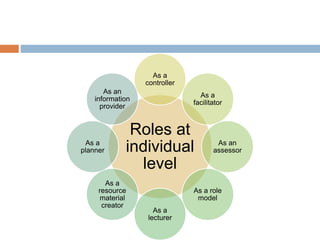
Roles at
individual
level
As a
controller
As a
facilitator
As an
assessor
As a role
model
As a
lecturer
As a
resource
material
creator
As a
planner
As an
information
provider
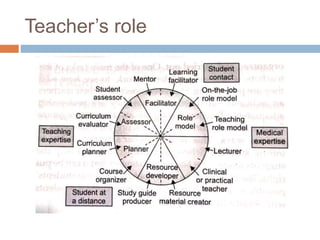
Teacher’s role
Teacher as a controller
 Most common role
 Complete charge of class and activity
 Control not only what the students do, but also
what they speak and what language they use
 Maintain class discipline
Teacher as facilitator
 Focus is on the students learning
 Adopt student-centered approach
 Facilitate professional learning opportunities
among staff members is very important role of
teacher leaders
 When teachers learn with and from one
another , they can focus on what most directly
improves students learning
Teacher as learner and planner
 Constantly taking classes and attending
professional development sessions
 Regularly collaborate with one another
 Analyze test results
 Design lesson plans
Teacher as an assessor
 Most important tasks of the teacher
 Organize feedback
 Offer correction and scoring
 Communicated to students
As role model
 Role models are people who set good
examples by words they speak and by the
actions they take
 Students tend to copy the behaviour and
mannerism of teachers
 The ideal teacher is one who through his
thoughts, words, deeds, gives and an
impression of an honest, upright life which can
serve as a model for the students
Teacher as lecturer
 Act as coach when students are involved in
project work or self study
 Provides advise and guidance and helps
students clarify ideas and limit tasks
 Provider of information in the lecture context
 The teacher is seen as an expert who is
knowledgeable in his or her field, and who
conveys that knowledge to students usually by
word of mouth.
Teacher as a tutor
 This is the role that teacher plays when
students are doing projects on their own or are
involved in self study
 The teacher will help them limit the task by
showing the errors in the first versions of their
work
 The individual and personal contact gives
students a real chance to feel supported and
helped and this improves the atmosphere in
the class
Teacher as an observer
 Monitor students during activities to give them
useful and individual or group feedback
 During observation avoid drawing attention to
them
Teachers as an information
provider and evaluator
 It is the responsibility of the teacher to facilitate
the student use of the resources by overcoming
any deficiencies in the materials and by
integrating them with the curriculum
 Teachers are facilitators of learning, providing
students with the information and tools they need
to master a subject
 Teachers also play a major role of evaluators,
constantly assessing students abilities through
formal and inform assessments, providing
suggestions for improvement and assigning
grades
Teacher as a resource material
creator
 Offer help to students when ever need
 Make himself available so that the students
can consult when they wish
 Should not make students over- reliant on
teacher
Teacher as a prompter
 Encourage students to participate and
provides suggestions on activities
 Should not make students dependent
 Encourage students to think creatively
Teacher as curriculum planner
 Plan and implement educational programmes
 Assess course and curriculum delivered
 Assessed through
 Students feedback
 Peer evaluation
 Assessment of the product of the educational
programme
Teachers role in the society
 A teacher is a member of society. He/she lives
and works in the society. A teacher plays his
role towards society in two ways :
 Inside the school by preparing students for
effective citizens
 Outside the school by assuming the role of a
social worker and an agent of social change
Broad classification of a teachers
role
 Teacher as an agent of social change
 Teachers role in community welfare
 Teachers role in elimination of social tensions
and conflict
 Teachers role in international understanding
 Teachers role in pupil development
Teachers multifactorious role in
pupil development
 Confident
 Democrat
 Detective
 Ego supporter
 Equalizer
 Facilitator of learning
 Friend and
philosopher
 Group leader
 Guidance counselor
and helper
 Initiator
 Role model
 Evaluator
 Moral educator
 Parent surrogate
 Rationalist
 Problem solver
 Reformer
 Resource person
 Secularist
 Upholder of the
norms and values
The class room teacher : roles and
responsibilities
 Class room teacher as manager
 Class room teacher as social skills/
behavioural counselor
 Class room teacher as academic coach,
mentor. Guide and instructor
 Teacher as collaborator
Teacher as manager
 Taking attendance
 Respond to illness
 Collect numerous forms
 Orders materials
 Create an atmosphere for learning
 Responds to parents mails
As social skill behavioral
counselor
 Coaching and mentoring related to social skills
and behaviour
 Teachers works day in and day out with
students to develop their abilities
As academic coach, mentor, guide
and teacher as instructor
 Need to relook at professional responsibility in
academic relation
 Restructure the roles, schedules and
responsibility related to academic instruction
 Respond to students and families
As collaborator
the teacher must,
 Attend the morning assembly
 Address the students on moral principles, social and
environmental issues
 Follow the conduct rules notified
 Maintain the teachers diary with lesson pan
 Punctuality
 Evaluate the students
 Conduct regular meetings
 Prepare well in and each aspects of lesson
 Link the topic with previous knowledge
As collaborator
the teacher must,
 Develop and use relevant teaching aids
 Use different methods and techniques of teaching
 Interact with students
 Give activity and application
 Maintain cleanliness and discipline
 Appoint monitors for different duties
 Make attendance of students in the class register
 Durating of board with noble work of great
personalities
 Display clearly the time table of the class
The teacher should not
 Leave the assembly or the class unattended at
any cost
 Stand in groups and gossip during the
assembly
 Use only ‘telling method’
 Use guides , help books, as they hamper the
thinking process
 Humiliate a child or resort to corporate
punishment
Functions of a teacher
 The main functions are
 Character development
 Effective teaching and learning
 Curriculum development and implementation
 Adjusting individual differences
 Class room management
 Evaluation of pupil performance
 Developing good family and community
relationship
 Total school effectiveness
 Professional growth and ethics
Character development
 Teacher creates an atmosphere which helps
the student to build his character and develops
a respects for the rights, privileges and
opinions of others
 Teacher set a standard
 Help to develop socially appropriate behaviour
 Encourages each pupils thinking and action
Effective teaching and learning
 Formulate the objectives of teaching and plans
well ahead for teaching
 Prepare adequately before the class
 Select suitable learning material and AV aids
 Constantly evaluate the activities
 Develop desirable work and study skills and
habits
 Report pupils achievement to parents
 Help poor students to facilitate learning
Curriculum development and
implementation
 Helps in the developments, implementation
and evaluation of curricula
 Participate in curriculum revision and
innovation
 Serve as a member of curriculum committee
and brings the problems related to curriculum
implementation
Adjusting individual differences
 Understand the importance of individual
difference and follow various techniques
 Apply the basic knowledge of educational
psychology
 Develop a sense of personal growth and value
among pupils
 Maintain discipline
Classroom management
 Assign responsibilities to pupils
 Maintain discipline
 Takes care of all records and registers
Evaluating and reporting pupils
performance
 Conduct periodic tests
 Periodically evaluate the assignments
 Inform parents about the progress by PTA
meeting and by progress records
Developing good family and
community relationship
 Participating in parent-teacher and similar
activities
 Participate in community affaires
 Making himself available to parents at
scheduled time
 Shows a helpful, sympathetic and
understanding attitudes towards parents and
their children's schooling problems
Total school effectiveness
 Accepting responsibility
 Cooperating with all coworkers and exchange
ideas
 Executing all required school regulations and
assignments on time
 Taking positive steps for developing and
maintaining faculty and students morale
 Contributing constructively to committees,
faculty meetings, and other school system
groups
Organize
 Primary function is to organize education
 Set routines and create order
 Delegate responsibilities
 Determine goals and activities for the class
Build relationships
 Spend time for talking to students
 Understand students
 Sharing of information
Teach discernment
 Simply disseminate information from a single
source and equip students with ability to
assess and sort through information
themselves
Make learning fun
 One of the fundamental rule of teaching
 Inspire students to go out and learn on their
own
 Involving them in the choice of subject matter
and activities
 Emphasize on projects
Functions of teacher
 Teachers are required to understand the need of
every child for,
 Material education
 Education for becoming good human being
 For divine education
So that they can face the realities of life in the new
millennium
 Teacher act as a medium to achieve the objectives of
excellence coupled with equity and social justice by
way of imparting quality of education without
discrimination so that they become physically fit,
mentally alert, emotionally balanced and spiritually
sound
Characteristics of a teacher
 Good communicator
 Act calmly
 Good sense of humor
 Good time management
 Fair attitude
 Dedication
 Command over the subject matter
 Meticulous and have an eye for detail
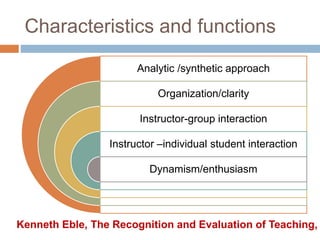
Characteristics and functions
Analytic /synthetic approach
Organization/clarity
Instructor-group interaction
Instructor –individual student interaction
Dynamism/enthusiasm
Kenneth Eble, The Recognition and Evaluation of Teaching,
Analytic and synthetic approach
 Discuss points of view other than his/her own
 Contrasts implications of various theories
 Discuss recent developments in the field
 Present origins of ideas and concepts
 Give references for more interesting and
involved points
 Presents facts and concepts from a related
field
 Emphasizes conceptual understandings
Organization/clarity
 Explains clarity
 Is well prepared
 Gives lectures that are easy to outline
 Is careful and precise in answering questions
 Summarizes major points
 States objectives for each class session
 Identifies what he/she considers important
Instructor-group interaction
 Encourage class discussion
 Invites students to share their knowledge and
experiences
 Clarifies thinking by identifying reasons for
questions
 Invites criticism of his /her own ideas
 Knows if the class is understanding him/her or not
 Has interest and concern in the quality of his/her
teaching
 Has students apply concepts to demonstrate
understanding
Instructor –individual student
interaction
 She has genuine interest in students
 Is friendly toward students
 Relates to student as individuals
 Recognizes and greets student out of class
 Is valued for advise not directly related to the
course
 Is accessible to students out of class
 Respects students as persons
Dynamism/enthusiasm
 Is a dynamic and energetic person
 Has an interesting style of presentation
 Seems to enjoy teaching
 Is enthusiastic about the subject
 Seems to have self confidence
 Varies the speed and tone of his /her voice
 Has sense of humor
Characteristics of effective
teachers
 Master of his/her subject, competent
 Lectures well prepared, orderly
 Subject related to life, practical
 Students, questions and opinions encouraged
 Enthusiastic about his/her subject
 Approachable, friendly, available
 Concerned for students progress
 Has sense of humor, amusing
 Warm, kind, sympathetic
 Teaching aids used effectively
Edward Sheffield, Teaching in Universities-No One Way,197
Characteristics of great
teachers
 They get right down to business
 They teach at a fast pace
 They use variety of instructional strategies
 They stay with their subjects
 They use humor
 They have command of their classes
 They interact with the students
 Give immediate responds to student questions or
answer
Lea Ebro, Instructional Behaviour Patterns of
Distinguished University Teachers,1977
Characteristics of great
teachers
 Provides corrective feedback
 Use probing questions
 Praise correct answers with an observation based on
answer
 Provide a warm “classroom climate”
 students are free to interrupt at anytime
 Spontaneous introduction of humor
 Nonverbal behaviour
 Use gestures frequently
 Walk around as they talk
 Extensive use of eye contact
Lea Ebro, Instructional Behaviour Patterns of Distinguished University Teachers,1977
Teaching skills and teacher
competency
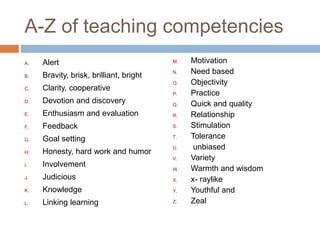
A-Z of teaching competencies
A. Alert
B. Bravity, brisk, brilliant, bright
C. Clarity, cooperative
D. Devotion and discovery
E. Enthusiasm and evaluation
F. Feedback
G. Goal setting
H. Honesty, hard work and humor
I. Involvement
J. Judicious
K. Knowledge
L. Linking learning
M. Motivation
N. Need based
O. Objectivity
P. Practice
Q. Quick and quality
R. Relationship
S. Stimulation
T. Tolerance
U. unbiased
V. Variety
W. Warmth and wisdom
X. x- raylike
Y. Youthful and
Z. Zeal
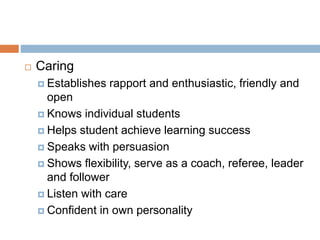
 Caring
 Establishes rapport and enthusiastic, friendly and
open
 Knows individual students
 Helps student achieve learning success
 Speaks with persuasion
 Shows flexibility, serve as a coach, referee, leader
and follower
 Listen with care
 Confident in own personality
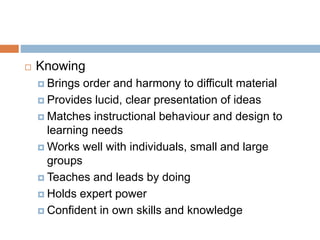
 Knowing
 Brings order and harmony to difficult material
 Provides lucid, clear presentation of ideas
 Matches instructional behaviour and design to
learning needs
 Works well with individuals, small and large
groups
 Teaches and leads by doing
 Holds expert power
 Confident in own skills and knowledge
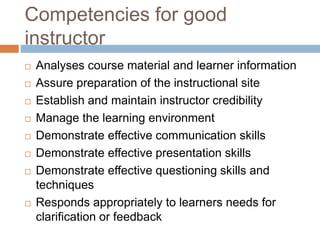
Competencies for good
instructor
 Analyses course material and learner information
 Assure preparation of the instructional site
 Establish and maintain instructor credibility
 Manage the learning environment
 Demonstrate effective communication skills
 Demonstrate effective presentation skills
 Demonstrate effective questioning skills and
techniques
 Responds appropriately to learners needs for
clarification or feedback
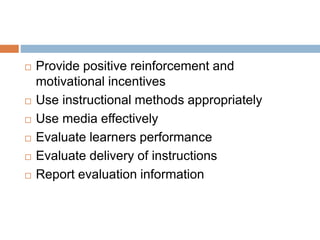
 Provide positive reinforcement and
motivational incentives
 Use instructional methods appropriately
 Use media effectively
 Evaluate learners performance
 Evaluate delivery of instructions
 Report evaluation information
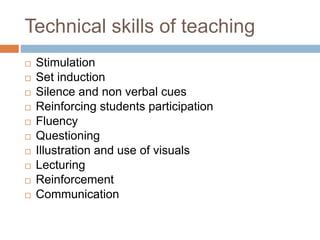
Technical skills of teaching
 Stimulation
 Set induction
 Silence and non verbal cues
 Reinforcing students participation
 Fluency
 Questioning
 Illustration and use of visuals
 Lecturing
 Reinforcement
 Communication
Qualities of a teacher
“A great teacher is one a student remember
and cherishes for ever”
 Teachers have long lasting impacts on the
lives of their students and the greatest teacher
inspires students toward greatness
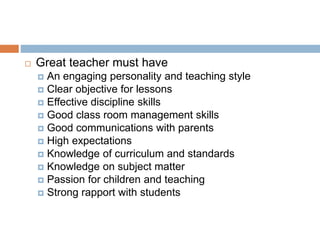
 Great teacher must have
 An engaging personality and teaching style
 Clear objective for lessons
 Effective discipline skills
 Good class room management skills
 Good communications with parents
 High expectations
 Knowledge of curriculum and standards
 Knowledge on subject matter
 Passion for children and teaching
 Strong rapport with students
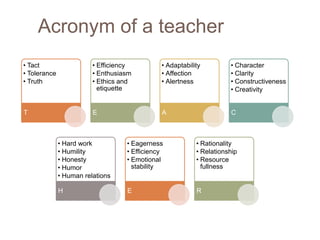
Acronym of a teacher
• Tact
• Tolerance
• Truth
T
• Efficiency
• Enthusiasm
• Ethics and
etiquette
E
• Adaptability
• Affection
• Alertness
A
• Character
• Clarity
• Constructiveness
• Creativity
C
• Hard work
• Humility
• Honesty
• Humor
• Human relations
H
• Eagerness
• Efficiency
• Emotional
stability
E
• Rationality
• Relationship
• Resource
fullness
R
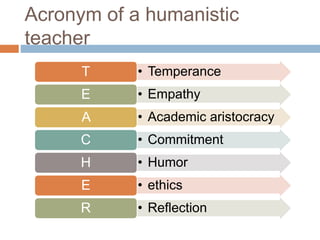
Acronym of a humanistic
teacher
• TemperanceT
• EmpathyE
• Academic aristocracyA
• CommitmentC
• HumorH
• ethicsE
• ReflectionR
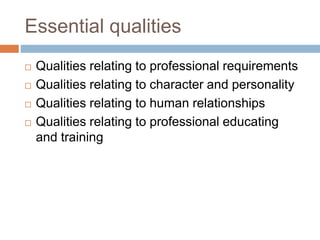
Essential qualities
 Qualities relating to professional requirements
 Qualities relating to character and personality
 Qualities relating to human relationships
 Qualities relating to professional educating
and training
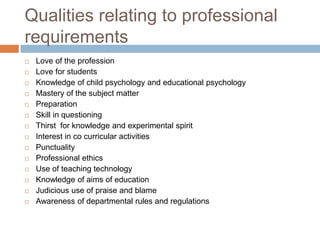
Qualities relating to professional
requirements
 Love of the profession
 Love for students
 Knowledge of child psychology and educational psychology
 Mastery of the subject matter
 Preparation
 Skill in questioning
 Thirst for knowledge and experimental spirit
 Interest in co curricular activities
 Punctuality
 Professional ethics
 Use of teaching technology
 Knowledge of aims of education
 Judicious use of praise and blame
 Awareness of departmental rules and regulations
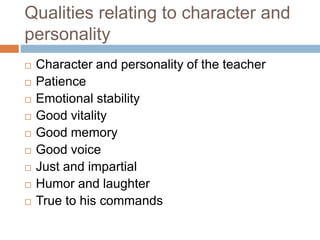
Qualities relating to character and
personality
 Character and personality of the teacher
 Patience
 Emotional stability
 Good vitality
 Good memory
 Good voice
 Just and impartial
 Humor and laughter
 True to his commands
Qualities relating to human
relationships
 Cooperative attitude
 Democratic attitude
 Political neutrality
 Religious tolerance
 Self analysis on the part of teacher
Qualities relating to professional
education and training
INC and university have prescribed the
syllabus and qualifications required to be a
teacher in nursing. The government and
departments of the states have prescribed
minimum academic and training qualifications
for different categories of teachers.
Qualities of a professional
teacher
 Good motivator
 Role model
 Good guide and counselor
 Effective organizer
 Good administrator
 Keen observer, supporter
and listener
 Maintain good human
relation
 Good communicator
 Researcher
 Good evaluator
 Good leader
 Mastery over the subject
 Professionally well groomed
 Responsible and creative
teacher
 Kind and patient
 Well balanced personality
 Friendly in nature
 Effective utilization of
resources
 Employs varied teaching
approaches
Summary
“The influence of a good teacher can never be erased”

Teacher roles and responsibilities, functions, competencies, qualities

  • 1.
    TEACHER : ROLE AND RESPONSIBILITI ES FUNCTIONS, CHARACTERISTI CS, COMPETENCIES ANDQUALITIES MRS. ARIFA T N FIRST YEAR M.Sc. NURSING,MIMS COLLEGE OF NURSING, PUTHUKODE, MALAPPURAM
  • 2.
    INTRODUCTION Teacher  A teacheris a person who provides education to pupils (children) and students (adults).  The role of a teacher is formal and ongoing, carried out at school or other place of formal education.  The role of teacher in society is both significant and valuable  Students are deeply affected by the teachers , they will try to follow their teacher.  An effective teacher understands that teaching involves performing multiple tasks to ensure that the school runs smoothly and all students receives quality education
  • 3.
    Definitions of teacher Accordingto Dr. S. Radhakrishnan ‘the teacher’s place in society is of vital importance. He acts as the pivot for the transmission of intellectual traditions and technical skills from generation to generation and helps to keep the lamp of civilization burning’
  • 4.
    Definitions of teacher Accordingto secondary education commission, “ every teacher and educationalist of experience knows that even the best curriculum and the most perfect syllabus remains dead unless quickened into life by the right method of teaching and the right kind of teacher According to Manu, “ A teacher is the image of Brahma” According to Sir John Adams, “ The teacher is the maker of man”
  • 5.
  • 6.
    Role and responsibilities Role is the part played by somebody in a given social context, with any characteristics expected patterns of behaviour that it entails.  The variety of roles can ensure that teachers can find ways to lead that fit their talents and interests
  • 7.
     The rolesof the teachers are Roles of a teacher Instructional role Individual role Faculty role
  • 8.
    Instructional role  Planningand organizing courses  Creating and maintaining a desirable group climate  Adapting teaching and preparing instructional materials  Motivating and challenging students  Teaching involves may activities  Supplying information needed and its source  Explaining, clarifying and interpreting  Demonstrating  Serve as a resource person  Supervision  Evaluation
  • 9.
    Faculty role  Varyaccording to the philosophy, objectives and setting of teaching institution,  Chairperson/chair women, secretary or member of one or more committees  Counselor of students  Researchers  Resource person to groups outside the institution, other schools and health agencies  Representative to professional nursing organizations  Public relation agent
  • 10.
    Individual role  Asan individual teacher plays persona role  As a member of family, religious group, a community and a citizen.  Dignified, distinct personality  At the individual level, teacher plays various roles…..
  • 11.
    Roles at individual level As a controller Asa facilitator As an assessor As a role model As a lecturer As a resource material creator As a planner As an information provider
  • 12.
  • 13.
    Teacher as acontroller  Most common role  Complete charge of class and activity  Control not only what the students do, but also what they speak and what language they use  Maintain class discipline
  • 14.
    Teacher as facilitator Focus is on the students learning  Adopt student-centered approach  Facilitate professional learning opportunities among staff members is very important role of teacher leaders  When teachers learn with and from one another , they can focus on what most directly improves students learning
  • 15.
    Teacher as learnerand planner  Constantly taking classes and attending professional development sessions  Regularly collaborate with one another  Analyze test results  Design lesson plans
  • 16.
    Teacher as anassessor  Most important tasks of the teacher  Organize feedback  Offer correction and scoring  Communicated to students
  • 17.
    As role model Role models are people who set good examples by words they speak and by the actions they take  Students tend to copy the behaviour and mannerism of teachers  The ideal teacher is one who through his thoughts, words, deeds, gives and an impression of an honest, upright life which can serve as a model for the students
  • 18.
    Teacher as lecturer Act as coach when students are involved in project work or self study  Provides advise and guidance and helps students clarify ideas and limit tasks  Provider of information in the lecture context  The teacher is seen as an expert who is knowledgeable in his or her field, and who conveys that knowledge to students usually by word of mouth.
  • 19.
    Teacher as atutor  This is the role that teacher plays when students are doing projects on their own or are involved in self study  The teacher will help them limit the task by showing the errors in the first versions of their work  The individual and personal contact gives students a real chance to feel supported and helped and this improves the atmosphere in the class
  • 20.
    Teacher as anobserver  Monitor students during activities to give them useful and individual or group feedback  During observation avoid drawing attention to them
  • 21.
    Teachers as aninformation provider and evaluator  It is the responsibility of the teacher to facilitate the student use of the resources by overcoming any deficiencies in the materials and by integrating them with the curriculum  Teachers are facilitators of learning, providing students with the information and tools they need to master a subject  Teachers also play a major role of evaluators, constantly assessing students abilities through formal and inform assessments, providing suggestions for improvement and assigning grades
  • 22.
    Teacher as aresource material creator  Offer help to students when ever need  Make himself available so that the students can consult when they wish  Should not make students over- reliant on teacher
  • 23.
    Teacher as aprompter  Encourage students to participate and provides suggestions on activities  Should not make students dependent  Encourage students to think creatively
  • 24.
    Teacher as curriculumplanner  Plan and implement educational programmes  Assess course and curriculum delivered  Assessed through  Students feedback  Peer evaluation  Assessment of the product of the educational programme
  • 25.
    Teachers role inthe society  A teacher is a member of society. He/she lives and works in the society. A teacher plays his role towards society in two ways :  Inside the school by preparing students for effective citizens  Outside the school by assuming the role of a social worker and an agent of social change
  • 26.
    Broad classification ofa teachers role  Teacher as an agent of social change  Teachers role in community welfare  Teachers role in elimination of social tensions and conflict  Teachers role in international understanding  Teachers role in pupil development
  • 27.
    Teachers multifactorious rolein pupil development  Confident  Democrat  Detective  Ego supporter  Equalizer  Facilitator of learning  Friend and philosopher  Group leader  Guidance counselor and helper  Initiator  Role model  Evaluator  Moral educator  Parent surrogate  Rationalist  Problem solver  Reformer  Resource person  Secularist  Upholder of the norms and values
  • 28.
    The class roomteacher : roles and responsibilities  Class room teacher as manager  Class room teacher as social skills/ behavioural counselor  Class room teacher as academic coach, mentor. Guide and instructor  Teacher as collaborator
  • 29.
    Teacher as manager Taking attendance  Respond to illness  Collect numerous forms  Orders materials  Create an atmosphere for learning  Responds to parents mails
  • 30.
    As social skillbehavioral counselor  Coaching and mentoring related to social skills and behaviour  Teachers works day in and day out with students to develop their abilities
  • 31.
    As academic coach,mentor, guide and teacher as instructor  Need to relook at professional responsibility in academic relation  Restructure the roles, schedules and responsibility related to academic instruction  Respond to students and families
  • 32.
    As collaborator the teachermust,  Attend the morning assembly  Address the students on moral principles, social and environmental issues  Follow the conduct rules notified  Maintain the teachers diary with lesson pan  Punctuality  Evaluate the students  Conduct regular meetings  Prepare well in and each aspects of lesson  Link the topic with previous knowledge
  • 33.
    As collaborator the teachermust,  Develop and use relevant teaching aids  Use different methods and techniques of teaching  Interact with students  Give activity and application  Maintain cleanliness and discipline  Appoint monitors for different duties  Make attendance of students in the class register  Durating of board with noble work of great personalities  Display clearly the time table of the class
  • 34.
    The teacher shouldnot  Leave the assembly or the class unattended at any cost  Stand in groups and gossip during the assembly  Use only ‘telling method’  Use guides , help books, as they hamper the thinking process  Humiliate a child or resort to corporate punishment
  • 35.
  • 36.
     The mainfunctions are  Character development  Effective teaching and learning  Curriculum development and implementation  Adjusting individual differences  Class room management  Evaluation of pupil performance  Developing good family and community relationship  Total school effectiveness  Professional growth and ethics
  • 37.
    Character development  Teachercreates an atmosphere which helps the student to build his character and develops a respects for the rights, privileges and opinions of others  Teacher set a standard  Help to develop socially appropriate behaviour  Encourages each pupils thinking and action
  • 38.
    Effective teaching andlearning  Formulate the objectives of teaching and plans well ahead for teaching  Prepare adequately before the class  Select suitable learning material and AV aids  Constantly evaluate the activities  Develop desirable work and study skills and habits  Report pupils achievement to parents  Help poor students to facilitate learning
  • 39.
    Curriculum development and implementation Helps in the developments, implementation and evaluation of curricula  Participate in curriculum revision and innovation  Serve as a member of curriculum committee and brings the problems related to curriculum implementation
  • 40.
    Adjusting individual differences Understand the importance of individual difference and follow various techniques  Apply the basic knowledge of educational psychology  Develop a sense of personal growth and value among pupils  Maintain discipline
  • 41.
    Classroom management  Assignresponsibilities to pupils  Maintain discipline  Takes care of all records and registers
  • 42.
    Evaluating and reportingpupils performance  Conduct periodic tests  Periodically evaluate the assignments  Inform parents about the progress by PTA meeting and by progress records
  • 43.
    Developing good familyand community relationship  Participating in parent-teacher and similar activities  Participate in community affaires  Making himself available to parents at scheduled time  Shows a helpful, sympathetic and understanding attitudes towards parents and their children's schooling problems
  • 44.
    Total school effectiveness Accepting responsibility  Cooperating with all coworkers and exchange ideas  Executing all required school regulations and assignments on time  Taking positive steps for developing and maintaining faculty and students morale  Contributing constructively to committees, faculty meetings, and other school system groups
  • 45.
    Organize  Primary functionis to organize education  Set routines and create order  Delegate responsibilities  Determine goals and activities for the class
  • 46.
    Build relationships  Spendtime for talking to students  Understand students  Sharing of information
  • 47.
    Teach discernment  Simplydisseminate information from a single source and equip students with ability to assess and sort through information themselves
  • 48.
    Make learning fun One of the fundamental rule of teaching  Inspire students to go out and learn on their own  Involving them in the choice of subject matter and activities  Emphasize on projects
  • 49.
    Functions of teacher Teachers are required to understand the need of every child for,  Material education  Education for becoming good human being  For divine education So that they can face the realities of life in the new millennium  Teacher act as a medium to achieve the objectives of excellence coupled with equity and social justice by way of imparting quality of education without discrimination so that they become physically fit, mentally alert, emotionally balanced and spiritually sound
  • 50.
  • 51.
     Good communicator Act calmly  Good sense of humor  Good time management  Fair attitude  Dedication  Command over the subject matter  Meticulous and have an eye for detail
  • 52.
    Characteristics and functions Analytic/synthetic approach Organization/clarity Instructor-group interaction Instructor –individual student interaction Dynamism/enthusiasm Kenneth Eble, The Recognition and Evaluation of Teaching,
  • 53.
    Analytic and syntheticapproach  Discuss points of view other than his/her own  Contrasts implications of various theories  Discuss recent developments in the field  Present origins of ideas and concepts  Give references for more interesting and involved points  Presents facts and concepts from a related field  Emphasizes conceptual understandings
  • 54.
    Organization/clarity  Explains clarity Is well prepared  Gives lectures that are easy to outline  Is careful and precise in answering questions  Summarizes major points  States objectives for each class session  Identifies what he/she considers important
  • 55.
    Instructor-group interaction  Encourageclass discussion  Invites students to share their knowledge and experiences  Clarifies thinking by identifying reasons for questions  Invites criticism of his /her own ideas  Knows if the class is understanding him/her or not  Has interest and concern in the quality of his/her teaching  Has students apply concepts to demonstrate understanding
  • 56.
    Instructor –individual student interaction She has genuine interest in students  Is friendly toward students  Relates to student as individuals  Recognizes and greets student out of class  Is valued for advise not directly related to the course  Is accessible to students out of class  Respects students as persons
  • 57.
    Dynamism/enthusiasm  Is adynamic and energetic person  Has an interesting style of presentation  Seems to enjoy teaching  Is enthusiastic about the subject  Seems to have self confidence  Varies the speed and tone of his /her voice  Has sense of humor
  • 58.
    Characteristics of effective teachers Master of his/her subject, competent  Lectures well prepared, orderly  Subject related to life, practical  Students, questions and opinions encouraged  Enthusiastic about his/her subject  Approachable, friendly, available  Concerned for students progress  Has sense of humor, amusing  Warm, kind, sympathetic  Teaching aids used effectively Edward Sheffield, Teaching in Universities-No One Way,197
  • 59.
    Characteristics of great teachers They get right down to business  They teach at a fast pace  They use variety of instructional strategies  They stay with their subjects  They use humor  They have command of their classes  They interact with the students  Give immediate responds to student questions or answer Lea Ebro, Instructional Behaviour Patterns of Distinguished University Teachers,1977
  • 60.
    Characteristics of great teachers Provides corrective feedback  Use probing questions  Praise correct answers with an observation based on answer  Provide a warm “classroom climate”  students are free to interrupt at anytime  Spontaneous introduction of humor  Nonverbal behaviour  Use gestures frequently  Walk around as they talk  Extensive use of eye contact Lea Ebro, Instructional Behaviour Patterns of Distinguished University Teachers,1977
  • 61.
    Teaching skills andteacher competency
  • 62.
    A-Z of teachingcompetencies A. Alert B. Bravity, brisk, brilliant, bright C. Clarity, cooperative D. Devotion and discovery E. Enthusiasm and evaluation F. Feedback G. Goal setting H. Honesty, hard work and humor I. Involvement J. Judicious K. Knowledge L. Linking learning M. Motivation N. Need based O. Objectivity P. Practice Q. Quick and quality R. Relationship S. Stimulation T. Tolerance U. unbiased V. Variety W. Warmth and wisdom X. x- raylike Y. Youthful and Z. Zeal
  • 63.
     Caring  Establishesrapport and enthusiastic, friendly and open  Knows individual students  Helps student achieve learning success  Speaks with persuasion  Shows flexibility, serve as a coach, referee, leader and follower  Listen with care  Confident in own personality
  • 64.
     Knowing  Bringsorder and harmony to difficult material  Provides lucid, clear presentation of ideas  Matches instructional behaviour and design to learning needs  Works well with individuals, small and large groups  Teaches and leads by doing  Holds expert power  Confident in own skills and knowledge
  • 65.
    Competencies for good instructor Analyses course material and learner information  Assure preparation of the instructional site  Establish and maintain instructor credibility  Manage the learning environment  Demonstrate effective communication skills  Demonstrate effective presentation skills  Demonstrate effective questioning skills and techniques  Responds appropriately to learners needs for clarification or feedback
  • 66.
     Provide positivereinforcement and motivational incentives  Use instructional methods appropriately  Use media effectively  Evaluate learners performance  Evaluate delivery of instructions  Report evaluation information
  • 67.
    Technical skills ofteaching  Stimulation  Set induction  Silence and non verbal cues  Reinforcing students participation  Fluency  Questioning  Illustration and use of visuals  Lecturing  Reinforcement  Communication
  • 68.
  • 69.
    Qualities of ateacher “A great teacher is one a student remember and cherishes for ever”  Teachers have long lasting impacts on the lives of their students and the greatest teacher inspires students toward greatness
  • 70.
     Great teachermust have  An engaging personality and teaching style  Clear objective for lessons  Effective discipline skills  Good class room management skills  Good communications with parents  High expectations  Knowledge of curriculum and standards  Knowledge on subject matter  Passion for children and teaching  Strong rapport with students
  • 71.
    Acronym of ateacher • Tact • Tolerance • Truth T • Efficiency • Enthusiasm • Ethics and etiquette E • Adaptability • Affection • Alertness A • Character • Clarity • Constructiveness • Creativity C • Hard work • Humility • Honesty • Humor • Human relations H • Eagerness • Efficiency • Emotional stability E • Rationality • Relationship • Resource fullness R
  • 72.
    Acronym of ahumanistic teacher • TemperanceT • EmpathyE • Academic aristocracyA • CommitmentC • HumorH • ethicsE • ReflectionR
  • 73.
    Essential qualities  Qualitiesrelating to professional requirements  Qualities relating to character and personality  Qualities relating to human relationships  Qualities relating to professional educating and training
  • 74.
    Qualities relating toprofessional requirements  Love of the profession  Love for students  Knowledge of child psychology and educational psychology  Mastery of the subject matter  Preparation  Skill in questioning  Thirst for knowledge and experimental spirit  Interest in co curricular activities  Punctuality  Professional ethics  Use of teaching technology  Knowledge of aims of education  Judicious use of praise and blame  Awareness of departmental rules and regulations
  • 75.
    Qualities relating tocharacter and personality  Character and personality of the teacher  Patience  Emotional stability  Good vitality  Good memory  Good voice  Just and impartial  Humor and laughter  True to his commands
  • 76.
    Qualities relating tohuman relationships  Cooperative attitude  Democratic attitude  Political neutrality  Religious tolerance  Self analysis on the part of teacher
  • 77.
    Qualities relating toprofessional education and training INC and university have prescribed the syllabus and qualifications required to be a teacher in nursing. The government and departments of the states have prescribed minimum academic and training qualifications for different categories of teachers.
  • 78.
    Qualities of aprofessional teacher  Good motivator  Role model  Good guide and counselor  Effective organizer  Good administrator  Keen observer, supporter and listener  Maintain good human relation  Good communicator  Researcher  Good evaluator  Good leader  Mastery over the subject  Professionally well groomed  Responsible and creative teacher  Kind and patient  Well balanced personality  Friendly in nature  Effective utilization of resources  Employs varied teaching approaches
  • 79.
  • 80.
    “The influence ofa good teacher can never be erased”