The teachers teacha course of study or a practical
skill to the pupils. Teachers use different techniques in
order to enhance the students’ learning. Students
respond differently to different methods of teaching.
There are many different ways to teach and help
students to learn. A teacher considers students'
background knowledge, environment, and their learning
goals when going to decide what teaching method
should be used.
INTRODUCTION TO TEACHING
3.
“To be aprofessional, you must look the part, act the
part, and become the part.”…………… …………
In every fiber of my bone, I am a teacher
TEACHING
BECOMING A
PROFESSIONAL
4.
TEACHING
School ethos and
stude
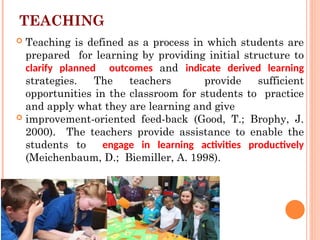
Teaching is defined as a process in which students are
prepared for learning by providing initial structure to
clarify planned outcomes and indicate derived learning
strategies. The teachers provide sufficient
opportunities in the classroom for students to practice
and apply what they are learning and give
improvement-oriented feed-back (Good, T.; Brophy, J.
2000). The teachers provide assistance to enable the
students to engage in learning activities productively
(Meichenbaum, D.; Biemiller, A. 1998).
5.
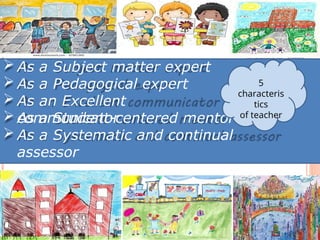
As aSubject matter expert
As a Pedagogical expert
As an Excellent
communicator
As a Student-centered mentor
As a Systematic and continual
assessor
5
characteris
tics
of teacher
6.
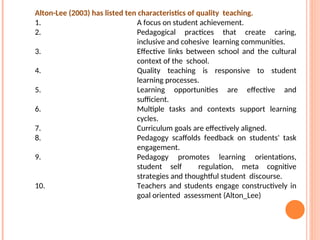
Alton-Lee (2003) haslisted ten characteristics of quality teaching.
1. A focus on student achievement.
2. Pedagogical practices that create caring,
inclusive and cohesive learning communities.
3. Effective links between school and the cultural
context of the school.
4. Quality teaching is responsive to student
learning processes.
5. Learning opportunities are effective and
sufficient.
6. Multiple tasks and contexts support learning
cycles.
7. Curriculum goals are effectively aligned.
8. Pedagogy scaffolds feedback on students' task
engagement.
9. Pedagogy promotes learning orientations,
student self regulation, meta cognitive
strategies and thoughtful student discourse.
10. Teachers and students engage constructively in
goal oriented assessment (Alton_Lee)
7.
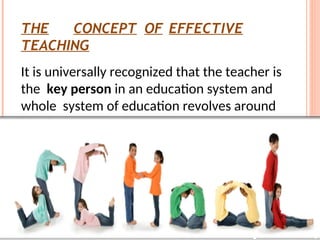
THE CONCEPT OFEFFECTIVE
TEACHING
It is universally recognized that the teacher is
the key person in an education system and
whole system of education revolves around
him/her.
8.
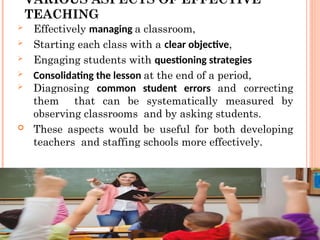
VARIOUS ASPECTS OFEFFECTIVE
TEACHING
Effectively managing a classroom,
Starting each class with a clear objective,
Engaging students with questioning strategies
Consolidating the lesson at the end of a period,
Diagnosing common student errors and correcting
them that can be systematically measured by
observing classrooms and by asking students.
These aspects would be useful for both developing
teachers and staffing schools more effectively.
9.
WHAT DOES THE
LITERATURESAY ABOUT
GOOD TEACHERS?
Good teachers are:
Knowledgeable about their subject
Adopt an organised and systematic approach to their
teaching
Are enthusiastic and interesting
Respect their students
Have high expectations of their students performance
10.
SOME ASSUMPTIONS ABOUT
TEACHING
Teaching is a process not an event
There is no one right way to teach, but there are many ways to
teach better
Both teachers AND students are responsible for learning
Learning is more likely to occur if the process has been planned
Assessment drives learning
Learning occurs best in a relevant context And most
importantly...
Teachers want to teach better
11.
SOME ASSUMPTIONS ABOUT
LEARNERS?
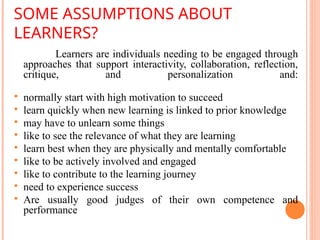
Learnersare individuals needing to be engaged through
approaches that support interactivity, collaboration, reflection,
critique, and personalization and:
normally start with high motivation to succeed
learn quickly when new learning is linked to prior knowledge
may have to unlearn some things
like to see the relevance of what they are learning
learn best when they are physically and mentally comfortable
like to be actively involved and engaged
like to contribute to the learning journey
need to experience success
Are usually good judges of their own competence and
performance
WHAT IS LEARNING?
Criteriathat indicates learning has
occurred involves :
A change in a person’s behaviour or ability
to do something
A stipulation that this change must result
from some sort of practice or experience
A stipulation that the change is an enduring
one
14.
APPROACHES TO LEARNING
Learningas a Process
which involves:
Constructivism
Deep and surface learning
These in turn involve:
Authenticity
Activity
Engagement
15.
Following seven measures
1.Multiplemeasures of effectiveness
2.Accurate teacher evaluation
3.More meaningful tenure
4. Differentiated pay based on
effectiveness
5.Strategic placement of teachers
6.More effective teachers
7.Better student outcomes
EFFECTIVE TEACHING
MEASURES
16.
PRINCIPLES OF
EFFECTIVE TEACHING
Accordingto Richard T. Walls "Four Aces of Effective Teaching "are
summarized below
Ace 1:Outcomes
1.let students know where they are going and why
2.drive hard toward clear goals
Ace 2:Clarity
1 .make the contact as clear and simple as possible 2 .build on what
students already know
Ace 3:Engagement
1 .Don’t lecture for more than 30 minutes before running an activity that
involves all students
2 .People learn what they DO, so have students DO everything that you want
them to learn
Ace 4: Enthusiasm
1 .If you hate to teach it, your students will hate to learn it 2 .The only key
to motivation is success
CONDUCIVE CLASSROOM
ENVIRONMENT
The bestclassroom environment is one that
results in efficient learning (Callahan 1996).The
classroom atmosphere becomes conducive
(favorable) to learning when teacher before
planning teaching analyzes the behavior of each
student of the class. In such environment
students become self directive when encouraged
through proper guidance and teaching
techniques of the teacher.
20.
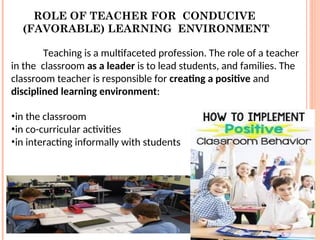
ROLE OF TEACHERFOR CONDUCIVE
(FAVORABLE) LEARNING ENVIRONMENT
Teaching is a multifaceted profession. The role of a teacher
in the classroom as a leader is to lead students, and families. The
classroom teacher is responsible for creating a positive and
disciplined learning environment:
•in the classroom
•in co-curricular activities
•in interacting informally with students
21.
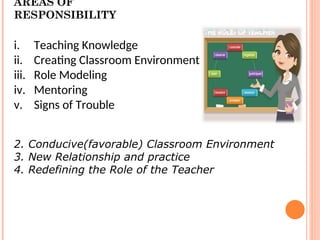
AREAS OF
RESPONSIBILITY
i. TeachingKnowledge
ii. Creating Classroom Environment
iii. Role Modeling
iv. Mentoring
v. Signs of Trouble
2. Conducive(favorable) Classroom Environment
3. New Relationship and practice
4. Redefining the Role of the Teacher
22.
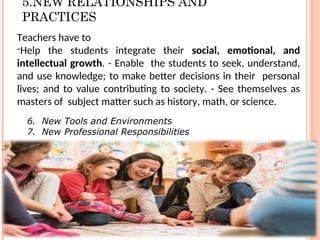
5.NEW RELATIONSHIPS AND
PRACTICES
Teachershave to
-Help the students integrate their social, emotional, and
intellectual growth. - Enable the students to seek, understand,
and use knowledge; to make better decisions in their personal
lives; and to value contributing to society. - See themselves as
masters of subject matter such as history, math, or science.
6. New Tools and Environments
7. New Professional Responsibilities
23.
CHARACTERISTICS OF AN
EFFECTIVETEACHER
Personal qualities characteristics:
Strong interpersonal and communication skills
A genuine interest in children and respect for their individuality
The ability to sense children's individual needs
The ability to be creative, imaginative, patient, energetic, organized and
resourceful
The ability to establish rapport children and parents
Strong leadership and teamwork skills and a good sense of humour
A high level of dedication to work which often impacts personal lifestyle
choices
aAclear, pleasant speaking voice and the ability to convey confidence
Positive conflict resolution skills and the ability to handle stress
well.
HOW TO HANDLEMISBEHAVING
STUDENT?
Deal with the present, current problem immediately,
not with the past instances of the student misbehavior.
Talk to the student directly, instead of talking about
him with others.
Don’t be harsh and provoked. Stay calm and address
firmly. Anger, empty threats and physical handling
must be avoided.
If the student is hostile, the teacher can diffuse his
hostility by responding with softly, calm, and soothing
tone. The feeling of the students must be acknowledged
in order to calm him down.
OUTLINE OF THE
METHOD
1.Set the problem
2. Create a background memo
3. Select participant
4. Create a list of lead
questions
5. Session conduct
6. The Process
29.
PROBLEM-SOLVING
METHOD
Steps of ProblemSolving Process 1-
Choosing the topic and emergence of
problem.
2- Delimitation of the problem. 3-
Planning the application.
4- Preparing the working guide. 5-
Providing the sources.
6- Examining the problem. 7-
Getting a conclusion.
8- Disputation the topics, views and
findings.