Shifting from TCC to LCC
Student-Centered Learning:
Relinquishing Control
Mr. Emad Halawa
1
Objectives :
Through out this presentation the attendants would:
2
Discuss the following photos
“It is a rain of information”
“In traditional classes, students learn not to ask
too many questions, instead they learn to listen
and repeat the expected answers. Students are
the receivers of information, and the teacher is
the dispenser.
Movement toward:
• Competency based versus
knowledge-based education.
• “Guide on the Side” versus
“Sage on the Stage.”
• Critical thinking versus specific
content knowledge.
Some Current Trends
An object in motion continues in
motion with the same speed and in
the same direction unless another
force acts upon it to slow it down or
stop it.
Newton’s First Law of Motion: The Law of Inertia
An object at rest will remain at
rest unless another force acts
upon it to make it move.
Which kind of force do you want to be?
Changes Toward a
Learner-Centered
Classroom
7
Task 1
8
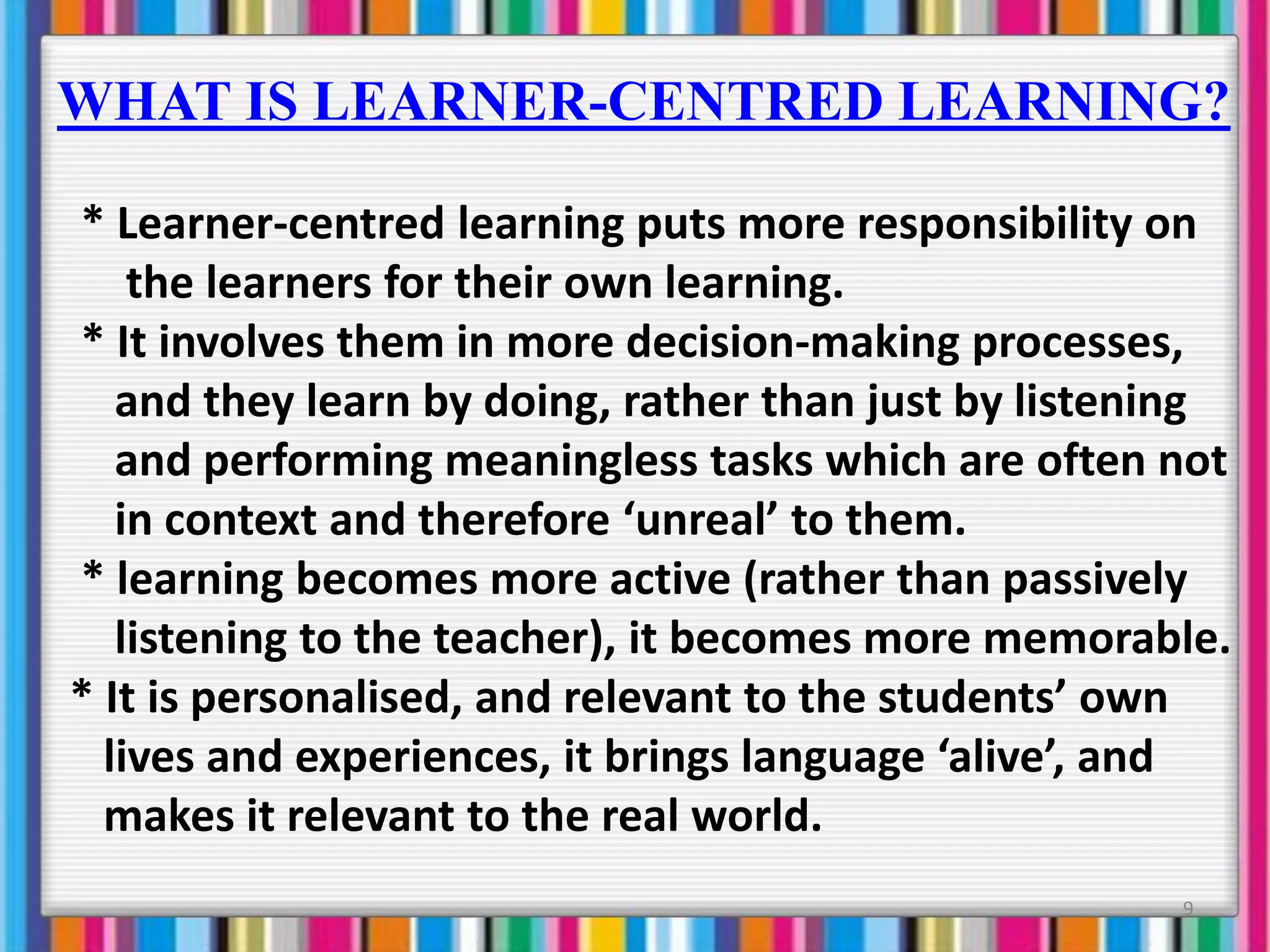
* Learner-centred learning puts more responsibility on
the learners for their own learning.
* It involves them in more decision-making processes,
and they learn by doing, rather than just by listening
and performing meaningless tasks which are often not
in context and therefore ‘unreal’ to them.
* learning becomes more active (rather than passively
listening to the teacher), it becomes more memorable.
* It is personalised, and relevant to the students’ own
lives and experiences, it brings language ‘alive’, and
makes it relevant to the real world.
WHAT IS LEARNER-CENTRED LEARNING?
9
Five Principles to Learner-Centered Approach
(Weimer 2002)
1. Balance of Power:
• Give students power in making decisions
and contributions to the course
2. The Function of Content:
• Don’t feel stressed to cover everything and
remember, covering content and promoting
learning are mutually reinforcing!!
Five Principles Continued
3. The Role of Teacher:
• Teachers would be “guides, gardeners, helpers”
not just deliverers or organizers of information
4. The Responsibility for Learning:
• Is the student’s responsibility.
5. The Purpose and Processes of Evaluation:
• Should be more about how much they are
learning than what grade they received.
How are they similar?
How are they different?
Student Centered vs. Teacher Centered
12
Task 2
13
Differences
14
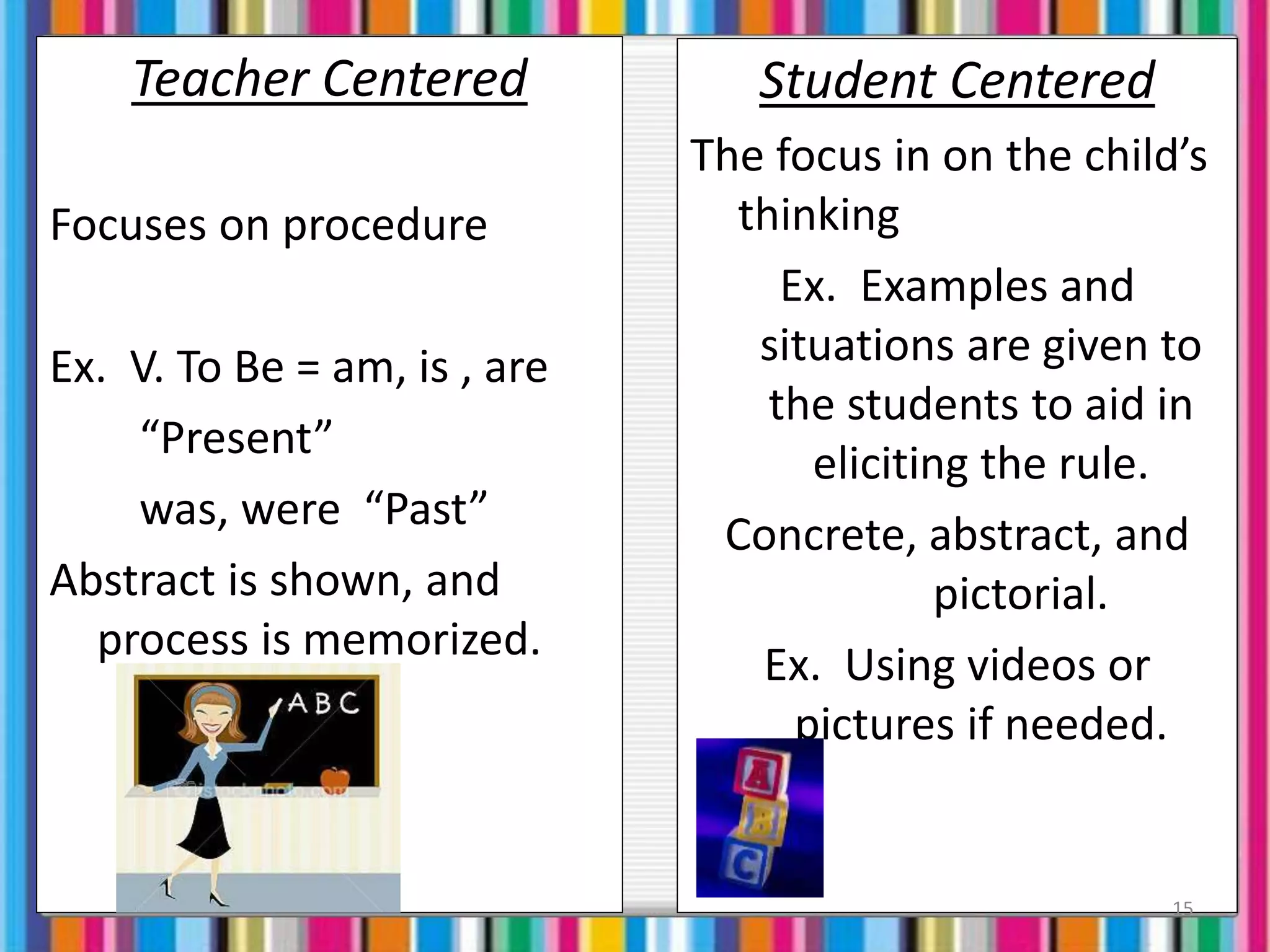
Teacher Centered
Focuses on procedure
Ex. V. To Be = am, is , are
“Present”
was, were “Past”
Abstract is shown, and
process is memorized.
Student Centered
The focus in on the child’s
thinking
Ex. Examples and
situations are given to
the students to aid in
eliciting the rule.
Concrete, abstract, and
pictorial.
Ex. Using videos or
pictures if needed.
15
Teacher Centered
The teacher is the
instructor and the
decision maker
Ex. -Right and Wrong
Student Centered
The teacher is the
facilitator and guide, and
the students are the
decision makers
Ex. -Student created
-Choices!
16
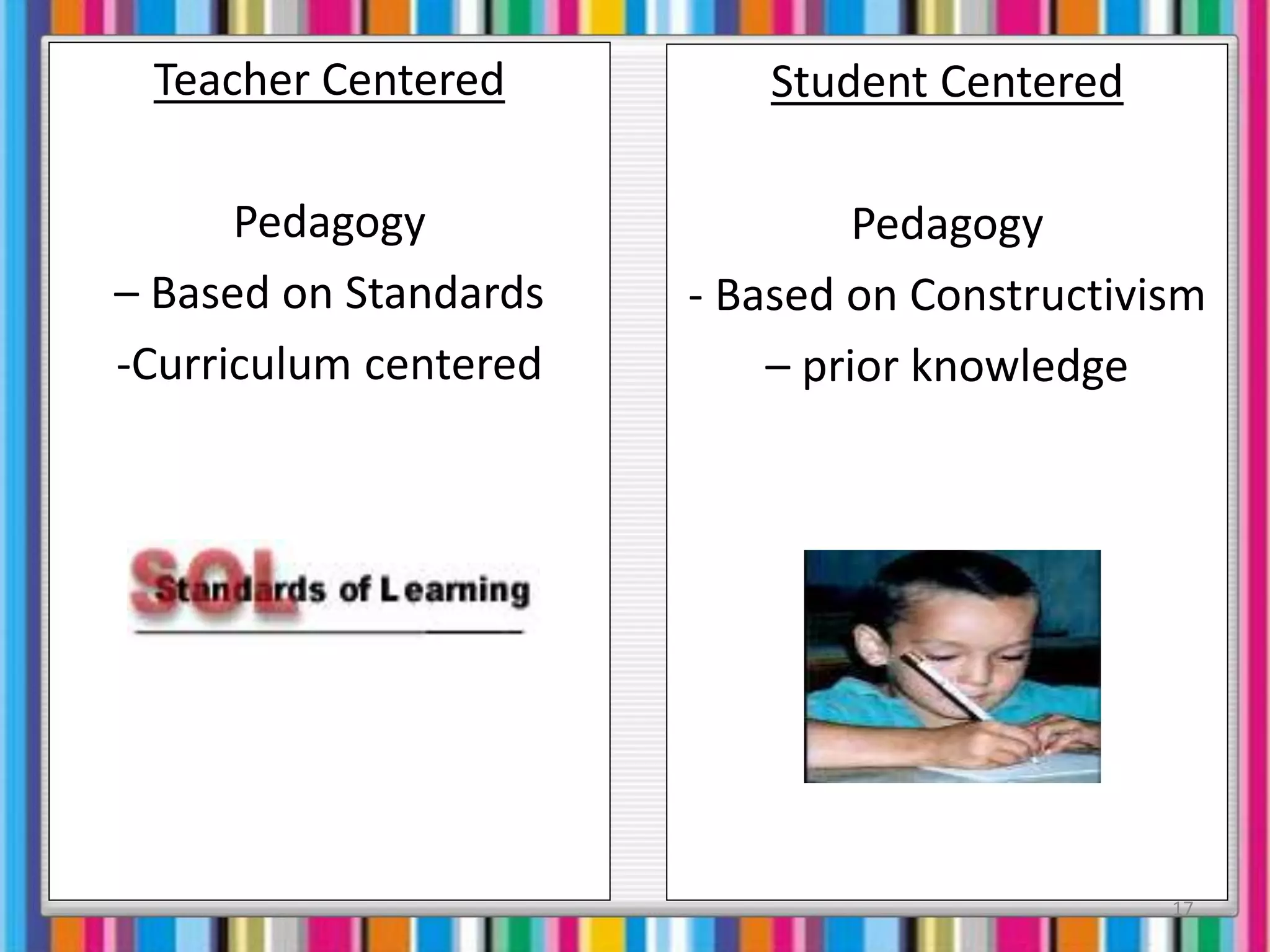
Teacher Centered
Pedagogy
– Based on Standards
-Curriculum centered
Student Centered
Pedagogy
- Based on Constructivism
– prior knowledge
17
Teacher Centered
Relies more on the
textbook and direct
instruction
Ex. Go to page 24 and answer the
questions.
Student Centered
Highlights real life
examples
Use situations that tie into
the student’s lives that they
can relate to and find
interesting.
.
18
Teacher Centered
Rote knowledge
Student Centered
Experiential knowledge
For example: Using problem
solving methods and
experimental ways of solving
problems. The implementation
of the student’s prior
knowledge.
Learning a procedure without
truly understanding the
material. For example
memorizing the steps of
solving a problem.
19
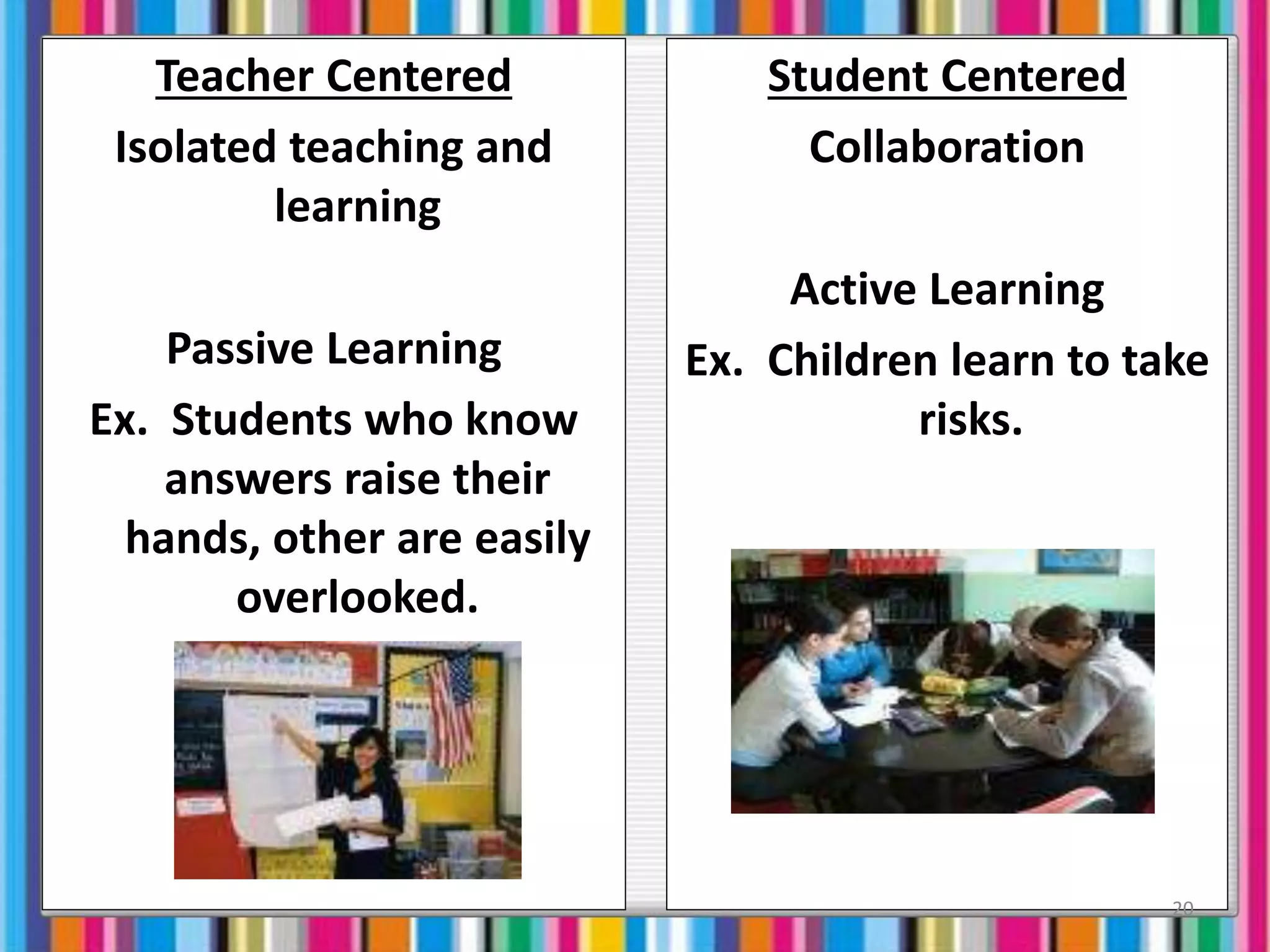
Teacher Centered
Isolated teaching and
learning
Passive Learning
Ex. Students who know
answers raise their
hands, other are easily
overlooked.
Student Centered
Collaboration
Active Learning
Ex. Children learn to take
risks.
20
Teacher Centered
Learning takes place only
in the classroom
Student Centered
Learning extends beyond
the classroom
- Students are able to relate
problems and strategies
to their lives.
21
Similarities
22
* The objective is to teach the child to understand
the concept!
* The teacher corrects the child when he or she is
incorrect.
* The teacher is present to overlook the child’s
work, and help guide the child in the right
direction.
Tactics For LCCs ( I )
Ask don’t tell: always try to elicit information, ideas, and
answers from the students.
Focus on students’ experience and interests: use the
course book as a base for then moving on to practice
activities relating to the students' personal lives and
areas of interest and experience (personalization)
Communication over accuracy: the main reason for
students learning a language is to be able to
communicate with other speakers of that language
24
Tactics For LCCs ( II )
Learning by doing: the more actively involved students
are in their own learning, the more they are likely to
remember what they learn.
Students have choices and make decisions about
learning. Group work requires negotiation and decision
making – working together towards a common goal.
Focus on confidence building for real-world skills.
25
Tactics For LCCs ( III )
Encourage interest in English used in the real world.
By using authentic materials familiar to the students
(magazines, Internet, video, television, letters.. etc.),
students are constantly in touch with the language in an
absorbing way.
Tasks are open-ended. Open-ended tasks are wider
in their focus and involve a variety of language skills.
High exposure to English through the use of authentic
materials again: students may be set homework
involving research undertaken using the internet or
other English language reference sources.
26
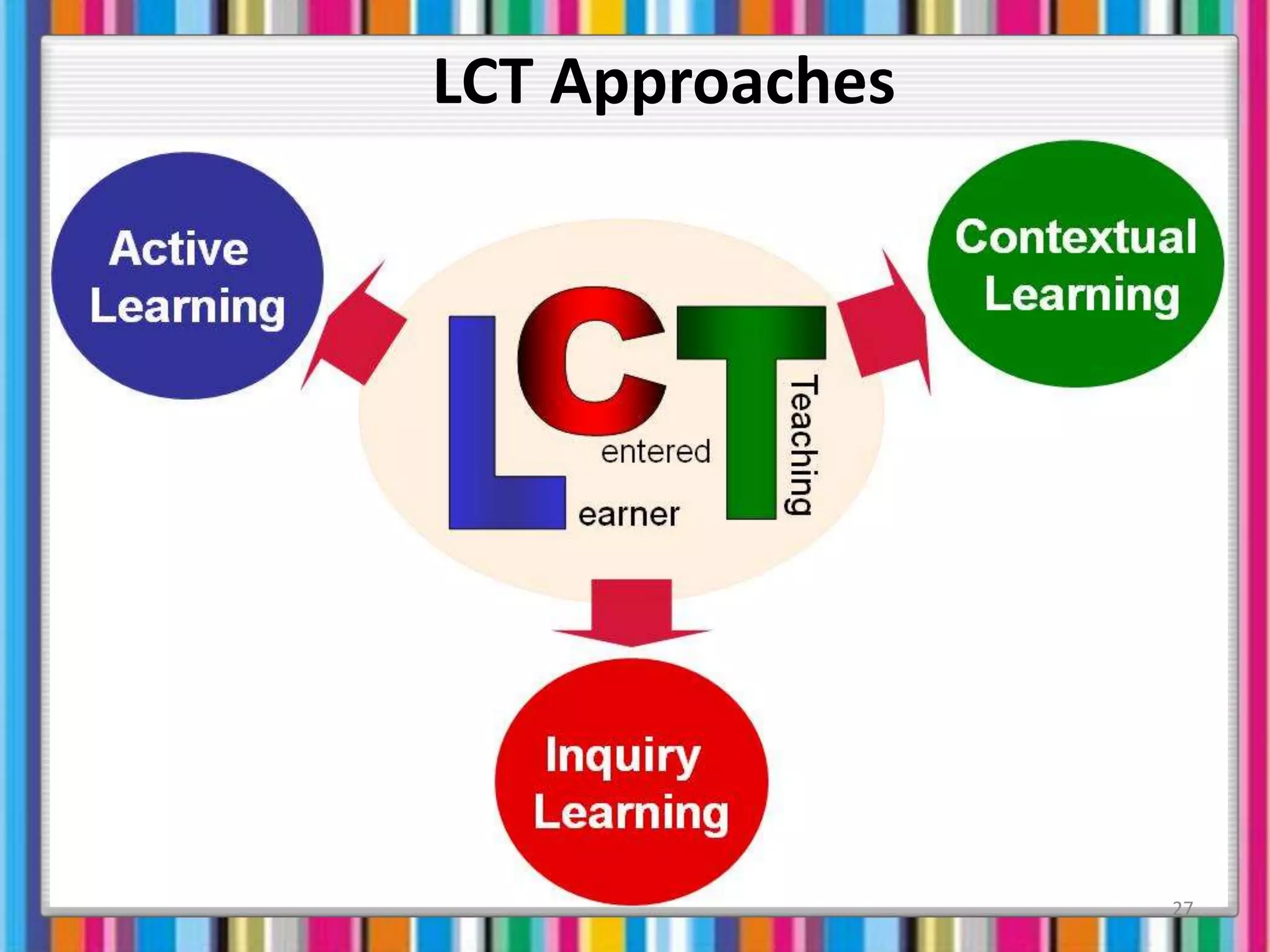
LCT Approaches
27
Relinquishing Control: The Process is the Product
Not:
• Something completely new.
• Simply relinquishing the role of lecturer.
• Compromising the educational experience.
Rather:
• Creating active learning opportunities.
• Becoming more student-centered in your teaching
approach.
• Creating a semiautonomous classroom.
Why Do It?
The active learning approach:
• Forces students to think about
themselves as learners.
• Is more about knowledge and skills (intrinsic) and less about
tests/grades (extrinsic).
• Encourages students to be producers of knowledge rather
than just information consumers/containers.
• Prepares student for 21st century challenges.
Why Does it Work?
• Empowers students.
• Forces students to think about themselves as learners.
• Creates independence and ownership of learning.
• Fosters collaborative learning.
• Encourages creativity.
• Creates a rich learning environment inside and outside the
classroom.
• Fosters new skills – problem solving, critical thinking, etc.
Some Results
• Students learn to ask questions,
not just repeat back answers.
• Students become active learners,
rather than passive learners.
• Students build confidence.
• Students prepare for 21st century
challenges with 21st century
skills.
Adapt
Experience
Create
Discuss
Express
Question
Collaborate
Engage
Synthesize
Compare-Contrast
Debate
• “We have so much to cover!”
• “They won’t do the work; they
expect me to lecture!”
• “I’m the expert on this, not the
students.”
• Others?
Some “yes-buts”
How to Do It
• Find out who students are and what they expect
• What they want to learn.
• What questions they have.
• Use project-based learning.
• Employ teams.
• Assign roles.
• Let students choose some topics/sequences of material.
• Create rubrics – and have students create theirs.
• Introduce learning contracts (especially with teamwork).
• Encourage self-assessment.
• Break into groups of three.
• Plan four ways to teach students about
personal hygiene.
• Lecture (I’m telling you)
• Demonstration (I’m showing you)
• Application (you do it)
• Discovery (you figure it out)
• Choose a topic from one of your courses –
and try it again.
Now … Let’s Do It!
How Do We Assess the Learning?
• Hard measures:
• Comparison of learning using different
teaching methods (Teaching as Research: TAR).
• Standardized tests.
• Soft measures:
• Attendance.
• Energy in the room.
• Student satisfaction.
• Teacher evaluations.
• Teacher satisfaction.
• What fears do you have?
• What’s worked for you?
• What barriers do you
anticipate?
Task 3
Challenges
• Still need to maintain quality and set
high expectations.
• Still need teaching plan – and need to
stick to it.
- but need to be flexible and allow
some “wiggle room.”
• Need to prepare students for the new
active model.
Still …
• It can be messy at first.
• It is not linear, it is complex.
• It can be uncomfortable.
• It takes resilience to effect change.
The winding road gets you to
the top of the mountain!
Sources
Sources:
Mallinger, M. "Maintaining Control in the Classroom by Giving Up Control Maintenir Le Contrôle De La Classe Par l'Abandon Du Contrôle]."
Journal of management education (Newbury Park, Calif.) 22.4 (1998)ProQuest. Web. 3 Sep. 2013.
AbstractAlthough collaborative learning models are used by numerous faculty members, many instructors are concerned that giving
up control in the classroom means com-promising the educational experience. Empowering students, however, requires more of the
instructor than just relinquishing the role of lecturer. This article offers a set of frameworks to help faculty create a semiautonomous
classroom and, at the same time, protect against loss of quality control. Cross-cultural implications of collaborative learning are all
addressed
On Relinquishing Control in the Classroom (and Life)
http://alisonlentz.blogspot.com/2012/04/on-relinquishing-control-in-classroom.html?m=1
How We Started Relinquishing Control
http://relinquishingcontrol.wikispaces.com/Start+with+the+Basics
Classroom Innovation Means Giving Up Control: The essence of what drives innovation begins with what kids want to learn.
http://www.cea-ace.ca/blog/donna-fry/2012/12/5/classroom-innovation-means-giving-control
Relinquishing Control
http://edtechideas.com/2010/11/24/relinquishing-control/
Don’t give up on relinquishing control to your students
http://educatedtodeath.com/post/12164495790/0022-dont-give-up-on-relinquishing-control-to-your
Student-Centered Classroom Culture (PDF)
http://www.intel.com/content/dam/www/program/education/us/en/documents/assessing-projects/overview-and-
benefits/student-centered-classroom-culture.pdf

student-centered-learning1.pptx

  • 1.
    Shifting from TCCto LCC Student-Centered Learning: Relinquishing Control Mr. Emad Halawa 1
  • 2.
    Objectives : Through outthis presentation the attendants would: 2
  • 3.
    Discuss the followingphotos “It is a rain of information”
  • 4.
    “It is arain of information” “In traditional classes, students learn not to ask too many questions, instead they learn to listen and repeat the expected answers. Students are the receivers of information, and the teacher is the dispenser.
  • 5.
    Movement toward: • Competencybased versus knowledge-based education. • “Guide on the Side” versus “Sage on the Stage.” • Critical thinking versus specific content knowledge. Some Current Trends
  • 6.
    An object inmotion continues in motion with the same speed and in the same direction unless another force acts upon it to slow it down or stop it. Newton’s First Law of Motion: The Law of Inertia An object at rest will remain at rest unless another force acts upon it to make it move. Which kind of force do you want to be?
  • 7.
  • 8.
  • 9.
    * Learner-centred learningputs more responsibility on the learners for their own learning. * It involves them in more decision-making processes, and they learn by doing, rather than just by listening and performing meaningless tasks which are often not in context and therefore ‘unreal’ to them. * learning becomes more active (rather than passively listening to the teacher), it becomes more memorable. * It is personalised, and relevant to the students’ own lives and experiences, it brings language ‘alive’, and makes it relevant to the real world. WHAT IS LEARNER-CENTRED LEARNING? 9
  • 10.
    Five Principles toLearner-Centered Approach (Weimer 2002) 1. Balance of Power: • Give students power in making decisions and contributions to the course 2. The Function of Content: • Don’t feel stressed to cover everything and remember, covering content and promoting learning are mutually reinforcing!!
  • 11.
    Five Principles Continued 3.The Role of Teacher: • Teachers would be “guides, gardeners, helpers” not just deliverers or organizers of information 4. The Responsibility for Learning: • Is the student’s responsibility. 5. The Purpose and Processes of Evaluation: • Should be more about how much they are learning than what grade they received.
  • 12.
    How are theysimilar? How are they different? Student Centered vs. Teacher Centered 12
  • 13.
  • 14.
  • 15.
    Teacher Centered Focuses onprocedure Ex. V. To Be = am, is , are “Present” was, were “Past” Abstract is shown, and process is memorized. Student Centered The focus in on the child’s thinking Ex. Examples and situations are given to the students to aid in eliciting the rule. Concrete, abstract, and pictorial. Ex. Using videos or pictures if needed. 15
  • 16.
    Teacher Centered The teacheris the instructor and the decision maker Ex. -Right and Wrong Student Centered The teacher is the facilitator and guide, and the students are the decision makers Ex. -Student created -Choices! 16
  • 17.
    Teacher Centered Pedagogy – Basedon Standards -Curriculum centered Student Centered Pedagogy - Based on Constructivism – prior knowledge 17
  • 18.
    Teacher Centered Relies moreon the textbook and direct instruction Ex. Go to page 24 and answer the questions. Student Centered Highlights real life examples Use situations that tie into the student’s lives that they can relate to and find interesting. . 18
  • 19.
    Teacher Centered Rote knowledge StudentCentered Experiential knowledge For example: Using problem solving methods and experimental ways of solving problems. The implementation of the student’s prior knowledge. Learning a procedure without truly understanding the material. For example memorizing the steps of solving a problem. 19
  • 20.
    Teacher Centered Isolated teachingand learning Passive Learning Ex. Students who know answers raise their hands, other are easily overlooked. Student Centered Collaboration Active Learning Ex. Children learn to take risks. 20
  • 21.
    Teacher Centered Learning takesplace only in the classroom Student Centered Learning extends beyond the classroom - Students are able to relate problems and strategies to their lives. 21
  • 22.
  • 23.
    * The objectiveis to teach the child to understand the concept! * The teacher corrects the child when he or she is incorrect. * The teacher is present to overlook the child’s work, and help guide the child in the right direction.
  • 24.
    Tactics For LCCs( I ) Ask don’t tell: always try to elicit information, ideas, and answers from the students. Focus on students’ experience and interests: use the course book as a base for then moving on to practice activities relating to the students' personal lives and areas of interest and experience (personalization) Communication over accuracy: the main reason for students learning a language is to be able to communicate with other speakers of that language 24
  • 25.
    Tactics For LCCs( II ) Learning by doing: the more actively involved students are in their own learning, the more they are likely to remember what they learn. Students have choices and make decisions about learning. Group work requires negotiation and decision making – working together towards a common goal. Focus on confidence building for real-world skills. 25
  • 26.
    Tactics For LCCs( III ) Encourage interest in English used in the real world. By using authentic materials familiar to the students (magazines, Internet, video, television, letters.. etc.), students are constantly in touch with the language in an absorbing way. Tasks are open-ended. Open-ended tasks are wider in their focus and involve a variety of language skills. High exposure to English through the use of authentic materials again: students may be set homework involving research undertaken using the internet or other English language reference sources. 26
  • 27.
  • 28.
    Relinquishing Control: TheProcess is the Product Not: • Something completely new. • Simply relinquishing the role of lecturer. • Compromising the educational experience. Rather: • Creating active learning opportunities. • Becoming more student-centered in your teaching approach. • Creating a semiautonomous classroom.
  • 29.
    Why Do It? Theactive learning approach: • Forces students to think about themselves as learners. • Is more about knowledge and skills (intrinsic) and less about tests/grades (extrinsic). • Encourages students to be producers of knowledge rather than just information consumers/containers. • Prepares student for 21st century challenges.
  • 30.
    Why Does itWork? • Empowers students. • Forces students to think about themselves as learners. • Creates independence and ownership of learning. • Fosters collaborative learning. • Encourages creativity. • Creates a rich learning environment inside and outside the classroom. • Fosters new skills – problem solving, critical thinking, etc.
  • 31.
    Some Results • Studentslearn to ask questions, not just repeat back answers. • Students become active learners, rather than passive learners. • Students build confidence. • Students prepare for 21st century challenges with 21st century skills. Adapt Experience Create Discuss Express Question Collaborate Engage Synthesize Compare-Contrast Debate
  • 32.
    • “We haveso much to cover!” • “They won’t do the work; they expect me to lecture!” • “I’m the expert on this, not the students.” • Others? Some “yes-buts”
  • 33.
    How to DoIt • Find out who students are and what they expect • What they want to learn. • What questions they have. • Use project-based learning. • Employ teams. • Assign roles. • Let students choose some topics/sequences of material. • Create rubrics – and have students create theirs. • Introduce learning contracts (especially with teamwork). • Encourage self-assessment.
  • 34.
    • Break intogroups of three. • Plan four ways to teach students about personal hygiene. • Lecture (I’m telling you) • Demonstration (I’m showing you) • Application (you do it) • Discovery (you figure it out) • Choose a topic from one of your courses – and try it again. Now … Let’s Do It!
  • 35.
    How Do WeAssess the Learning? • Hard measures: • Comparison of learning using different teaching methods (Teaching as Research: TAR). • Standardized tests. • Soft measures: • Attendance. • Energy in the room. • Student satisfaction. • Teacher evaluations. • Teacher satisfaction.
  • 36.
    • What fearsdo you have? • What’s worked for you? • What barriers do you anticipate? Task 3
  • 37.
    Challenges • Still needto maintain quality and set high expectations. • Still need teaching plan – and need to stick to it. - but need to be flexible and allow some “wiggle room.” • Need to prepare students for the new active model.
  • 38.
    Still … • Itcan be messy at first. • It is not linear, it is complex. • It can be uncomfortable. • It takes resilience to effect change. The winding road gets you to the top of the mountain!
  • 39.
    Sources Sources: Mallinger, M. "MaintainingControl in the Classroom by Giving Up Control Maintenir Le Contrôle De La Classe Par l'Abandon Du Contrôle]." Journal of management education (Newbury Park, Calif.) 22.4 (1998)ProQuest. Web. 3 Sep. 2013. AbstractAlthough collaborative learning models are used by numerous faculty members, many instructors are concerned that giving up control in the classroom means com-promising the educational experience. Empowering students, however, requires more of the instructor than just relinquishing the role of lecturer. This article offers a set of frameworks to help faculty create a semiautonomous classroom and, at the same time, protect against loss of quality control. Cross-cultural implications of collaborative learning are all addressed On Relinquishing Control in the Classroom (and Life) http://alisonlentz.blogspot.com/2012/04/on-relinquishing-control-in-classroom.html?m=1 How We Started Relinquishing Control http://relinquishingcontrol.wikispaces.com/Start+with+the+Basics Classroom Innovation Means Giving Up Control: The essence of what drives innovation begins with what kids want to learn. http://www.cea-ace.ca/blog/donna-fry/2012/12/5/classroom-innovation-means-giving-control Relinquishing Control http://edtechideas.com/2010/11/24/relinquishing-control/ Don’t give up on relinquishing control to your students http://educatedtodeath.com/post/12164495790/0022-dont-give-up-on-relinquishing-control-to-your Student-Centered Classroom Culture (PDF) http://www.intel.com/content/dam/www/program/education/us/en/documents/assessing-projects/overview-and- benefits/student-centered-classroom-culture.pdf