Facilitating Learner-Centered
Teaching
DAN LHERY S. GREGORIOUS, Ph.D, LPT, SMRIEDr, FMERU, FMERC
1
 This course is designed to explore and equip pre-service teachers with the
fundamental principles, processes, and practices anchored on learner-
centeredness and other educational psychologies supportive of learning
environments as these apply to facilitate various teaching learning delivery
modes to enhance learning.
 It also includes the demonstration of knowledge and understanding of
differentiated teaching to suit the learners’ gender, needs, strengths,
interests and experiences.
 Further, pre-service teachers will be trained to implement teaching strategies
that are responsive to learners’ linguistic, cultural, socio-economic and
religious backgrounds.
Objectives :
Through out this presentation the attendants would:
3
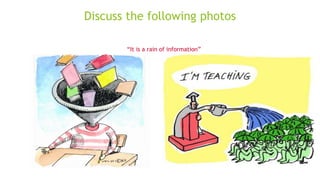
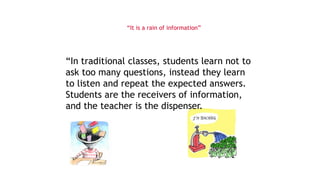
“It is a rain of information”
Discuss the following photos
“It is a rain of information”
“In traditional classes, students learn not to
ask too many questions, instead they learn
to listen and repeat the expected answers.
Students are the receivers of information,
and the teacher is the dispenser.
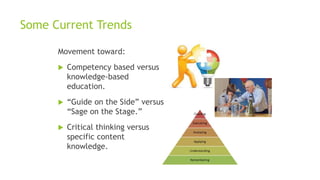
Some Current Trends
Movement toward:
 Competency based versus
knowledge-based
education.
 “Guide on the Side” versus
“Sage on the Stage.”
 Critical thinking versus
specific content
knowledge.
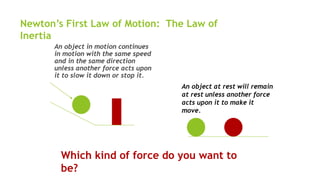
Newton’s First Law of Motion: The Law of
Inertia
An object in motion continues
in motion with the same speed
and in the same direction
unless another force acts upon
it to slow it down or stop it.
An object at rest will remain
at rest unless another force
acts upon it to make it
move.
Which kind of force do you want to
be?
Changes Toward
a Learner-
Centered
Classroom
8
Task
1
9
* Learner-centred learning puts more responsibility on
the learners for their own learning.
* It involves them in more decision-making processes,
and they learn by doing, rather than just by listening
and performing meaningless tasks which are often not
in context and therefore ‘unreal’ to them.
* learning becomes more active (rather than passively
listening to the teacher), it becomes more memorable.
* It is personalised, and relevant to the students’ own
lives and experiences, it brings language ‘alive’, and
makes it relevant to the real world.
WHAT IS LEARNER-CENTRED LEARNING?
10
Five Principles to Learner-Centered
Approach (Weimer 2002)
1. Balance of Power:
 Give students power in making decisions and
contributions to the course
2. The Function of Content:
 Don’t feel stressed to cover everything and
remember, covering content and promoting
learning are mutually reinforcing!!
Five Principles Continued
3. The Role of Teacher:
 Teachers would be “guides, gardeners, helpers” not just
deliverers or organizers of information
4. The Responsibility for Learning:
 Is the student’s responsibility.
5. The Purpose and Processes of Evaluation:
 Should be more about how much they are learning than
what grade they received.
Student Centered vs. Teacher
Centered
How are they similar?
How are they different?
13
Task
2
14
Differences
15
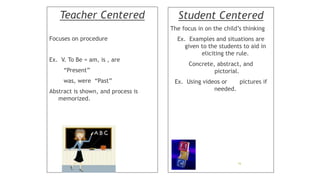
Teacher Centered
Focuses on procedure
Ex. V. To Be = am, is , are
“Present”
was, were “Past”
Abstract is shown, and process is
memorized.
Student Centered
The focus in on the child’s thinking
Ex. Examples and situations are
given to the students to aid in
eliciting the rule.
Concrete, abstract, and
pictorial.
Ex. Using videos or pictures if
needed.
16
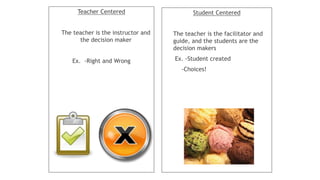
Teacher Centered
The teacher is the instructor and
the decision maker
Ex. -Right and Wrong
Student Centered
The teacher is the facilitator and
guide, and the students are the
decision makers
Ex. -Student created
-Choices!
17
Teacher Centered
Pedagogy
– Based on Standards
-Curriculum centered
Student Centered
Pedagogy
- Based on Constructivism
– prior knowledge
18
Teacher Centered
Relies more on the textbook and
direct instruction
Ex. Go to page 24 and answer the
questions.
Student Centered
Highlights real life examples
19
Use situations that tie into
the student’s lives that they
can relate to and find
interesting.
.
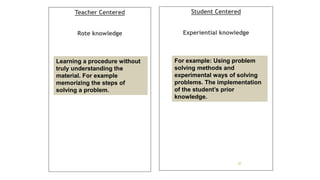
Teacher Centered
Rote knowledge
Student Centered
Experiential knowledge
20
For example: Using problem
solving methods and
experimental ways of solving
problems. The implementation
of the student’s prior
knowledge.
Learning a procedure without
truly understanding the
material. For example
memorizing the steps of
solving a problem.
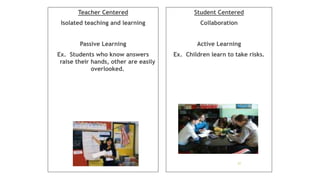
Teacher Centered
Isolated teaching and learning
Passive Learning
Ex. Students who know answers
raise their hands, other are easily
overlooked.
Student Centered
Collaboration
Active Learning
Ex. Children learn to take risks.
21
Teacher Centered
Learning takes place only in the
classroom
Student Centered
Learning extends beyond the
classroom
- Students are able to relate problems
and strategies to their lives.
22
Similarities
23
* The objective is to teach the child to understand the concept!
* The teacher corrects the child when he or she is incorrect.
* The teacher is present to overlook the child’s work, and help guide the child
in the right direction.
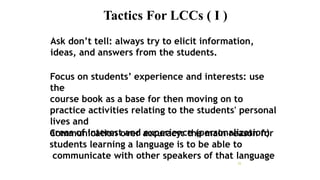
Tactics For LCCs ( I )
25
Ask don’t tell: always try to elicit information,
ideas, and answers from the students.
Focus on students’ experience and interests: use
the
course book as a base for then moving on to
practice activities relating to the students' personal
lives and
areas of interest and experience (personalization)
Communication over accuracy: the main reason for
students learning a language is to be able to
communicate with other speakers of that language
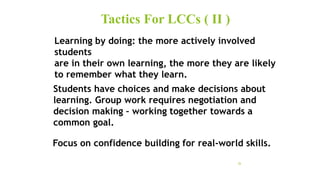
Tactics For LCCs ( II )
26
Learning by doing: the more actively involved
students
are in their own learning, the more they are likely
to remember what they learn.
Students have choices and make decisions about
learning. Group work requires negotiation and
decision making – working together towards a
common goal.
Focus on confidence building for real-world skills.
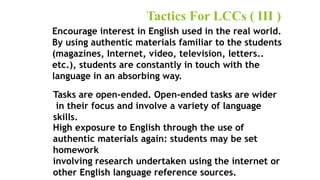
Tactics For LCCs ( III )
27
Encourage interest in English used in the real world.
By using authentic materials familiar to the students
(magazines, Internet, video, television, letters..
etc.), students are constantly in touch with the
language in an absorbing way.
Tasks are open-ended. Open-ended tasks are wider
in their focus and involve a variety of language
skills.
High exposure to English through the use of
authentic materials again: students may be set
homework
involving research undertaken using the internet or
other English language reference sources.
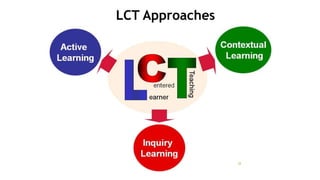
LCT Approaches
28
Relinquishing Control: The Process is the
Product
Not:
 Something completely new.
 Simply relinquishing the role of lecturer.
 Compromising the educational experience.
Rather:
 Creating active learning opportunities.
 Becoming more student-centered in your teaching approach.
 Creating a semiautonomous classroom.
Why Do It?
The active learning approach:
 Forces students to think about
themselves as learners.
 Is more about knowledge and skills (intrinsic) and
less about tests/grades (extrinsic).
 Encourages students to be producers of knowledge
rather than just information consumers/containers.
 Prepares student for 21st century challenges.
Why Does it Work?
 Empowers students.
 Forces students to think about themselves as learners.
 Creates independence and ownership of learning.
 Fosters collaborative learning.
 Encourages creativity.
 Creates a rich learning environment inside and outside
the classroom.
 Fosters new skills – problem solving, critical thinking,
etc.
Some Results
 Students learn to ask
questions, not just repeat
back answers.
 Students become active
learners, rather than passive
learners.
 Students build confidence.
 Students prepare for 21st
century challenges with 21st
century skills.
Adapt
Experience
Create
Discuss
Express
Question
Collaborate
Engage
Synthesize
Compare-Contrast
Debate
Some “yes-buts”
 “We have so much to cover!”
 “They won’t do the work; they
expect me to lecture!”
 “I’m the expert on this, not the
students.”
 Others?
How to Do It
 Find out who students are and what they expect
 What they want to learn.
 What questions they have.
 Use project-based learning.
 Employ teams.
 Assign roles.
 Let students choose some topics/sequences of material.
 Create rubrics – and have students create theirs.
 Introduce learning contracts (especially with teamwork).
 Encourage self-assessment.
Now … Let’s Do It!
 Break into groups of three.
 Plan four ways to teach students
about personal hygiene.
 Lecture (I’m telling you)
 Demonstration (I’m showing you)
 Application (you do it)
 Discovery (you figure it out)
 Choose a topic from one of your
courses – and try it again.
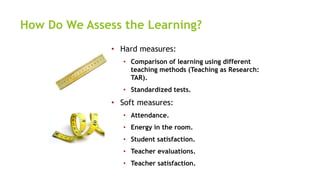
How Do We Assess the Learning?
• Hard measures:
• Comparison of learning using different
teaching methods (Teaching as Research:
TAR).
• Standardized tests.
• Soft measures:
• Attendance.
• Energy in the room.
• Student satisfaction.
• Teacher evaluations.
• Teacher satisfaction.
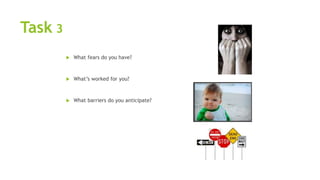
Task 3
 What fears do you have?
 What’s worked for you?
 What barriers do you anticipate?
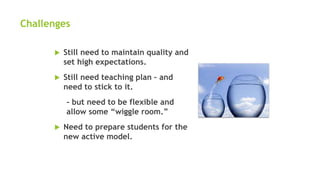
Challenges
 Still need to maintain quality and
set high expectations.
 Still need teaching plan – and
need to stick to it.
- but need to be flexible and
allow some “wiggle room.”
 Need to prepare students for the
new active model.
Still …
 It can be messy at first.
 It is not linear, it is complex.
 It can be uncomfortable.
 It takes resilience to effect change.
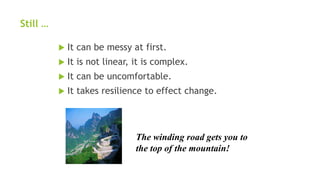
The winding road gets you to
the top of the mountain!
Sources
Sources:
Mallinger, M. "Maintaining Control in the Classroom by Giving Up Control Maintenir Le Contrôle De La Classe Par l'Abandon Du Contrôle]." Journal of
management education (Newbury Park, Calif.) 22.4 (1998)ProQuest. Web. 3 Sep. 2013.
AbstractAlthough collaborative learning models are used by numerous faculty members, many instructors are concerned that giving up control in
the classroom means com-promising the educational experience. Empowering students, however, requires more of the instructor than just
relinquishing the role of lecturer. This article offers a set of frameworks to help faculty create a semiautonomous classroom and, at the same time,
protect against loss of quality control. Cross-cultural implications of collaborative learning are all addressed
On Relinquishing Control in the Classroom (and Life)
http://alisonlentz.blogspot.com/2012/04/on-relinquishing-control-in-classroom.html?m=1
How We Started Relinquishing Control
http://relinquishingcontrol.wikispaces.com/Start+with+the+Basics
Classroom Innovation Means Giving Up Control: The essence of what drives innovation begins with what kids want to learn.
http://www.cea-ace.ca/blog/donna-fry/2012/12/5/classroom-innovation-means-giving-control
Relinquishing Control
http://edtechideas.com/2010/11/24/relinquishing-control/
Don’t give up on relinquishing control to your students
http://educatedtodeath.com/post/12164495790/0022-dont-give-up-on-relinquishing-control-to-your
Student-Centered Classroom Culture (PDF)
http://www.intel.com/content/dam/www/program/education/us/en/documents/assessing-projects/overview-and-benefits/student-centered-
classroom-culture.pdf