Student Engagement and
Teaching Methodology
FDP on 10
FDP on 10th
th
July 2018,
July 2018,
HRDC, Osmania Univ.
HRDC, Osmania Univ.
Dr. Nandita Sethi
Founder & MD
Mindset by Caroll S Dweck
• The Expectation Effect
• During the 1964-1965 school year, Harvard's
Robert Rosenthal conducted an experiment in
an elementary school to see whether teacher
expectations influenced their students'
performances.Teachers were told the names of
children in their classes who were "late
bloomers," about to dramatically spurt in their
academic learning.
• . WHAT WAS THE RESULT?
Research on divergent thinking
 In 1968, George Land conducted research to study
the creative development and capacity for divergent
thinking in children, using a similar test to the one
devised to identify innovative engineers and scientists
for NASA.
 He tested 1,600 children intermittently at
 Age five - 98% had divergent thinking
 Age ten – 30% had divergent thinking
 Age 15-year – 12 % had divergent thinking.
 Same test was given to 280,000 adults
 Adult - the result was just 2%.
Presentation path
Presentation path
• The Millennial Generation
• Massive changes in the educational sector
• Student Engagement
• Classroom Management
• Teaching Methodology
• Communication/Presentation Skills
1. The Millennial Generation : Some
Interesting Facts
Interesting Facts
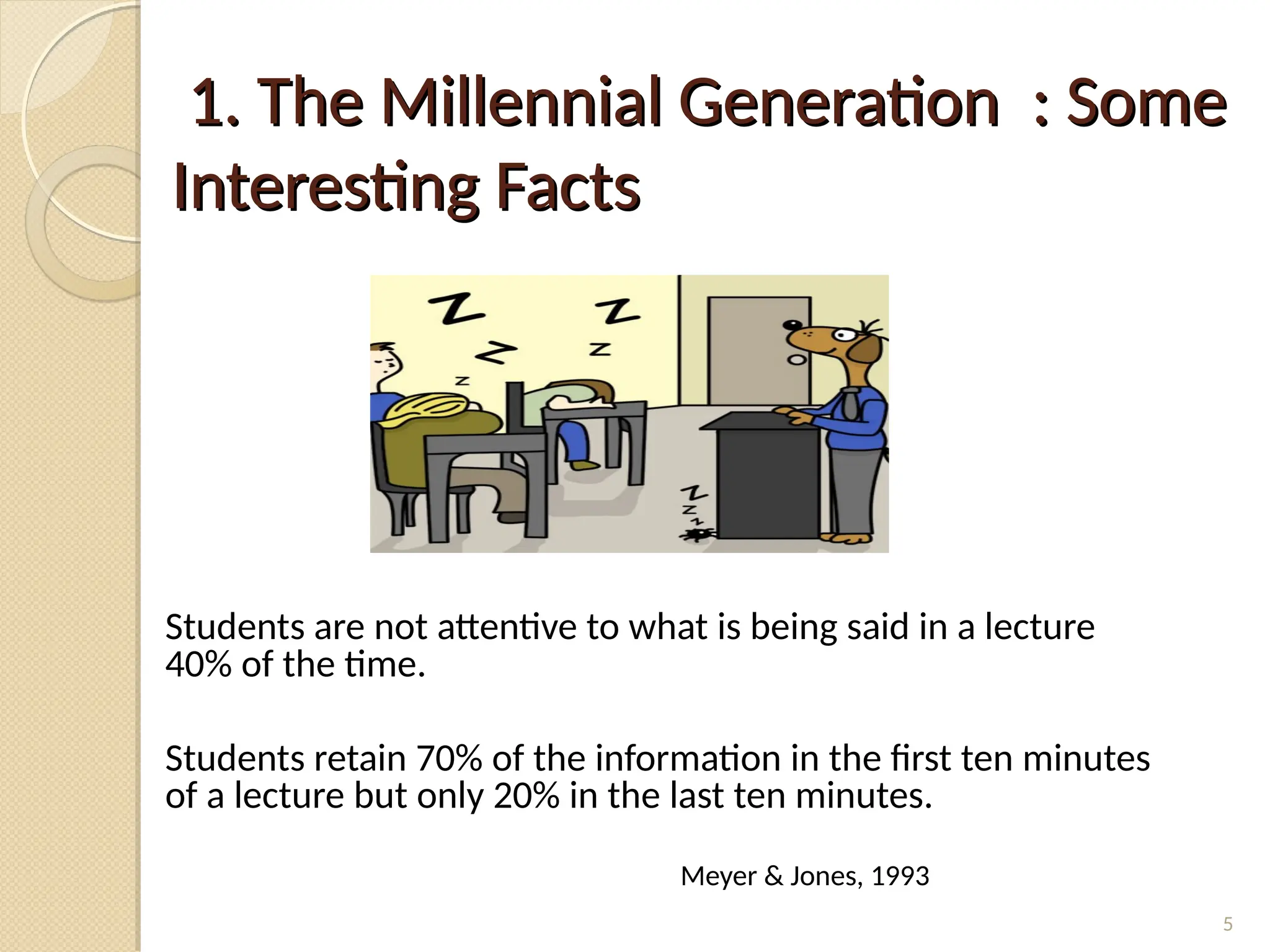
Students are not attentive to what is being said in a lecture
40% of the time.
Students retain 70% of the information in the first ten minutes
of a lecture but only 20% in the last ten minutes.
Meyer & Jones, 1993
5
How Do We Do It?
How Do We Do It?
Attention Spans:
Most students can only sit and absorb
information for fifteen minutes at a time.
Many students can’t focus for ten minutes!
2. Massive changes in Educational Sector
 Role of a teacher …..paradigm shift . No longer an
information provider
 What’s going to be important is….. how to impart this
information and knowledge.
 Delivery of knowledge is getting more personalised.
Students are to be looked as customers
 Online world has reduced the need for attending a
physical class itself. MOOCs are becoming a norm
 Technology will change the way a traditional classroom
is envisioned the human factor will continue to be
important specially in areas of experience.
Other change that are going to impact this
fraternity
fraternity
 Informal education is going to be more important
than formal education.
 Job market and skill requirements are constantly
changing. Newer skills are demanding different types
of training and courses
 Education is moving from being focused on job
seeking to job creating
 So a teacher and institutions in their present form
are soon going to be outdated if they don’t undergo
a metamorphosis.Teachers now will be looked at
more as Mentors & facilitators.
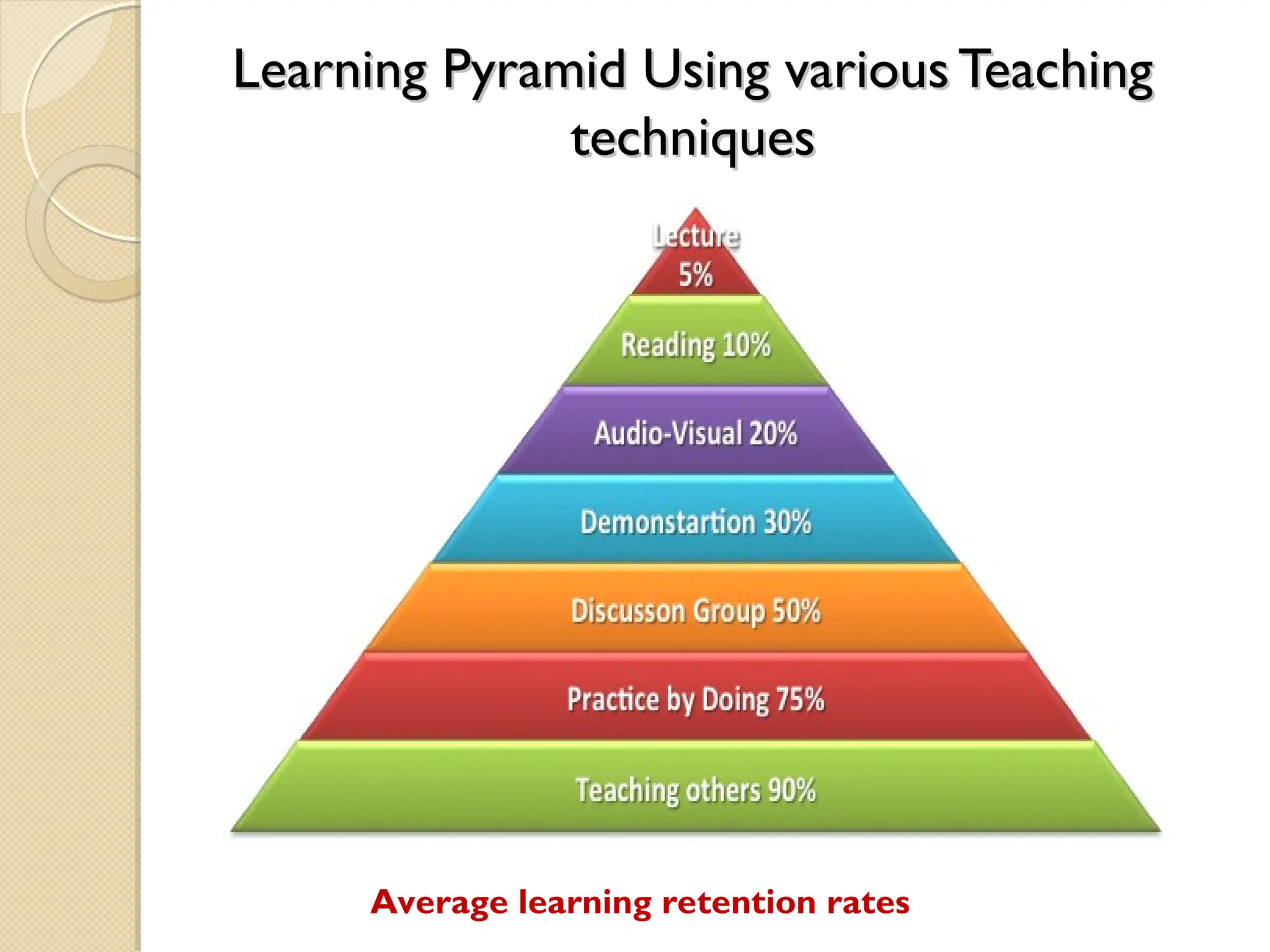
Learning Pyramid Using various Teaching
techniques
techniques
Average learning retention rates
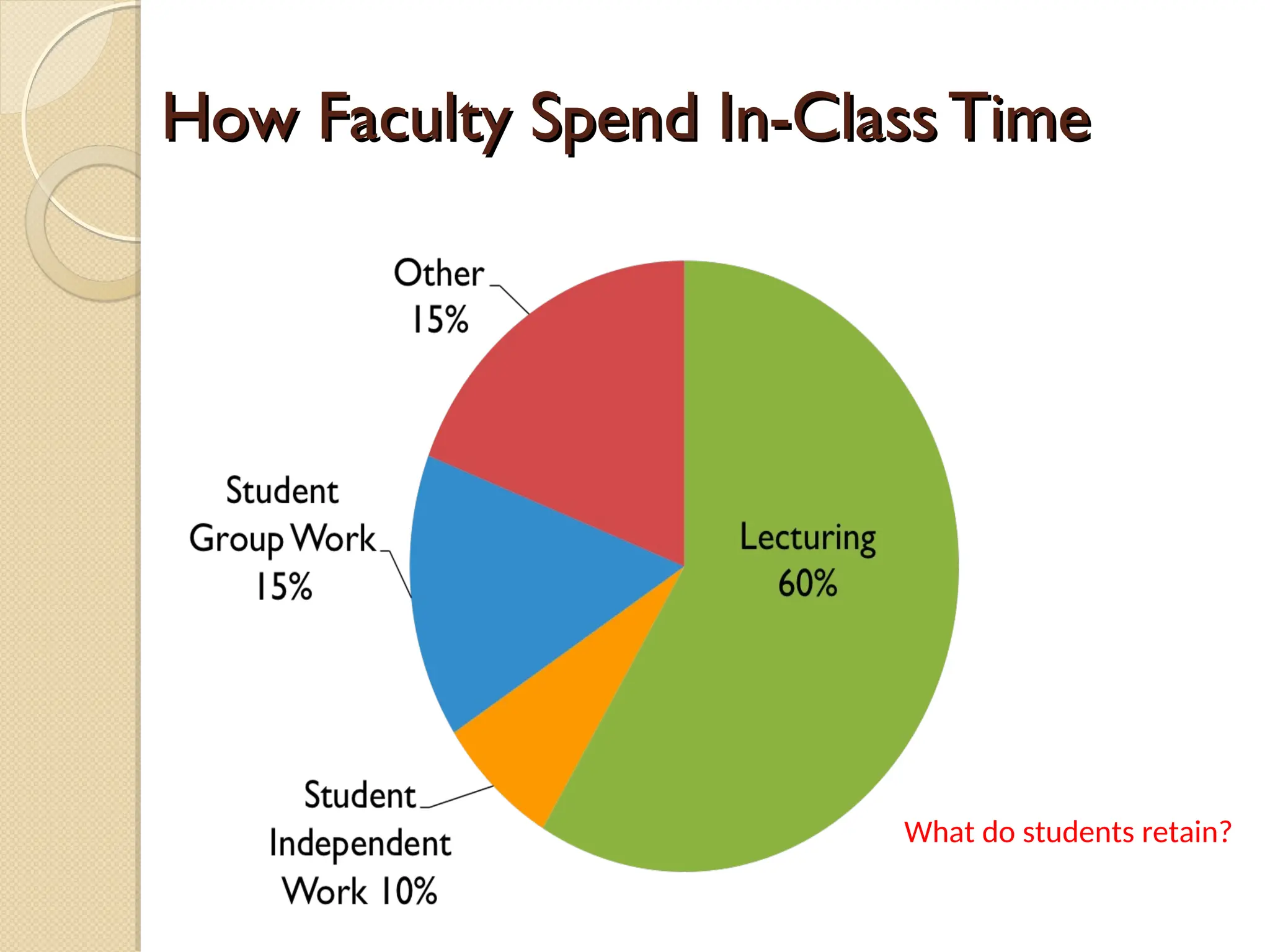
How Faculty Spend In-Class Time
What do students retain?
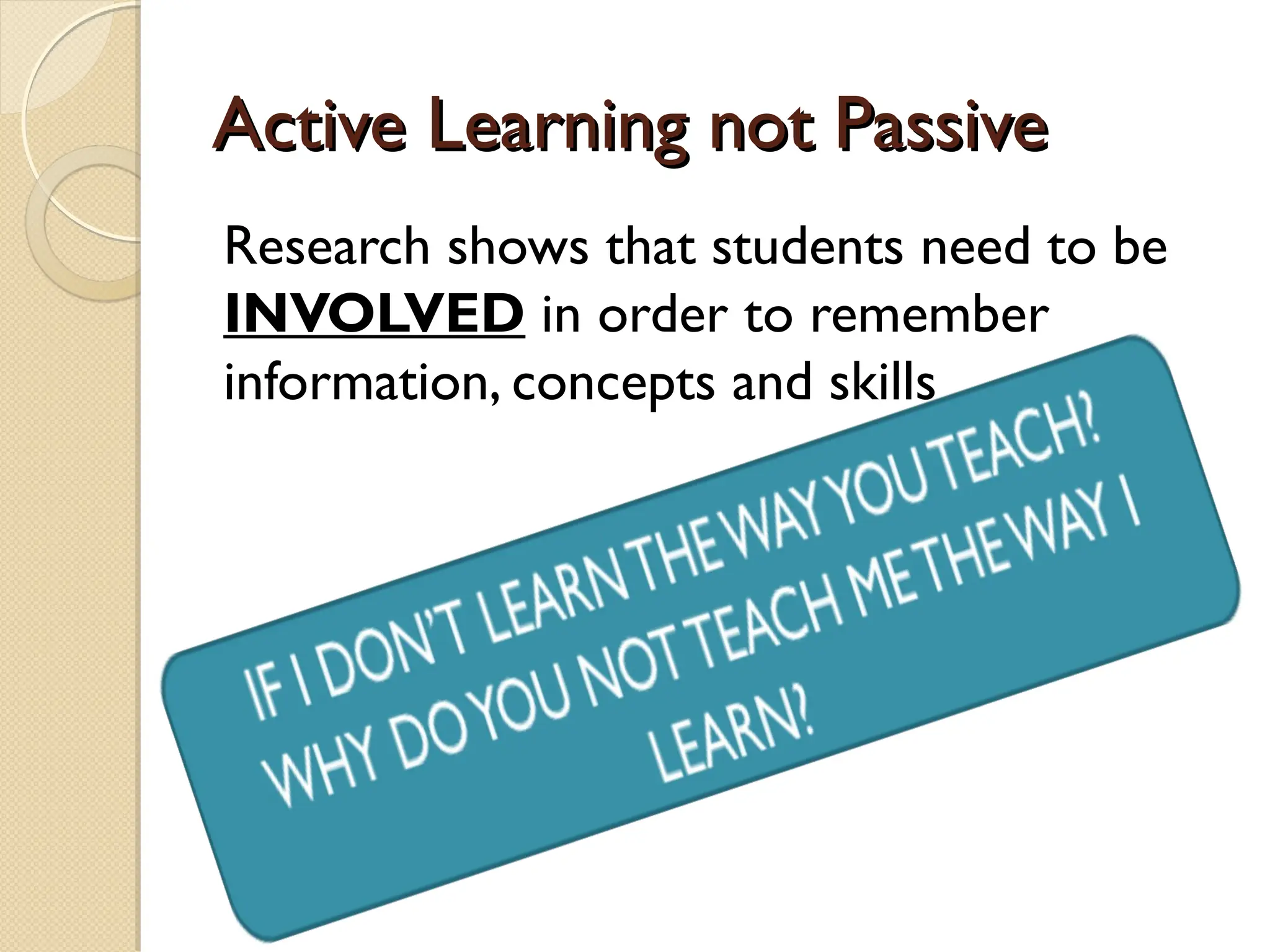
Active Learning not Passive
Research shows that students need to be
INVOLVED in order to remember
information, concepts and skills
3. Student Engagement
 Today, more than info, it’s the way you transfer
the info that is important
 Empathize with students
 Speak their language
 Use modern not outdated techniques of teaching
 Your body language and attitude should reflect
confidence as well as student friendliness
 Be close to students as well as know the limits of
the closeness.
 Command respect not demand it.
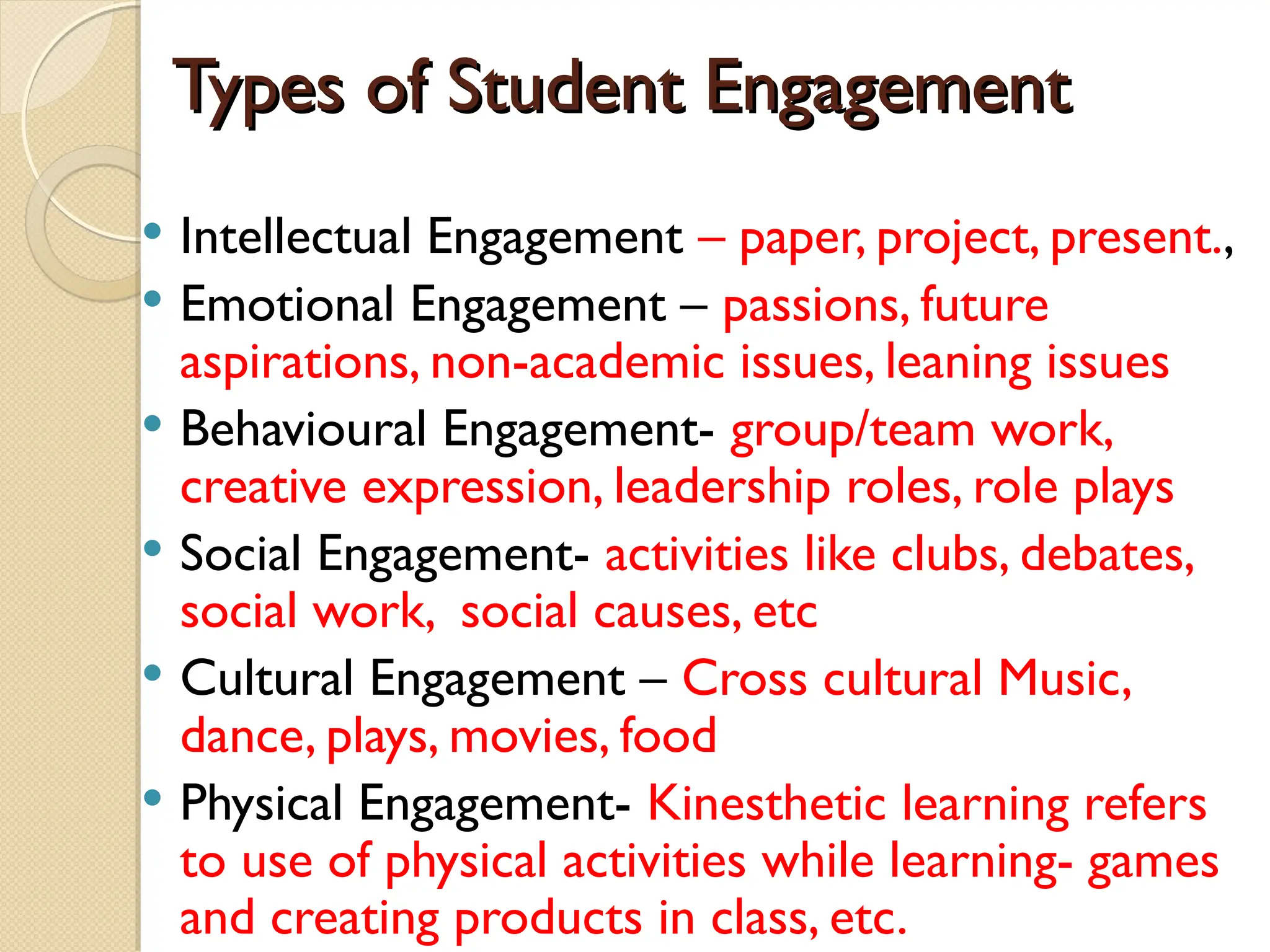
Types of Student Engagement
 Intellectual Engagement – paper, project, present.,
 Emotional Engagement – passions, future
aspirations, non-academic issues, leaning issues
 Behavioural Engagement- group/team work,
creative expression, leadership roles, role plays
 Social Engagement- activities like clubs, debates,
social work, social causes, etc
 Cultural Engagement – Cross cultural Music,
dance, plays, movies, food
 Physical Engagement- Kinesthetic learning refers
to use of physical activities while learning- games
and creating products in class, etc.
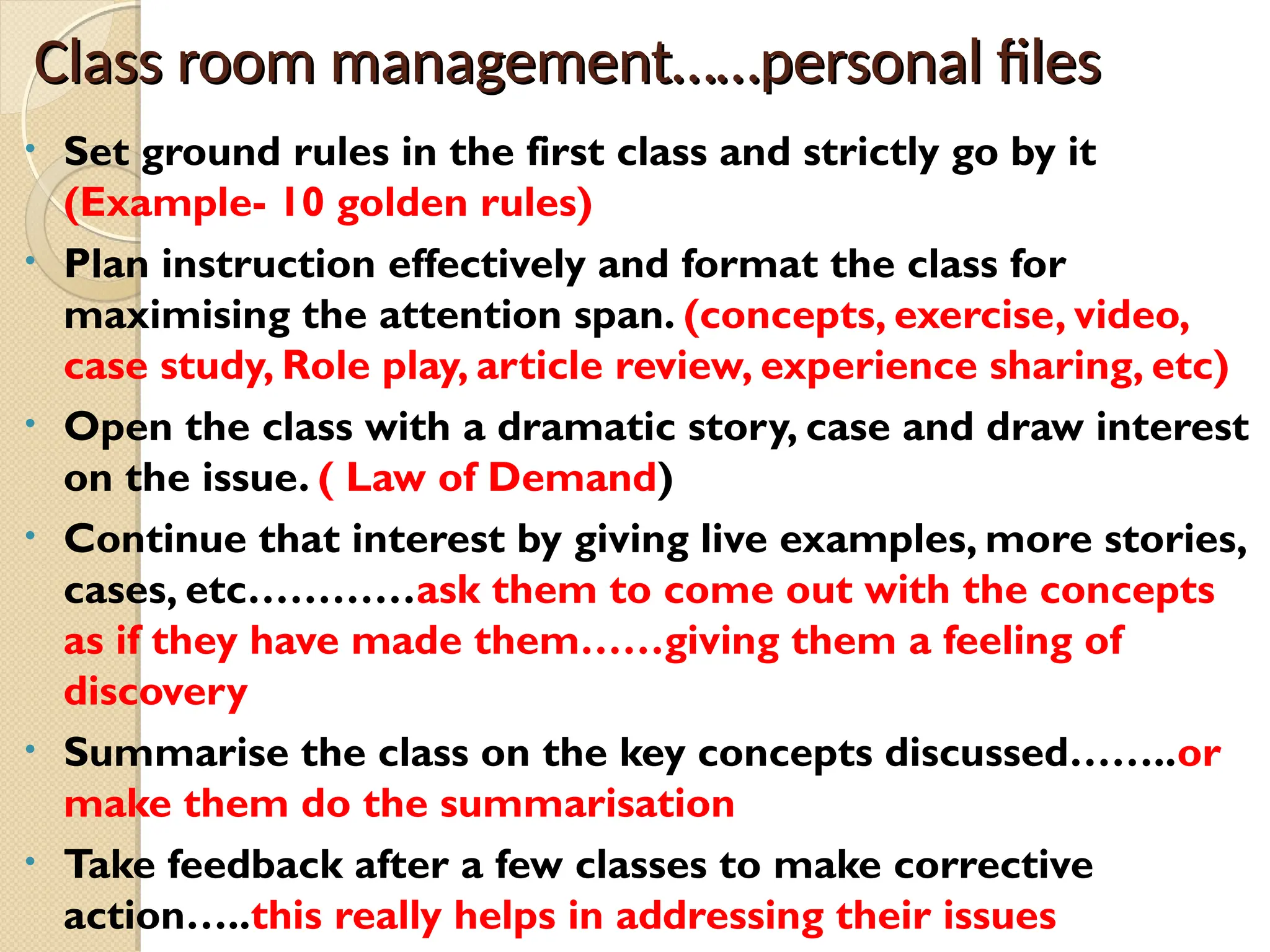
Class room management……personal files
• Set ground rules in the first class and strictly go by it
(Example- 10 golden rules)
• Plan instruction effectively and format the class for
maximising the attention span. (concepts, exercise, video,
case study, Role play, article review, experience sharing, etc)
• Open the class with a dramatic story, case and draw interest
on the issue. ( Law of Demand)
• Continue that interest by giving live examples, more stories,
cases, etc…………ask them to come out with the concepts
as if they have made them……giving them a feeling of
discovery
• Summarise the class on the key concepts discussed……..or
make them do the summarisation
• Take feedback after a few classes to make corrective
action…..this really helps in addressing their issues
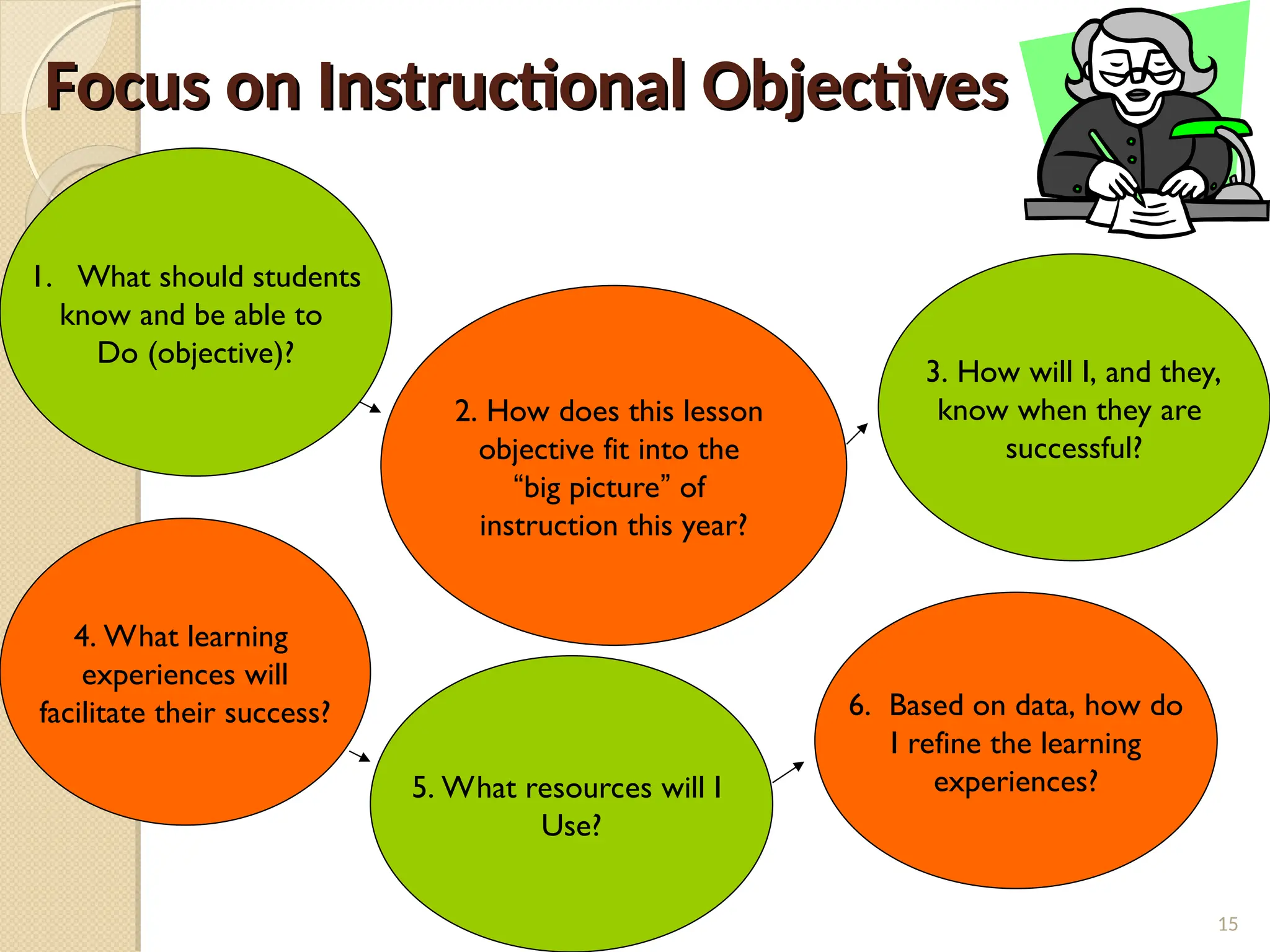
Focus on Instructional Objectives
15
1. What should students
know and be able to
Do (objective)?
3. How will I, and they,
know when they are
successful?
4. What learning
experiences will
facilitate their success? 6. Based on data, how do
I refine the learning
experiences?
2. How does this lesson
objective fit into the
“big picture” of
instruction this year?
5. What resources will I
Use?
Planning Teaching:
Planning Teaching:
 For teaching to be effective, two ingredients
are needed at the outset:
 Careful planning and Constructive
Alignment.
 The former will be especially reliant on
‘SMART’ learning outcomes and the latter
on connectivity between strategies for LTA
(Learning and Teaching Activity).
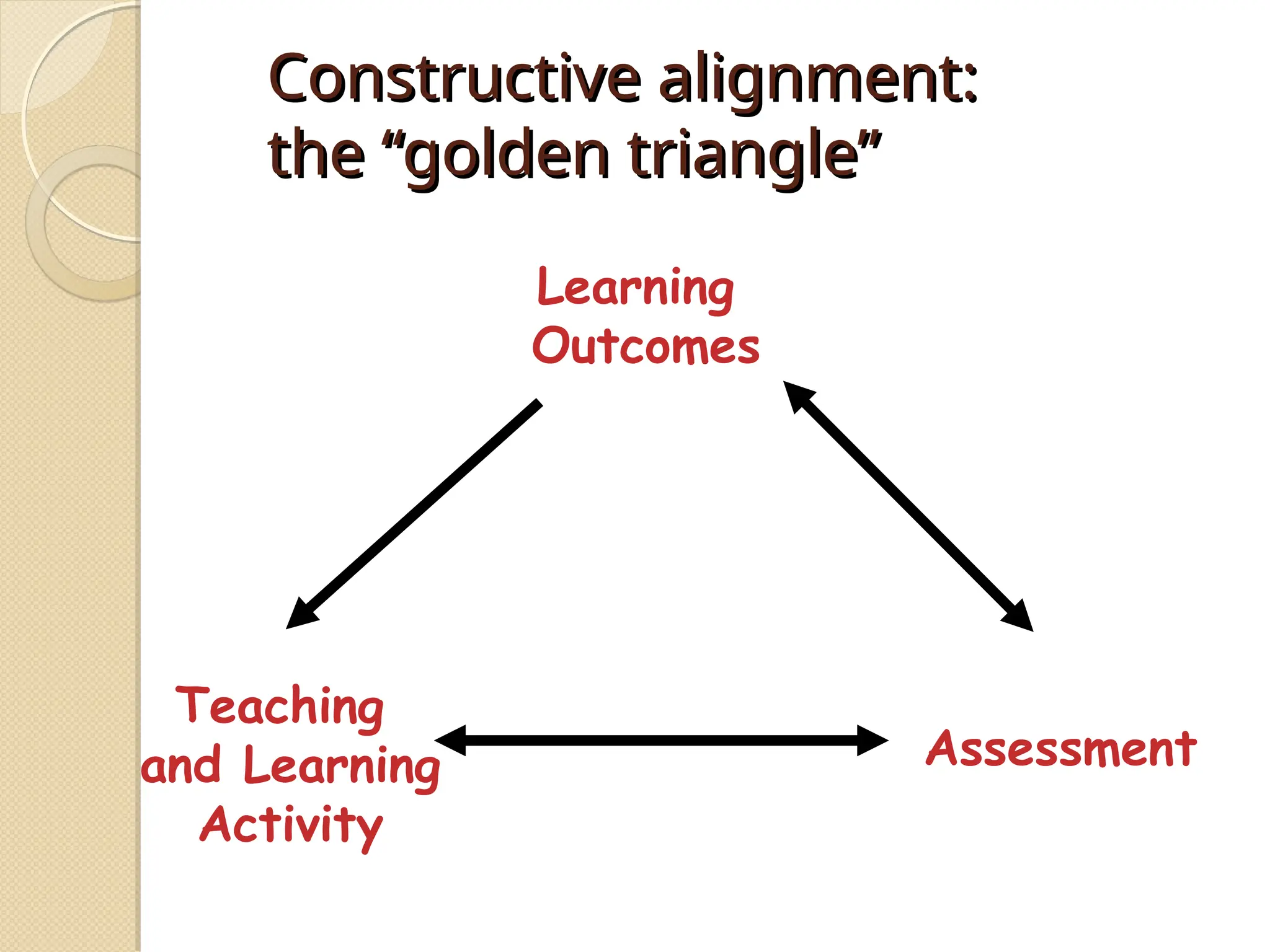
Constructive alignment:
the “golden triangle”
Learning
Outcomes
Teaching
and Learning
Activity
Assessment
‘
‘PAR
PAR’
’ and
and ‘
‘BEM
BEM’
’
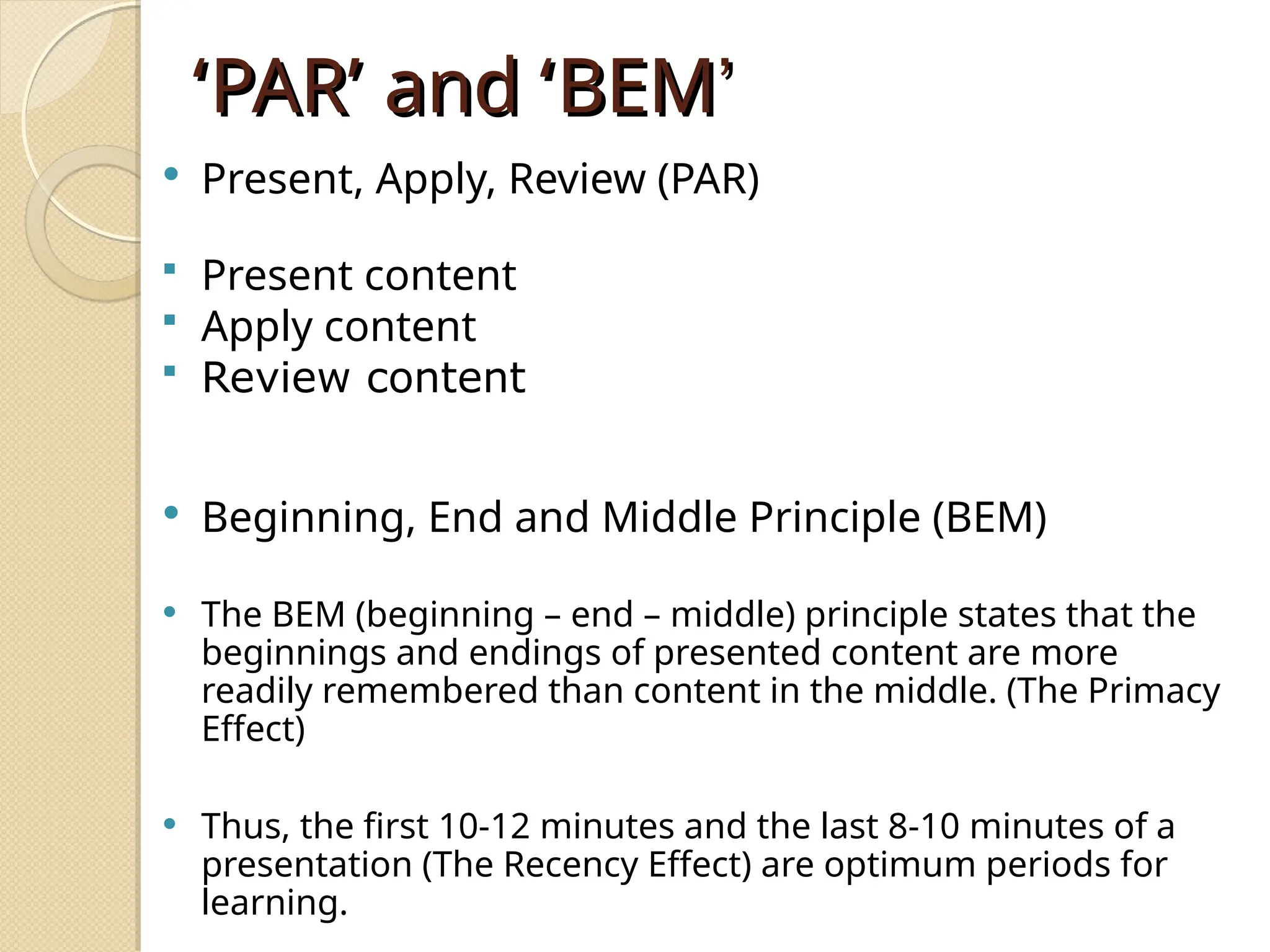
 Present, Apply, Review (PAR)
 Present content
 Apply content
 Review content
 Beginning, End and Middle Principle (BEM)
 The BEM (beginning – end – middle) principle states that the
beginnings and endings of presented content are more
readily remembered than content in the middle. (The Primacy
Effect)
 Thus, the first 10-12 minutes and the last 8-10 minutes of a
presentation (The Recency Effect) are optimum periods for
learning.
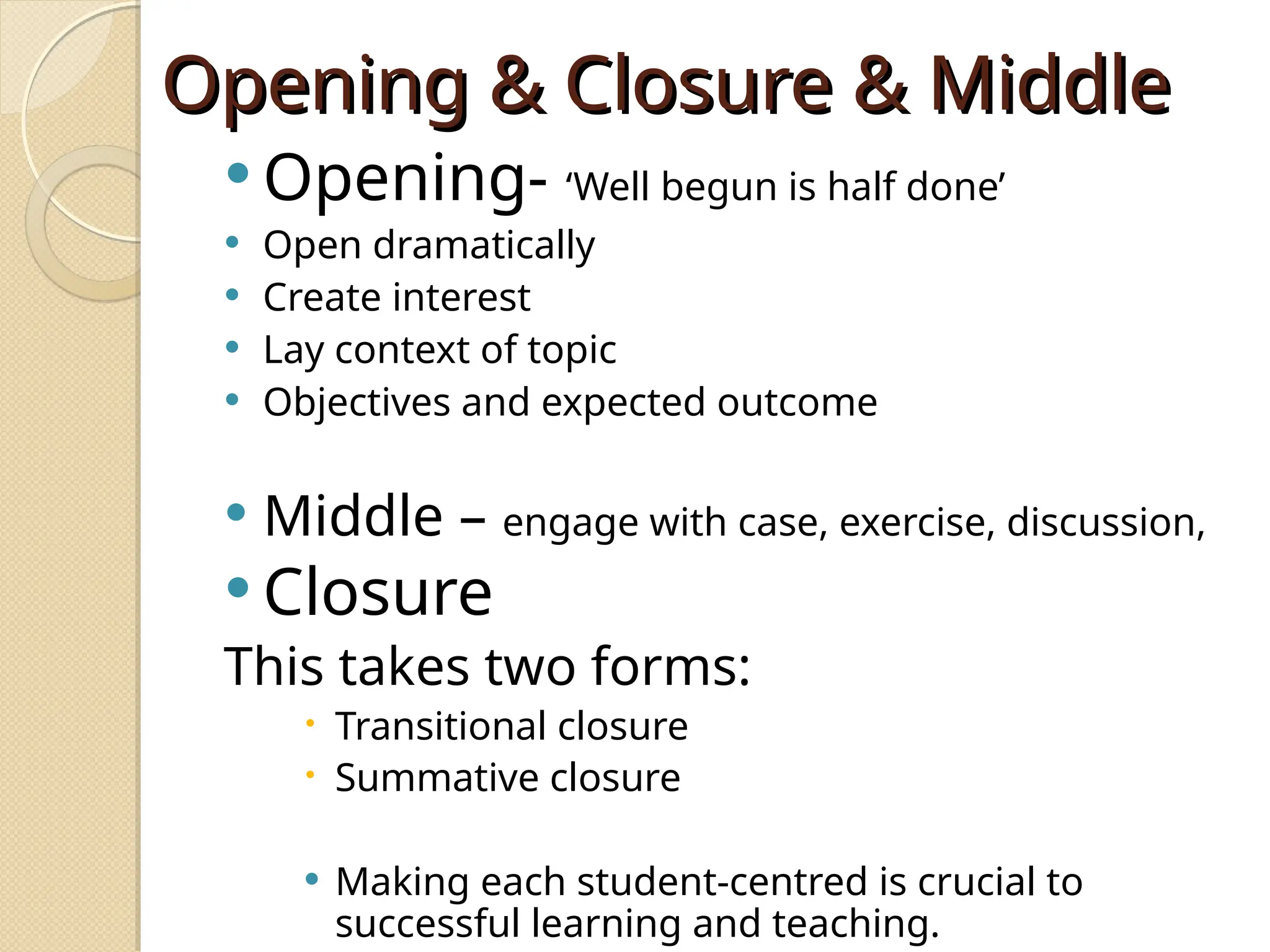
Opening & Closure & Middle
 Opening- ‘Well begun is half done’
 Open dramatically
 Create interest
 Lay context of topic
 Objectives and expected outcome
 Middle – engage with case, exercise, discussion,
 Closure
This takes two forms:
 Transitional closure
 Summative closure
 Making each student-centred is crucial to
successful learning and teaching.
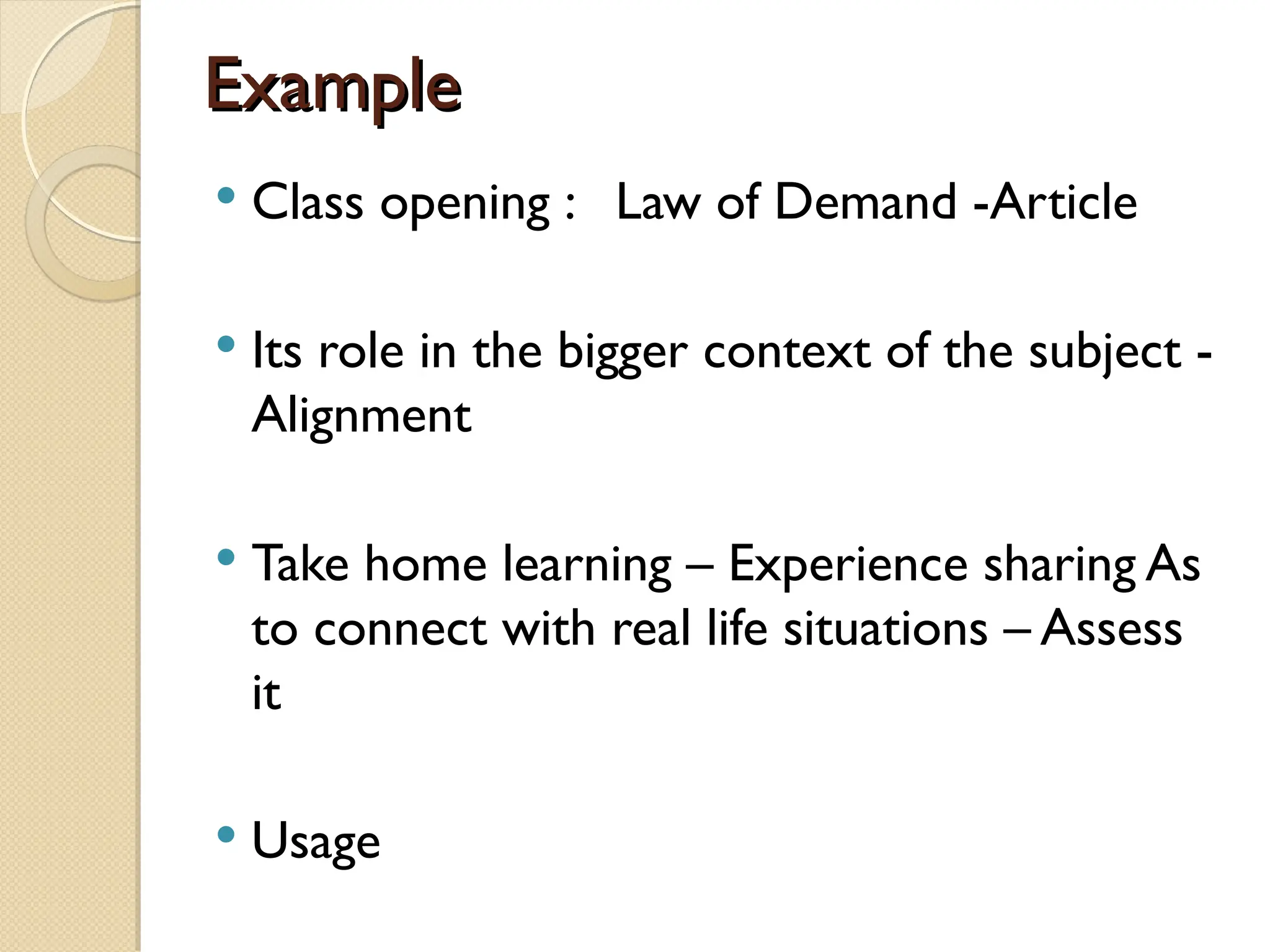
Example
Example
 Class opening : Law of Demand -Article
 Its role in the bigger context of the subject -
Alignment
 Take home learning – Experience sharing As
to connect with real life situations – Assess
it
 Usage
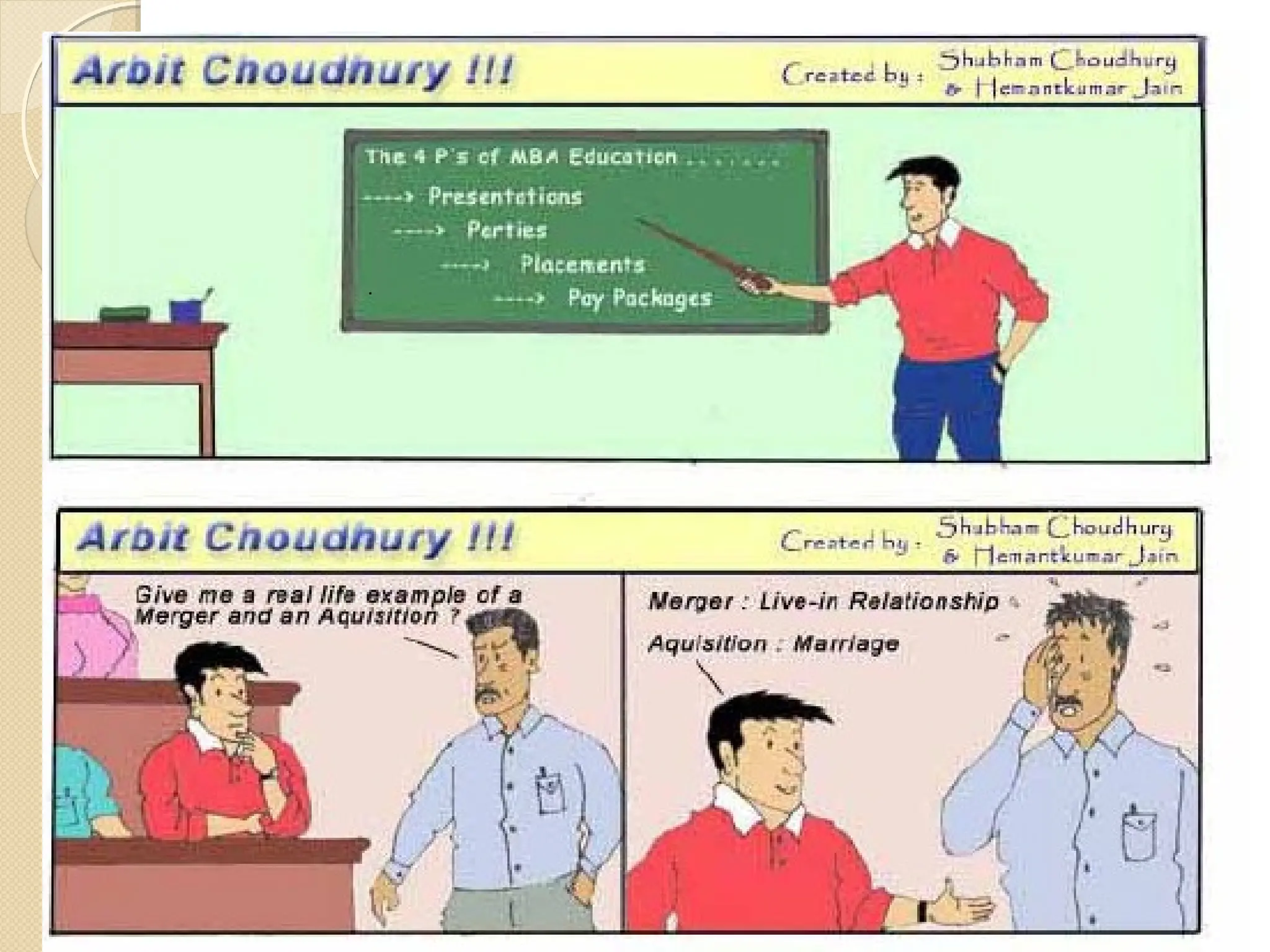
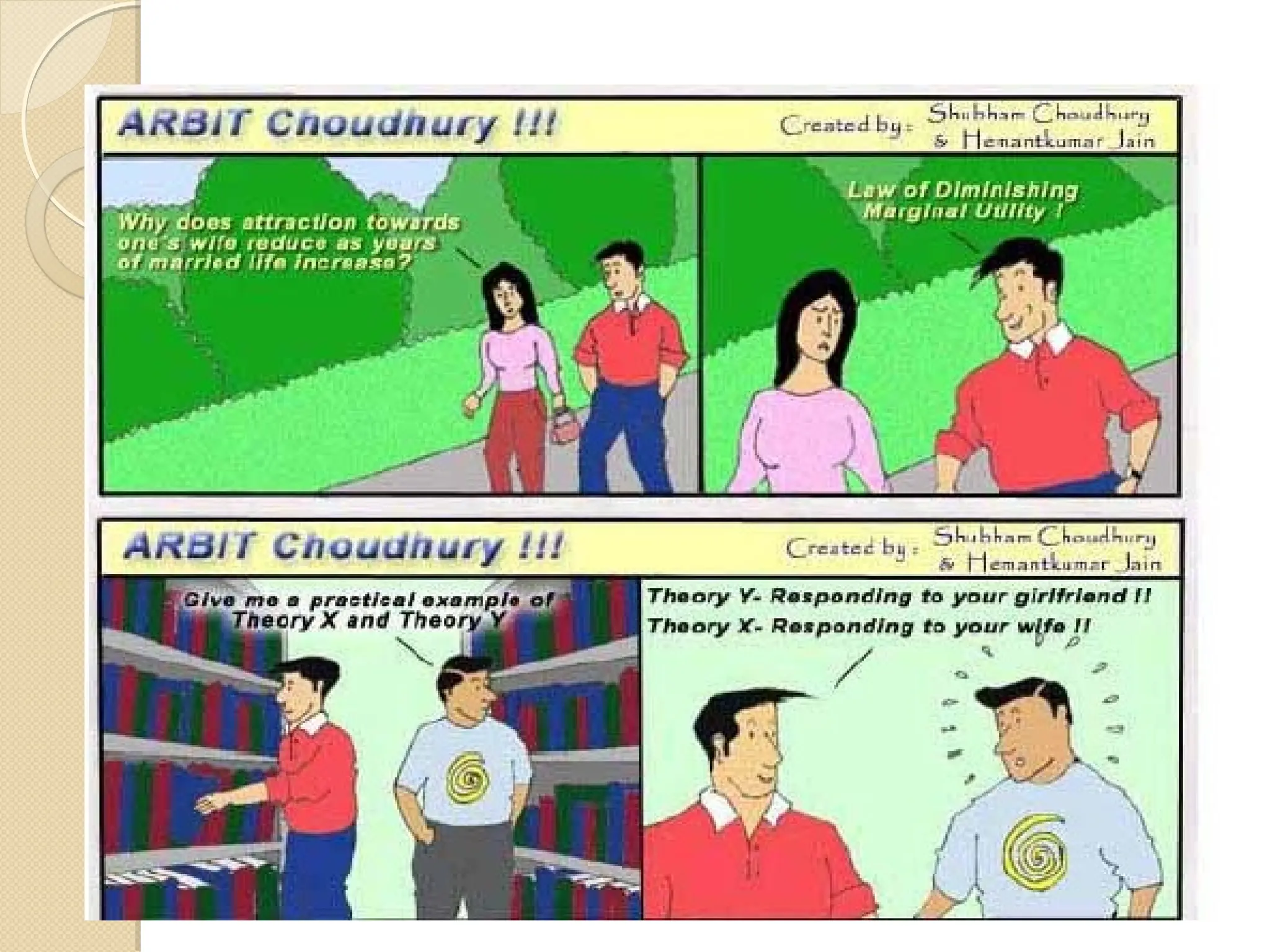
TEACHING WITH SENSE OF
HUMOUR
HUMOUR
Laughter is a natural, universal
phenomenon, with beneficial effects, both
physical and psychological.
Everyone loves a teacher with an
infectious sense of humor.
Ability to relax people and reduce tension.
Communication
Communication
1. Words
2. Voice Tone
3. Body language
4. Compelling Message
5. Listening
6. 4-language skill- Visual (High Energy),
Auditory (Articulate), Analytical
(Thorough) and kinesthetic (warm
connect)
7. Authentic Passion
From Personal Files……..
GENERAL TEACHING METHODOLOGY
• Plan your class as a mix of concepts/theories, their appli-
cation & relevance, examples, stories, case studies, (eg
demand for currency, Continental airlines, Pharma Co.)
• Just lecture 60% of the class, leave 40% to them (Ask them
to share experiences relating to all the concepts you are
teaching so that they can correlate-these can be from daily
life – DMU, Marginalism, Price discrimination)
• Give interesting and relevant assignments
(for eg, collect price and sales figs of cars and compute
elasticity over a 5 yr period, collect GDP and other data for
4 countries and give its macro implications )
 Be passionate about your work. A song in your heart as you enter a class.
 In today’s online world – what info you impart is less important than how you
impart
 Teach less, engage more
 There is no substitute for good communication skills
 Move with world - use modern technology for teaching but not at the cost of the
basic teaching skills
 Every session should have a format –concept, case, discussion, exercise, etc)
 Add humour to your classes.
 Always take feedback to improve yourself
 Move from being a teacher to becoming a mentor
26
In Summary
Always take Feedback
Its gives you inputs to make yours teaching
and delivery more effective, student
oriented, and relevant to them
Story of the Gardener Boy.
27
EXPERIENCE SHARING
EXPERIENCE SHARING

student engagement and teaching methodology1.ppt

  • 1.
    Student Engagement and StudentEngagement and Teaching Methodology Teaching Methodology FDP on 10 FDP on 10th th July 2018, July 2018, HRDC, Osmania Univ. HRDC, Osmania Univ. Dr. Nandita Sethi Founder & MD
  • 2.
    Mindset by CarollS Dweck Mindset by Caroll S Dweck • The Expectation Effect • During the 1964-1965 school year, Harvard's Robert Rosenthal conducted an experiment in an elementary school to see whether teacher expectations influenced their students' performances.Teachers were told the names of children in their classes who were "late bloomers," about to dramatically spurt in their academic learning. • . WHAT WAS THE RESULT?
  • 3.
    Research on divergentthinking Research on divergent thinking  In 1968, George Land conducted research to study the creative development and capacity for divergent thinking in children, using a similar test to the one devised to identify innovative engineers and scientists for NASA.  He tested 1,600 children intermittently at  Age five - 98% had divergent thinking  Age ten – 30% had divergent thinking  Age 15-year – 12 % had divergent thinking.  Same test was given to 280,000 adults  Adult - the result was just 2%.
  • 4.
    Presentation path Presentation path •The Millennial Generation • Massive changes in the educational sector • Student Engagement • Classroom Management • Teaching Methodology • Communication/Presentation Skills
  • 5.
    1. The MillennialGeneration : Some 1. The Millennial Generation : Some Interesting Facts Interesting Facts Students are not attentive to what is being said in a lecture 40% of the time. Students retain 70% of the information in the first ten minutes of a lecture but only 20% in the last ten minutes. Meyer & Jones, 1993 5
  • 6.
    How Do WeDo It? How Do We Do It? Attention Spans: Most students can only sit and absorb information for fifteen minutes at a time. Many students can’t focus for ten minutes!
  • 7.
    2. Massive changesin Educational Sector 2. Massive changes in Educational Sector  Role of a teacher …..paradigm shift . No longer an information provider  What’s going to be important is….. how to impart this information and knowledge.  Delivery of knowledge is getting more personalised. Students are to be looked as customers  Online world has reduced the need for attending a physical class itself. MOOCs are becoming a norm  Technology will change the way a traditional classroom is envisioned the human factor will continue to be important specially in areas of experience.
  • 8.
    Other change thatare going to impact this Other change that are going to impact this fraternity fraternity  Informal education is going to be more important than formal education.  Job market and skill requirements are constantly changing. Newer skills are demanding different types of training and courses  Education is moving from being focused on job seeking to job creating  So a teacher and institutions in their present form are soon going to be outdated if they don’t undergo a metamorphosis.Teachers now will be looked at more as Mentors & facilitators.
  • 9.
    Learning Pyramid Usingvarious Teaching Learning Pyramid Using various Teaching techniques techniques Average learning retention rates
  • 10.
    How Faculty SpendIn-Class Time How Faculty Spend In-Class Time What do students retain?
  • 11.
    Active Learning notPassive Active Learning not Passive Research shows that students need to be INVOLVED in order to remember information, concepts and skills
  • 12.
    3. Student Engagement 3.Student Engagement  Today, more than info, it’s the way you transfer the info that is important  Empathize with students  Speak their language  Use modern not outdated techniques of teaching  Your body language and attitude should reflect confidence as well as student friendliness  Be close to students as well as know the limits of the closeness.  Command respect not demand it.
  • 13.
    Types of StudentEngagement Types of Student Engagement  Intellectual Engagement – paper, project, present.,  Emotional Engagement – passions, future aspirations, non-academic issues, leaning issues  Behavioural Engagement- group/team work, creative expression, leadership roles, role plays  Social Engagement- activities like clubs, debates, social work, social causes, etc  Cultural Engagement – Cross cultural Music, dance, plays, movies, food  Physical Engagement- Kinesthetic learning refers to use of physical activities while learning- games and creating products in class, etc.
  • 14.
    Class room management……personalfiles Class room management……personal files • Set ground rules in the first class and strictly go by it (Example- 10 golden rules) • Plan instruction effectively and format the class for maximising the attention span. (concepts, exercise, video, case study, Role play, article review, experience sharing, etc) • Open the class with a dramatic story, case and draw interest on the issue. ( Law of Demand) • Continue that interest by giving live examples, more stories, cases, etc…………ask them to come out with the concepts as if they have made them……giving them a feeling of discovery • Summarise the class on the key concepts discussed……..or make them do the summarisation • Take feedback after a few classes to make corrective action…..this really helps in addressing their issues
  • 15.
    Focus on InstructionalObjectives Focus on Instructional Objectives 15 1. What should students know and be able to Do (objective)? 3. How will I, and they, know when they are successful? 4. What learning experiences will facilitate their success? 6. Based on data, how do I refine the learning experiences? 2. How does this lesson objective fit into the “big picture” of instruction this year? 5. What resources will I Use?
  • 16.
    Planning Teaching: Planning Teaching: For teaching to be effective, two ingredients are needed at the outset:  Careful planning and Constructive Alignment.  The former will be especially reliant on ‘SMART’ learning outcomes and the latter on connectivity between strategies for LTA (Learning and Teaching Activity).
  • 17.
    Constructive alignment: Constructive alignment: the“golden triangle” the “golden triangle” Learning Outcomes Teaching and Learning Activity Assessment
  • 18.
    ‘ ‘PAR PAR’ ’ and and ‘ ‘BEM BEM’ ’ Present, Apply, Review (PAR)  Present content  Apply content  Review content  Beginning, End and Middle Principle (BEM)  The BEM (beginning – end – middle) principle states that the beginnings and endings of presented content are more readily remembered than content in the middle. (The Primacy Effect)  Thus, the first 10-12 minutes and the last 8-10 minutes of a presentation (The Recency Effect) are optimum periods for learning.
  • 19.
    Opening & Closure& Middle Opening & Closure & Middle  Opening- ‘Well begun is half done’  Open dramatically  Create interest  Lay context of topic  Objectives and expected outcome  Middle – engage with case, exercise, discussion,  Closure This takes two forms:  Transitional closure  Summative closure  Making each student-centred is crucial to successful learning and teaching.
  • 20.
    Example Example  Class opening: Law of Demand -Article  Its role in the bigger context of the subject - Alignment  Take home learning – Experience sharing As to connect with real life situations – Assess it  Usage
  • 21.
    TEACHING WITH SENSEOF TEACHING WITH SENSE OF HUMOUR HUMOUR Laughter is a natural, universal phenomenon, with beneficial effects, both physical and psychological. Everyone loves a teacher with an infectious sense of humor. Ability to relax people and reduce tension.
  • 24.
    Communication Communication 1. Words 2. VoiceTone 3. Body language 4. Compelling Message 5. Listening 6. 4-language skill- Visual (High Energy), Auditory (Articulate), Analytical (Thorough) and kinesthetic (warm connect) 7. Authentic Passion
  • 25.
    From Personal Files…….. GENERALTEACHING METHODOLOGY • Plan your class as a mix of concepts/theories, their appli- cation & relevance, examples, stories, case studies, (eg demand for currency, Continental airlines, Pharma Co.) • Just lecture 60% of the class, leave 40% to them (Ask them to share experiences relating to all the concepts you are teaching so that they can correlate-these can be from daily life – DMU, Marginalism, Price discrimination) • Give interesting and relevant assignments (for eg, collect price and sales figs of cars and compute elasticity over a 5 yr period, collect GDP and other data for 4 countries and give its macro implications )
  • 26.
     Be passionateabout your work. A song in your heart as you enter a class.  In today’s online world – what info you impart is less important than how you impart  Teach less, engage more  There is no substitute for good communication skills  Move with world - use modern technology for teaching but not at the cost of the basic teaching skills  Every session should have a format –concept, case, discussion, exercise, etc)  Add humour to your classes.  Always take feedback to improve yourself  Move from being a teacher to becoming a mentor 26 In Summary
  • 27.
    Always take Feedback Alwaystake Feedback Its gives you inputs to make yours teaching and delivery more effective, student oriented, and relevant to them Story of the Gardener Boy. 27
  • 28.

Editor's Notes

  • #5 Therefore, we need to make sure to engage students in active participation.
  • #9 The foundation coalition is a coalition of 8 institutions funded by the NSF in 1993 as the 5th coalition in the NSF’s Engineering Educations Coalition Program Institutions include: Texas A and M, U Mass, and UW, Arizona State, U of Alabama 4 “thrusts” Improved integration of subject matter Enhancing active learning Enhancing technology Continuous quality improvement through evaluation and assessment : whose focus is primarily science education but they have a strong interest in the pursuit of support in the area of active learning in the sciences They devised another visual model called the Cone of Learning which corroborates Sousa’s Stice’s and others’ findings: that we tend to remember more the more we are INVOLVED. Their graph suggests that we can approach maximum retention by “doing the real thing” Their collaboration of studies corroborates sousa’s and other findings that the trend in learning is that the more involved we are, the more we tend to remember. LEARNING TO DRIVE EXAMPLE
  • #15 Collaborate with your grade level colleagues to share ideas, strategies, and resources. Plan lessons together keeping in mind the your own students needs.
  • #26 Guthrie’s study of active engagement concluded that engaged readers from less educated families had higher achievement rates than disengaged readers from higher educated families. The results prove that active student engagement in reading needs to be a priority and key feature in reading instruction for all students.