EFFECTIVE TEACHING
EDUARDO B. ARDALES, Ed. D.
Sample Pictures.lnk
“Teachers like leaves,
everywhere abound.
Effective teachers, like
fruits, are rarely found.”
 Teachers in all Philippine schools are
committed and accountable for providing
classroom instruction with results that are
manifested in high performance levels in
terms of student learning outcomes.
 Teachers are dedicated to the well-being of
the students and communities they serve,
taking into account their cultural diversity,
group aspirations and what is valued in
education.
Statement of Principle
Our country seeks to prepare teachers
who
demonstrate excellence
in the classroom
serve as leaders in the
field of education
Common Attributes of
Teaching
Teaching can be considered a
process
Teaching can also be regarded
as an interpersonal activity
Teaching is intentional
What is Good
Teaching?
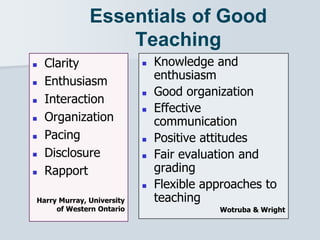
Essentials of Good
Teaching
 Clarity
 Enthusiasm
 Interaction
 Organization
 Pacing
 Disclosure
 Rapport
Harry Murray, University
of Western Ontario
 Knowledge and
enthusiasm
 Good organization
 Effective
communication
 Positive attitudes
 Fair evaluation and
grading
 Flexible approaches to
teaching
Wotruba & Wright
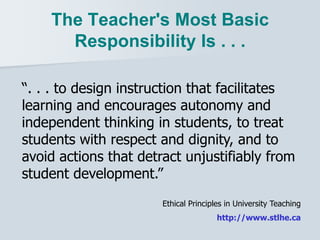
The Teacher's Most Basic
Responsibility Is . . .
“. . . to design instruction that facilitates
learning and encourages autonomy and
independent thinking in students, to treat
students with respect and dignity, and to
avoid actions that detract unjustifiably from
student development.”
Ethical Principles in University Teaching
http://www.stlhe.ca
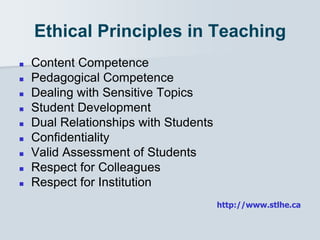
Ethical Principles in Teaching
 Content Competence
 Pedagogical Competence
 Dealing with Sensitive Topics
 Student Development
 Dual Relationships with Students
 Confidentiality
 Valid Assessment of Students
 Respect for Colleagues
 Respect for Institution
http://www.stlhe.ca
Seven Principles of Good Practice
1. Encourage contact between students and
teachers
2. Develop rapport and cooperation among
students
3. Use active learning techniques
4. Give prompt feedback
5. Emphasize time on task
6. Communicate high expectations
7. Respect diverse talents and ways of learning
(Chickering & Gamson)
)
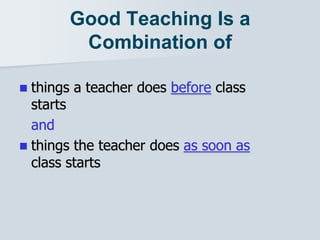
Good Teaching Is a
Combination of
 things a teacher does before class
starts
and
 things the teacher does as soon as
class starts
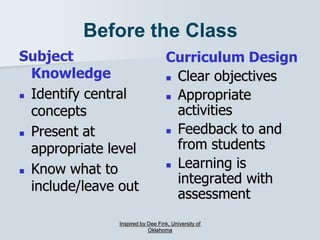
Before the Class
Subject
Knowledge
 Identify central
concepts
 Present at
appropriate level
 Know what to
include/leave out
Curriculum Design
 Clear objectives
 Appropriate
activities
 Feedback to and
from students
 Learning is
integrated with
assessment
Inspired by Dee Fink, University of
Oklahoma
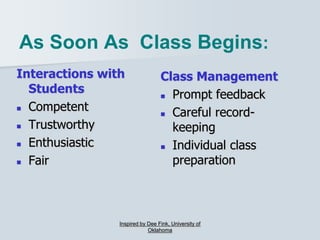
As Soon As Class Begins:
Interactions with
Students
 Competent
 Trustworthy
 Enthusiastic
 Fair
Class Management
 Prompt feedback
 Careful record-
keeping
 Individual class
preparation
Inspired by Dee Fink, University of
Oklahoma
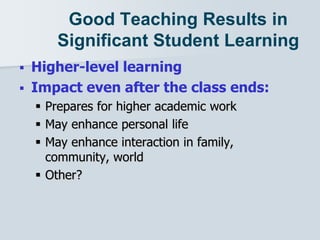
Good Teaching Results in
Significant Student Learning
 Higher-level learning
 Impact even after the class ends:
 Prepares for higher academic work
 May enhance personal life
 May enhance interaction in family,
community, world
 Other?
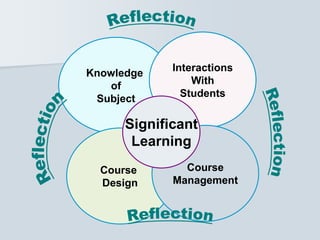
Knowledge
of
Subject
Course
Design
Interactions
With
Students
Course
Management
Significant
Learning
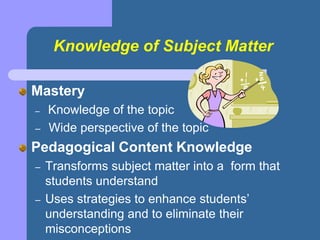
Knowledge of Subject Matter
Mastery
– Knowledge of the topic
– Wide perspective of the topic
Pedagogical Content Knowledge
– Transforms subject matter into a form that
students understand
– Uses strategies to enhance students’
understanding and to eliminate their
misconceptions
Use of Instructional Materials, Aids and Devices
Suits materials for instruction to the aim
of the lesson
Utilizes realistic, practical, indigenous,
recycled, improvised, and easy to
handle materials, aids and devices.
Maximizes the use of instructional
materials, aids, and devices
Has adequate and updated
instructional materials for group activity
Methodology/Presentation
– Clarity of Instruction
Checks previous knowledge of the learners
Summarizes the lesson at the end
Informs learner of skills and knowledge
expected at the end of the lesson
– Appropriate and Creative Use of
Strategies
Uses strategies to reorganize students’
understanding and to correct
misconceptions
Communication
Questioning Skills
– Gives students time to think when
asked thought- provoking higher-order
thinking skills (HOTS) questions
Examples: How? Why? What do you
mean? What do you observed? What if
….? Can you guess what will come next?
Can you describe the pattern? What
conclusion can you draw?
– Phrases questions clearly and
accurately
Listening Skills
 Listens carefully to the students’
response
 Paraphrases students’ answers
when necessary
 Allows enough time for students to
explain their answer
Blackboard Skills
Writes legibly and neatly
Uses blackboard effectively, writing
clearly from left to right
Feedback
Reinforces students’ answer;
appropriately addresses incorrect
answers
Leads students to arrive at the
correct answer
Body Language
Show enthusiasm through facial
expressions
Establishes eye contact with students
from time to time
Stays at appropriate distance from
the students
Demonstrates relaxed body posture
and gestures
Mannerism
– Shows no distracting
mannerism
– Does not use same word(s) or
phrase(s) frequently
Language
– Uses correct grammar
– Talks with modulated voice
Movement
– Moves freely inside the classroom
– Moves with confidence and poise
 Class Participation
– Has rapport with the students
– Generates interest and enthusiasm
among students
– Involves more students in class
discussion/activities
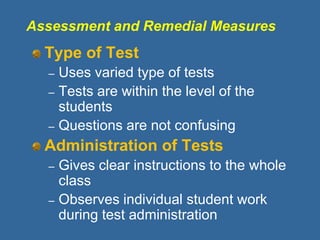
Assessment and Remedial Measures
Type of Test
– Uses varied type of tests
– Tests are within the level of the
students
– Questions are not confusing
Administration of Tests
– Gives clear instructions to the whole
class
– Observes individual student work
during test administration
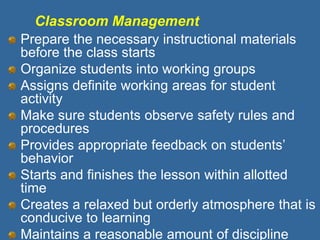
Classroom Management
Prepare the necessary instructional materials
before the class starts
Organize students into working groups
Assigns definite working areas for student
activity
Make sure students observe safety rules and
procedures
Provides appropriate feedback on students’
behavior
Starts and finishes the lesson within allotted
time
Creates a relaxed but orderly atmosphere that is
conducive to learning
Maintains a reasonable amount of discipline
GOOD TEACHING: THE TOP TEN
REQUIREMENTS
 One
Good teaching is as
much about passion as it
is about reason.
GOOD TEACHING: THE TOP TEN REQUIREMENTS
 Two
Good teaching is about
substance and treating
students as consumers
of knowledge.
GOOD TEACHING: THE TOP TEN REQUIREMENTS
 Three
Good teaching is about
listening, questioning,
being responsive, and
remembering that each
student and class is
different.
GOOD TEACHING: THE TOP TEN REQUIREMENTS
 Four
Good teaching is about NOT
always having a fixed agenda
and being rigid, but being
flexible, fluid, experimenting,
and having the confidence to
react and adjust to changing
circumstances.
GOOD TEACHING: THE TOP TEN REQUIREMENTS
 Five
Good teaching is also about
style.
GOOD TEACHING: THE TOP TEN REQUIREMENTS
 Six
This is very important -- good
teaching is about humor.
GOOD TEACHING: THE TOP TEN REQUIREMENTS
 Seven
Good teaching is about
caring, nurturing, and
developing minds and
talents.
GOOD TEACHING: THE TOP TEN REQUIREMENTS
 Eight
Good teaching is supported
by strong and visionary
leadership, and very tangible
institutional support --
resources, personnel, and
funds.
GOOD TEACHING: THE TOP TEN REQUIREMENTS
 Nine
Good teaching is about
mentoring between senior
and junior faculty, teamwork,
and being recognized and
promoted by one's peers.
GOOD TEACHING: THE TOP TEN REQUIREMENTS
 Ten
At the end of the day, good teaching is
about having fun, experiencing
pleasure and intrinsic rewards ... like
locking eyes with a student in the back
row and seeing the synapses and
neurons connecting, thoughts being
formed, the person becoming better,
and a smile cracking across a face as
learning all of a sudden happens.
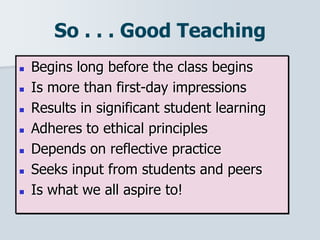
So . . . Good Teaching
 Begins long before the class begins
 Is more than first-day impressions
 Results in significant student learning
 Adheres to ethical principles
 Depends on reflective practice
 Seeks input from students and peers
 Is what we all aspire to!
"A teacher affects
eternity; he can
never tell where his
influence stops."
-Henry Brooks Adams
• BEFORE I END ….
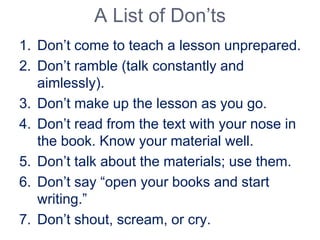
A List of Don’ts
1. Don’t come to teach a lesson unprepared.
2. Don’t ramble (talk constantly and
aimlessly).
3. Don’t make up the lesson as you go.
4. Don’t read from the text with your nose in
the book. Know your material well.
5. Don’t talk about the materials; use them.
6. Don’t say “open your books and start
writing.”
7. Don’t shout, scream, or cry.
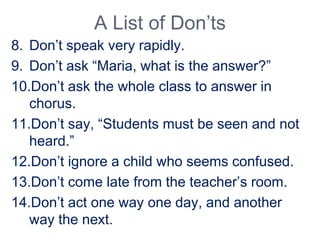
A List of Don’ts
8. Don’t speak very rapidly.
9. Don’t ask “Maria, what is the answer?”
10.Don’t ask the whole class to answer in
chorus.
11.Don’t say, “Students must be seen and not
heard.”
12.Don’t ignore a child who seems confused.
13.Don’t come late from the teacher’s room.
14.Don’t act one way one day, and another
way the next.
FINALLY
43
May you all touch the lives of your students in very
special ways.
May you find the joy in teaching that I have found
all these years.
May you find a tiny bit of wisdom in my words.
May you start off better prepared than I ever was.
May you grow and bloom and make this world a better
place for being a teacher.
May you all find joy in teaching.
ADAPTED
44
Thank You.
Effective Teaching