Built In Self Test(BIST)
Prepared by
Mrs.V.Femila Savio/AP/ECE
St.Xavier’s Catholic College of Engineering, Nagercoil
Introduction
•These techniques add area to the chip for the test
logic, but reduce the test time required and thus
can lower the overall system cost.
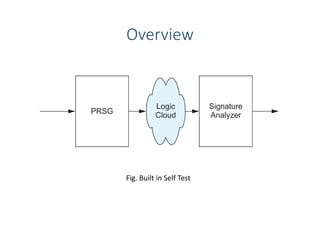
•This involves using a pseudo-random sequence
generator (PRSG) to produce the input signals for a
section of combinational circuitry and a signature
analyzer to observe the output signals.
Overview
Fig. Built in Self Test
PRSG
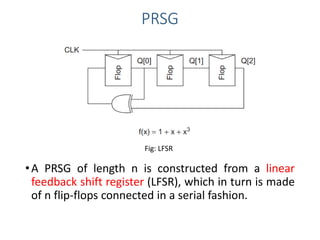
•A PRSG of length n is constructed from a linear
feedback shift register (LFSR), which in turn is made
of n flip-flops connected in a serial fashion.
Fig: LFSR
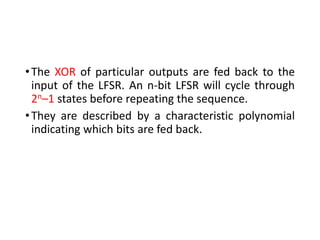
•The XOR of particular outputs are fed back to the
input of the LFSR. An n-bit LFSR will cycle through
2n–1 states before repeating the sequence.
•They are described by a characteristic polynomial
indicating which bits are fed back.
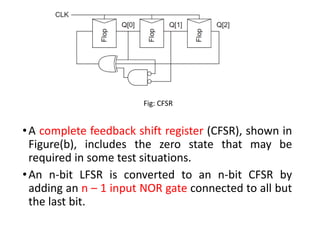
•A complete feedback shift register (CFSR), shown in
Figure(b), includes the zero state that may be
required in some test situations.
•An n-bit LFSR is converted to an n-bit CFSR by
adding an n – 1 input NOR gate connected to all but
the last bit.
Fig: CFSR
Signature Analyzer
•A signature analyzer receives successive outputs of
a combinational logic block and produces a
syndrome that is a function of these outputs.
• The syndrome is reset to 0, and then XORed with
the output on each cycle.
•The syndrome is swizzled each cycle so that a fault
in one bit is unlikely to cancel itself out.
•At the end of a test sequence, the LFSR contains the
syndrome that is a function of all previous outputs.
•This can be compared with the correct syndrome
(derived by running a test program on the good
logic) to determine whether the circuit is good or
bad.
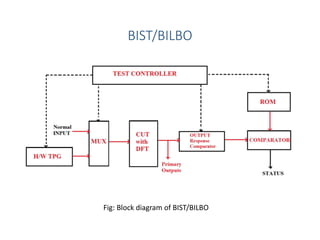
•The combination of signature analysis and the scan
technique creates a structure known as BIST—for
Built-In Self-Test or BILBO—for Built-In Logic Block
Observation.
BIST/BILBO
Fig: Block diagram of BIST/BILBO
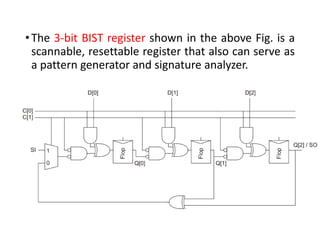
•The 3-bit BIST register shown in the above Fig. is a
scannable, resettable register that also can serve as
a pattern generator and signature analyzer.
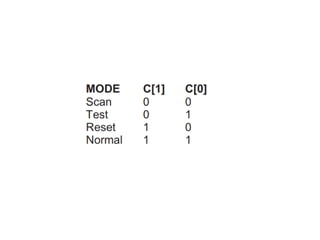
•C[1:0] specifies the mode of operation.
• In the reset mode (10), all the flip-flops are
synchronously initialized to 0.
•In normal mode (11), the flip-flops behave normally
with their D input and Q output.
• In scan mode (00), the flip-flops are configured as a
3-bit shift register between SI and SO.
•Note that there is an inversion between each stage.
•In test mode (01), the register behaves as a pseudo-
random sequence generator or signature analyzer.
•If all the D inputs are held low, the Q outputs loop
through a pseudo-random bit sequence, which can
serve as the input to the combinational logic.
• If the D inputs are taken from the combinational
logic output, they are swizzled with the existing
state to produce the syndrome.
•BIST is performed by first resetting the syndrome in
the output register. Then both registers are placed
in the test mode to produce the pseudo-random
inputs and calculate the syndrome.
•Finally, the syndrome is shifted out through the
scan chain.
Advantges
•Low cost
•Better fault coverage
•Shorter test time
•Allow the consumers themselves to test the chip
Disdvantges
•Additional Silicon area and fabrication process
required
•On chip testing hardware itself can fail
Introduction to Built In Self Test (BIST).pdf

Introduction to Built In Self Test (BIST).pdf

  • 1.
    Built In SelfTest(BIST) Prepared by Mrs.V.Femila Savio/AP/ECE St.Xavier’s Catholic College of Engineering, Nagercoil
  • 2.
    Introduction •These techniques addarea to the chip for the test logic, but reduce the test time required and thus can lower the overall system cost. •This involves using a pseudo-random sequence generator (PRSG) to produce the input signals for a section of combinational circuitry and a signature analyzer to observe the output signals.
  • 3.
  • 4.
    PRSG •A PRSG oflength n is constructed from a linear feedback shift register (LFSR), which in turn is made of n flip-flops connected in a serial fashion. Fig: LFSR
  • 5.
    •The XOR ofparticular outputs are fed back to the input of the LFSR. An n-bit LFSR will cycle through 2n–1 states before repeating the sequence. •They are described by a characteristic polynomial indicating which bits are fed back.
  • 6.
    •A complete feedbackshift register (CFSR), shown in Figure(b), includes the zero state that may be required in some test situations. •An n-bit LFSR is converted to an n-bit CFSR by adding an n – 1 input NOR gate connected to all but the last bit. Fig: CFSR
  • 7.
    Signature Analyzer •A signatureanalyzer receives successive outputs of a combinational logic block and produces a syndrome that is a function of these outputs. • The syndrome is reset to 0, and then XORed with the output on each cycle. •The syndrome is swizzled each cycle so that a fault in one bit is unlikely to cancel itself out. •At the end of a test sequence, the LFSR contains the syndrome that is a function of all previous outputs.
  • 8.
    •This can becompared with the correct syndrome (derived by running a test program on the good logic) to determine whether the circuit is good or bad. •The combination of signature analysis and the scan technique creates a structure known as BIST—for Built-In Self-Test or BILBO—for Built-In Logic Block Observation.
  • 9.
  • 10.
    •The 3-bit BISTregister shown in the above Fig. is a scannable, resettable register that also can serve as a pattern generator and signature analyzer.
  • 12.
    •C[1:0] specifies themode of operation. • In the reset mode (10), all the flip-flops are synchronously initialized to 0. •In normal mode (11), the flip-flops behave normally with their D input and Q output. • In scan mode (00), the flip-flops are configured as a 3-bit shift register between SI and SO. •Note that there is an inversion between each stage. •In test mode (01), the register behaves as a pseudo- random sequence generator or signature analyzer.
  • 13.
    •If all theD inputs are held low, the Q outputs loop through a pseudo-random bit sequence, which can serve as the input to the combinational logic. • If the D inputs are taken from the combinational logic output, they are swizzled with the existing state to produce the syndrome. •BIST is performed by first resetting the syndrome in the output register. Then both registers are placed in the test mode to produce the pseudo-random inputs and calculate the syndrome. •Finally, the syndrome is shifted out through the scan chain.
  • 14.
    Advantges •Low cost •Better faultcoverage •Shorter test time •Allow the consumers themselves to test the chip Disdvantges •Additional Silicon area and fabrication process required •On chip testing hardware itself can fail