
DFT (design for testability)
OBJECTIVES
 What is DFT?
 Why we need DFT?
 DFT methods.
 What is scanned flip flop?
 What is scan chain?
 Fault models.
 Stuck at fault models.
What is DFT?
 DFT is a technique, which facilitates a design to become
testable after production. Its the extra logic which we put in
the normal design, during the design process, which helps
its post-production testing.
Why we need DFT?
 Post-production testing is necessary because, the process of
 manufacturing is not 100% error free.
 There are defects in silicon which contribute towards the errors introduced
in the physical device.
 Of course a chip will not work as per the specifications if there are any
errors
 To increase Productivity
 To improve Quality
 how to detect that?
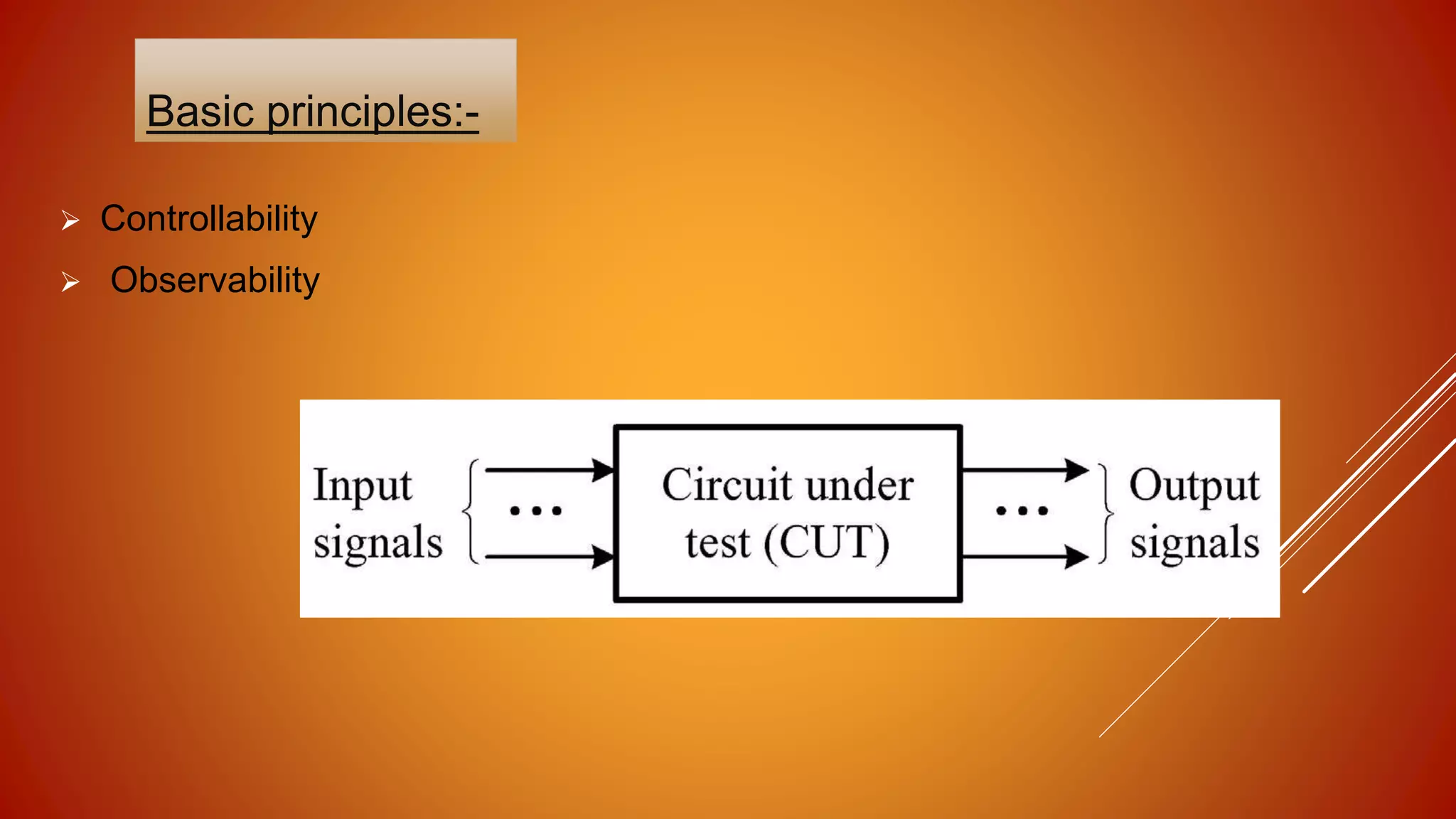
Basic principles:-
 Controllability
 Observability
DFT methods
There are two types of dft methods are
DFT methods for digital circuits:
 Ad-hoc methods
 Structured methods
DFT techniques
Ad-hoc technique:-
 it Is temporary technique
 Good design practice learnt through experience are used as guide lines for ad-
hoc DFT
 Structural technique:-
 it provides more systematic & automatic approach to enhance the design
testability.
 It targets manufacturing defects.
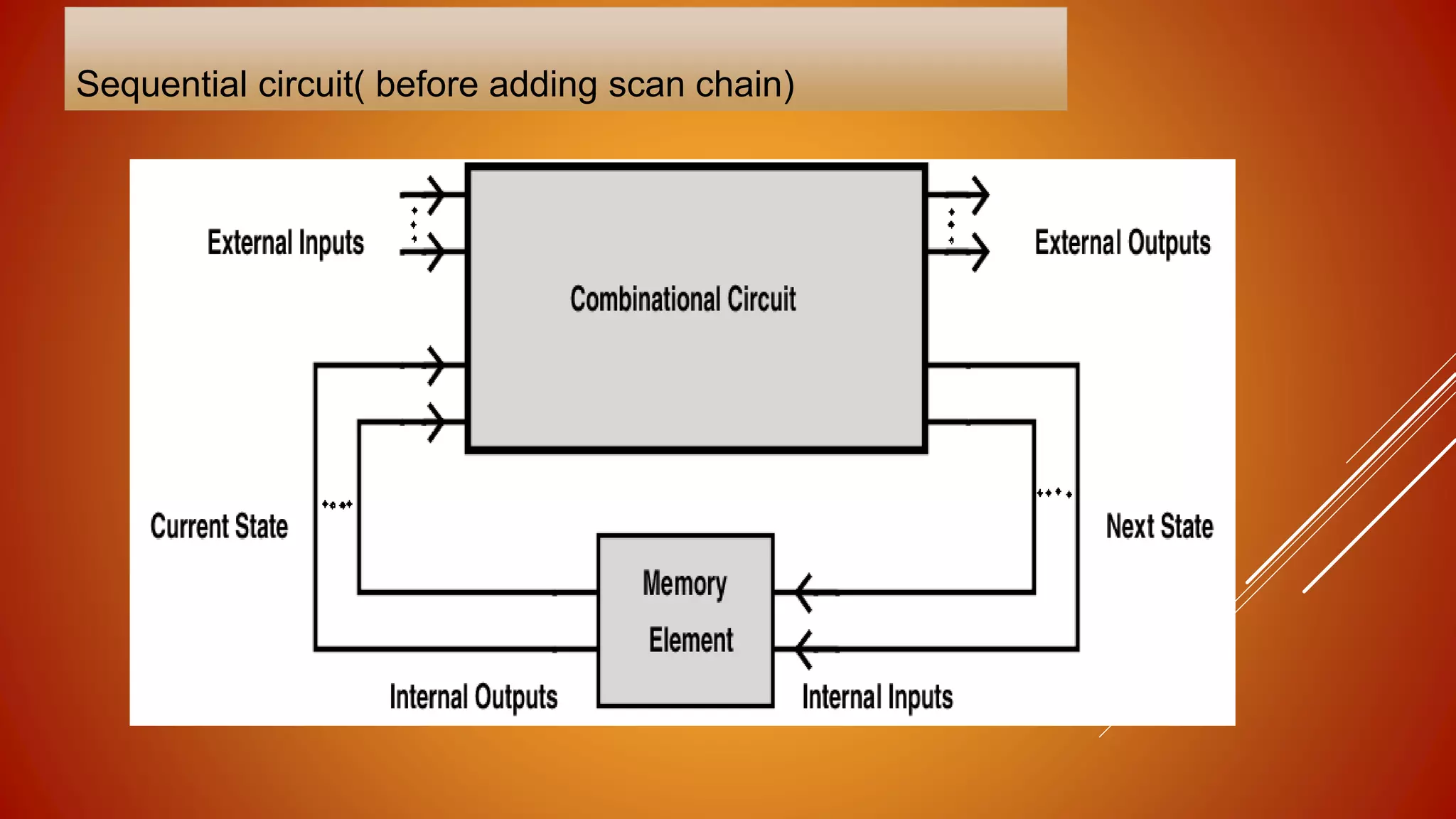
Sequential circuit( before adding scan chain)
What is scanned flip flop?
 D flip flop followed by mux…
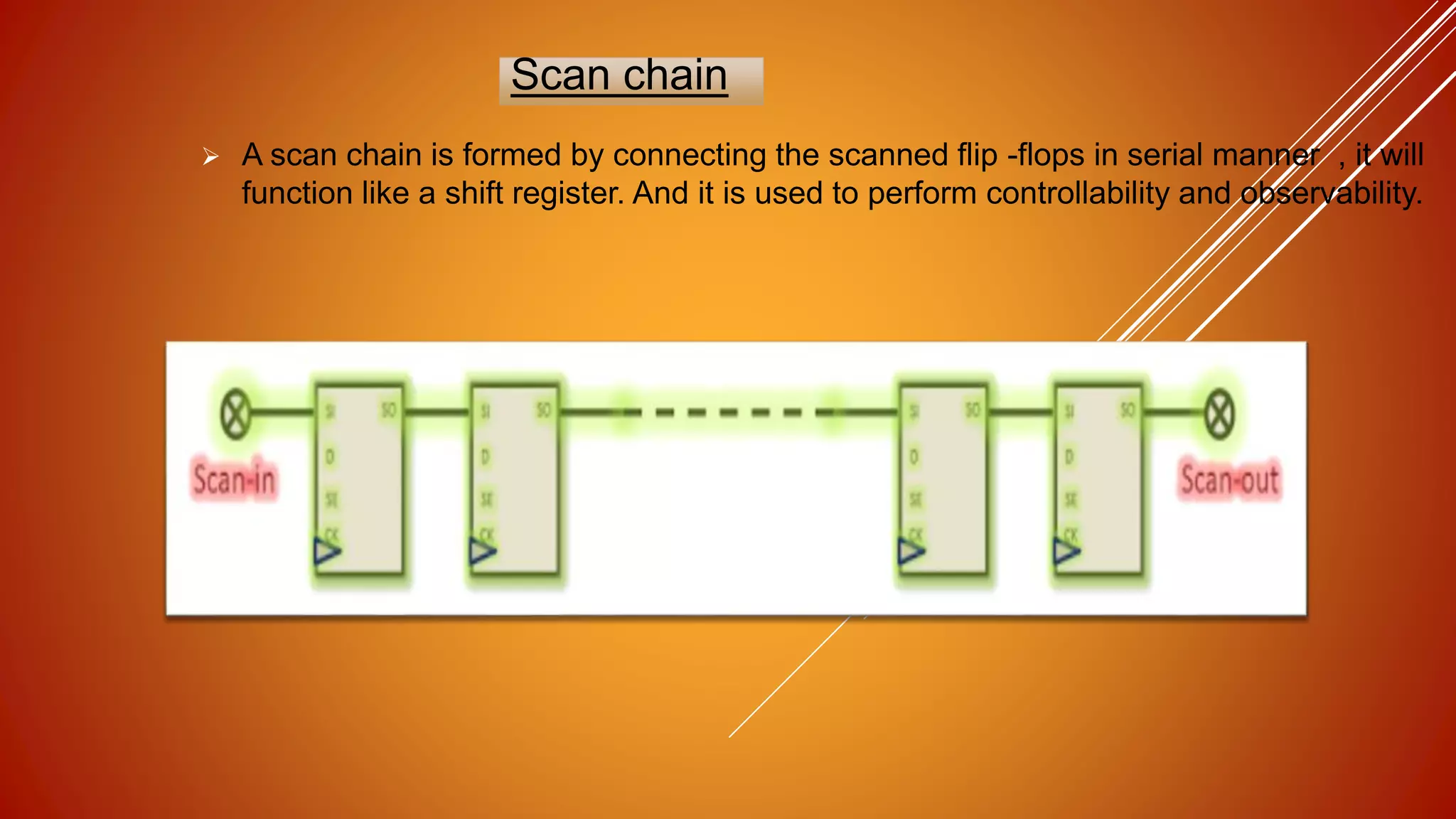
Scan chain
 A scan chain is formed by connecting the scanned flip -flops in serial manner , it will
function like a shift register. And it is used to perform controllability and observability.
After adding scan chain
Fault models
FAULT MODELS
 Stuck-at fault model
 Transistor faults
 Bridging faults
 Delay faults
• Delay faults can be classified as:
• Gate delay fault
• 2) Transition fault
• 3) Hold Time fault
• 4) Slow/Small delay fault
Fault modeling
Def:-
Due to defect during manufacturing of integrated circuit, There is need to
model the possible faults that might occur during fabrication process, this is
called fault modelling.
 Stuck-at-fault.
 Transition fault
Stuck at fault:-
 It is most popular fault model used in practice .
 These faults occurred due to process variations , manufacturing defects.
Stuck at fault models
Dft (design for testability)

Dft (design for testability)

  • 1.
    DFT (design fortestability)
  • 2.
    OBJECTIVES  What isDFT?  Why we need DFT?  DFT methods.  What is scanned flip flop?  What is scan chain?  Fault models.  Stuck at fault models.
  • 3.
    What is DFT? DFT is a technique, which facilitates a design to become testable after production. Its the extra logic which we put in the normal design, during the design process, which helps its post-production testing.
  • 4.
    Why we needDFT?  Post-production testing is necessary because, the process of  manufacturing is not 100% error free.  There are defects in silicon which contribute towards the errors introduced in the physical device.  Of course a chip will not work as per the specifications if there are any errors  To increase Productivity  To improve Quality  how to detect that?
  • 5.
  • 6.
    DFT methods There aretwo types of dft methods are DFT methods for digital circuits:  Ad-hoc methods  Structured methods
  • 7.
    DFT techniques Ad-hoc technique:- it Is temporary technique  Good design practice learnt through experience are used as guide lines for ad- hoc DFT  Structural technique:-  it provides more systematic & automatic approach to enhance the design testability.  It targets manufacturing defects.
  • 9.
    Sequential circuit( beforeadding scan chain)
  • 10.
    What is scannedflip flop?  D flip flop followed by mux…
  • 11.
    Scan chain  Ascan chain is formed by connecting the scanned flip -flops in serial manner , it will function like a shift register. And it is used to perform controllability and observability.
  • 12.
  • 13.
    Fault models FAULT MODELS Stuck-at fault model  Transistor faults  Bridging faults  Delay faults • Delay faults can be classified as: • Gate delay fault • 2) Transition fault • 3) Hold Time fault • 4) Slow/Small delay fault
  • 14.
    Fault modeling Def:- Due todefect during manufacturing of integrated circuit, There is need to model the possible faults that might occur during fabrication process, this is called fault modelling.  Stuck-at-fault.  Transition fault
  • 15.
    Stuck at fault:- It is most popular fault model used in practice .  These faults occurred due to process variations , manufacturing defects.
  • 16.