 The grammar- translation method of
  foreign language teaching is one of the
  most traditional methods.
 It was originally used to teach ‘dead’
  languages (and literatures) such as Latin
  and Greek, involving little or no spoken
  communication or listening
  comprehension.
To read and translate literary
 masterpieces and classics.
 A focus on learning the rules of grammar and
  their application in translation passages from one
  language into the other
 Vocabulary in the target language is learned
  through direct translation from the native
  language. e.g.
           the house = la casa
           the mouse = el ratÓn
   Readings in the target language are translated
    directly and then discussed in the native language.

   Grammar is taught with extensive explanations in
    the native language, and only later applied in the
    production of sentences through translation from
    one language to the other. e.g:
    Do you have my book? = ………………………….
    I don’t know where your book is = ………………….
   Students will be able to read literature written in
    the target language

   Students will be able to translate from one
    language to another

   It Helps students to develop reading and writing
    skill
   To help students read and appreciate foreign
    language literature

   Students can become more familiar with the
    grammar of their native language

   Helpful for mental exercise
PRINCIPLES
 Literary language is superior to the spoken
  language. Students study literature and fine arts.
 Translating each language into each other is an
  important goal for learners.
 The authority in the classroom is the teacher.
 The ability to communicate with the target
  language is not among the goals of instruction.
PRINCIPLES

 The   primary skills to be improved are
  reading and writing.
 Its focus is on accuracy (grammatical correctness)
  and not fluency.
 Ss should be conscious of the
  grammatical rule of the target language.
1. Translation of a literary passage

  › Students will be asked to read a literary
    passage and then translate the target
    language into their native language
  › Translation may be written or spoken
  › Translation made by the students can show
    that they understand their meaning
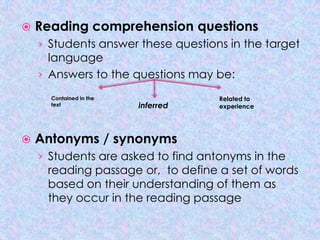
   Reading comprehension questions
    › Students answer these questions in the target
      language
    › Answers to the questions may be:

      Contained in the              Related to
      text               inferred   experience


   Antonyms / synonyms
    › Students are asked to find antonyms in the
     reading passage or, to define a set of words
     based on their understanding of them as
     they occur in the reading passage
   Deductive application of rule
    › It is important for students to learn about the
      forms(grammar rules) of the target language
    › Grammar rules are presented with examples
    › Students are asked to apply the rules on
      examples they are given
   Fill in the blank
    › Teacher give students sentences with word
      missing.
    › Students should fill in the blanks with the new
      vocabulary or with a particular grammar
      type
   Memorization
    › Students are asked to memorize new
      words, grammatical rules, and verb
      conjugation
   Use the words in sentences
    › Students are asked to make up sentences
      with the new words they learn in the text
    › This technique can show whether students
      really understand the new words
   Composition
    › Students are asked to write a composition in
      the target language
    › The topic is based on some aspect of the
      reading passage
Advantages and disadvantages 
 An effective way for application of
  grammar and sentence structure
 Least stressful for students as they use
  their native language.
   Wrong idea of what language is.
   Unnatural method. It starts with the teaching of reading
    not listening.
   Speech is neglected as it lays emphasis on reading and
    writing.
   It does not give pattern practice.
   Less learners’ motivation

   Create frustration for learners

The Grammar Translation Method

  • 2.
     The grammar-translation method of foreign language teaching is one of the most traditional methods.  It was originally used to teach ‘dead’ languages (and literatures) such as Latin and Greek, involving little or no spoken communication or listening comprehension.
  • 3.
    To read andtranslate literary masterpieces and classics.
  • 4.
     A focuson learning the rules of grammar and their application in translation passages from one language into the other  Vocabulary in the target language is learned through direct translation from the native language. e.g. the house = la casa the mouse = el ratÓn
  • 5.
    Readings in the target language are translated directly and then discussed in the native language.  Grammar is taught with extensive explanations in the native language, and only later applied in the production of sentences through translation from one language to the other. e.g: Do you have my book? = …………………………. I don’t know where your book is = ………………….
  • 6.
    Students will be able to read literature written in the target language  Students will be able to translate from one language to another  It Helps students to develop reading and writing skill
  • 7.
    To help students read and appreciate foreign language literature  Students can become more familiar with the grammar of their native language  Helpful for mental exercise
  • 8.
  • 9.
     Literary languageis superior to the spoken language. Students study literature and fine arts.  Translating each language into each other is an important goal for learners.  The authority in the classroom is the teacher.  The ability to communicate with the target language is not among the goals of instruction.
  • 10.
    PRINCIPLES  The primary skills to be improved are reading and writing.  Its focus is on accuracy (grammatical correctness) and not fluency.  Ss should be conscious of the grammatical rule of the target language.
  • 11.
    1. Translation ofa literary passage › Students will be asked to read a literary passage and then translate the target language into their native language › Translation may be written or spoken › Translation made by the students can show that they understand their meaning
  • 12.
    Reading comprehension questions › Students answer these questions in the target language › Answers to the questions may be: Contained in the Related to text inferred experience  Antonyms / synonyms › Students are asked to find antonyms in the reading passage or, to define a set of words based on their understanding of them as they occur in the reading passage
  • 13.
    Deductive application of rule › It is important for students to learn about the forms(grammar rules) of the target language › Grammar rules are presented with examples › Students are asked to apply the rules on examples they are given
  • 14.
    Fill in the blank › Teacher give students sentences with word missing. › Students should fill in the blanks with the new vocabulary or with a particular grammar type  Memorization › Students are asked to memorize new words, grammatical rules, and verb conjugation
  • 15.
    Use the words in sentences › Students are asked to make up sentences with the new words they learn in the text › This technique can show whether students really understand the new words  Composition › Students are asked to write a composition in the target language › The topic is based on some aspect of the reading passage
  • 16.
  • 17.
     An effectiveway for application of grammar and sentence structure  Least stressful for students as they use their native language.
  • 18.
    Wrong idea of what language is.  Unnatural method. It starts with the teaching of reading not listening.  Speech is neglected as it lays emphasis on reading and writing.  It does not give pattern practice.  Less learners’ motivation  Create frustration for learners