Grammar-translation
method
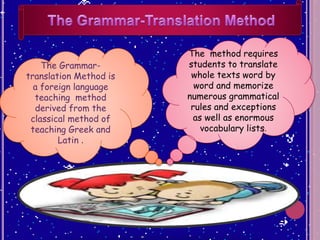
The method requires
students to translate
whole texts word by
word and memorize
numerous grammatical
rules and exceptions
as well as enormous
vocabulary lists.
The Grammar-
translation Method is
a foreign language
teaching method
derived from the
classical method of
teaching Greek and
Latin .
HISTORY
 .
The,The Grammar-Translation Method is not new. It
has had different names, but it has been used by
language teachers for many years. At one time it
was called Classical Method since it was first used
in the teaching of the classical languages, Latin
and Greek. Earlier in 20th century, this method
was used for the purpose of helping students read
and appreciate foreign language literature.,
In the 18th century foreign
languages started to appear on
the school curricula, requiring a
systematic approach to teach
them. Grammar Translation was
in fact first known in the United
States as the Prussian Method.
3- Literary language
is consider superior
to spoken language
and is therefore the
language student
study.
1- The teacher’s role
is to be the authority
in the classroom. The
student’s role is to do
what the teacher
says.
2- Most of the
interaction in
classroom is
from the
teacher to the
student.
6- Written test in
which students
have to translate
from there native
language to the
target language
or vise versa.
7- if students
make errors or
don’t know an
answer, the
teacher supplies
them with the
correct answer.
Be able to read literature written in
the target language.
2- teach grammar rules and vocabulary
of the target language.
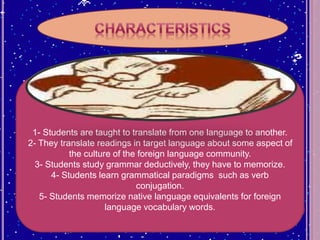
1- Students are taught to translate from one language to another.
2- They translate readings in target language about some aspect of
the culture of the foreign language community.
3- Students study grammar deductively, they have to memorize.
4- Students learn grammatical paradigms such as verb
conjugation.
5- Students memorize native language equivalents for foreign
language vocabulary words.
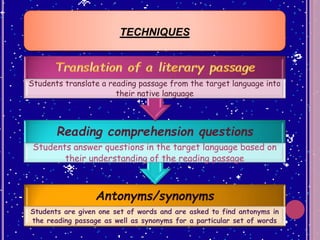
Antonyms/synonyms
Students are given one set of words and are asked to find antonyms in
the reading passage as well as synonyms for a particular set of words
Reading comprehension questions
Students answer questions in the target language based on
their understanding of the reading passage
Students translate a reading passage from the target language into
their native language
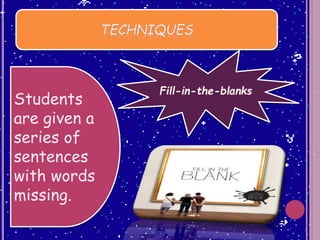
TECHNIQUES
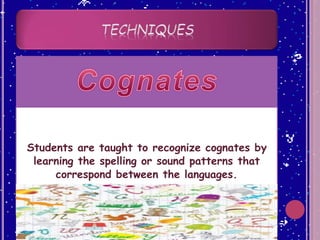
Students are taught to recognize cognates by
learning the spelling or sound patterns that
correspond between the languages.
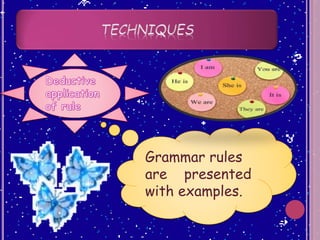
Grammar rules
are presented
with examples.
Students
are given a
series of
sentences
with words
missing.
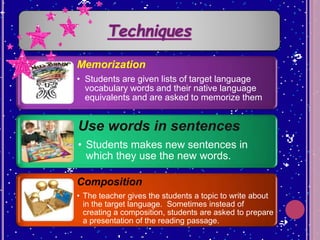
Memorization
• Students are given lists of target language
vocabulary words and their native language
equivalents and are asked to memorize them
Use words in sentences
• Students makes new sentences in
which they use the new words.
Composition
• The teacher gives the students a topic to write about
in the target language. Sometimes instead of
creating a composition, students are asked to prepare
a presentation of the reading passage.
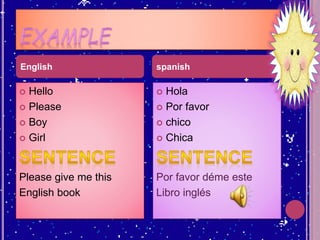
 Hello
 Please
 Boy
 Girl
Please give me this
English book
 Hola
 Por favor
 chico
 Chica
Por favor déme este
Libro inglés
English spanish
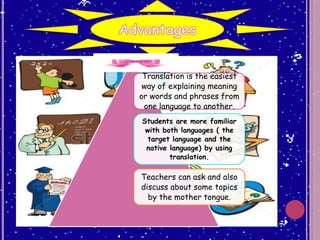
Translation is the easiest
way of explaining meaning
or words and phrases from
one language to another.
Students are more familiar
with both languages ( the
target language and the
native language) by using
translation.
Teachers can ask and also
discuss about some topics
by the mother tongue.
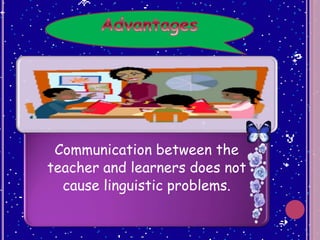
Communication between the
teacher and learners does not
cause linguistic problems.
Disadvantages
The grammar translation method
lays emphasis on reading and
writing. It neglects speech.
Speech is neglected for the
reason that grammar is the
principal skill used
DISADVANTAGES
Exact translation is not possible.
Translation is, indeed, a difficult
task and exact translation from one
language to another is not always
possible.
The person who have learnt a foreign or
second language through this method find
it difficult to give up the habit of first
thinking in their mother tongue and then
translating their ideas into the second
language.
conclusion
Students will learn
grammar by using
translation from
the target language
to the first
language with
teacher’s help and
using long text,
phrases and then
translate to known
language.

Presentation1 130525063009-phpapp02

  • 1.
  • 2.
    The method requires studentsto translate whole texts word by word and memorize numerous grammatical rules and exceptions as well as enormous vocabulary lists. The Grammar- translation Method is a foreign language teaching method derived from the classical method of teaching Greek and Latin .
  • 3.
    HISTORY  . The,The Grammar-TranslationMethod is not new. It has had different names, but it has been used by language teachers for many years. At one time it was called Classical Method since it was first used in the teaching of the classical languages, Latin and Greek. Earlier in 20th century, this method was used for the purpose of helping students read and appreciate foreign language literature.,
  • 4.
    In the 18thcentury foreign languages started to appear on the school curricula, requiring a systematic approach to teach them. Grammar Translation was in fact first known in the United States as the Prussian Method.
  • 5.
    3- Literary language isconsider superior to spoken language and is therefore the language student study. 1- The teacher’s role is to be the authority in the classroom. The student’s role is to do what the teacher says. 2- Most of the interaction in classroom is from the teacher to the student.
  • 6.
    6- Written testin which students have to translate from there native language to the target language or vise versa. 7- if students make errors or don’t know an answer, the teacher supplies them with the correct answer.
  • 7.
    Be able toread literature written in the target language. 2- teach grammar rules and vocabulary of the target language.
  • 8.
    1- Students aretaught to translate from one language to another. 2- They translate readings in target language about some aspect of the culture of the foreign language community. 3- Students study grammar deductively, they have to memorize. 4- Students learn grammatical paradigms such as verb conjugation. 5- Students memorize native language equivalents for foreign language vocabulary words.
  • 9.
    Antonyms/synonyms Students are givenone set of words and are asked to find antonyms in the reading passage as well as synonyms for a particular set of words Reading comprehension questions Students answer questions in the target language based on their understanding of the reading passage Students translate a reading passage from the target language into their native language TECHNIQUES
  • 10.
    Students are taughtto recognize cognates by learning the spelling or sound patterns that correspond between the languages.
  • 11.
  • 12.
    Students are given a seriesof sentences with words missing.
  • 13.
    Memorization • Students aregiven lists of target language vocabulary words and their native language equivalents and are asked to memorize them Use words in sentences • Students makes new sentences in which they use the new words. Composition • The teacher gives the students a topic to write about in the target language. Sometimes instead of creating a composition, students are asked to prepare a presentation of the reading passage.
  • 14.
     Hello  Please Boy  Girl Please give me this English book  Hola  Por favor  chico  Chica Por favor déme este Libro inglés English spanish
  • 15.
    Translation is theeasiest way of explaining meaning or words and phrases from one language to another. Students are more familiar with both languages ( the target language and the native language) by using translation. Teachers can ask and also discuss about some topics by the mother tongue.
  • 16.
    Communication between the teacherand learners does not cause linguistic problems.
  • 17.
    Disadvantages The grammar translationmethod lays emphasis on reading and writing. It neglects speech. Speech is neglected for the reason that grammar is the principal skill used
  • 18.
    DISADVANTAGES Exact translation isnot possible. Translation is, indeed, a difficult task and exact translation from one language to another is not always possible. The person who have learnt a foreign or second language through this method find it difficult to give up the habit of first thinking in their mother tongue and then translating their ideas into the second language.
  • 19.
    conclusion Students will learn grammarby using translation from the target language to the first language with teacher’s help and using long text, phrases and then translate to known language.