Presented By   :
•Nur Rohmah D. A
•Heny P
What is Grammar Translation Method?

 Classical Method
  - first used in teaching Latin and Greek
  - read and appreciate foreign literature
 The study of the grammar
Objectives
 Memorizing verb forms, grammar rules,
  and vocabulary.
 Ability to read the text (literature).
 Translating from one language to another.
 To develop reading and writing skills.
Advantages
 Translation is the easiest way of explaining
  meanings or words and phrases from one
  language into another.
 Students are more familiar with both languages
  (the target language and the natve langage) by
  using translation.
 Teachers can ask and also discuss about some
  topics by the mother tongue
Disadvantages
 GTM lays emphasis on reading and writing only. It
  neglects speech.

 Exact translation from one language to another is not
  always possible.

• It seemed there was no need for students to master the
  four skills of English (listening, speaking, reading, and
  writing)

• Worst effect of this method is on pupil's motivation.
  Because (s)he cannot succeed - leads to frustration,
  boredom and indiscipline
Principles
 The goals of teachers who use the grammar-
  translation method
 The role of the teacher
 The role of the learners
 Some characteristics of the teaching/learning process
 The nature of student-teacher interaction and student-
  student interaction
 Emphasized areas of language and language skills
 Teacher respond to student errors
Conclusion
 Students will learn grammar by using translation
  from the target language to the first language
  with teacher´s help and using long text, frases
  and then translate to the known language.
The goals of teachers who use
the GTM
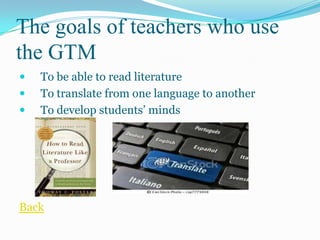
   To be able to read literature
   To translate from one language to another
   To develop students’ minds


Back
Teacher’s Role
 Traditional instructor.
 The authority in the classroom.
 What does the teacher do?
  - explain
  - translate
  - conduct practices
  - correct mistakes

Back
Learner’s Role
 Do as the teacher says.
 Learners interact with the teacher, not with each
  other.
 What does the student do?
  - translate
  - study words and rules
  - memorize

Back
Some characteristics of the
teaching/learning process
   use the students’ native language
   Translate from one language to another
   Students study grammar deductively
   Students memorize vocabulary and grammar rules


Back
The nature of student-teacher interaction and
student-student interaction
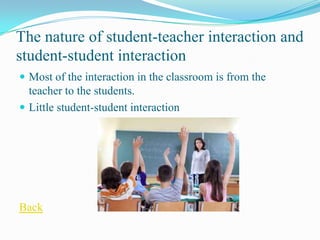
 Most of the interaction in the classroom is from the
  teacher to the students.
 Little student-student interaction


Back
Emphasized areas of language and
language skills
 Areas of language which are developed are Vocabulary
  and grammar
 Language skills which are emphasized are Reading and
  writing


Back
Teacher respond to student errors

 If a student’s answer of a question is incorrect, the
  teacher selects a different student to give the correct
  answer or s/he replies himself/herself


Back

Grammar translation method

  • 1.
    Presented By : •Nur Rohmah D. A •Heny P
  • 2.
    What is GrammarTranslation Method?  Classical Method - first used in teaching Latin and Greek - read and appreciate foreign literature  The study of the grammar
  • 3.
    Objectives  Memorizing verbforms, grammar rules, and vocabulary.  Ability to read the text (literature).  Translating from one language to another.  To develop reading and writing skills.
  • 4.
    Advantages  Translation isthe easiest way of explaining meanings or words and phrases from one language into another.  Students are more familiar with both languages (the target language and the natve langage) by using translation.  Teachers can ask and also discuss about some topics by the mother tongue
  • 5.
    Disadvantages  GTM laysemphasis on reading and writing only. It neglects speech.  Exact translation from one language to another is not always possible. • It seemed there was no need for students to master the four skills of English (listening, speaking, reading, and writing) • Worst effect of this method is on pupil's motivation. Because (s)he cannot succeed - leads to frustration, boredom and indiscipline
  • 6.
    Principles  The goalsof teachers who use the grammar- translation method  The role of the teacher  The role of the learners  Some characteristics of the teaching/learning process  The nature of student-teacher interaction and student- student interaction  Emphasized areas of language and language skills  Teacher respond to student errors
  • 7.
    Conclusion  Students willlearn grammar by using translation from the target language to the first language with teacher´s help and using long text, frases and then translate to the known language.
  • 9.
    The goals ofteachers who use the GTM  To be able to read literature  To translate from one language to another  To develop students’ minds Back
  • 10.
    Teacher’s Role  Traditionalinstructor.  The authority in the classroom.  What does the teacher do? - explain - translate - conduct practices - correct mistakes Back
  • 11.
    Learner’s Role  Doas the teacher says.  Learners interact with the teacher, not with each other.  What does the student do? - translate - study words and rules - memorize Back
  • 12.
    Some characteristics ofthe teaching/learning process  use the students’ native language  Translate from one language to another  Students study grammar deductively  Students memorize vocabulary and grammar rules Back
  • 13.
    The nature ofstudent-teacher interaction and student-student interaction  Most of the interaction in the classroom is from the teacher to the students.  Little student-student interaction Back
  • 14.
    Emphasized areas oflanguage and language skills  Areas of language which are developed are Vocabulary and grammar  Language skills which are emphasized are Reading and writing Back
  • 15.
    Teacher respond tostudent errors  If a student’s answer of a question is incorrect, the teacher selects a different student to give the correct answer or s/he replies himself/herself Back