Grammar -Translation
By: Myrna C. Egos
A.B. English-3
The Grammar-Translation Method
"a method of foreign or second
language teaching which makes
use of translation and grammar
study as the main teaching and
learning activities."
---Richards, J. C., & Schmidt, R. (2002). Longman Dictionary
of Language Teaching and Applied Linguistics. Pearson Education
Limited. pp.231.
History
 Dates back to Erasmus 1466-1536
 Originally used to teach Latin and
Greek in the late 19th
and early 20th
centuries
 Earlier in 20th century, this method
was used for the purpose of helping
students read and appreciate foreign
language literature.
Background
 Traditional method of second language
teaching in schools
 Most common language teaching method
 Stressed the literacy development
 Teacher centered
Introduction
 Original purposes
 Helping students read and
appreciate foreign language
literature
 Students can become more familiar
with the grammar of their native
language also write and speak their
native language better
 Helpful for mental exercise
Prator and Celce-Murcia in Teaching English as a Second Foreign
Language (1979:3), 
 Classes are taught in the mother tongue, with little
active use of the target language.  
 Much vocabulary is taught in the form of lists of
isolated words. 
 Long elaborate explanations of the intricacies of
grammar are given.  
 Grammar provides the rules for putting words
together, and instruction often focuses on the form
and inflection of words.  
Key Features
 Reading of difficult classical texts is begun
early. 
 Little attention is paid to the content of texts,
which are treated as exercises in grammatical
analysis.  
 Often the only drills are exercises in
translating disconnected sentences from the
target language into the mother tongue.  
Principles and Techniques
 Translation of a literary passage
 Students will be asked to read a
literary passage and then translate the
target language into their native
language
 Translation may be written or spoken
 Translation made by the students can
show that they understand their
meaning
Advantages
 Easiest for teachers to use
 Does not require teachers to speak good
English or make good lesson
preparations.
 Only uses the textbook
 Least stressful for students-teaching occurs
in the first language
 Students learn the new language without
contact with native speakers.
Disadvantages
 Students lack comprehension-only
translating word-for-word
 Does not allow students to create
meaning in English
 Students do not learn to read.
 Extensive memorization
 Very little student/teacher and
student/student interaction
Principles and Techniques
 The ability of communicating in the
target language is not a goal
 The students ask questions in their
native language and are also answered
by the teacher also in their native
language
 The teacher asks students in their
native language
Principles and Techniques
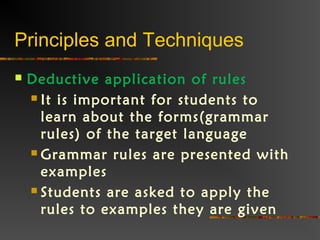
 Deductive application of rules
 It is important for students to
learn about the forms(grammar
rules) of the target language
 Grammar rules are presented with
examples
 Students are asked to apply the
rules to examples they are given
Principles and Techniques
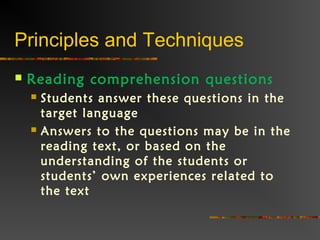
 Reading comprehension questions
 Students answer these questions in the
target language
 Answers to the questions may be in the
reading text, or based on the
understanding of the students or
students’ own experiences related to
the text
Principles and Techniques
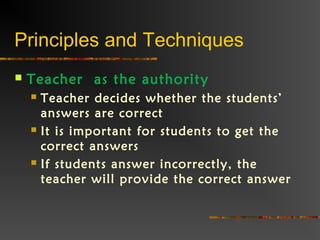
 Teacher as the authority
 Teacher decides whether the students’
answers are correct
 It is important for students to get the
correct answers
 If students answer incorrectly, the
teacher will provide the correct answer
Principles and Techniques
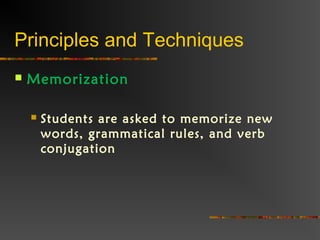
 Memorization
 Students are asked to memorize new
words, grammatical rules, and verb
conjugation
Principles and Techniques
 Fill-in-the-blanks
 Teacher give students sentences with
word missing
 Students should fill in the blanks
with the new vocabulary or with a
particular grammar type
Principles and Techniques
 Use words in sentences
 Students are asked to make up sentences
with the new words they learn in the
text
 This technique can show whether
students really understand the new
words
Principles and Techniques
 Composition
 Students are asked to write a
composition in the target language
 The topic is based on some aspect of
the reading passage
Conclusion
Teaching involves any instructional
technique that draws learners' attention
to some specific grammatical form in such
a way that it helps them either to
understand it metalinguistically and/or
process it in comprehension and/or
production so that they can internalize it.
Thank You!!!

The grammar translation method

  • 1.
    Grammar -Translation By: MyrnaC. Egos A.B. English-3
  • 2.
    The Grammar-Translation Method "amethod of foreign or second language teaching which makes use of translation and grammar study as the main teaching and learning activities." ---Richards, J. C., & Schmidt, R. (2002). Longman Dictionary of Language Teaching and Applied Linguistics. Pearson Education Limited. pp.231.
  • 3.
    History  Dates backto Erasmus 1466-1536  Originally used to teach Latin and Greek in the late 19th and early 20th centuries  Earlier in 20th century, this method was used for the purpose of helping students read and appreciate foreign language literature.
  • 4.
    Background  Traditional methodof second language teaching in schools  Most common language teaching method  Stressed the literacy development  Teacher centered
  • 5.
    Introduction  Original purposes Helping students read and appreciate foreign language literature  Students can become more familiar with the grammar of their native language also write and speak their native language better  Helpful for mental exercise
  • 6.
    Prator and Celce-Murciain Teaching English as a Second Foreign Language (1979:3),   Classes are taught in the mother tongue, with little active use of the target language.    Much vocabulary is taught in the form of lists of isolated words.   Long elaborate explanations of the intricacies of grammar are given.    Grammar provides the rules for putting words together, and instruction often focuses on the form and inflection of words.   Key Features
  • 7.
     Reading ofdifficult classical texts is begun early.   Little attention is paid to the content of texts, which are treated as exercises in grammatical analysis.    Often the only drills are exercises in translating disconnected sentences from the target language into the mother tongue.  
  • 8.
    Principles and Techniques Translation of a literary passage  Students will be asked to read a literary passage and then translate the target language into their native language  Translation may be written or spoken  Translation made by the students can show that they understand their meaning
  • 9.
    Advantages  Easiest forteachers to use  Does not require teachers to speak good English or make good lesson preparations.  Only uses the textbook  Least stressful for students-teaching occurs in the first language  Students learn the new language without contact with native speakers.
  • 10.
    Disadvantages  Students lackcomprehension-only translating word-for-word  Does not allow students to create meaning in English  Students do not learn to read.  Extensive memorization  Very little student/teacher and student/student interaction
  • 11.
    Principles and Techniques The ability of communicating in the target language is not a goal  The students ask questions in their native language and are also answered by the teacher also in their native language  The teacher asks students in their native language
  • 12.
    Principles and Techniques Deductive application of rules  It is important for students to learn about the forms(grammar rules) of the target language  Grammar rules are presented with examples  Students are asked to apply the rules to examples they are given
  • 13.
    Principles and Techniques Reading comprehension questions  Students answer these questions in the target language  Answers to the questions may be in the reading text, or based on the understanding of the students or students’ own experiences related to the text
  • 14.
    Principles and Techniques Teacher as the authority  Teacher decides whether the students’ answers are correct  It is important for students to get the correct answers  If students answer incorrectly, the teacher will provide the correct answer
  • 15.
    Principles and Techniques Memorization  Students are asked to memorize new words, grammatical rules, and verb conjugation
  • 16.
    Principles and Techniques Fill-in-the-blanks  Teacher give students sentences with word missing  Students should fill in the blanks with the new vocabulary or with a particular grammar type
  • 17.
    Principles and Techniques Use words in sentences  Students are asked to make up sentences with the new words they learn in the text  This technique can show whether students really understand the new words
  • 18.
    Principles and Techniques Composition  Students are asked to write a composition in the target language  The topic is based on some aspect of the reading passage
  • 19.
    Conclusion Teaching involves anyinstructional technique that draws learners' attention to some specific grammatical form in such a way that it helps them either to understand it metalinguistically and/or process it in comprehension and/or production so that they can internalize it.
  • 20.