Syed Mohsin Rizvi
Roll No. 40
Ⅰ. Introduction
Ⅱ. The Grammar-Translation Method
Ⅲ. The Direct Methods
Ⅳ. Audio-lingual Method
Ⅴ. Communicative Language Teaching
Ⅵ. Other Teaching Methods
Ⅶ. Summary
i. What Is Teaching Method?
Teaching method is a way of teaching a language
which is based on systematic principles and
procedures, i.e., which is an application of views on
how a language is best taught and learned.
The Grammar-Translation Method
The Direct Methods
Audio-lingualism
The Situational Language Teaching
Communicative Language Teaching
Humanistic Approaches
Task-based Teaching
i. Background
The grammar-translation method of foreign language
teaching is one of the most tradi-tional methods, dating
back to the late nine-teenth and early twentieth
centuries. It was originally used to teach 'dead' languages
(and literatures) such as Latin and Greek, and this may
account for its heavy bias to-wards written work to the
virtual exclusion
of oral production.
Classes are taught in the students' mother tongue.
Vocabulary is taught in the form of isolated word
lists.
Elaborate explanations of grammar are always
provided.
Reading of difficult texts is begun early in the
course of study.
Little attention is paid to the content of texts.
Often the only drills are exercises in translating
disconnected sentences.
Little or no attention is given to pronunciation.
No class time is allocated to allow students to produce
their own sentences.
There is often little contextualization of the grammar
The type of error correction can be harmful to the
students’ learning processes.
i. Background: a reaction to the grammar-
translation approach in an attempt to integrate
more use of the target language in instruction.
ii. The Principal Characteristics
Only use the target language in class.
The learner should be actively involved in using the
language in realistic everyday situations.
Students are encouraged to think in the target
language.
First speaking is taught and then only reading and
writing.
L2 should be learned in way in which L1 was ac-
quired - by total immersion technique.
It rejects use of the printed word - but this objec-tion
is illogical since L2 learner has already mas-tered his
reading skills.
Later disciples of Direct Method took it to extremes
and refused to speak a single word of English in
lessons.
Also Direct Methodists failed to grade and struc-ture
their materials adequately - no selection, grading or
controlled presentation of vocabulary and structures.
Q & A: The teacher asks questions of any nature
and the students answer.
Dictation: The teacher chooses a grade appro-
priate passage and reads the text aloud.
Reading Aloud: Students take turn reading sec-
tions of a passage, play or dialog out loud.
Getting Students to Self-Correct: The teacher
should have the students self-correct by offering
them a choice between what they said and the
proper pronunciation.
Map Drawing
i. Background
This method is based on the principles of behavior
psychology. It adapted many of the principles and
procedures of the Direct Method, in part as a re-
action to the lack of speaking skills of the Reading
Approach.
Dependence on mimicry and memorization of set
phrases
Teaching structural patterns by means of
repetitive drills
No grammatical explanation
Learning vocabulary in context
Use of tapes and visual aids
Focus on pronunciation
Immediate reinforcement of correct responses
Dialog Memorization
Backward Build Up
Transformation Drill
Complete the Dialog
Dictation
Flashcards
i. Background
The communicative approach could be said to be the product of
educators and linguists who had grown dissatisfied with the
audio-lingual and grammar-translation methods of foreign
language instruction.
The origins of Communicative Language Teaching are to be
found in the changes in the British languages teaching tradi-tion
dating from the late 1960s. Interest in and development of
communicative-style teaching mushroomed in the 1970s;
authentic language use and classroom exchanges where students
engaged in real communication with one another became quite
popular.
Learner-Centered
The role of the instructor in CLT is quite differ-ent from
traditional teaching methods. In the traditional classroom,
the teacher is in charge and "controls" the learning. In CLT
the teacher serves as more of a facilitator, allowing stu-dents
to be in charge of their own learning.
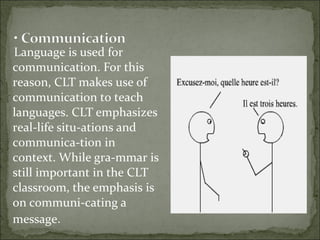
Language is used for
communication. For this
reason, CLT makes use of
communication to teach
languages. CLT emphasizes
real-life situ-ations and
communica-tion in
context. While gra-mmar is
still important in the CLT
classroom, the emphasis is
on communi-cating a
message.  
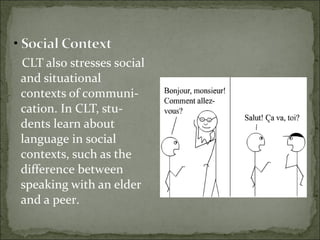
CLT also stresses social
and situational
contexts of communi-
cation. In CLT, stu-
dents learn about
language in social
contexts, such as the
difference between
speaking with an elder
and a peer.
Multimedia is an ideal way to teach lan-guage using CLT
as the theory. It allows for realistic simulations of
communicative situ-ations. Many such programs are
games, such as "A la rencontre de Philipe" or "Who is
Oscar Lake?". They place the learner in a situation in
which understanding basic com-munication, and social
and cultural contexts are vital to advancing in the game.
i. Humanism is described in applied linguistics
as ‘language teaching respecting the integrity of
learners, allowing for per-sonal growth and
responsibility, taking psychological and affective
factors into account, and representing “whole person
learning”’. The roots of humanism in lan-guage
teaching are various. One central one is the
‘discovery-learning’ movement.
The students have to be fully alert to make the most of
what the teacher says to play the major part in the
learning.
Various aids are used as simple pointers, or to make
shapes, helping the learners de-duce the meanings for
themselves.
The method has many traditional aspects, including use
of traditional structural sylla-buses.
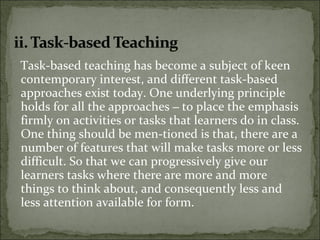
Task-based teaching has become a subject of keen
contemporary interest, and different task-based
approaches exist today. One underlying principle
holds for all the approaches – to place the emphasis
firmly on activities or tasks that learners do in class.
One thing should be men-tioned is that, there are a
number of features that will make tasks more or less
difficult. So that we can progressively give our
learners tasks where there are more and more
things to think about, and consequently less and
less attention available for form.
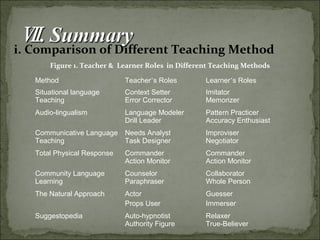
i. Comparison of Different Teaching Method
Figure 1. Teacher & Learner Roles in Different Teaching Methods
Method Teacher’s Roles Learner’s Roles
Situational language
Teaching
Context Setter
Error Corrector
Imitator
Memorizer
Audio-lingualism Language Modeler
Drill Leader
Pattern Practicer
Accuracy Enthusiast
Communicative Language
Teaching
Needs Analyst
Task Designer
Improviser
Negotiator
Total Physical Response Commander
Action Monitor
Commander
Action Monitor
Community Language
Learning
Counselor
Paraphraser
Collaborator
Whole Person
The Natural Approach Actor
Props User
Guesser
Immerser
Suggestopedia Auto-hypnotist
Authority Figure
Relaxer
True-Believer
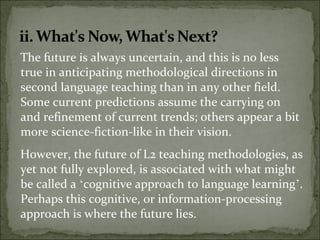
The future is always uncertain, and this is no less
true in anticipating methodological directions in
second language teaching than in any other field.
Some current predictions assume the carrying on
and refinement of current trends; others appear a bit
more science-fiction-like in their vision.
However, the future of L2 teaching methodologies, as
yet not fully explored, is associated with what might
be called a ‘cognitive approach to language learning’.
Perhaps this cognitive, or information-processing
approach is where the future lies.
Second language and its teaching methods

Second language and its teaching methods

  • 1.
  • 2.
    Ⅰ. Introduction Ⅱ. TheGrammar-Translation Method Ⅲ. The Direct Methods Ⅳ. Audio-lingual Method Ⅴ. Communicative Language Teaching Ⅵ. Other Teaching Methods Ⅶ. Summary
  • 3.
    i. What IsTeaching Method? Teaching method is a way of teaching a language which is based on systematic principles and procedures, i.e., which is an application of views on how a language is best taught and learned.
  • 4.
    The Grammar-Translation Method TheDirect Methods Audio-lingualism The Situational Language Teaching Communicative Language Teaching Humanistic Approaches Task-based Teaching
  • 5.
    i. Background The grammar-translationmethod of foreign language teaching is one of the most tradi-tional methods, dating back to the late nine-teenth and early twentieth centuries. It was originally used to teach 'dead' languages (and literatures) such as Latin and Greek, and this may account for its heavy bias to-wards written work to the virtual exclusion of oral production.
  • 6.
    Classes are taughtin the students' mother tongue. Vocabulary is taught in the form of isolated word lists. Elaborate explanations of grammar are always provided. Reading of difficult texts is begun early in the course of study. Little attention is paid to the content of texts. Often the only drills are exercises in translating disconnected sentences. Little or no attention is given to pronunciation.
  • 7.
    No class timeis allocated to allow students to produce their own sentences. There is often little contextualization of the grammar The type of error correction can be harmful to the students’ learning processes.
  • 8.
    i. Background: areaction to the grammar- translation approach in an attempt to integrate more use of the target language in instruction. ii. The Principal Characteristics Only use the target language in class. The learner should be actively involved in using the language in realistic everyday situations. Students are encouraged to think in the target language. First speaking is taught and then only reading and writing.
  • 9.
    L2 should belearned in way in which L1 was ac- quired - by total immersion technique. It rejects use of the printed word - but this objec-tion is illogical since L2 learner has already mas-tered his reading skills. Later disciples of Direct Method took it to extremes and refused to speak a single word of English in lessons. Also Direct Methodists failed to grade and struc-ture their materials adequately - no selection, grading or controlled presentation of vocabulary and structures.
  • 10.
    Q & A:The teacher asks questions of any nature and the students answer. Dictation: The teacher chooses a grade appro- priate passage and reads the text aloud. Reading Aloud: Students take turn reading sec- tions of a passage, play or dialog out loud. Getting Students to Self-Correct: The teacher should have the students self-correct by offering them a choice between what they said and the proper pronunciation. Map Drawing
  • 11.
    i. Background This methodis based on the principles of behavior psychology. It adapted many of the principles and procedures of the Direct Method, in part as a re- action to the lack of speaking skills of the Reading Approach.
  • 12.
    Dependence on mimicryand memorization of set phrases Teaching structural patterns by means of repetitive drills No grammatical explanation Learning vocabulary in context Use of tapes and visual aids Focus on pronunciation Immediate reinforcement of correct responses
  • 13.
    Dialog Memorization Backward BuildUp Transformation Drill Complete the Dialog Dictation Flashcards
  • 14.
    i. Background The communicativeapproach could be said to be the product of educators and linguists who had grown dissatisfied with the audio-lingual and grammar-translation methods of foreign language instruction. The origins of Communicative Language Teaching are to be found in the changes in the British languages teaching tradi-tion dating from the late 1960s. Interest in and development of communicative-style teaching mushroomed in the 1970s; authentic language use and classroom exchanges where students engaged in real communication with one another became quite popular.
  • 15.
    Learner-Centered The role ofthe instructor in CLT is quite differ-ent from traditional teaching methods. In the traditional classroom, the teacher is in charge and "controls" the learning. In CLT the teacher serves as more of a facilitator, allowing stu-dents to be in charge of their own learning.
  • 16.
    Language is usedfor communication. For this reason, CLT makes use of communication to teach languages. CLT emphasizes real-life situ-ations and communica-tion in context. While gra-mmar is still important in the CLT classroom, the emphasis is on communi-cating a message.  
  • 17.
    CLT also stressessocial and situational contexts of communi- cation. In CLT, stu- dents learn about language in social contexts, such as the difference between speaking with an elder and a peer.
  • 18.
    Multimedia is anideal way to teach lan-guage using CLT as the theory. It allows for realistic simulations of communicative situ-ations. Many such programs are games, such as "A la rencontre de Philipe" or "Who is Oscar Lake?". They place the learner in a situation in which understanding basic com-munication, and social and cultural contexts are vital to advancing in the game.
  • 19.
    i. Humanism isdescribed in applied linguistics as ‘language teaching respecting the integrity of learners, allowing for per-sonal growth and responsibility, taking psychological and affective factors into account, and representing “whole person learning”’. The roots of humanism in lan-guage teaching are various. One central one is the ‘discovery-learning’ movement.
  • 20.
    The students haveto be fully alert to make the most of what the teacher says to play the major part in the learning. Various aids are used as simple pointers, or to make shapes, helping the learners de-duce the meanings for themselves. The method has many traditional aspects, including use of traditional structural sylla-buses.
  • 21.
    Task-based teaching hasbecome a subject of keen contemporary interest, and different task-based approaches exist today. One underlying principle holds for all the approaches – to place the emphasis firmly on activities or tasks that learners do in class. One thing should be men-tioned is that, there are a number of features that will make tasks more or less difficult. So that we can progressively give our learners tasks where there are more and more things to think about, and consequently less and less attention available for form.
  • 22.
    i. Comparison ofDifferent Teaching Method Figure 1. Teacher & Learner Roles in Different Teaching Methods Method Teacher’s Roles Learner’s Roles Situational language Teaching Context Setter Error Corrector Imitator Memorizer Audio-lingualism Language Modeler Drill Leader Pattern Practicer Accuracy Enthusiast Communicative Language Teaching Needs Analyst Task Designer Improviser Negotiator Total Physical Response Commander Action Monitor Commander Action Monitor Community Language Learning Counselor Paraphraser Collaborator Whole Person The Natural Approach Actor Props User Guesser Immerser Suggestopedia Auto-hypnotist Authority Figure Relaxer True-Believer
  • 23.
    The future isalways uncertain, and this is no less true in anticipating methodological directions in second language teaching than in any other field. Some current predictions assume the carrying on and refinement of current trends; others appear a bit more science-fiction-like in their vision. However, the future of L2 teaching methodologies, as yet not fully explored, is associated with what might be called a ‘cognitive approach to language learning’. Perhaps this cognitive, or information-processing approach is where the future lies.