GRAMMAR
TRANSLATION
METHOD
By: Tamara Oorts
The Grammar-Translation Method
“A method of foreign or second language teaching which
makes use of translation and grammar study as the main
teaching and learning activities.”
---Richards, J. C., & Schmidt, R. (2002). Longman Dictionary
of Language Teaching and Applied Linguistics. Pearson Education
Limited. pp.231.
History
• Dates back to Erasmus 1466-1536
• Originally used to teach Latin and
• Greek in the late 19th and early 20th centuries
• Earlier in 20th century, this method was used
for the purpose of helping students read and
appreciate foreign language literature.
The Grammar-Translation Method
GTM is the oldest method of teaching. The grammar
translation method is a foreign language teaching method
derived from the classical (sometimes called traditional)
method of teaching Greek and Latin.
This method has been used from the classical times to
translate classical languages, Latin and Greek, it has been
called Classical method.
The Grammar-Translation Method
MAIN GOEL
• To be able to read literature written in the target language.
• To be able to translate from one language to another.
• To develop reading and writing skill.
LEARNING THEORY
Deductive learning is essential.
First, the teacher gives rules explicitly then the rules are reinforced
with examples and exercises.
The Grammar-Translation Method
LANGUAGE THEORY
Language is for understanding the literature.
Translation is the way to learn the language.
Oral communication is not primarily important.
Written language is superior to spoken language.
Students also learn the structure of their own native language. Those
who study a foreign language become more cultured and intellectual.
L1 USAGE: Classes are conducted in the native language. Classroom
instructions are given in L1.
L2 USAGE: The foreign language use is limited. Classroom will use
foreign language for L2.
The Grammar-Translation Method
TECHNIQUES
1. Translation of a Literary Passage: students translate a passage from the target
language into their native language.
The passage provides the focus for several classes: vocabulary and grammatical
structures in the passage are studied in the
following lessons.
2. Reading Comprehension Questions: Students answer questions in the target
language based on their understanding of the reading passage.
• First, they answer information questions whose answers they can find in the passage.
• Second, they answer inference questions based on their comprehension of the
passage although the answer cannot be found in the passage directly.
• Third, they answer the questions that require students to relate the topic of the
passage to their own experience.
The Grammar-Translation Method
TECHNIQUES
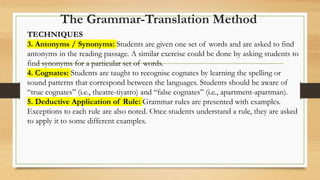
3. Antonyms / Synonyms: Students are given one set of words and are asked to find
antonyms in the reading passage. A similar exercise could be done by asking students to
find synonyms for a particular set of words.
4. Cognates: Students are taught to recognise cognates by learning the spelling or
sound patterns that correspond between the languages. Students should be aware of
“true cognates” (i.e., theatre-tiyatro) and “false cognates” (i.e., apartment-apartman).
5. Deductive Application of Rule: Grammar rules are presented with examples.
Exceptions to each rule are also noted. Once students understand a rule, they are asked
to apply it to some different examples.
The Grammar-Translation Method
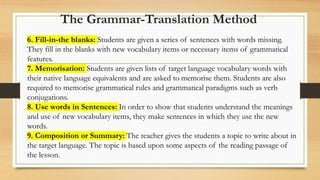
6. Fill-in-the blanks: Students are given a series of sentences with words missing.
They fill in the blanks with new vocabulary items or necessary items of grammatical
features.
7. Memorisation: Students are given lists of target language vocabulary words with
their native language equivalents and are asked to memorise them. Students are also
required to memorise grammatical rules and grammatical paradigms such as verb
conjugations.
8. Use words in Sentences: In order to show that students understand the meanings
and use of new vocabulary items, they make sentences in which they use the new
words.
9. Composition or Summary: The teacher gives the students a topic to write about in
the target language. The topic is based upon some aspects of the reading passage of
the lesson.
The Grammar-Translation Method
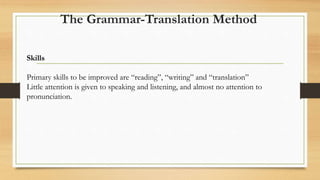
Skills
Primary skills to be improved are “reading”, “writing” and “translation”
Little attention is given to speaking and listening, and almost no attention to
pronunciation.
The Grammar-Translation Method
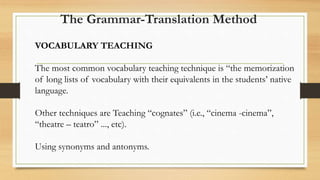
VOCABULARY TEACHING
The most common vocabulary teaching technique is “the memorization
of long lists of vocabulary with their equivalents in the students’ native
language.
Other techniques are Teaching “cognates” (i.e., “cinema -cinema”,
“theatre – teatro” ..., etc).
Using synonyms and antonyms.
The Grammar-Translation Method
GRAMMAR TEACHING
Explicit teaching of grammar.
Teacher introduces the rules explicitly and wants the students to apply
these rules to new examples in exercises.
Students are supposed to memorise the rules.
In order to explain the rules, the teacher uses comparison and contrast
between the students’ native language grammar and target language
grammar.
Translation is a common way to clarify the meanings of the new
grammar patterns in the target language.
The Grammar-Translation Method
TEACHER’S ROLES:
• Teacher is the strict authority.
• Classes are teacher-centered.
STUDENTS' ROLES
• Students are the passive receivers of the new information.
• The teacher starts the activities and directs them.
• Students are supposed to memorize the rules and the new
vocabulary with their meanings in their native language.
INTERACTIONS
• Very often “Teacher –Student” interactions occur.
• Rarely “Student – Student” interactions also occur.
The Grammar-Translation Method
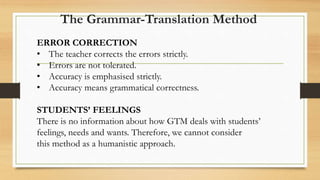
ERROR CORRECTION
• The teacher corrects the errors strictly.
• Errors are not tolerated.
• Accuracy is emphasised strictly.
• Accuracy means grammatical correctness.
STUDENTS’ FEELINGS
There is no information about how GTM deals with students’
feelings, needs and wants. Therefore, we cannot consider
this method as a humanistic approach.
The Grammar-Translation Method
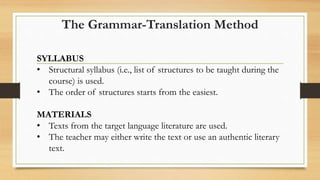
SYLLABUS
• Structural syllabus (i.e., list of structures to be taught during the
course) is used.
• The order of structures starts from the easiest.
MATERIALS
• Texts from the target language literature are used.
• The teacher may either write the text or use an authentic literary
text.
The Grammar-Translation Method
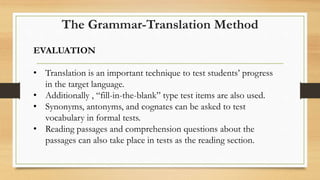
EVALUATION
• Translation is an important technique to test students’ progress
in the target language.
• Additionally , “fill-in-the-blank” type test items are also used.
• Synonyms, antonyms, and cognates can be asked to test
vocabulary in formal tests.
• Reading passages and comprehension questions about the
passages can also take place in tests as the reading section.
The Grammar-Translation Method
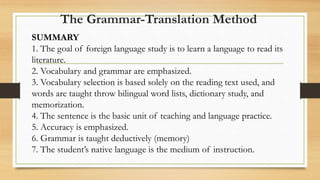
SUMMARY
1. The goal of foreign language study is to learn a language to read its
literature.
2. Vocabulary and grammar are emphasized.
3. Vocabulary selection is based solely on the reading text used, and
words are taught throw bilingual word lists, dictionary study, and
memorization.
4. The sentence is the basic unit of teaching and language practice.
5. Accuracy is emphasized.
6. Grammar is taught deductively (memory)
7. The student’s native language is the medium of instruction.
The Grammar-Translation Method
ADVANTAGES?
The Grammar-Translation Method
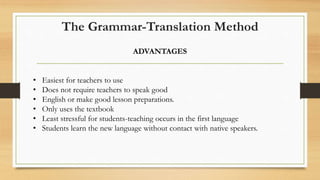
ADVANTAGES
• Easiest for teachers to use
• Does not require teachers to speak good
• English or make good lesson preparations.
• Only uses the textbook
• Least stressful for students-teaching occurs in the first language
• Students learn the new language without contact with native speakers.
The Grammar-Translation Method
DISADVANTAGES?
The Grammar-Translation Method
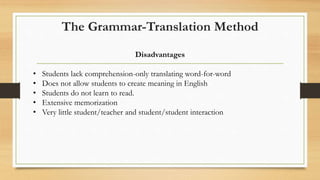
Disadvantages
• Students lack comprehension-only translating word-for-word
• Does not allow students to create meaning in English
• Students do not learn to read.
• Extensive memorization
• Very little student/teacher and student/student interaction
The Grammar-Translation Method
DISAVANTAGES
1. Overemphasis on translation can never emancipate the learners from
dependence on the first language.
2. The Grammar-Translation puts too much emphasis on reading and writing and
neglects listening and speaking.
3. In the Grammar-Translation Method, the texts are mostly taken form literary
works. The language learned often doesn’t meet the practical needs of the
learners.
4. Memorizing grammar rules and bilingual word lists does not motivate students
to actively communicate in the target language.
5. No scope for effective communication and very tedious for |Learner.
6. Direct translation is widely regarded as an inefficient way of becoming fluent
in any language
The Grammar-Translation Method
REFERENCES
• Brown, D. H. (1987). Principles of Language Learning and Teaching. New
Jersey: Printice Hall Regents.
• Celce-Murcia, M. (1991). Language Teaching Approaches. In M. Celce-Murcia
(Ed.), Teaching English as a Second or
• Foreign Language. (pp.3-10). Boston, Massachusetts: Heinle & Heinle.
• Larsen-Freeman, D. (1993). Techniques and Principles in Language Teaching.
Hong Kong: Oxford University Press.
• Richards, J. C. & Rodgers, T. S. (1990). Approaches and Methods in Language
Teaching: A description and analysis. New York: Cambridge University Press.
The Grammar-Translation Method

GRAMMAR TRANSLATION METHOD.pptx

  • 1.
  • 2.
    The Grammar-Translation Method “Amethod of foreign or second language teaching which makes use of translation and grammar study as the main teaching and learning activities.” ---Richards, J. C., & Schmidt, R. (2002). Longman Dictionary of Language Teaching and Applied Linguistics. Pearson Education Limited. pp.231.
  • 3.
    History • Dates backto Erasmus 1466-1536 • Originally used to teach Latin and • Greek in the late 19th and early 20th centuries • Earlier in 20th century, this method was used for the purpose of helping students read and appreciate foreign language literature. The Grammar-Translation Method
  • 4.
    GTM is theoldest method of teaching. The grammar translation method is a foreign language teaching method derived from the classical (sometimes called traditional) method of teaching Greek and Latin. This method has been used from the classical times to translate classical languages, Latin and Greek, it has been called Classical method. The Grammar-Translation Method
  • 5.
    MAIN GOEL • Tobe able to read literature written in the target language. • To be able to translate from one language to another. • To develop reading and writing skill. LEARNING THEORY Deductive learning is essential. First, the teacher gives rules explicitly then the rules are reinforced with examples and exercises. The Grammar-Translation Method
  • 6.
    LANGUAGE THEORY Language isfor understanding the literature. Translation is the way to learn the language. Oral communication is not primarily important. Written language is superior to spoken language. Students also learn the structure of their own native language. Those who study a foreign language become more cultured and intellectual. L1 USAGE: Classes are conducted in the native language. Classroom instructions are given in L1. L2 USAGE: The foreign language use is limited. Classroom will use foreign language for L2. The Grammar-Translation Method
  • 7.
    TECHNIQUES 1. Translation ofa Literary Passage: students translate a passage from the target language into their native language. The passage provides the focus for several classes: vocabulary and grammatical structures in the passage are studied in the following lessons. 2. Reading Comprehension Questions: Students answer questions in the target language based on their understanding of the reading passage. • First, they answer information questions whose answers they can find in the passage. • Second, they answer inference questions based on their comprehension of the passage although the answer cannot be found in the passage directly. • Third, they answer the questions that require students to relate the topic of the passage to their own experience. The Grammar-Translation Method
  • 8.
    TECHNIQUES 3. Antonyms /Synonyms: Students are given one set of words and are asked to find antonyms in the reading passage. A similar exercise could be done by asking students to find synonyms for a particular set of words. 4. Cognates: Students are taught to recognise cognates by learning the spelling or sound patterns that correspond between the languages. Students should be aware of “true cognates” (i.e., theatre-tiyatro) and “false cognates” (i.e., apartment-apartman). 5. Deductive Application of Rule: Grammar rules are presented with examples. Exceptions to each rule are also noted. Once students understand a rule, they are asked to apply it to some different examples. The Grammar-Translation Method
  • 9.
    6. Fill-in-the blanks:Students are given a series of sentences with words missing. They fill in the blanks with new vocabulary items or necessary items of grammatical features. 7. Memorisation: Students are given lists of target language vocabulary words with their native language equivalents and are asked to memorise them. Students are also required to memorise grammatical rules and grammatical paradigms such as verb conjugations. 8. Use words in Sentences: In order to show that students understand the meanings and use of new vocabulary items, they make sentences in which they use the new words. 9. Composition or Summary: The teacher gives the students a topic to write about in the target language. The topic is based upon some aspects of the reading passage of the lesson. The Grammar-Translation Method
  • 10.
    Skills Primary skills tobe improved are “reading”, “writing” and “translation” Little attention is given to speaking and listening, and almost no attention to pronunciation. The Grammar-Translation Method
  • 11.
    VOCABULARY TEACHING The mostcommon vocabulary teaching technique is “the memorization of long lists of vocabulary with their equivalents in the students’ native language. Other techniques are Teaching “cognates” (i.e., “cinema -cinema”, “theatre – teatro” ..., etc). Using synonyms and antonyms. The Grammar-Translation Method
  • 12.
    GRAMMAR TEACHING Explicit teachingof grammar. Teacher introduces the rules explicitly and wants the students to apply these rules to new examples in exercises. Students are supposed to memorise the rules. In order to explain the rules, the teacher uses comparison and contrast between the students’ native language grammar and target language grammar. Translation is a common way to clarify the meanings of the new grammar patterns in the target language. The Grammar-Translation Method
  • 13.
    TEACHER’S ROLES: • Teacheris the strict authority. • Classes are teacher-centered. STUDENTS' ROLES • Students are the passive receivers of the new information. • The teacher starts the activities and directs them. • Students are supposed to memorize the rules and the new vocabulary with their meanings in their native language. INTERACTIONS • Very often “Teacher –Student” interactions occur. • Rarely “Student – Student” interactions also occur. The Grammar-Translation Method
  • 14.
    ERROR CORRECTION • Theteacher corrects the errors strictly. • Errors are not tolerated. • Accuracy is emphasised strictly. • Accuracy means grammatical correctness. STUDENTS’ FEELINGS There is no information about how GTM deals with students’ feelings, needs and wants. Therefore, we cannot consider this method as a humanistic approach. The Grammar-Translation Method
  • 15.
    SYLLABUS • Structural syllabus(i.e., list of structures to be taught during the course) is used. • The order of structures starts from the easiest. MATERIALS • Texts from the target language literature are used. • The teacher may either write the text or use an authentic literary text. The Grammar-Translation Method
  • 16.
    EVALUATION • Translation isan important technique to test students’ progress in the target language. • Additionally , “fill-in-the-blank” type test items are also used. • Synonyms, antonyms, and cognates can be asked to test vocabulary in formal tests. • Reading passages and comprehension questions about the passages can also take place in tests as the reading section. The Grammar-Translation Method
  • 17.
    SUMMARY 1. The goalof foreign language study is to learn a language to read its literature. 2. Vocabulary and grammar are emphasized. 3. Vocabulary selection is based solely on the reading text used, and words are taught throw bilingual word lists, dictionary study, and memorization. 4. The sentence is the basic unit of teaching and language practice. 5. Accuracy is emphasized. 6. Grammar is taught deductively (memory) 7. The student’s native language is the medium of instruction. The Grammar-Translation Method
  • 18.
  • 19.
    ADVANTAGES • Easiest forteachers to use • Does not require teachers to speak good • English or make good lesson preparations. • Only uses the textbook • Least stressful for students-teaching occurs in the first language • Students learn the new language without contact with native speakers. The Grammar-Translation Method
  • 20.
  • 21.
    Disadvantages • Students lackcomprehension-only translating word-for-word • Does not allow students to create meaning in English • Students do not learn to read. • Extensive memorization • Very little student/teacher and student/student interaction The Grammar-Translation Method
  • 22.
    DISAVANTAGES 1. Overemphasis ontranslation can never emancipate the learners from dependence on the first language. 2. The Grammar-Translation puts too much emphasis on reading and writing and neglects listening and speaking. 3. In the Grammar-Translation Method, the texts are mostly taken form literary works. The language learned often doesn’t meet the practical needs of the learners. 4. Memorizing grammar rules and bilingual word lists does not motivate students to actively communicate in the target language. 5. No scope for effective communication and very tedious for |Learner. 6. Direct translation is widely regarded as an inefficient way of becoming fluent in any language The Grammar-Translation Method
  • 23.
    REFERENCES • Brown, D.H. (1987). Principles of Language Learning and Teaching. New Jersey: Printice Hall Regents. • Celce-Murcia, M. (1991). Language Teaching Approaches. In M. Celce-Murcia (Ed.), Teaching English as a Second or • Foreign Language. (pp.3-10). Boston, Massachusetts: Heinle & Heinle. • Larsen-Freeman, D. (1993). Techniques and Principles in Language Teaching. Hong Kong: Oxford University Press. • Richards, J. C. & Rodgers, T. S. (1990). Approaches and Methods in Language Teaching: A description and analysis. New York: Cambridge University Press. The Grammar-Translation Method