GRAMMAR-TRANSLATION 
METHOD
HISTORY
History of GTM 
 It is the oldest method of teaching of English, also known 
as the Classical Method 
 dominated European and foreign language teaching from 
the 1800s to the 1940s, and in modified form it continues to 
be widely used in some parts of word day. 
 was used for the teaching of English in the beginning, 
under the influence of classical languages like Latin, Greek 
and Sanskrit
History of GTM 
 In the Grammar – Translation Method, the student 
first study the parts of speech and syntax in detail. 
The sentences in English and the mother tongue 
were compared and contrasted side by side. 
 In this method the mother tongue is used to teach 
English.
FEATURES
The goal of foreign language study 
To read its literature 
 To benefit from the metal discipline and 
intellectual development 
 To analyze rules before translating
Language skills 
Reading and writing: focus. 
 Speaking or listening: little or no systematic 
attention. 
 Vocabulary : selecting on the reading texts 
used; teaching words through bilingual 
word list, dictionary, and memorization. 
 Pronunciation: little or no attention.
Sentence 
Basic unit of teaching and language 
practice 
Being translated into and out of the 
target language
Accuracy and Grammar 
 Accuracy is emphasized: Students are expected 
to attain high standards in translation. 
 Grammar : 
Taught deductively presentation and study of 
grammar rules → practice through translation 
exercises
Medium of instructions & language learning 
 Medium of instruction in class: student’s 
native language 
 Language learning: By memorization of 
rules and manipulation of the morphology 
and syntax of the foreign language.
STRONG POINTS
STRONG POINTS 
Understanding of words and phrases 
becomes very better and quicker. 
 Developing the art of translation. 
 Strong memory bond is created. 
 It saves time and more effective.
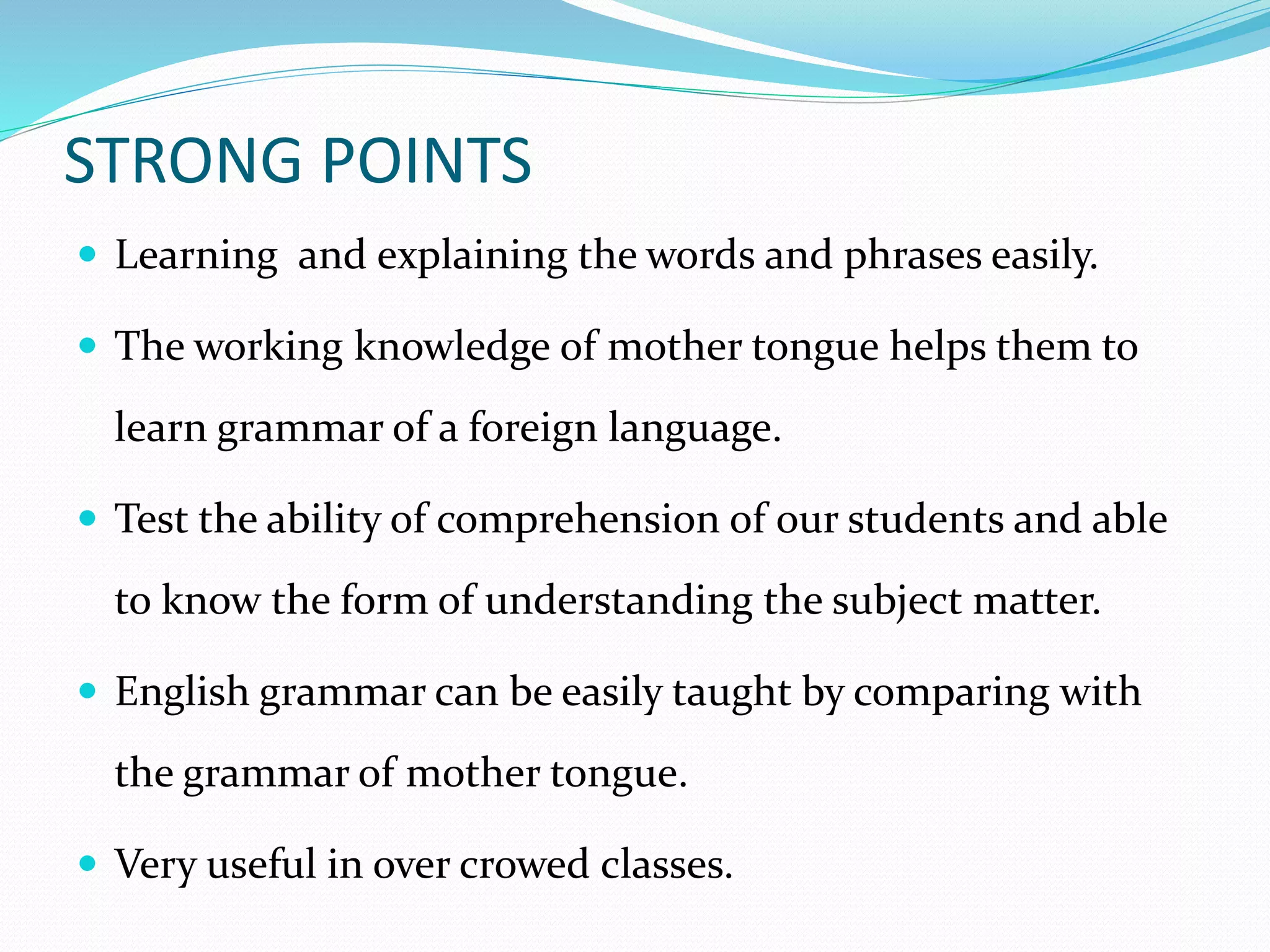
STRONG POINTS 
 Learning and explaining the words and phrases easily. 
 The working knowledge of mother tongue helps them to 
learn grammar of a foreign language. 
 Test the ability of comprehension of our students and able 
to know the form of understanding the subject matter. 
 English grammar can be easily taught by comparing with 
the grammar of mother tongue. 
 Very useful in over crowed classes.
WEAK POINTS
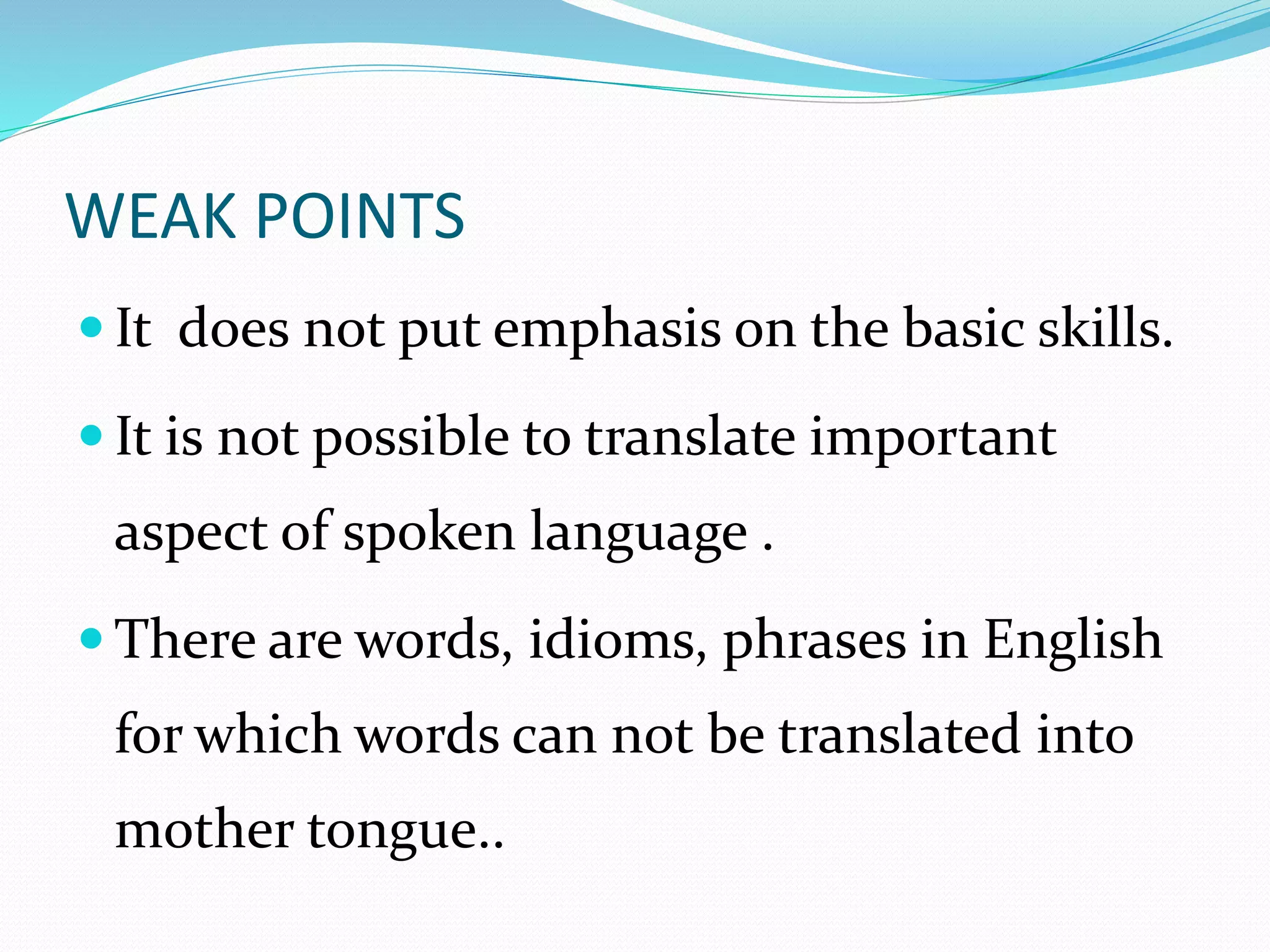
WEAK POINTS 
 It does not put emphasis on the basic skills. 
 It is not possible to translate important 
aspect of spoken language . 
 There are words, idioms, phrases in English 
for which words can not be translated into 
mother tongue..
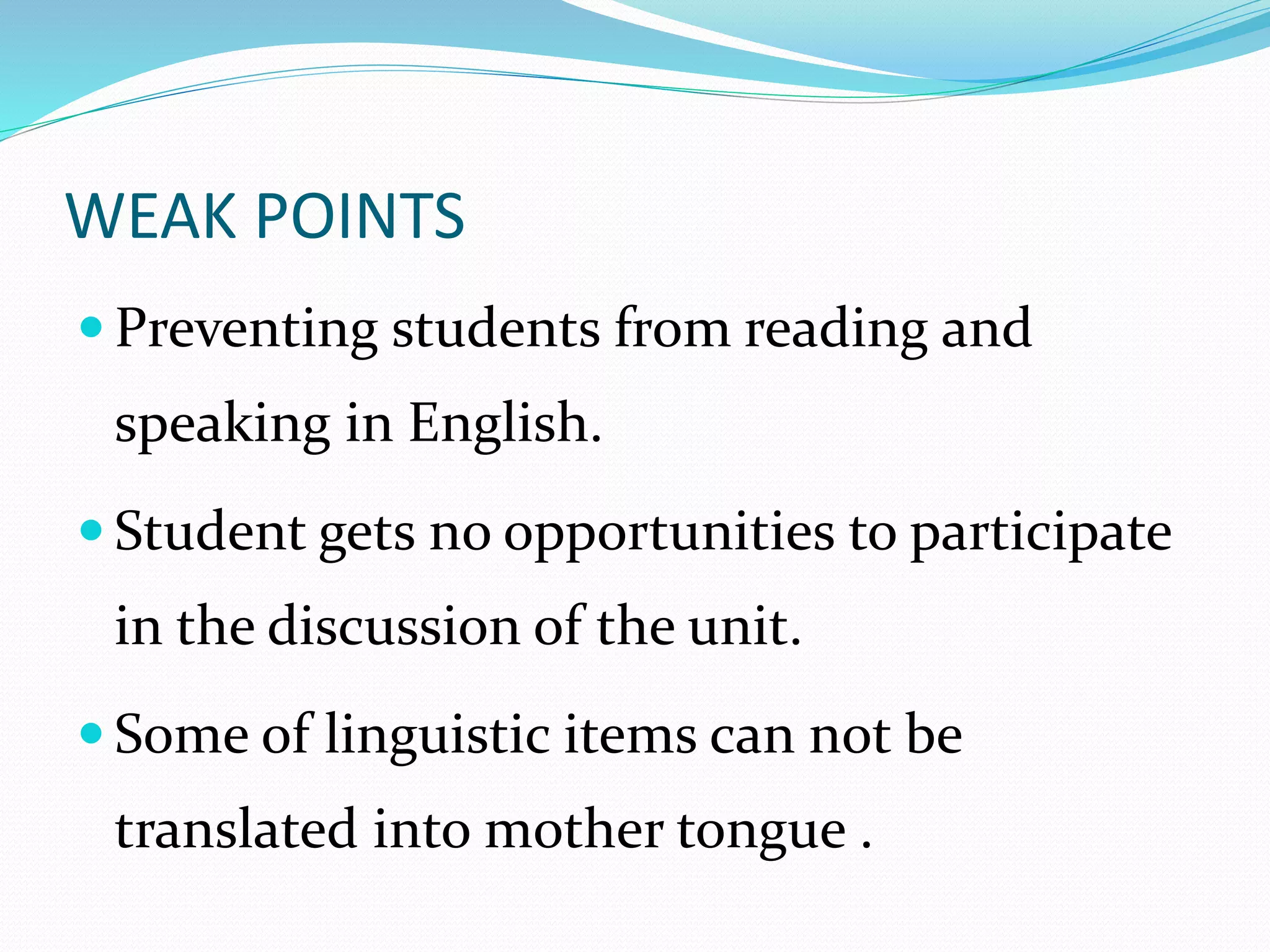
WEAK POINTS 
 Preventing students from reading and 
speaking in English. 
 Student gets no opportunities to participate 
in the discussion of the unit. 
Some of linguistic items can not be 
translated into mother tongue .
WEAK POINTS 
 Affecting the originality of the words. 
 It prevents students to think directly in 
English. 
 Grammar class can never be effective when 
there is use of translation of grammatical 
rules and their explanation.
WEAK POINTS 
 Favouring to teach English by rules and not 
by use. 
 Psychologically and linguistically, this 
method is not suitable.

Grammar translation method

  • 1.
  • 2.
  • 3.
    History of GTM  It is the oldest method of teaching of English, also known as the Classical Method  dominated European and foreign language teaching from the 1800s to the 1940s, and in modified form it continues to be widely used in some parts of word day.  was used for the teaching of English in the beginning, under the influence of classical languages like Latin, Greek and Sanskrit
  • 4.
    History of GTM  In the Grammar – Translation Method, the student first study the parts of speech and syntax in detail. The sentences in English and the mother tongue were compared and contrasted side by side.  In this method the mother tongue is used to teach English.
  • 5.
  • 6.
    The goal offoreign language study To read its literature  To benefit from the metal discipline and intellectual development  To analyze rules before translating
  • 7.
    Language skills Readingand writing: focus.  Speaking or listening: little or no systematic attention.  Vocabulary : selecting on the reading texts used; teaching words through bilingual word list, dictionary, and memorization.  Pronunciation: little or no attention.
  • 8.
    Sentence Basic unitof teaching and language practice Being translated into and out of the target language
  • 9.
    Accuracy and Grammar  Accuracy is emphasized: Students are expected to attain high standards in translation.  Grammar : Taught deductively presentation and study of grammar rules → practice through translation exercises
  • 10.
    Medium of instructions& language learning  Medium of instruction in class: student’s native language  Language learning: By memorization of rules and manipulation of the morphology and syntax of the foreign language.
  • 11.
  • 12.
    STRONG POINTS Understandingof words and phrases becomes very better and quicker.  Developing the art of translation.  Strong memory bond is created.  It saves time and more effective.
  • 13.
    STRONG POINTS Learning and explaining the words and phrases easily.  The working knowledge of mother tongue helps them to learn grammar of a foreign language.  Test the ability of comprehension of our students and able to know the form of understanding the subject matter.  English grammar can be easily taught by comparing with the grammar of mother tongue.  Very useful in over crowed classes.
  • 14.
  • 15.
    WEAK POINTS It does not put emphasis on the basic skills.  It is not possible to translate important aspect of spoken language .  There are words, idioms, phrases in English for which words can not be translated into mother tongue..
  • 16.
    WEAK POINTS Preventing students from reading and speaking in English.  Student gets no opportunities to participate in the discussion of the unit. Some of linguistic items can not be translated into mother tongue .
  • 17.
    WEAK POINTS Affecting the originality of the words.  It prevents students to think directly in English.  Grammar class can never be effective when there is use of translation of grammatical rules and their explanation.
  • 18.
    WEAK POINTS Favouring to teach English by rules and not by use.  Psychologically and linguistically, this method is not suitable.