Mersin University
         Faculty of Science and Letters
  Department of English Language and Literature


THE DIRECT METHOD IN LANGUAGE TEACHING


                  Soner KALAN
                  İsmail PİŞER
                 Şenol BAKIRAL
                 Erkan PATIBAY
                   Soner İÇEN
                  Burak ERGİN


                    İDB 422
               Applied Linguistics

              Dr. Pınar İBE AKCAN

                     Mersin
                   April, 2012
THE DIRECT METHOD

The Direct Method of language
teaching is also called:
THE DIRECT METHOD

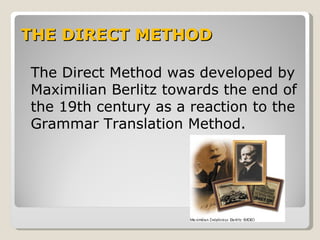
The Direct Method was developed by
Maximilian Berlitz towards the end of
the 19th century as a reaction to the
Grammar Translation Method.
THE DIRECT METHOD

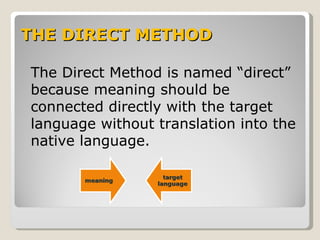
The Direct Method is named “direct”
because meaning should be
connected directly with the target
language without translation into the
native language.
THE DIRECT METHOD


   Basically, the Direct Method aims
to provide language learners with a
practically useful knowledge of
language. Knowing a language is
being able to speak it.
THE DIRECT METHOD


This method argues that a foreign
language can be taught without
translation, unlike the argument of
the Grammar-Translation Method.
THE DIRECT METHOD


Rather than translating the teaching
material, the teacher is expected to
directly use the target language in
class because a language can best be
taught by using it actively in the
classroom.
THE DIRECT METHOD


The teacher should not explain but
associate the meaning through action
and demonstration.
THE DIRECT METHOD


In this way, learners will be able to
induce grammar rules through
examples, illustrations, and
demonstrations.
THE DIRECT METHOD


This method replaces the textbook
with teacher-student / student-
student activities such as reading
aloud, question-answer exercises,
fill-in-the-blank exercises, etc.
THE DIRECT METHOD


Correct pronunciation is given careful
attention in this method. In addition,
new vocabulary is taught by using
known words.
BASIC PRINCIPLES


1. Classroom instruction is conducted
 exclusively in the target language.
 The teacher should demonstrate, not
 explain or translate.

 NEVER TRANSLATE:
 DEMONSTRATE
BASIC PRINCIPLES


2. Only everyday vocabulary and
 sentences are taught.

 BASIC VOCABULARY IS GIVEN
 FIRST
BASIC PRINCIPLES


3. Grammar is taught inductively.
 There may never be an explicit
 grammar rule given.

 DO NOT GIVE RULES:
 MAKE THEM FIGURE OUT THE
 RULE.
BASIC PRINCIPLES


4. New teaching points are introduced
 orally.

 ORAL TRANSMISSION
BASIC PRINCIPLES

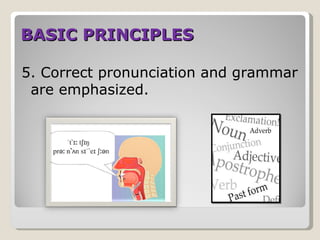
5. Correct pronunciation and grammar
 are emphasized.
BASIC PRINCIPLES


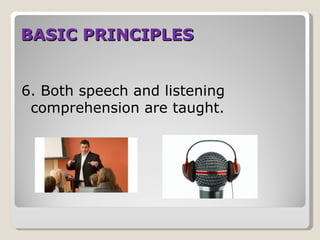
6. Both speech and listening
 comprehension are taught.
BASIC PRINCIPLES


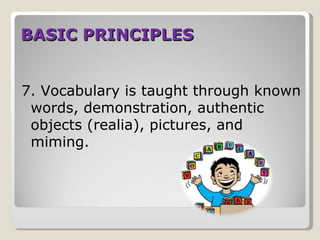
7. Vocabulary is taught through known
 words, demonstration, authentic
 objects (realia), pictures, and
 miming.
BASIC PRINCIPLES


8. The teacher, by asking the student
 to make a choice, gets him to correct
 his own error.

 LEARNING BY SELF-CORRECTION
BASIC PRINCIPLES


9. The syllabus is based on situations
 or topics, not usually on linguistic
 structures.

 CONTEXTUAL/TOPICAL
 TEACHING
BASIC PRINCIPLES


10. Learning is not merely restricted
 with formal language knowledge; it
 also involves speaker conventions
 and descriptive usage.

 NOT formal BUT NATURAL USE
BASIC PRINCIPLES

11. Students should learn to think in
 the target language as soon as
 possible. Vocabulary is acquired
 more naturally if students use it in
 full sentences, rather than
 memorizing word lists.
 NOT memorization but
 PRODUCTION
BASIC PRINCIPLES

12. The purpose of language learning
 is communication; therefore students
 need to learn how to ask questions
 as well as answer them.

 COMMUNICATION-FIRST
 PRINCIPLE
TECHNIQUES IN THE DIRECT
             METHOD
   Reading aloud
   Question-answer exercise
   Student self-correction
   Conversation practice
   Fill-in-the-blank exercise
   Dictation
Grammar-Translation Method vs.
The Direct Method: A Comparison

             in terms of GRAMMAR


 Direct Method                   Grammar translation
                                 method
 In the direct method, the       The GTM focuses on grammar
 teacher provides the            rules and their application.
 knowledge in grammar            Language is learned through
 inductively through speaking.   rules.
Grammar-Translation Method vs.
The Direct Method: A Comparison

          in terms of VOCABULARY


 Direct Method                 Grammar translation
                               method
 The vocabulary is learned     The vocabulary is learned
 through practice every day.   through direct translation of
                               L1. Students learn vocabulary
                               when they are translated.
Grammar-Translation Method vs.
The Direct Method: A Comparison

     in terms of TEACHER ATTITUDE

 Direct Method                   Grammar translation
                                 method
 The role of the teacher is of   The role of the teacher is not
 great importance. He asks       very active because he just
 questions to students           limits his work to translate for
 constantly, encourages them     the students.
 to participate in class and
 corrects their mistakes
 immediately.
Grammar-Translation Method vs.
The Direct Method: A Comparison

     in terms of STUDENT ATTITUDE


 Direct Method                     Grammar translation
                                   method
 The students are very actives,    The accuracy from the
 their oral communication skills   students is expected and they
 are emphasized, they have to      have to practice by
 speak a lot.                      translation.
Grammar-Translation Method vs.
The Direct Method: A Comparison

      in terms of LANGUAGE SKILLS


Direct Method                   Grammar translation
                                method
Oral communication skills are   Primary skills to be improved:
built up in a carefully grade   Reading and writing.
APPLICATION OF
  THE DIRECT
    METHOD

The Direct Method in Language Teaching

  • 1.
    Mersin University Faculty of Science and Letters Department of English Language and Literature THE DIRECT METHOD IN LANGUAGE TEACHING Soner KALAN İsmail PİŞER Şenol BAKIRAL Erkan PATIBAY Soner İÇEN Burak ERGİN İDB 422 Applied Linguistics Dr. Pınar İBE AKCAN Mersin April, 2012
  • 2.
    THE DIRECT METHOD TheDirect Method of language teaching is also called:
  • 3.
    THE DIRECT METHOD TheDirect Method was developed by Maximilian Berlitz towards the end of the 19th century as a reaction to the Grammar Translation Method.
  • 4.
    THE DIRECT METHOD TheDirect Method is named “direct” because meaning should be connected directly with the target language without translation into the native language.
  • 5.
    THE DIRECT METHOD Basically, the Direct Method aims to provide language learners with a practically useful knowledge of language. Knowing a language is being able to speak it.
  • 6.
    THE DIRECT METHOD Thismethod argues that a foreign language can be taught without translation, unlike the argument of the Grammar-Translation Method.
  • 7.
    THE DIRECT METHOD Ratherthan translating the teaching material, the teacher is expected to directly use the target language in class because a language can best be taught by using it actively in the classroom.
  • 8.
    THE DIRECT METHOD Theteacher should not explain but associate the meaning through action and demonstration.
  • 9.
    THE DIRECT METHOD Inthis way, learners will be able to induce grammar rules through examples, illustrations, and demonstrations.
  • 10.
    THE DIRECT METHOD Thismethod replaces the textbook with teacher-student / student- student activities such as reading aloud, question-answer exercises, fill-in-the-blank exercises, etc.
  • 11.
    THE DIRECT METHOD Correctpronunciation is given careful attention in this method. In addition, new vocabulary is taught by using known words.
  • 12.
    BASIC PRINCIPLES 1. Classroominstruction is conducted exclusively in the target language. The teacher should demonstrate, not explain or translate. NEVER TRANSLATE: DEMONSTRATE
  • 13.
    BASIC PRINCIPLES 2. Onlyeveryday vocabulary and sentences are taught. BASIC VOCABULARY IS GIVEN FIRST
  • 14.
    BASIC PRINCIPLES 3. Grammaris taught inductively. There may never be an explicit grammar rule given. DO NOT GIVE RULES: MAKE THEM FIGURE OUT THE RULE.
  • 15.
    BASIC PRINCIPLES 4. Newteaching points are introduced orally. ORAL TRANSMISSION
  • 16.
    BASIC PRINCIPLES 5. Correctpronunciation and grammar are emphasized.
  • 17.
    BASIC PRINCIPLES 6. Bothspeech and listening comprehension are taught.
  • 18.
    BASIC PRINCIPLES 7. Vocabularyis taught through known words, demonstration, authentic objects (realia), pictures, and miming.
  • 19.
    BASIC PRINCIPLES 8. Theteacher, by asking the student to make a choice, gets him to correct his own error. LEARNING BY SELF-CORRECTION
  • 20.
    BASIC PRINCIPLES 9. Thesyllabus is based on situations or topics, not usually on linguistic structures. CONTEXTUAL/TOPICAL TEACHING
  • 21.
    BASIC PRINCIPLES 10. Learningis not merely restricted with formal language knowledge; it also involves speaker conventions and descriptive usage. NOT formal BUT NATURAL USE
  • 22.
    BASIC PRINCIPLES 11. Studentsshould learn to think in the target language as soon as possible. Vocabulary is acquired more naturally if students use it in full sentences, rather than memorizing word lists. NOT memorization but PRODUCTION
  • 23.
    BASIC PRINCIPLES 12. Thepurpose of language learning is communication; therefore students need to learn how to ask questions as well as answer them. COMMUNICATION-FIRST PRINCIPLE
  • 24.
    TECHNIQUES IN THEDIRECT METHOD  Reading aloud  Question-answer exercise  Student self-correction  Conversation practice  Fill-in-the-blank exercise  Dictation
  • 25.
    Grammar-Translation Method vs. TheDirect Method: A Comparison in terms of GRAMMAR Direct Method Grammar translation method In the direct method, the The GTM focuses on grammar teacher provides the rules and their application. knowledge in grammar Language is learned through inductively through speaking. rules.
  • 26.
    Grammar-Translation Method vs. TheDirect Method: A Comparison in terms of VOCABULARY Direct Method Grammar translation method The vocabulary is learned The vocabulary is learned through practice every day. through direct translation of L1. Students learn vocabulary when they are translated.
  • 27.
    Grammar-Translation Method vs. TheDirect Method: A Comparison in terms of TEACHER ATTITUDE Direct Method Grammar translation method The role of the teacher is of The role of the teacher is not great importance. He asks very active because he just questions to students limits his work to translate for constantly, encourages them the students. to participate in class and corrects their mistakes immediately.
  • 28.
    Grammar-Translation Method vs. TheDirect Method: A Comparison in terms of STUDENT ATTITUDE Direct Method Grammar translation method The students are very actives, The accuracy from the their oral communication skills students is expected and they are emphasized, they have to have to practice by speak a lot. translation.
  • 29.
    Grammar-Translation Method vs. TheDirect Method: A Comparison in terms of LANGUAGE SKILLS Direct Method Grammar translation method Oral communication skills are Primary skills to be improved: built up in a carefully grade Reading and writing.
  • 30.
    APPLICATION OF THE DIRECT METHOD