Theories of Language
    Acquisition


  Language Acquisition
         T.Lama
     level 5 -2nd Lec
   Introduction

   Three Domains of Language Development:
    Syntax, Semantics, & Pragmatics

   Three Theories of Language Development

1. Learning Theory
2. Nativist Theory
3. Interactionist Theories
Introduction
   When we communicate successfully, we do so
    because we are able to do at least four different
    things.

   First, we need to be able to perceive and
    produce the sounds that make up a language
    and convey meanings to other people.
   Second, we need to know what the words of a
    language mean.

   Third, we need to know how to put these words
    together in grammatically appropriate ways such
    that others will understand us.

   Fourth, we need to know how to effectively use
    our language to communicate with others.
   Psychologists who study language refer to each
    of these processes by different names.
   How we produce meaningful sounds is the study
    of phonology.

   Semantics is the study of word meaning and
    how we acquire a vocabulary.

   The study of grammar (or syntax) refers to how
    we learn the rules of a language.

   Pragmatics is the study of how we use language
    to achieve communicative goals.
Theories of Language
    Acquisition
Theories of Language Acquisition
1.   Behavioural –( Learning) Theory
   Skinner argued that children learn language as
    parents selectively reward or punish only those
    behaviors which they recognize as appropriate,
    grammatically correct utterances.

   Bandura argued that language learning takes place
    primarily by processes of observation &
    imitation. Simply put, children overhear
    language being used and they imitate the behavior
    of these models.
   Learning theory has been criticized on a number of counts.

   It is simply not possible for parents to reinforce or punish
    all of the possible utterances a child will use.

   Studies of parent-child interaction show that parents
    reward grammatically incorrect utterances that are truthful.

   The language that children hear contains too few examples
    for them to learn the correct rules (poverty of the
    stimulus argument).
2. Nativist Theory
2. Nativist Theory

   The nativist view of language development is traced back
    to the work of Noam Chomsky (1957).

   Chomsky argued that language is the product of an
    unlearned, biologically-based, internal mental structure.

   Because the rules which underlie a language are too
    complex to be acquired by children in a few short years,
    some aspects of language must be innately specified.
   In short, many aspects of language are not
    learned but are a part of our biological
    endowment.
   Nativist theory has been criticized on a number of counts.

   Linguists have failed to specify the nature of universal
    grammar. Many linguists have speculated that this may not
    be possible.

   Grammar is not learned as rapidly as one might expect if a
    great deal of innate knowledge is assumed.
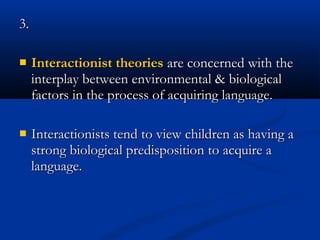
3
   Interactionist Theory
3.

    Interactionist theories are concerned with the
     interplay between environmental & biological
     factors in the process of acquiring language.

    Interactionists tend to view children as having a
     strong biological predisposition to acquire a
     language.
   However, in contrast to nativists, interactionists
    stress the importance of both the social support
    that parents provide the young language learner,
    as well as the social contexts in which language-
    learning child is instructed.
   Bruner (1983) argues parents provide their
    children a language acquisition support system
    or LASS.

   The LASS is a collection of strategies that parents
    employ to facilitate their children’s acquisition of
    language.
   Another strategy is called infant-directed speech or
    ‘motherese’. When using infant-directed speech, parents
    speak in a higher pitch, stress important words, and talk
    more slowly to their infants.

   Very young infants show a clear preference for infant-
    directed speech. Gets an infant’s attention & increases the
    chances of their understanding the message.
   Criticisms of Interactionist Perspectives

   deVilliers & deVilliers (1992) suggest that parents
    rarely offer their children direct feedback on the
    appropriateness of their grammar.

   Linguistic & social practices vary widely across
    cultures. Some cultures do not use anything like
    the practices described above and yet, their children
    still learn language at a similar rate to Western
    children.
Conclusions
   Each of the three theoretical perspective adds
    something to the study of human language.

   Learning theory provides some thoughts on
    plausible mechanisms that might underlie the
    acquisition of at least some facets of human
    language.
   Nativist theory highlights the fact that now all
    aspects of a language can be learned in the time
    that humans typically do and thus, that an innate
    language mechanism must be a part of our
    equipment.

   Interactionist theories highlight the important
    role of the social environment and the important
    role social input has in structuring our language-
    learning.
Quiz
In brief, Talk about what do you understand from This Lecture according
to
1- Learning Theory
2- nativest Theory
3-interactionst Theory

Complete

1-How we produce meaningful sounds is the study of ..............
.2-...............is the study of word meaning and how we acquire a vocabulary.

3-The study of ..........(or syntax) refers to how we learn the rules of a language.

4............ is the study of how we use language to achieve communicative goals.


5-……..a collection of strategies that parents employ to facilitate their
children’s acquisition of
 language

Language acquistion theories

  • 1.
    Theories of Language Acquisition Language Acquisition T.Lama level 5 -2nd Lec
  • 2.
    Introduction  Three Domains of Language Development: Syntax, Semantics, & Pragmatics  Three Theories of Language Development 1. Learning Theory 2. Nativist Theory 3. Interactionist Theories
  • 3.
    Introduction  When we communicate successfully, we do so because we are able to do at least four different things.  First, we need to be able to perceive and produce the sounds that make up a language and convey meanings to other people.
  • 4.
    Second, we need to know what the words of a language mean.  Third, we need to know how to put these words together in grammatically appropriate ways such that others will understand us.  Fourth, we need to know how to effectively use our language to communicate with others.
  • 5.
    Psychologists who study language refer to each of these processes by different names.
  • 6.
    How we produce meaningful sounds is the study of phonology.  Semantics is the study of word meaning and how we acquire a vocabulary.  The study of grammar (or syntax) refers to how we learn the rules of a language.  Pragmatics is the study of how we use language to achieve communicative goals.
  • 7.
  • 8.
    Theories of LanguageAcquisition 1. Behavioural –( Learning) Theory
  • 9.
    Skinner argued that children learn language as parents selectively reward or punish only those behaviors which they recognize as appropriate, grammatically correct utterances.  Bandura argued that language learning takes place primarily by processes of observation & imitation. Simply put, children overhear language being used and they imitate the behavior of these models.
  • 10.
    Learning theory has been criticized on a number of counts.  It is simply not possible for parents to reinforce or punish all of the possible utterances a child will use.  Studies of parent-child interaction show that parents reward grammatically incorrect utterances that are truthful.  The language that children hear contains too few examples for them to learn the correct rules (poverty of the stimulus argument).
  • 11.
  • 12.
    2. Nativist Theory  The nativist view of language development is traced back to the work of Noam Chomsky (1957).  Chomsky argued that language is the product of an unlearned, biologically-based, internal mental structure.  Because the rules which underlie a language are too complex to be acquired by children in a few short years, some aspects of language must be innately specified.
  • 13.
    In short, many aspects of language are not learned but are a part of our biological endowment.
  • 14.
    Nativist theory has been criticized on a number of counts.  Linguists have failed to specify the nature of universal grammar. Many linguists have speculated that this may not be possible.  Grammar is not learned as rapidly as one might expect if a great deal of innate knowledge is assumed.
  • 15.
    3  Interactionist Theory
  • 16.
    3.  Interactionist theories are concerned with the interplay between environmental & biological factors in the process of acquiring language.  Interactionists tend to view children as having a strong biological predisposition to acquire a language.
  • 17.
    However, in contrast to nativists, interactionists stress the importance of both the social support that parents provide the young language learner, as well as the social contexts in which language- learning child is instructed.
  • 18.
    Bruner (1983) argues parents provide their children a language acquisition support system or LASS.  The LASS is a collection of strategies that parents employ to facilitate their children’s acquisition of language.
  • 19.
    Another strategy is called infant-directed speech or ‘motherese’. When using infant-directed speech, parents speak in a higher pitch, stress important words, and talk more slowly to their infants.  Very young infants show a clear preference for infant- directed speech. Gets an infant’s attention & increases the chances of their understanding the message.
  • 20.
    Criticisms of Interactionist Perspectives  deVilliers & deVilliers (1992) suggest that parents rarely offer their children direct feedback on the appropriateness of their grammar.  Linguistic & social practices vary widely across cultures. Some cultures do not use anything like the practices described above and yet, their children still learn language at a similar rate to Western children.
  • 21.
    Conclusions  Each of the three theoretical perspective adds something to the study of human language.  Learning theory provides some thoughts on plausible mechanisms that might underlie the acquisition of at least some facets of human language.
  • 22.
    Nativist theory highlights the fact that now all aspects of a language can be learned in the time that humans typically do and thus, that an innate language mechanism must be a part of our equipment.  Interactionist theories highlight the important role of the social environment and the important role social input has in structuring our language- learning.
  • 23.
    Quiz In brief, Talkabout what do you understand from This Lecture according to 1- Learning Theory 2- nativest Theory 3-interactionst Theory Complete 1-How we produce meaningful sounds is the study of .............. .2-...............is the study of word meaning and how we acquire a vocabulary. 3-The study of ..........(or syntax) refers to how we learn the rules of a language. 4............ is the study of how we use language to achieve communicative goals. 5-……..a collection of strategies that parents employ to facilitate their children’s acquisition of language

Editor's Notes

  • #21 Same argument as above; parents often reward truthful utterances they can get the gist of, not ones that are grammatically correct. For example, children in many native American cultures are carried about for the first 3 years of their lives in a sling on their parents’ back or front, receiving little direct linguistic interaction. However, these children typically learn language at a normal rate.