GRAMMAR TRANSLATION
METHOD
PRESENT
BY
ANTIKA KURNIA PUTRI
RAHMI FEBRIANI
Class VA
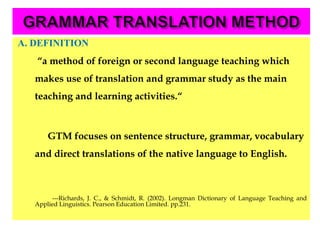
A. DEFINITION
“a method of foreign or second language teaching which
makes use of translation and grammar study as the main
teaching and learning activities.“
GTM focuses on sentence structure, grammar, vocabulary
and direct translations of the native language to English.
---Richards, J. C., & Schmidt, R. (2002). Longman Dictionary of Language Teaching and
Applied Linguistics. Pearson Education Limited. pp.231.
B. BACKGROUND
 Originally used to teach Latin and Greek in the
late 19th and early 20th centuries
 Earlier in 20th century, this method was used for
the purpose of helping students read and
appreciate foreign language literature.
C. AIMS
• > Help student read and understand foreign
language literature.
• > Help student to communicate accurately,
meaningfully.
D. PRINCIPLE
 Grammar Translation Method is a way of studying
a language.
 Reading and writing are the major focus.
 Vocabulary based on reading is taught a bilingual
language word lists, dictionary study and
memorization.
 Much of the lesson is devoted to translating
sentences.
 Grammar is taught deductively.
 The L1 is the medium instruction.
E. TYPICAL TECHNIQUES
Diane Larsen-Freeman, in her book Techniques and
Principles in Language Teaching (1986:13)
 > Translation of a Literary Passage
 > Deductive Application of Rule
 > Memorization
> Fill in the blank
 > Reading Comprehension Questions
 > Antonyms/Synonyms
F. Communicative Approach
> Definition
> Principle
> Teacher’s role
> Teacher student activities
> Materials
G. Grammar Method Approach
> Deductive approach
General  Specific
> Inductive approach
Specific  General
CONCLUSION
The use of translation will contribute to the use
of the target language effectively. Learning gets
meaningful via translation, and better comprehension
promotes foreign language proficiency. The Grammar-
Translation method is useful because learning process
is clearer, thus accuracy will be acquired by students.
REFERENCES
Eisenstein, M. (1987). Grammatical explanations in ESL: Teach the student,
Not the method. In M. Long & J. Richards (Eds.), Methodology in
TESOL (pp. 282-292). New Jersey: Heinle & Heinle Publishers.
Fish, S. (2003). Is there a text in this class? – The authority of interpretative
communities. 12.ed.Cambridge, USA: Harvard University Press.
Fortune, A. (1992). Self-study grammar practice: Learners views and
preferences. ELT Journal 46(2), 160-171.
Larsen-Freeman, D. (2000). Techniques and Principles in Language Teaching.
Oxford: Oxford University Press.
TEFL ( Grammar Translation Method)

TEFL ( Grammar Translation Method)

  • 1.
  • 2.
    A. DEFINITION “a methodof foreign or second language teaching which makes use of translation and grammar study as the main teaching and learning activities.“ GTM focuses on sentence structure, grammar, vocabulary and direct translations of the native language to English. ---Richards, J. C., & Schmidt, R. (2002). Longman Dictionary of Language Teaching and Applied Linguistics. Pearson Education Limited. pp.231.
  • 3.
    B. BACKGROUND  Originallyused to teach Latin and Greek in the late 19th and early 20th centuries  Earlier in 20th century, this method was used for the purpose of helping students read and appreciate foreign language literature.
  • 4.
    C. AIMS • >Help student read and understand foreign language literature. • > Help student to communicate accurately, meaningfully.
  • 5.
    D. PRINCIPLE  GrammarTranslation Method is a way of studying a language.  Reading and writing are the major focus.  Vocabulary based on reading is taught a bilingual language word lists, dictionary study and memorization.  Much of the lesson is devoted to translating sentences.  Grammar is taught deductively.  The L1 is the medium instruction.
  • 6.
    E. TYPICAL TECHNIQUES DianeLarsen-Freeman, in her book Techniques and Principles in Language Teaching (1986:13)  > Translation of a Literary Passage  > Deductive Application of Rule  > Memorization > Fill in the blank  > Reading Comprehension Questions  > Antonyms/Synonyms
  • 7.
    F. Communicative Approach >Definition > Principle > Teacher’s role > Teacher student activities > Materials
  • 8.
    G. Grammar MethodApproach > Deductive approach General  Specific > Inductive approach Specific  General
  • 9.
    CONCLUSION The use oftranslation will contribute to the use of the target language effectively. Learning gets meaningful via translation, and better comprehension promotes foreign language proficiency. The Grammar- Translation method is useful because learning process is clearer, thus accuracy will be acquired by students.
  • 10.
    REFERENCES Eisenstein, M. (1987).Grammatical explanations in ESL: Teach the student, Not the method. In M. Long & J. Richards (Eds.), Methodology in TESOL (pp. 282-292). New Jersey: Heinle & Heinle Publishers. Fish, S. (2003). Is there a text in this class? – The authority of interpretative communities. 12.ed.Cambridge, USA: Harvard University Press. Fortune, A. (1992). Self-study grammar practice: Learners views and preferences. ELT Journal 46(2), 160-171. Larsen-Freeman, D. (2000). Techniques and Principles in Language Teaching. Oxford: Oxford University Press.