by Andrea Pichilef and
Agustín Caldentey, 2012
   General approach to foreign language.
   It gives importance to listening
    comprehension. Language learning
    should come first with understanding
    and later proceed to production.
   Similar as how students acquire their
    native language.
•   Natural Approach by Krashen and Terrel: creates
    a “low affective filter”
•   Comprehension Approach by Winitz and Reed:
    students listen to tape recorder.
•   Lexical Approach by Michael Lewis: students
    receive abundant comprehensible input.
•   Total Physical Response by Asher: students
    follow directions uttered by the instructor.
   http://www.youtube.com/watch?v=
    bkMQXFOqyQA&feature=related
   Teacher gives several commands to students.
   Even though they have not done the actions before , the
    students are able to perform according to the teacher’s
    commands.
   Soon the teacher alters the order of the commands, but
    children are still able to perform them.
   Teacher writes commands on the board and then acts
    them out. Students may copy the commands on their
    notebooks.
   They are not actually saying anything but the
    comprehend anyway.
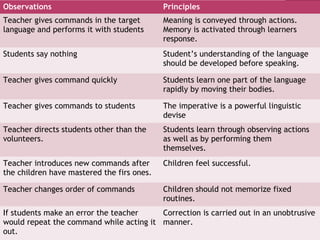
Observations                                Principles
Teacher gives commands in the target        Meaning is conveyed through actions.
language and performs it with students      Memory is activated through learners
                                            response.
Students say nothing                        Student’s understanding of the language
                                            should be developed before speaking.

Teacher gives command quickly               Students learn one part of the language
                                            rapidly by moving their bodies.

Teacher gives commands to students          The imperative is a powerful linguistic
                                            devise
Teacher directs students other than the     Students learn through observing actions
volunteers.                                 as well as by performing them
                                            themselves.
Teacher introduces new commands after       Children feel successful.
the children have mastered the firs ones.

Teacher changes order of commands           Children should not memorize fixed
                                            routines.
If students make an error the teacher    Correction is carried out in an unobtrusive
would repeat the command while acting it manner.
out.
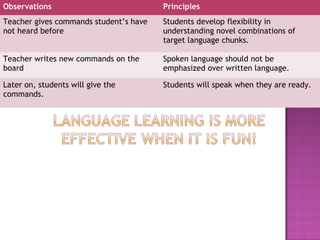
Observations                            Principles
Teacher gives commands student’s have   Students develop flexibility in
not heard before                        understanding novel combinations of
                                        target language chunks.

Teacher writes new commands on the      Spoken language should not be
board                                   emphasized over written language.

Later on, students will give the        Students will speak when they are ready.
commands.
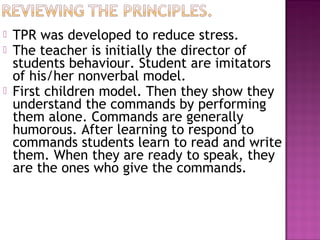
   TPR was developed to reduce stress.
   The teacher is initially the director of
    students behaviour. Student are imitators
    of his/her nonverbal model.
   First children model. Then they show they
    understand the commands by performing
    them alone. Commands are generally
    humorous. After learning to respond to
    commands students learn to read and write
    them. When they are ready to speak, they
    are the ones who give the commands.
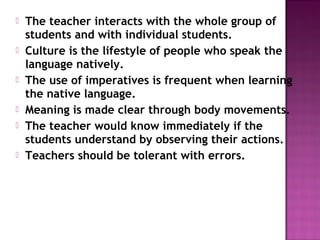
   The teacher interacts with the whole group of
    students and with individual students.
   Culture is the lifestyle of people who speak the
    language natively.
   The use of imperatives is frequent when learning
    the native language.
   Meaning is made clear through body movements.
   The teacher would know immediately if the
    students understand by observing their actions.
   Teachers should be tolerant with errors.
   Using commands to direct behaviour:
    The use of commands is the major technique of
    TPR. It is given to get students to perform an
    action. The action makes the meaning of the
    command clearer.
   Role reversal:
    Students will give the command when they are
    ready.
   Action sequence:
     As students learn more and more of the target
    language, a longer series of commands can be
    given.

Total Physical Response

  • 1.
    by Andrea Pichilefand Agustín Caldentey, 2012
  • 2.
    General approach to foreign language.  It gives importance to listening comprehension. Language learning should come first with understanding and later proceed to production.  Similar as how students acquire their native language.
  • 3.
    Natural Approach by Krashen and Terrel: creates a “low affective filter” • Comprehension Approach by Winitz and Reed: students listen to tape recorder. • Lexical Approach by Michael Lewis: students receive abundant comprehensible input. • Total Physical Response by Asher: students follow directions uttered by the instructor.
  • 4.
    http://www.youtube.com/watch?v= bkMQXFOqyQA&feature=related  Teacher gives several commands to students.  Even though they have not done the actions before , the students are able to perform according to the teacher’s commands.  Soon the teacher alters the order of the commands, but children are still able to perform them.  Teacher writes commands on the board and then acts them out. Students may copy the commands on their notebooks.  They are not actually saying anything but the comprehend anyway.
  • 5.
    Observations Principles Teacher gives commands in the target Meaning is conveyed through actions. language and performs it with students Memory is activated through learners response. Students say nothing Student’s understanding of the language should be developed before speaking. Teacher gives command quickly Students learn one part of the language rapidly by moving their bodies. Teacher gives commands to students The imperative is a powerful linguistic devise Teacher directs students other than the Students learn through observing actions volunteers. as well as by performing them themselves. Teacher introduces new commands after Children feel successful. the children have mastered the firs ones. Teacher changes order of commands Children should not memorize fixed routines. If students make an error the teacher Correction is carried out in an unobtrusive would repeat the command while acting it manner. out.
  • 6.
    Observations Principles Teacher gives commands student’s have Students develop flexibility in not heard before understanding novel combinations of target language chunks. Teacher writes new commands on the Spoken language should not be board emphasized over written language. Later on, students will give the Students will speak when they are ready. commands.
  • 7.
    TPR was developed to reduce stress.  The teacher is initially the director of students behaviour. Student are imitators of his/her nonverbal model.  First children model. Then they show they understand the commands by performing them alone. Commands are generally humorous. After learning to respond to commands students learn to read and write them. When they are ready to speak, they are the ones who give the commands.
  • 8.
    The teacher interacts with the whole group of students and with individual students.  Culture is the lifestyle of people who speak the language natively.  The use of imperatives is frequent when learning the native language.  Meaning is made clear through body movements.  The teacher would know immediately if the students understand by observing their actions.  Teachers should be tolerant with errors.
  • 9.
    Using commands to direct behaviour: The use of commands is the major technique of TPR. It is given to get students to perform an action. The action makes the meaning of the command clearer.  Role reversal: Students will give the command when they are ready.  Action sequence: As students learn more and more of the target language, a longer series of commands can be given.