Direct Method 
What is Direct Method?
Direct Method 
The Direct Method has one 
very basic rule: No 
translation is allowed.
What is Direct Method? 
“The method of teaching foreign language 
without the use of mother tongue.” 
It only uses target language to teach target 
language. 
It is also called “Natural language” because 
of its learners do not use native language.
Background 
Founded by Francois Gouin, in 1860, he 
observed hundreds of French students learning a 
foreign language and concluded that learning a 
foreign language should be in the same way by 
which people learn their L1. 
It aims to use the target language to communicate 
with daily words. Grammar is taught inductively, 
in which students discover the rules.
Background 
It’s to make up with the Grammar-Translation 
Meth0od, which emphasizes reading and writing, 
fixed rules for sentences patterns, and grammar 
and translation skills. 
So, in DM, no translation, no native language but 
with meaningful context, realia, pictures, visual 
aids, demonstration and dramatization to help 
students learn words, preposition, grammar of 
the target language.
Principles 
No translate but demonstrate 
Never explain but act 
Never make a speech but ask questions 
Native speaker to deliver teaching for 
correct pronunciation, and better oral skills.
Four Major Principles 
No Translation under any circumstances. 
A strong emphasize on oral work. 
Avoidance of grammatical expression. 
Maximum use of question answer 
techniques.
Role of the students 
Student are less passive as compared to 
GTM. 
They think and speak in the target 
language. 
They try to speak as much as possible. 
They learn how to ask a question as well as 
answer them.
Role of the Teacher 
The teacher role is quite active. 
He /She directs all the classroom activities. 
Asks minimum Questions and Answers. 
He /She uses sentences instead of words 
and makes student speak much.
Techniques 
Reading loud 
Question and answer exercise 
Getting students to self-correct 
Conversation practice 
Fill-in-the-blank exercise 
Dictation 
Map drawing 
Paragraph writing
Techniques 
Reading aloud: 
Student take turns reading sections of a passage, 
play, or whatever teaching materials. The teacher 
uses gestures, pictures, examples, or other means 
to make the meaning of the section clear. 
Question and answer exercise 
Students ask answer Questions in full sentences 
and practice new words and grammatical rules.
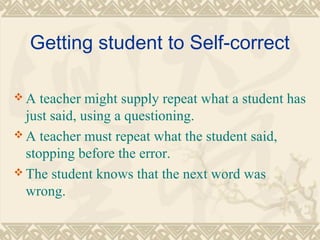
Getting student to Self-correct 
A teacher might supply repeat what a student has 
just said, using a questioning. 
A teacher must repeat what the student said, 
stopping before the error. 
The student knows that the next word was 
wrong.
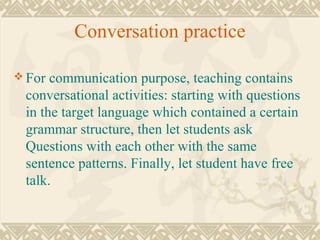
Conversation practice 
For communication purpose, teaching contains 
conversational activities: starting with questions 
in the target language which contained a certain 
grammar structure, then let students ask 
Questions with each other with the same 
sentence patterns. Finally, let student have free 
talk.
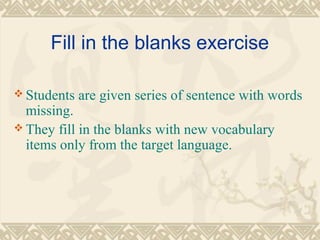
Fill in the blanks exercise 
Students are given series of sentence with words 
missing. 
They fill in the blanks with new vocabulary 
items only from the target language.
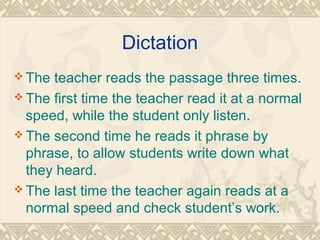
Dictation 
The teacher reads the passage three times. 
The first time the teacher read it at a normal 
speed, while the student only listen. 
The second time he reads it phrase by 
phrase, to allow students write down what 
they heard. 
The last time the teacher again reads at a 
normal speed and check student’s work.
Map drawing 
The student are given a map with the 
geographical features unnamed. 
The teacher gives directions to the students. 
The student can have a completely labeled 
map if they follow his instruction correct.
Paragraph writing 
The teacher asks students to write a 
paragraph in their own words. 
The student can do this from their memory. 
They can use the reading passage in the 
lesson as a model. 
The same techniques of paragraph can be 
applied to any other topics.
Advantages 
Let students learn the correct pronunciation 
and better oral skills because no native 
language is used and communication is 
main activity in the class. Whereas, 
students’ enterprising spirits and the teacher 
speaking the target language fluently are 
required.
Disadvantages 
Students may be afraid of asking Qs. 
It’s hard to practice the methods in a class 
with more than 20 students. It needs a great 
amount of teachers 
It’s hard to explain abstract words. 
It takes much time for teacher to explain the 
words that might be trivial.
The Role of DM in Pakistan 
Direct method is not used in Govt. schools 
because students are not taught the foreign 
languages from their beginning stages. 
In private schools DM is being used with 
some amendments. 
The Role of mother tongue is not ignored. 
Grammar and other rules are also taught 
according to the principal of DM.
The principles are still followed in 
contemporary schools: 
 Never translate: demonstrate, 
 Never explain: act, 
 Never make a speech: ask questions, 
 Never imitate mistakes: correct, 
 Never speak with single words: use sentences, 
 Never speak too much: make students speak much, 
 Never use the book: use your lesson plan, 
 Never jump around: follow your plan, 
 Never go too fast: keep the pace of the student, 
 Never speak too slowly: speak normally, 
 Never speak too quickly: speak naturally, 
 Never speak too loudly: speak naturally, 
 Never be impatient: take it easy.
Summary 
No method of teaching a target language is 
absolute rather contextual. 
A good teacher can reap maximum advantages 
from carefully handling the Direct Method. 
The complete detachment from mother tongue 
is almost impossible.
Conclusion 
Language learning should be of use. 
Good for the class of small size. 
Culture should be taught about people’s daily 
lives.
Thanks for attention! 
…!Good bye

Direct method by m.hasnnain

  • 1.
    Direct Method Whatis Direct Method?
  • 2.
    Direct Method TheDirect Method has one very basic rule: No translation is allowed.
  • 3.
    What is DirectMethod? “The method of teaching foreign language without the use of mother tongue.” It only uses target language to teach target language. It is also called “Natural language” because of its learners do not use native language.
  • 4.
    Background Founded byFrancois Gouin, in 1860, he observed hundreds of French students learning a foreign language and concluded that learning a foreign language should be in the same way by which people learn their L1. It aims to use the target language to communicate with daily words. Grammar is taught inductively, in which students discover the rules.
  • 5.
    Background It’s tomake up with the Grammar-Translation Meth0od, which emphasizes reading and writing, fixed rules for sentences patterns, and grammar and translation skills. So, in DM, no translation, no native language but with meaningful context, realia, pictures, visual aids, demonstration and dramatization to help students learn words, preposition, grammar of the target language.
  • 6.
    Principles No translatebut demonstrate Never explain but act Never make a speech but ask questions Native speaker to deliver teaching for correct pronunciation, and better oral skills.
  • 7.
    Four Major Principles No Translation under any circumstances. A strong emphasize on oral work. Avoidance of grammatical expression. Maximum use of question answer techniques.
  • 8.
    Role of thestudents Student are less passive as compared to GTM. They think and speak in the target language. They try to speak as much as possible. They learn how to ask a question as well as answer them.
  • 9.
    Role of theTeacher The teacher role is quite active. He /She directs all the classroom activities. Asks minimum Questions and Answers. He /She uses sentences instead of words and makes student speak much.
  • 10.
    Techniques Reading loud Question and answer exercise Getting students to self-correct Conversation practice Fill-in-the-blank exercise Dictation Map drawing Paragraph writing
  • 11.
    Techniques Reading aloud: Student take turns reading sections of a passage, play, or whatever teaching materials. The teacher uses gestures, pictures, examples, or other means to make the meaning of the section clear. Question and answer exercise Students ask answer Questions in full sentences and practice new words and grammatical rules.
  • 12.
    Getting student toSelf-correct A teacher might supply repeat what a student has just said, using a questioning. A teacher must repeat what the student said, stopping before the error. The student knows that the next word was wrong.
  • 13.
    Conversation practice Forcommunication purpose, teaching contains conversational activities: starting with questions in the target language which contained a certain grammar structure, then let students ask Questions with each other with the same sentence patterns. Finally, let student have free talk.
  • 14.
    Fill in theblanks exercise Students are given series of sentence with words missing. They fill in the blanks with new vocabulary items only from the target language.
  • 15.
    Dictation The teacherreads the passage three times. The first time the teacher read it at a normal speed, while the student only listen. The second time he reads it phrase by phrase, to allow students write down what they heard. The last time the teacher again reads at a normal speed and check student’s work.
  • 16.
    Map drawing Thestudent are given a map with the geographical features unnamed. The teacher gives directions to the students. The student can have a completely labeled map if they follow his instruction correct.
  • 17.
    Paragraph writing Theteacher asks students to write a paragraph in their own words. The student can do this from their memory. They can use the reading passage in the lesson as a model. The same techniques of paragraph can be applied to any other topics.
  • 18.
    Advantages Let studentslearn the correct pronunciation and better oral skills because no native language is used and communication is main activity in the class. Whereas, students’ enterprising spirits and the teacher speaking the target language fluently are required.
  • 19.
    Disadvantages Students maybe afraid of asking Qs. It’s hard to practice the methods in a class with more than 20 students. It needs a great amount of teachers It’s hard to explain abstract words. It takes much time for teacher to explain the words that might be trivial.
  • 20.
    The Role ofDM in Pakistan Direct method is not used in Govt. schools because students are not taught the foreign languages from their beginning stages. In private schools DM is being used with some amendments. The Role of mother tongue is not ignored. Grammar and other rules are also taught according to the principal of DM.
  • 21.
    The principles arestill followed in contemporary schools:  Never translate: demonstrate,  Never explain: act,  Never make a speech: ask questions,  Never imitate mistakes: correct,  Never speak with single words: use sentences,  Never speak too much: make students speak much,  Never use the book: use your lesson plan,  Never jump around: follow your plan,  Never go too fast: keep the pace of the student,  Never speak too slowly: speak normally,  Never speak too quickly: speak naturally,  Never speak too loudly: speak naturally,  Never be impatient: take it easy.
  • 22.
    Summary No methodof teaching a target language is absolute rather contextual. A good teacher can reap maximum advantages from carefully handling the Direct Method. The complete detachment from mother tongue is almost impossible.
  • 23.
    Conclusion Language learningshould be of use. Good for the class of small size. Culture should be taught about people’s daily lives.
  • 26.
    Thanks for attention! …!Good bye