.
 1. Language forms occur most
  naturally within a context “
  dialogue”.
 The native language and the target
  language have separate linguistic
  systems , they should be kept apart
  not interfered . So teachers use only
  the target language.
One of the language teacher's major
2.

roles is that of a model of the target
language. Teachers should provide
students with a native-speaker-like
model. By listening to how it is
supposed to sound, students should be
able to mimic the model.
3. Language learning is a process
of habit formation. The more
often something is repeated, the
stronger the habit and the
greater the learning (The
students repeat each line of the
new dialogue several times).
4. It is important to prevent
learners from making errors.
Errors lead to the formation of
bad habits. When errors do
occur, they should be
im-mediately corrected by the
teacher.
5. The purpose of language
learning is to learn how to use
the language to communicate
(The teacher initiates a chain
drill in which each student
greets another).
6. Positive reinforcement helps the
students to develop correct habits

(The teacher says, "Very good,"
when the students answer correctly).

7. The major objective of language
students should learn to respond to
both verbal and nonverbal stimuli
(The teacher uses spoken cues and
picture cues).
8. Each language has a finite
number of patterns.
Pattern practice helps students to
form habits which enable the
students to use the patterns.
Ex. Transformation or question and
answer
11. The major objective of language teaching
should be for students to acquire the structural
patterns. New vocabulary is introduced
afterwards.
12. It is important to prevent learners from
making errors. Errors lead to the formation of
bad habits. When errors do occur, they should
be im-mediately corrected by the teacher.

13. The learning of a foreign languages should
be the same as the acquisition of the native
language. We do not need to memorize rules in
order to use our native language.

So , no grammar rules are given but, taught
through examples and drills.
14. The major challenge of foreign
language teaching is getting students to
overcome the habits of their native
language. A comparison between the
native and target language will tell the
teacher in what areas her students will
probably experience.
15. Language cannot be separated from culture.
Culture is not only literature and the arts, but
also the everyday behavior of the people who
use the target language. One of the teacher's
responsibilities is to present information about
that culture.
16. The natural order of skill acquisition is
listening, speaking, reading and writing.
                                               
 Dialogue Memorization
 Backward Build-up (Expansion) Drill
 Repetition Drill
 Chain Drill
 Single-slot Substitution Drill
 Multiple-slot Substitution Drill
 Transformation Drill
 Question-and-answer Drill
 Use of Minimal Pairs
 Complete the Dialogue
 Grammar Game
 Students are given a short dialog to memorize
 then they must use mimicry and applied role
 playing to present the dialog.
 : Provide students with the sentence fragments found
 in the materials section. Students repeat each part of
 the sentence starting at the end of the sentence and
 expanding backwards through the sentence adding
 each part in sequence
 : The teacher provides a question which must be
 transformed into a statement. An extension of this
 activity is to have the students make a question out of
 a statement.
: Using any piece of literature at the students' reading 
     level, read the piece aloud several times. Have the
    students write down what they hear. The idea is to
    write what they have heard as literally as possible.
 : A chain of conversation forms around the room as the
 teacher greets or questions a student and that student
 responds then turns to the next student and greets or
 asks a question of the second student and the chain
 continues.
 : The teacher picks a category, such as the
  supermarket. Then the first student says, "I am going
  to the supermarket. I need a few apples." (The first
  student names something beginning with A.) The

  second student says, "I am going to the supermarket. I
  need a few apples and I need a few bananas." The

  game continues in this manner with each consecutive

  student adding an item beginning with the next letter
  after repeating the items named before their own.
 I’m going to the post office
Multiple-slot Substitution Drill

To give cue phrases, one at time, that fits
into different slots in the dialogue line.
To recognize what part of speech each cue
is and make any other changes, such as
subject-verb agreement.
To fit cue phrase into line where it belongs
and to say the line loudly.
I’m going to the post office.
She
She is going to the post office
The park
She is going to the park
They
They are going to the park
………….
 To change a certain kind of sentence pattern
    to another form.
    to transform an affirmative S. into a
    negative S.
    to transform a statement into a question.
    to transform an active S. into a passive S.
    to transform a direct speech into reported
    speech
 Students practice the target
  language with answering
  questions and the question
  patterns.
 Students answer the teacher’s
  question quickly.
1. introduces a new dialog (p36)
2. uses a backward build-up drill
3. uses a repetition drill (group)
4. initiates a chain drill (individual)
5. leads a single-slot substitution drill (replaces a word or
  phrase = cue) (shows pictures)
6. praise the class during the practice
1. reviews the dialog
2. expands upon the dialog by adding a few lines.
3. drills the new lines and introduces new vocabulary (p.41)
4. works on the mass and count nouns (a little/a few)
5. uses contrastive analysis (correct the pronunciation) (use of
  minimal pairs)
 Teachers want their students to be able to use the target
  language communicatively.
 Overlearning →automatically without stopping to think
 Forming new habits through overcoming the old habit.
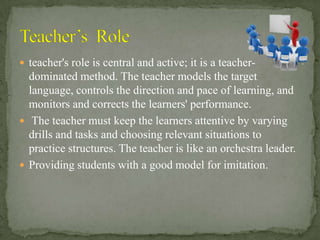
 teacher's role is central and active; it is a teacher-
  dominated method. The teacher models the target
  language, controls the direction and pace of learning, and
  monitors and corrects the learners' performance.
 The teacher must keep the learners attentive by varying
  drills and tasks and choosing relevant situations to
  practice structures. The teacher is like an orchestra leader.
 Providing students with a good model for imitation.
 Learners are viewed as organisms that can be directed by
  skilled training techniques to produce correct responses. In
  accordance with behaviorist learning theory, teaching
  focuses on the external manifestations of learning rather
  than on the internal processes.
 Learners play a reactive role by responding to stimuli, and
  thus have little control over the content, pace, or style of
  learning. The fact that In the early stages learners do not
  always understand the meaning of what they are repeating
  is not perceived as a drawback, for by listening to the
  teacher, imitating accurately, and responding to and
  performing controlled tasks they are learning a new form
  of verbal behavior.
 New vocabulary and structural patterns are presented
  through dialogs.
 Dialogs– learning through imitation and repetition
 Positively reinforced
 Grammar is induced from the examples.
 Interaction is teacher-directed
 Student-student interaction →Chain drills and dialogues
 The view of language → be influenced by descriptive linguists.
 Each level( phonological, morphological…)has its own
  distinctive patterns.
 Everyday speech is emphasized.
 The level of complexity of the speech is graded.
 Vocabulary is kept to a minimum while the students are
  mastering the sound system and grammatical patterns.
 The natural order of skills presentation is adhered to :
  listening, speaking, reading, and writing.
 The oral/aural skills receive most of the attention .
 The habits of the students’ native language are thought to
  interfere with the students’ attempts to master the target
  language.
 The target language is mostly used in the classroom
  instead of the native language.
→each question on the test would focus on only one point of
 the language at a time.
Ex: students might be asked to distinguish between words in
 a minimal pair.
 Students errors are to be avoided if at all possible through the
  teacher’s awareness of where the students will have difficulty
  and restriction of what they are taught to say.

Additional resource for audio lingual method

  • 1.
  • 3.
     1. Languageforms occur most naturally within a context “ dialogue”.  The native language and the target language have separate linguistic systems , they should be kept apart not interfered . So teachers use only the target language.
  • 4.
    One of thelanguage teacher's major 2. roles is that of a model of the target language. Teachers should provide students with a native-speaker-like model. By listening to how it is supposed to sound, students should be able to mimic the model.
  • 5.
    3. Language learningis a process of habit formation. The more often something is repeated, the stronger the habit and the greater the learning (The students repeat each line of the new dialogue several times).
  • 6.
    4. It isimportant to prevent learners from making errors. Errors lead to the formation of bad habits. When errors do occur, they should be im-mediately corrected by the teacher.
  • 7.
    5. The purposeof language learning is to learn how to use the language to communicate (The teacher initiates a chain drill in which each student greets another).
  • 8.
    6. Positive reinforcementhelps the students to develop correct habits (The teacher says, "Very good," when the students answer correctly). 7. The major objective of language students should learn to respond to both verbal and nonverbal stimuli (The teacher uses spoken cues and picture cues).
  • 9.
    8. Each languagehas a finite number of patterns. Pattern practice helps students to form habits which enable the students to use the patterns. Ex. Transformation or question and answer
  • 11.
    11. The majorobjective of language teaching should be for students to acquire the structural patterns. New vocabulary is introduced afterwards. 12. It is important to prevent learners from making errors. Errors lead to the formation of bad habits. When errors do occur, they should be im-mediately corrected by the teacher. 
  • 12.
    13. The learningof a foreign languages should be the same as the acquisition of the native language. We do not need to memorize rules in order to use our native language. So , no grammar rules are given but, taught through examples and drills.
  • 13.
    14. The majorchallenge of foreign language teaching is getting students to overcome the habits of their native language. A comparison between the native and target language will tell the teacher in what areas her students will probably experience.
  • 14.
    15. Language cannotbe separated from culture. Culture is not only literature and the arts, but also the everyday behavior of the people who use the target language. One of the teacher's responsibilities is to present information about that culture. 16. The natural order of skill acquisition is listening, speaking, reading and writing. 
  • 15.
     Dialogue Memorization Backward Build-up (Expansion) Drill  Repetition Drill  Chain Drill  Single-slot Substitution Drill  Multiple-slot Substitution Drill  Transformation Drill  Question-and-answer Drill  Use of Minimal Pairs  Complete the Dialogue  Grammar Game
  • 16.
     Students aregiven a short dialog to memorize then they must use mimicry and applied role playing to present the dialog.
  • 17.
     : Providestudents with the sentence fragments found in the materials section. Students repeat each part of the sentence starting at the end of the sentence and expanding backwards through the sentence adding each part in sequence
  • 18.
     : Theteacher provides a question which must be transformed into a statement. An extension of this activity is to have the students make a question out of a statement.
  • 19.
    : Using anypiece of literature at the students' reading  level, read the piece aloud several times. Have the students write down what they hear. The idea is to write what they have heard as literally as possible.
  • 20.
     : Achain of conversation forms around the room as the teacher greets or questions a student and that student responds then turns to the next student and greets or asks a question of the second student and the chain continues.
  • 21.
     : Theteacher picks a category, such as the supermarket. Then the first student says, "I am going to the supermarket. I need a few apples." (The first student names something beginning with A.) The second student says, "I am going to the supermarket. I need a few apples and I need a few bananas." The game continues in this manner with each consecutive student adding an item beginning with the next letter after repeating the items named before their own.
  • 22.
     I’m goingto the post office
  • 23.
    Multiple-slot Substitution Drill Togive cue phrases, one at time, that fits into different slots in the dialogue line. To recognize what part of speech each cue is and make any other changes, such as subject-verb agreement. To fit cue phrase into line where it belongs and to say the line loudly.
  • 24.
    I’m going tothe post office. She She is going to the post office The park She is going to the park They They are going to the park ………….
  • 25.
     To changea certain kind of sentence pattern to another form.  to transform an affirmative S. into a negative S.  to transform a statement into a question.  to transform an active S. into a passive S.  to transform a direct speech into reported speech
  • 26.
     Students practicethe target language with answering questions and the question patterns.  Students answer the teacher’s question quickly.
  • 27.
    1. introduces anew dialog (p36) 2. uses a backward build-up drill 3. uses a repetition drill (group) 4. initiates a chain drill (individual) 5. leads a single-slot substitution drill (replaces a word or phrase = cue) (shows pictures) 6. praise the class during the practice
  • 28.
    1. reviews thedialog 2. expands upon the dialog by adding a few lines. 3. drills the new lines and introduces new vocabulary (p.41) 4. works on the mass and count nouns (a little/a few) 5. uses contrastive analysis (correct the pronunciation) (use of minimal pairs)
  • 29.
     Teachers wanttheir students to be able to use the target language communicatively.  Overlearning →automatically without stopping to think  Forming new habits through overcoming the old habit.
  • 30.
     teacher's roleis central and active; it is a teacher- dominated method. The teacher models the target language, controls the direction and pace of learning, and monitors and corrects the learners' performance.  The teacher must keep the learners attentive by varying drills and tasks and choosing relevant situations to practice structures. The teacher is like an orchestra leader.  Providing students with a good model for imitation.
  • 31.
     Learners areviewed as organisms that can be directed by skilled training techniques to produce correct responses. In accordance with behaviorist learning theory, teaching focuses on the external manifestations of learning rather than on the internal processes.  Learners play a reactive role by responding to stimuli, and thus have little control over the content, pace, or style of learning. The fact that In the early stages learners do not always understand the meaning of what they are repeating is not perceived as a drawback, for by listening to the teacher, imitating accurately, and responding to and performing controlled tasks they are learning a new form of verbal behavior.
  • 32.
     New vocabularyand structural patterns are presented through dialogs.  Dialogs– learning through imitation and repetition  Positively reinforced  Grammar is induced from the examples.
  • 33.
     Interaction isteacher-directed  Student-student interaction →Chain drills and dialogues
  • 34.
     The viewof language → be influenced by descriptive linguists.  Each level( phonological, morphological…)has its own distinctive patterns.  Everyday speech is emphasized.  The level of complexity of the speech is graded.
  • 35.
     Vocabulary iskept to a minimum while the students are mastering the sound system and grammatical patterns.  The natural order of skills presentation is adhered to : listening, speaking, reading, and writing.  The oral/aural skills receive most of the attention .
  • 36.
     The habitsof the students’ native language are thought to interfere with the students’ attempts to master the target language.  The target language is mostly used in the classroom instead of the native language.
  • 37.
    →each question onthe test would focus on only one point of the language at a time. Ex: students might be asked to distinguish between words in a minimal pair.
  • 38.
     Students errorsare to be avoided if at all possible through the teacher’s awareness of where the students will have difficulty and restriction of what they are taught to say.