The Grammar
Translation Method


      Practice II: Didactics of English as EFL
                              Byrne, Laureana
                         Scaricaciottoli, Sofia
                                           2012
The also called Classical Method was originally
used to teach Latin and Greek during the 18th
Century and beginning of the 19th.
It focused on:
          Grammatical rules
          Memorization of vocabulary
          Declensions and conjugations
          Translations of texts by doing written
          exercises
This model did not give time to teaching
someone how to speak the language: languages were
taught for gaining reading proficiency.
 The Classical Method came to be known as Grammar
  Translation Method in the 19th Century.
 Characteristics:
 Classes were taught in the mother tongue
 Much vocabulary was taught in the form of lists of isolated
  words
                   E.g.: The house la casa
                         The mouse el ratón
 Long elaborated explanations of the intricancies of
  grammar are given
 Grammar provides the rules for putting words together
 Little attention is paid to the context of texts
 Teacher-centered
 To be able to communicate with the speakers of the
  target language is not among the goals
 The enhanced skills are reading and writing
 The focus is on accuracy not fluency
 The only drills are exercises in translating disconnected
  sentences
 Little or no attention is given to pronunciation
 It does not foster student’s communicative ability in the
  target language
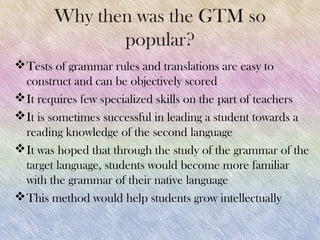
Why then was the GTM so
               popular?
 Tests of grammar rules and translations are easy to
  construct and can be objectively scored
 It requires few specialized skills on the part of teachers
 It is sometimes successful in leading a student towards a
  reading knowledge of the second language
 It was hoped that through the study of the grammar of the
  target language, students would become more familiar
  with the grammar of their native language
 This method would help students grow intellectually
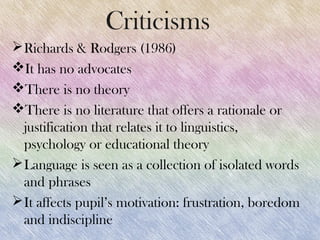
Criticisms
 Richards & Rodgers (1986)
It has no advocates
There is no theory
There is no literature that offers a rationale or
  justification that relates it to linguistics,
  psychology or educational theory
 Language is seen as a collection of isolated words
  and phrases
 It affects pupil’s motivation: frustration, boredom
  and indiscipline
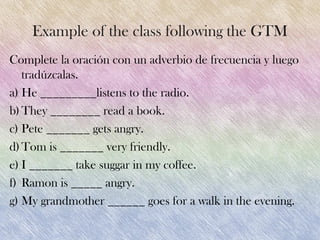
Example of the class following the GTM
Complete la oración con un adverbio de frecuencia y luego
   tradúzcalas.
a) He _________listens to the radio.
b) They ________ read a book.
c) Pete _______ gets angry.
d) Tom is _______ very friendly.
e) I _______ take suggar in my coffee.
f) Ramon is _____ angry.
g) My grandmother ______ goes for a walk in the evening.
References
Brown, D. H. (2007). A “Methodical” History
 of Language Teaching Teaching. In Brown, D.
 H. (Ed.) Teaching by Principles. Oxford,
 Longman
Larsen Freeman, D. (2000). Techniques and
 Principles in Language Teaching. Oxford:
 OUP
www.slideshare.net/vacoka/grammar-
 translation-method-presentation

The grammar translation method

  • 1.
    The Grammar Translation Method Practice II: Didactics of English as EFL Byrne, Laureana Scaricaciottoli, Sofia 2012
  • 2.
    The also calledClassical Method was originally used to teach Latin and Greek during the 18th Century and beginning of the 19th. It focused on: Grammatical rules Memorization of vocabulary Declensions and conjugations Translations of texts by doing written exercises This model did not give time to teaching someone how to speak the language: languages were taught for gaining reading proficiency.
  • 3.
     The ClassicalMethod came to be known as Grammar Translation Method in the 19th Century.  Characteristics:  Classes were taught in the mother tongue  Much vocabulary was taught in the form of lists of isolated words E.g.: The house la casa The mouse el ratón  Long elaborated explanations of the intricancies of grammar are given  Grammar provides the rules for putting words together  Little attention is paid to the context of texts
  • 4.
     Teacher-centered  Tobe able to communicate with the speakers of the target language is not among the goals  The enhanced skills are reading and writing  The focus is on accuracy not fluency  The only drills are exercises in translating disconnected sentences  Little or no attention is given to pronunciation  It does not foster student’s communicative ability in the target language
  • 5.
    Why then wasthe GTM so popular?  Tests of grammar rules and translations are easy to construct and can be objectively scored  It requires few specialized skills on the part of teachers  It is sometimes successful in leading a student towards a reading knowledge of the second language  It was hoped that through the study of the grammar of the target language, students would become more familiar with the grammar of their native language  This method would help students grow intellectually
  • 6.
    Criticisms  Richards &Rodgers (1986) It has no advocates There is no theory There is no literature that offers a rationale or justification that relates it to linguistics, psychology or educational theory  Language is seen as a collection of isolated words and phrases  It affects pupil’s motivation: frustration, boredom and indiscipline
  • 7.
    Example of theclass following the GTM Complete la oración con un adverbio de frecuencia y luego tradúzcalas. a) He _________listens to the radio. b) They ________ read a book. c) Pete _______ gets angry. d) Tom is _______ very friendly. e) I _______ take suggar in my coffee. f) Ramon is _____ angry. g) My grandmother ______ goes for a walk in the evening.
  • 8.
    References Brown, D. H.(2007). A “Methodical” History of Language Teaching Teaching. In Brown, D. H. (Ed.) Teaching by Principles. Oxford, Longman Larsen Freeman, D. (2000). Techniques and Principles in Language Teaching. Oxford: OUP www.slideshare.net/vacoka/grammar- translation-method-presentation