L. D. COLLEGE OF
ENGINEERING
RUBBER TECHNOLOGY
Sub:- engineering economics and management
1Prepared by:- Yogesh Malani
Topic:-Introduction to Economics,
Theory of Demand and
Supply
2Prepared by:- Yogesh Malani
Economics
Definition:-
Economics word derived from
two Greek words- ‘Oikos’ and
‘Nemein’.
‘Oikos’ means ‘household’
‘Nemein’ means ‘Management’
Management of household is
known as economics.
3Prepared by:- Yogesh Malani
Economics
Meaning of Economics:-
There are many definitions by different
economists at different time, which is differ from
each other.
There are classified into three categories as
under;
•Wealth oriented(Adam Smith,J.B.Say,J.S. Mill)
•Welfare oriented( Marshall, Pigou etc)
•Scarcity oriented(Robbins)
4Prepared by:- Yogesh Malani
Nature of Economics
There are four factors affecting to
nature of economics as per below;
•Economics is a Science.
•Economics is an Art.
•Economics is Positive & Normative
Science.
•Economics is Micro and Macro.
5Prepared by:- Yogesh Malani
Microeconomics
versus Macroeconomics
• Microeconomics
– The study of decision making undertaken by
individuals (or households) and by firms
– Like looking though a microscope to focus on
the smaller parts of the economy
• Decision of a worker to work overtime or not
• A family’s choice of having a baby
• An individual firm advertising
6Prepared by:- Yogesh Malani
Microeconomics
versus Macroeconomics
• Macroeconomics
– The study of the behavior of the economy as a
whole
– Deals with economy wide phenomena
• The national unemployment rate
• The rate of growth in the money supply
• The national government’s budget deficit
7Prepared by:- Yogesh Malani
Microeconomics
versus Macroeconomics
• Macroeconomics deals with aggregates, or
totals—such as total output in an economy.
• Modern economic theory blends micro and
macro concepts.
8Prepared by:- Yogesh Malani
9Prepared by:- Yogesh Malani
10Prepared by:- Yogesh Malani
11Prepared by:- Yogesh Malani
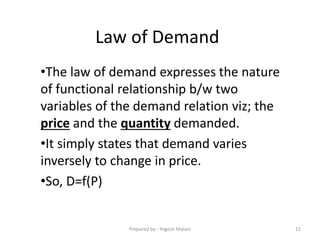
Law of Demand
•The law of demand expresses the nature
of functional relationship b/w two
variables of the demand relation viz; the
price and the quantity demanded.
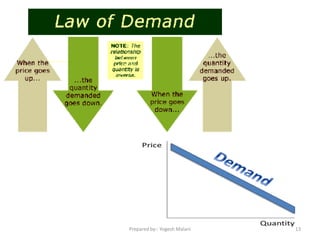
•It simply states that demand varies
inversely to change in price.
•So, D=f(P)
12Prepared by:- Yogesh Malani
13Prepared by:- Yogesh Malani
Application of law of Demand: Policy
to Reduce Smoking
• Option #1: Raise prices of cigarettes by
levying a tax
• Option #2: Introduce a public awareness
program regarding ill effects of smoking
• Policy impact on substitutes
• Policy impact on complements
14Prepared by:- Yogesh Malani
Supply
• The analysis of the supply of produced goods
has two parts:
– An analysis of the supply of the factors of
production to households and firms.
– An analysis of why firms transform those
factors of production into usable goods and
services.
15Prepared by:- Yogesh Malani
The Law of Supply
• There is a direct relationship between price
and quantity supplied.
– Quantity supplied rises as price rises, other things
constant.
– Quantity supplied falls as price falls, other things
constant.
16Prepared by:- Yogesh Malani
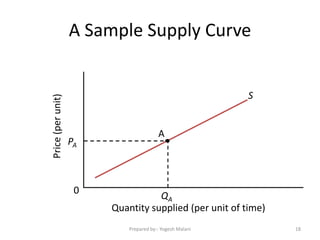
The Supply Curve
• The supply curve is the graphic representation
of the law of supply.
• The supply curve slopes upward to the right.
• The slope tells us that the quantity supplied
varies directly – in the same direction – with
the price.
17Prepared by:- Yogesh Malani
S
A
Quantity supplied (per unit of time)
0
Price(perunit)
PA
QA
A Sample Supply Curve
18Prepared by:- Yogesh Malani
19Prepared by:- Yogesh Malani
Shift Factors of Supply
• Other factors besides price affect how much
will be supplied:
– Prices of inputs used in the production of a good.
– Technology.
– Suppliers’ expectations.
– Taxes and subsidies.
20Prepared by:- Yogesh Malani
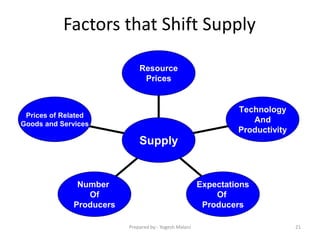
Factors that Shift Supply
Prices of Related
Goods and Services
Number
Of
Producers
Expectations
Of
Producers
Technology
And
Productivity
Resource
Prices
Supply
21Prepared by:- Yogesh Malani
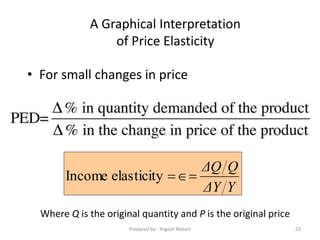
Definition Of Price Elasticity Of Demand
• The change in the quantity demanded of a
product due to a change in its price is known
as Price elasticity of demand. Thus, the
sensitiveness or responsiveness of demand to
change in price is as called elasticity of
demand
22Prepared by:- Yogesh Malani
A Graphical Interpretation
of Price Elasticity
• For small changes in price
YΔY
QΔQ
elasticityIncome 
Where Q is the original quantity and P is the original price
23Prepared by:- Yogesh Malani
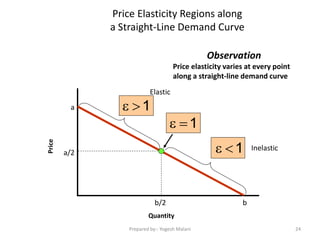
Price Elasticity Regions along
a Straight-Line Demand Curve
Quantity
Price
b/2
a/2
a
b
1
1
1
Observation
Price elasticity varies at every point
along a straight-line demand curve
Inelastic
Elastic
24Prepared by:- Yogesh Malani
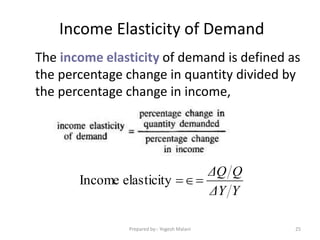
Income Elasticity of Demand
The income elasticity of demand is defined as
the percentage change in quantity divided by
the percentage change in income,
YΔY
QΔQ
elasticityIncome 
25Prepared by:- Yogesh Malani
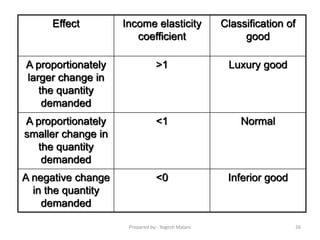
Effect Income elasticity
coefficient
Classification of
good
A proportionately
larger change in
the quantity
demanded
>1 Luxury good
A proportionately
smaller change in
the quantity
demanded
<1 Normal
A negative change
in the quantity
demanded
<0 Inferior good
26Prepared by:- Yogesh Malani
27Prepared by:- Yogesh Malani

Introduction to Economics, Theory of Demand and Supply

  • 1.
    L. D. COLLEGEOF ENGINEERING RUBBER TECHNOLOGY Sub:- engineering economics and management 1Prepared by:- Yogesh Malani
  • 2.
    Topic:-Introduction to Economics, Theoryof Demand and Supply 2Prepared by:- Yogesh Malani
  • 3.
    Economics Definition:- Economics word derivedfrom two Greek words- ‘Oikos’ and ‘Nemein’. ‘Oikos’ means ‘household’ ‘Nemein’ means ‘Management’ Management of household is known as economics. 3Prepared by:- Yogesh Malani
  • 4.
    Economics Meaning of Economics:- Thereare many definitions by different economists at different time, which is differ from each other. There are classified into three categories as under; •Wealth oriented(Adam Smith,J.B.Say,J.S. Mill) •Welfare oriented( Marshall, Pigou etc) •Scarcity oriented(Robbins) 4Prepared by:- Yogesh Malani
  • 5.
    Nature of Economics Thereare four factors affecting to nature of economics as per below; •Economics is a Science. •Economics is an Art. •Economics is Positive & Normative Science. •Economics is Micro and Macro. 5Prepared by:- Yogesh Malani
  • 6.
    Microeconomics versus Macroeconomics • Microeconomics –The study of decision making undertaken by individuals (or households) and by firms – Like looking though a microscope to focus on the smaller parts of the economy • Decision of a worker to work overtime or not • A family’s choice of having a baby • An individual firm advertising 6Prepared by:- Yogesh Malani
  • 7.
    Microeconomics versus Macroeconomics • Macroeconomics –The study of the behavior of the economy as a whole – Deals with economy wide phenomena • The national unemployment rate • The rate of growth in the money supply • The national government’s budget deficit 7Prepared by:- Yogesh Malani
  • 8.
    Microeconomics versus Macroeconomics • Macroeconomicsdeals with aggregates, or totals—such as total output in an economy. • Modern economic theory blends micro and macro concepts. 8Prepared by:- Yogesh Malani
  • 9.
  • 10.
  • 11.
  • 12.
    Law of Demand •Thelaw of demand expresses the nature of functional relationship b/w two variables of the demand relation viz; the price and the quantity demanded. •It simply states that demand varies inversely to change in price. •So, D=f(P) 12Prepared by:- Yogesh Malani
  • 13.
  • 14.
    Application of lawof Demand: Policy to Reduce Smoking • Option #1: Raise prices of cigarettes by levying a tax • Option #2: Introduce a public awareness program regarding ill effects of smoking • Policy impact on substitutes • Policy impact on complements 14Prepared by:- Yogesh Malani
  • 15.
    Supply • The analysisof the supply of produced goods has two parts: – An analysis of the supply of the factors of production to households and firms. – An analysis of why firms transform those factors of production into usable goods and services. 15Prepared by:- Yogesh Malani
  • 16.
    The Law ofSupply • There is a direct relationship between price and quantity supplied. – Quantity supplied rises as price rises, other things constant. – Quantity supplied falls as price falls, other things constant. 16Prepared by:- Yogesh Malani
  • 17.
    The Supply Curve •The supply curve is the graphic representation of the law of supply. • The supply curve slopes upward to the right. • The slope tells us that the quantity supplied varies directly – in the same direction – with the price. 17Prepared by:- Yogesh Malani
  • 18.
    S A Quantity supplied (perunit of time) 0 Price(perunit) PA QA A Sample Supply Curve 18Prepared by:- Yogesh Malani
  • 19.
  • 20.
    Shift Factors ofSupply • Other factors besides price affect how much will be supplied: – Prices of inputs used in the production of a good. – Technology. – Suppliers’ expectations. – Taxes and subsidies. 20Prepared by:- Yogesh Malani
  • 21.
    Factors that ShiftSupply Prices of Related Goods and Services Number Of Producers Expectations Of Producers Technology And Productivity Resource Prices Supply 21Prepared by:- Yogesh Malani
  • 22.
    Definition Of PriceElasticity Of Demand • The change in the quantity demanded of a product due to a change in its price is known as Price elasticity of demand. Thus, the sensitiveness or responsiveness of demand to change in price is as called elasticity of demand 22Prepared by:- Yogesh Malani
  • 23.
    A Graphical Interpretation ofPrice Elasticity • For small changes in price YΔY QΔQ elasticityIncome  Where Q is the original quantity and P is the original price 23Prepared by:- Yogesh Malani
  • 24.
    Price Elasticity Regionsalong a Straight-Line Demand Curve Quantity Price b/2 a/2 a b 1 1 1 Observation Price elasticity varies at every point along a straight-line demand curve Inelastic Elastic 24Prepared by:- Yogesh Malani
  • 25.
    Income Elasticity ofDemand The income elasticity of demand is defined as the percentage change in quantity divided by the percentage change in income, YΔY QΔQ elasticityIncome  25Prepared by:- Yogesh Malani
  • 26.
    Effect Income elasticity coefficient Classificationof good A proportionately larger change in the quantity demanded >1 Luxury good A proportionately smaller change in the quantity demanded <1 Normal A negative change in the quantity demanded <0 Inferior good 26Prepared by:- Yogesh Malani
  • 27.