SUPERGENE
ENRICHMENT
Definitions
 Definition from Evans
“Leaching of valuable elements from the upper parts of mineral
deposits and their precipitation at depth to produce higher
concentrations”
 Definition from Guilbert and Park
“Supergene enrichment occurs when oxidizing acids dissolve metal
ions from the “protore” and re-deposited it in more reducing, basic
areas (water table). This results in an oxidized zone on top(gossan),
a supergene zone beneath and the hypogene(protore) beneath
that.”
Process Occurring
 When ore deposits are exposed to the oxidation zone they are weathered
and altered with the country rocks.
 The surface waters oxidize many ore minerals and yield solvents that
dissolve other minerals.
 An ore body thus becomes oxidized and generally leached of many of its
valuable materials down to the groundwater table, or to depth where
oxidation cannot take place.
 As the cold, dilute, leaching solutions trickle downwards, they may lose a
part or all of their metallic content within the zone of oxidation to give rise to
oxidized ore deposits.
 If they penetrate the water table, their metallic content may be precipitated
in form of secondary sulfides – zone of secondary or supergene sulfide
enrichment.
 The lower , unaffected part of the deposit is called primary or hypogene
deposit.
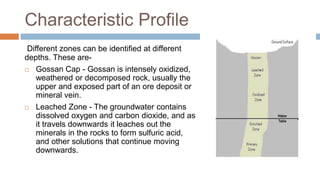
Characteristic Profile
Different zones can be identified at different
depths. These are-
 Gossan Cap - Gossan is intensely oxidized,
weathered or decomposed rock, usually the
upper and exposed part of an ore deposit or
mineral vein.
 Leached Zone - The groundwater contains
dissolved oxygen and carbon dioxide, and as
it travels downwards it leaches out the
minerals in the rocks to form sulfuric acid,
and other solutions that continue moving
downwards.
 Oxidized Zone – The region above the water table in an ore deposit is
known as oxidized zone as it is the zone of oxidation of the primary ore
minerals.
 Water table - At the water table the environment changes from
an oxidizing environment to a reducing one.
 Enriched Zone or Supergene Enrichment Zone – It is the richest part of an
ore deposit where metals are deposited by fluids percolating downwards
from the oxidized zone and concentrating in a narrow reducing band just
below the water table
 Primary Zone - The primary zone contains unaltered primary minerals.
Chemical Changes Involved
 There are two main chemical changes within the zone of oxidation:
 Oxidation, solution and removal of the valuable minerals
 Transformation in situ of metallic minerals into oxidized
compounds.
Most metallic deposits contain Pyrite.
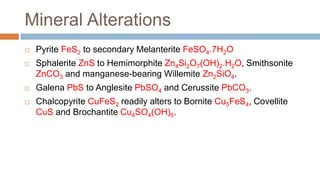
Mineral Alterations
 Pyrite FeS2 to secondary Melanterite FeSO4.7H2O
 Sphalerite ZnS to Hemimorphite Zn4Si2O7(OH)2.H2O, Smithsonite
ZnCO3 and manganese-bearing Willemite Zn2SiO4.
 Galena PbS to Anglesite PbSO4 and Cerussite PbCO3.
 Chalcopyrite CuFeS2 readily alters to Bornite Cu5FeS4, Covellite
CuS and Brochantite Cu4SO4(OH)6.
Effects of Oxidation & Supergene Enrichment:
 Effects of oxidation on mineral deposits are profound - the minerals are
altered and the structure is obliterated.
 The metallic substances are leached or altered to new compounds which
require different metallurgical treatment for their extraction unlike that
employed for the extraction for the unoxidized ore.
 The texture and type of deposits are obscured.
The effects are therefore:
1) To render barren the upper parts of many ore deposits.
2) To change minerals into more usable or less usable form.
3) Supergene enrichment may add much where there was little.
4) Leaner parts of the vein may be made rich.
5) Unworkable protore may be enriched to the ore grade. E.g. many of the
copper districts would not have come into existence except for the process
of enrichment.
Deposits in the zone of supergene
enrichment
 In the supergene zone metals are concentrated in a narrow band just below
the water table. This is the richest part of an ore deposit. The most common
minerals found in supergene zones are:
 Copper: chalcocite, bornite
 Lead: supergene galena
 Nickel: violarite
 Silver: acanthite, native silver
 Zinc: supergene sphalerite, wurtzite
Supergene Sulphide Enrichment
 Surface waters percolating down the outcrops of sulphide ore bodies
oxidize many ore minerals and yield solvents that dissolve other minerals.
Pyrite is almost ubiquitous in sulphide deposits.
 Mineral deposits containing sulfide minerals, especially copper sulfides,
that are subjected to weathering and alteration.
 Sulfide minerals are oxidized at the surface and produce sulfuric acid, and
acidified rainwater then carries the copper, as copper sulfate, down to the
water table. Below the water table, where sulfide minerals remain
unoxidized, any iron sulfide grains present will react with the copper sulfate
solution, putting iron into solution and precipitating a copper mineral.
 The net result is that copper is transferred from the oxidizing
upper portion of the deposit to that portion at and just below the
water table.
 Enrichment of porphyry copper deposits in the southwestern
United States, Mexico, Peru, and Chile is an important factor in
making those deposits ores.
 Lead, zinc, and silver deposits are also subject to supergene
enrichment under conditions of weathering.
Supergene Enrichment of BIF
 A primary BIF may contain only 25 to 30 percent iron by weight, but, when
subjected to intense weathering and supergene enrichment, portions of the
deposit can be enriched to as high as 65 percent iron.
 Some primary BIFs are now mined and beneficiated under the name
taconite, but in essentially all of these deposits mining actually commenced
in the high-grade supergene enrichment zone.
Examples
 World
 Huvela District - Spain (Rio Tinto) – Pyritic Deposits
 Ely, Nevada – Porphyry Copper Deposits
 Neihart, Montana – Silver Ores
 Miami, Arizona – Porphyry Copper Deposits
 Chanarcillo, Chile – Silver Deposits (Exhausted)

Oxidation supergene enrichment

  • 1.
  • 2.
    Definitions  Definition fromEvans “Leaching of valuable elements from the upper parts of mineral deposits and their precipitation at depth to produce higher concentrations”  Definition from Guilbert and Park “Supergene enrichment occurs when oxidizing acids dissolve metal ions from the “protore” and re-deposited it in more reducing, basic areas (water table). This results in an oxidized zone on top(gossan), a supergene zone beneath and the hypogene(protore) beneath that.”
  • 3.
    Process Occurring  Whenore deposits are exposed to the oxidation zone they are weathered and altered with the country rocks.  The surface waters oxidize many ore minerals and yield solvents that dissolve other minerals.  An ore body thus becomes oxidized and generally leached of many of its valuable materials down to the groundwater table, or to depth where oxidation cannot take place.
  • 4.
     As thecold, dilute, leaching solutions trickle downwards, they may lose a part or all of their metallic content within the zone of oxidation to give rise to oxidized ore deposits.  If they penetrate the water table, their metallic content may be precipitated in form of secondary sulfides – zone of secondary or supergene sulfide enrichment.  The lower , unaffected part of the deposit is called primary or hypogene deposit.
  • 5.
    Characteristic Profile Different zonescan be identified at different depths. These are-  Gossan Cap - Gossan is intensely oxidized, weathered or decomposed rock, usually the upper and exposed part of an ore deposit or mineral vein.  Leached Zone - The groundwater contains dissolved oxygen and carbon dioxide, and as it travels downwards it leaches out the minerals in the rocks to form sulfuric acid, and other solutions that continue moving downwards.
  • 6.
     Oxidized Zone– The region above the water table in an ore deposit is known as oxidized zone as it is the zone of oxidation of the primary ore minerals.  Water table - At the water table the environment changes from an oxidizing environment to a reducing one.  Enriched Zone or Supergene Enrichment Zone – It is the richest part of an ore deposit where metals are deposited by fluids percolating downwards from the oxidized zone and concentrating in a narrow reducing band just below the water table  Primary Zone - The primary zone contains unaltered primary minerals.
  • 7.
    Chemical Changes Involved There are two main chemical changes within the zone of oxidation:  Oxidation, solution and removal of the valuable minerals  Transformation in situ of metallic minerals into oxidized compounds. Most metallic deposits contain Pyrite.
  • 8.
    Mineral Alterations  PyriteFeS2 to secondary Melanterite FeSO4.7H2O  Sphalerite ZnS to Hemimorphite Zn4Si2O7(OH)2.H2O, Smithsonite ZnCO3 and manganese-bearing Willemite Zn2SiO4.  Galena PbS to Anglesite PbSO4 and Cerussite PbCO3.  Chalcopyrite CuFeS2 readily alters to Bornite Cu5FeS4, Covellite CuS and Brochantite Cu4SO4(OH)6.
  • 9.
    Effects of Oxidation& Supergene Enrichment:  Effects of oxidation on mineral deposits are profound - the minerals are altered and the structure is obliterated.  The metallic substances are leached or altered to new compounds which require different metallurgical treatment for their extraction unlike that employed for the extraction for the unoxidized ore.  The texture and type of deposits are obscured.
  • 10.
    The effects aretherefore: 1) To render barren the upper parts of many ore deposits. 2) To change minerals into more usable or less usable form. 3) Supergene enrichment may add much where there was little. 4) Leaner parts of the vein may be made rich. 5) Unworkable protore may be enriched to the ore grade. E.g. many of the copper districts would not have come into existence except for the process of enrichment.
  • 11.
    Deposits in thezone of supergene enrichment  In the supergene zone metals are concentrated in a narrow band just below the water table. This is the richest part of an ore deposit. The most common minerals found in supergene zones are:  Copper: chalcocite, bornite  Lead: supergene galena  Nickel: violarite  Silver: acanthite, native silver  Zinc: supergene sphalerite, wurtzite
  • 12.
    Supergene Sulphide Enrichment Surface waters percolating down the outcrops of sulphide ore bodies oxidize many ore minerals and yield solvents that dissolve other minerals. Pyrite is almost ubiquitous in sulphide deposits.  Mineral deposits containing sulfide minerals, especially copper sulfides, that are subjected to weathering and alteration.  Sulfide minerals are oxidized at the surface and produce sulfuric acid, and acidified rainwater then carries the copper, as copper sulfate, down to the water table. Below the water table, where sulfide minerals remain unoxidized, any iron sulfide grains present will react with the copper sulfate solution, putting iron into solution and precipitating a copper mineral.
  • 13.
     The netresult is that copper is transferred from the oxidizing upper portion of the deposit to that portion at and just below the water table.  Enrichment of porphyry copper deposits in the southwestern United States, Mexico, Peru, and Chile is an important factor in making those deposits ores.  Lead, zinc, and silver deposits are also subject to supergene enrichment under conditions of weathering.
  • 14.
    Supergene Enrichment ofBIF  A primary BIF may contain only 25 to 30 percent iron by weight, but, when subjected to intense weathering and supergene enrichment, portions of the deposit can be enriched to as high as 65 percent iron.  Some primary BIFs are now mined and beneficiated under the name taconite, but in essentially all of these deposits mining actually commenced in the high-grade supergene enrichment zone.
  • 15.
    Examples  World  HuvelaDistrict - Spain (Rio Tinto) – Pyritic Deposits  Ely, Nevada – Porphyry Copper Deposits  Neihart, Montana – Silver Ores  Miami, Arizona – Porphyry Copper Deposits  Chanarcillo, Chile – Silver Deposits (Exhausted)