AMELIORATION OF
K-MEANS ALGORITHM
K-MEANS ALGORITHM
K-means algorithm is used for creating and
analyzing clusters.
In this algorithm, ‘n’ number of data points are
divided into ‘k’ clusters based on some similarity
measurement criterion.
However results generated using this algorithm are
mainly dependent on choosing initial cluster
centroids.
ADVANTAGES &
DISADVANTAGES
Advantages of k-means algorithm:
1. Ease of implementation and high-speed performance
2. Measurable and efficient in large data collection
Disadvantages of k-means algorithm:
1. Selection of optimal number of clusters is difficult
2. Selection of the initial centroids is random.
PROBLEM DEFINITION
•In the original k-means algorithm, the resulting
set of clusters strongly depends on the selection
of initial centroids which is random.
•Thus, in our project, we will propose a method
for calculating the initial centroids, which will
make the k-Means algorithm more efficient, so
as to get quality clustering with reduced
complexity.
PROPOSED SOLUTION
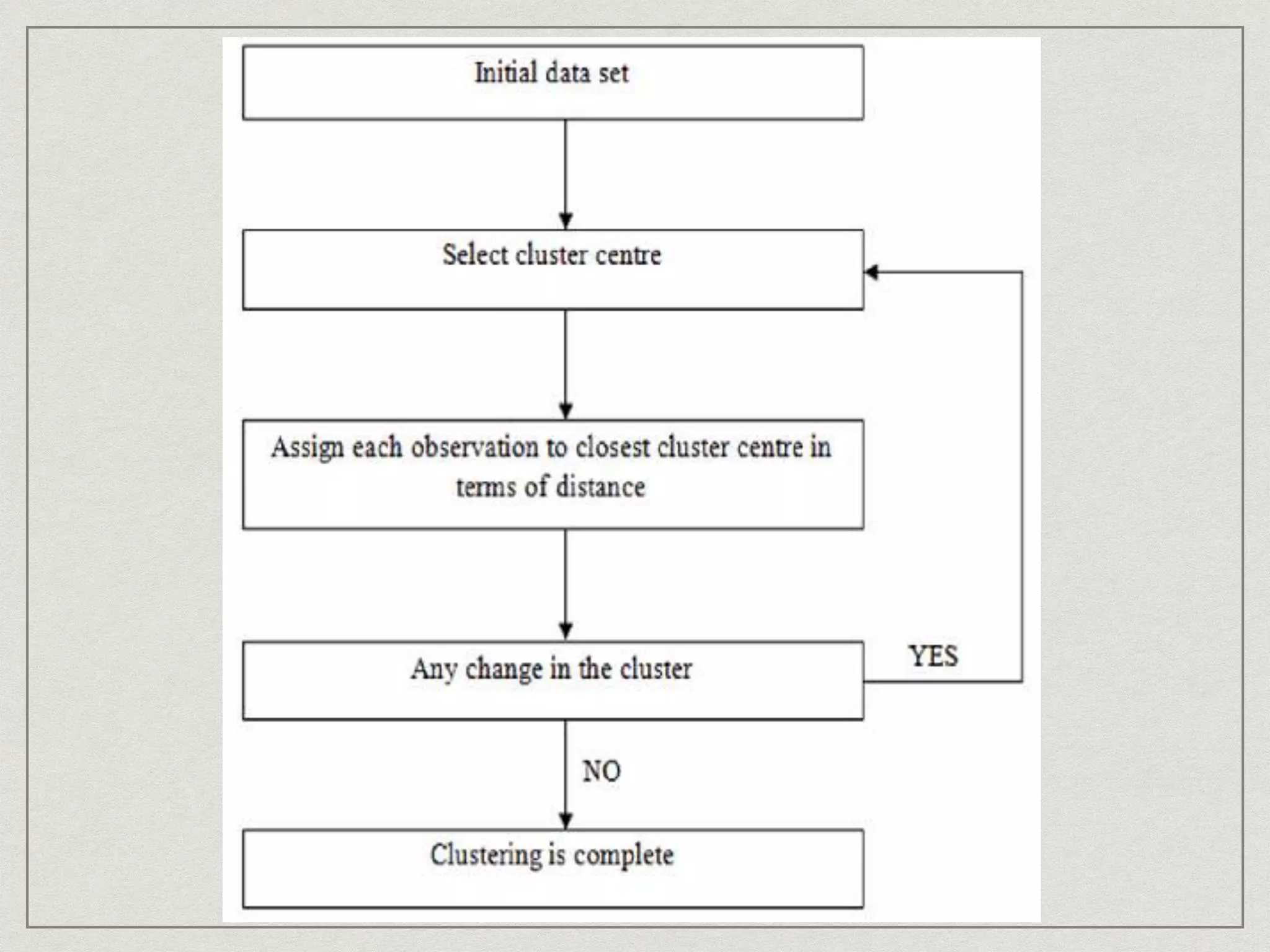
Phase-I: The input array of elements is scanned
and split up into sub-arrays, which represent the
initial clusters.
Phase-II: The centroids of previous initial clusters
are computed by calculating mean of each cluster.
Furthermore the data elements having less or equal
distance remains in the same cluster otherwise
they are moved to appropriate clusters. The entire
process continues until no changes in the clusters
are detected.
IMPROVED K-MEANS
ALGORITHM
Algorithm is divided into two Phases. In Phase-I, we find the initial
clusters, while in Phase-II, data elements are moved in appropriate
clusters.
Phase-I: To find the initial clusters
INPUT: Array {a1, a2, a3,..., an}
OUTPUT: A set of Initial Clusters.
Steps:
1) Find the size of cluster Si by calculating (n/k).
Where n= number of data points Dp (a1, a2, a3, ...... an)
k= number of clusters.
2) Create 'k' number of Arrays Ak
3) Move data points (Dp) from Input Array to Ak until Si.
4) Continue Step 3 until all Dp is removed from input array
5) Exit with having 'k' initial clusters.
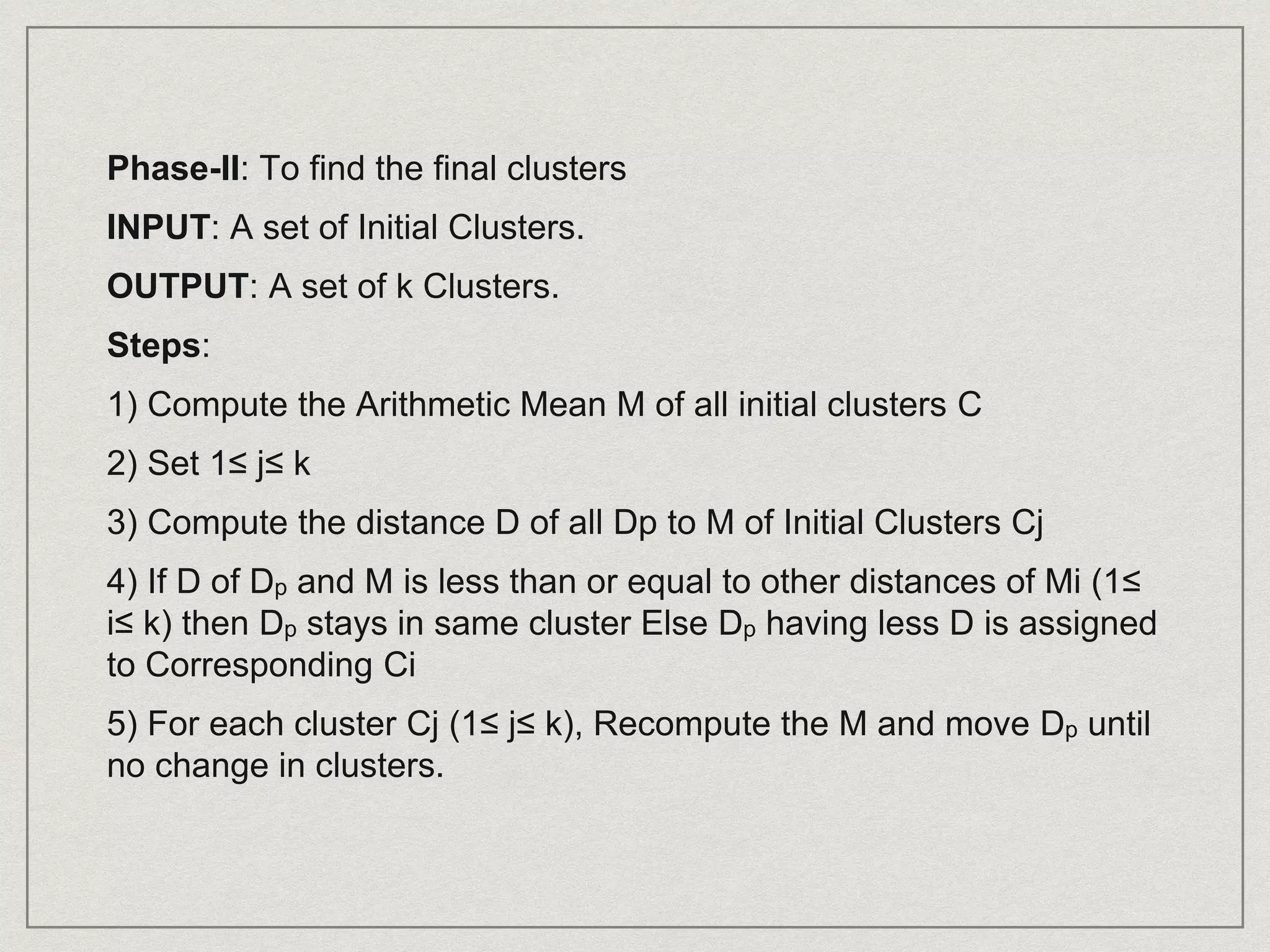
Phase-II: To find the final clusters
INPUT: A set of Initial Clusters.
OUTPUT: A set of k Clusters.
Steps:
1) Compute the Arithmetic Mean M of all initial clusters C
2) Set 1≤ j≤ k
3) Compute the distance D of all Dp to M of Initial Clusters Cj
4) If D of Dp and M is less than or equal to other distances of Mi (1≤
i≤ k) then Dp stays in same cluster Else Dp having less D is assigned
to Corresponding Ci
5) For each cluster Cj (1≤ j≤ k), Recompute the M and move Dp until
no change in clusters.
APPLICATION
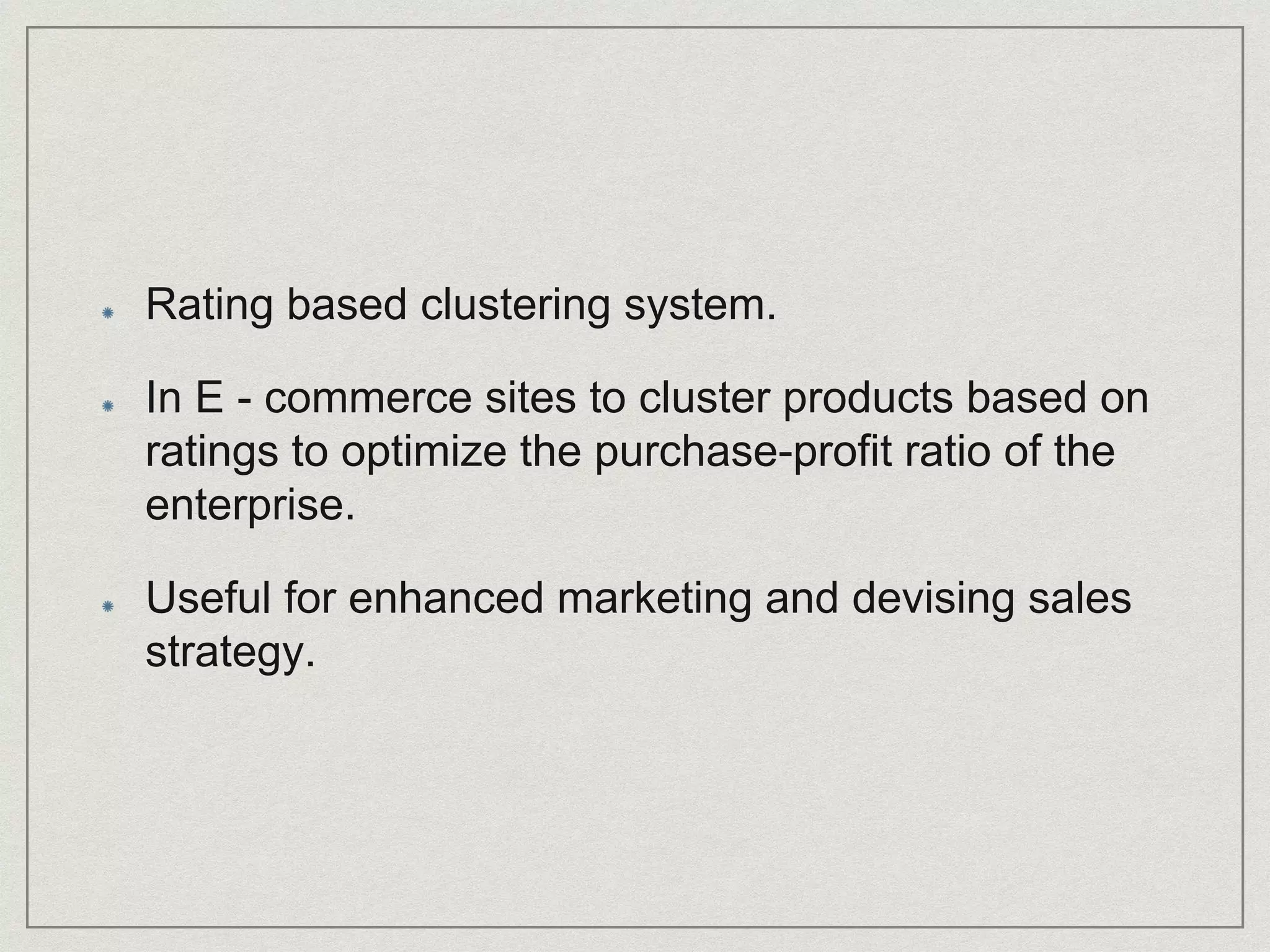
Rating based clustering system.
In E - commerce sites to cluster products based on
ratings to optimize the purchase-profit ratio of the
enterprise.
Useful for enhanced marketing and devising sales
strategy.
THANK YOU!

K means clustering algorithm

  • 1.
  • 2.
  • 3.
    K-means algorithm isused for creating and analyzing clusters. In this algorithm, ‘n’ number of data points are divided into ‘k’ clusters based on some similarity measurement criterion. However results generated using this algorithm are mainly dependent on choosing initial cluster centroids.
  • 5.
  • 6.
    Advantages of k-meansalgorithm: 1. Ease of implementation and high-speed performance 2. Measurable and efficient in large data collection Disadvantages of k-means algorithm: 1. Selection of optimal number of clusters is difficult 2. Selection of the initial centroids is random.
  • 7.
  • 8.
    •In the originalk-means algorithm, the resulting set of clusters strongly depends on the selection of initial centroids which is random. •Thus, in our project, we will propose a method for calculating the initial centroids, which will make the k-Means algorithm more efficient, so as to get quality clustering with reduced complexity.
  • 9.
  • 10.
    Phase-I: The inputarray of elements is scanned and split up into sub-arrays, which represent the initial clusters. Phase-II: The centroids of previous initial clusters are computed by calculating mean of each cluster. Furthermore the data elements having less or equal distance remains in the same cluster otherwise they are moved to appropriate clusters. The entire process continues until no changes in the clusters are detected.
  • 11.
  • 12.
    Algorithm is dividedinto two Phases. In Phase-I, we find the initial clusters, while in Phase-II, data elements are moved in appropriate clusters. Phase-I: To find the initial clusters INPUT: Array {a1, a2, a3,..., an} OUTPUT: A set of Initial Clusters. Steps: 1) Find the size of cluster Si by calculating (n/k). Where n= number of data points Dp (a1, a2, a3, ...... an) k= number of clusters. 2) Create 'k' number of Arrays Ak 3) Move data points (Dp) from Input Array to Ak until Si. 4) Continue Step 3 until all Dp is removed from input array 5) Exit with having 'k' initial clusters.
  • 13.
    Phase-II: To findthe final clusters INPUT: A set of Initial Clusters. OUTPUT: A set of k Clusters. Steps: 1) Compute the Arithmetic Mean M of all initial clusters C 2) Set 1≤ j≤ k 3) Compute the distance D of all Dp to M of Initial Clusters Cj 4) If D of Dp and M is less than or equal to other distances of Mi (1≤ i≤ k) then Dp stays in same cluster Else Dp having less D is assigned to Corresponding Ci 5) For each cluster Cj (1≤ j≤ k), Recompute the M and move Dp until no change in clusters.
  • 14.
  • 15.
    Rating based clusteringsystem. In E - commerce sites to cluster products based on ratings to optimize the purchase-profit ratio of the enterprise. Useful for enhanced marketing and devising sales strategy.
  • 16.