TOPIC – Distribution, Stratigraphy & Fossil content of
Siwalik Group
 INTRODUCTION
 ORIGIN
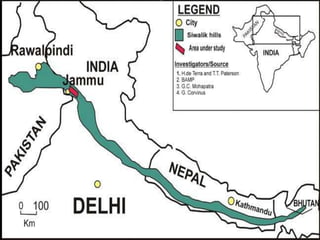
 DISTRIBUTION OF SIWALIK GROUP
 STRATIGRAPHY OF SIWALIK GROUP
 CLASSIFICATION OF SIWALIK GROUP
 FOSSILS OF SIWALIK GROUP
 SIGNIFICANCE
CONTENT :
Origin :- The origin of Siwalik system is middle Miocene to
lower Pleistocene with the uplift of sediment deposited in the
Tethys due to northward compression , a depression, fore-deep
type of topography is believed to have come into being which
started receiving sedimentation from the mountains of north the
Himalaya of that time. The `fore-deep` hypothesis has , however
better structural evidence in support of the origin of the Siwalik
system.
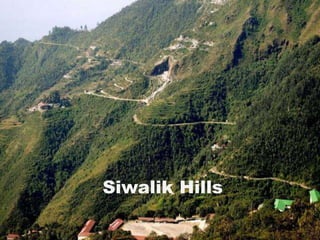
Siwalik Hills
INTRODUCTION : Physiographic division of India divide into three parts :
• Peninsular India
• Indo Gangetic Plan
• Extra Peninsular – Siwalik Group
Siwalik Group :- The name Siwalik was originally given by Captain P.T. Cautley in
the early nineteenth century to the outermost Sub-Himalayan
Ranges. Under the Siwalik system are grouped rocks of low lying outermost hills of
the Himalaya that had been deposited in shallow water conditions in the time from
middle Miocene to lower Pleistocene in the geological history of this area.
The Siwalik hills are relatively low and rarely exceed 1000m above mean sea level
with conformable treads running parallel to the Himalaya.
DISTRIBUTION
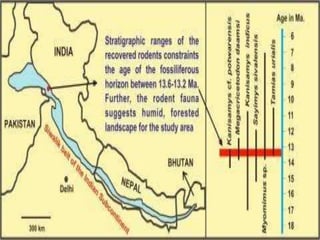
The Siwalik system extends from the Bramputra valley in the east to
Bannu plains in
Pakistan on the west.
• Manchar system
in sind (Pakistan)
• Makran system of Blauchistan
• Irrawaly system in Barma
• In India (Jammu & Kashmir , Himachal Pradesh , Uttrakhand , West
Bengal , Assam , Arunachal Pradesh )
Siwalik Group in India
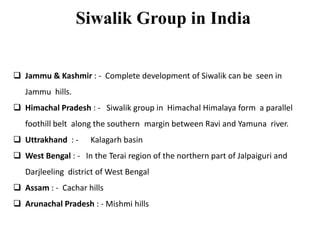
 Jammu & Kashmir : - Complete development of Siwalik can be seen in
Jammu hills.
 Himachal Pradesh : - Siwalik group in Himachal Himalaya form a parallel
foothill belt along the southern margin between Ravi and Yamuna river.
 Uttrakhand : - Kalagarh basin
 West Bengal : - In the Terai region of the northern part of Jalpaiguri and
Darjleeling district of West Bengal
 Assam : - Cachar hills
 Arunachal Pradesh : - Mishmi hills
Stratigraphy
 Lithology : -The Siwalik group is composed of 5000-6000m thick
succession of sediment rock of fluviatile as lacustine nature.
Sandstones are hard , compact , red colored in the lower Siwalik
becoming greyish and softer in the middle levels and virtually
becoming masses or loosely packed coarse sand with grits in the
upper region.
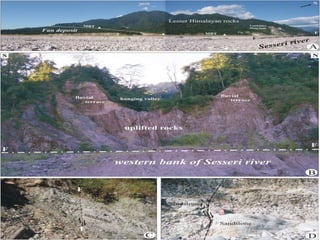
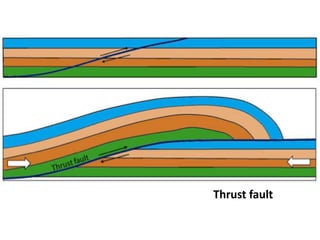
 structure : - Rock of Siwalik system in folding and faulting
indicating orosenic movement during and after their formation.
Mainly thrust fault anticline and over fold are present.
Thrust fault
Sub-Division Stages Lithology Age
Upper Siwlaik
(2000-2500 m)
Middle Siwlaik
(2000-2500 m)
Lower Siwalik
(1650 m)
Boulder
Conglomerate
Pinjor stage
Tatrots stage
Dhok Pathan
Stage
Nagri stage
Chinji stage
Kamlial stage
Conglomerates, Loose
sands, grits and clays
Grits, sandstones , dirty
white clays and
conglomerates
Soft sandstones , dirty
ehile clays and
conglomerates
Brown sandstones ,
gravel beds , clays and
shale's
Massive compact and
hard sandstones shales
Red sandstones,
intercalated red shales
Hard red sandstones,
purple shales
Pseudoconglomerates
Cromerian (1.5 to 0.5
m.y.)
Villafranchian(2.47
m.y.)
Astian (5.5 m.y.)
Pontian (8.5 m.y.)
Sarmatian (10.8 m.y.)
Tortonian (14.3 m.y.)
Helvetian ( 18.3 m.y. )
Fossils of Siwalik
Most of the stages in Siwalik system are typically rich in mammalian fossils.
Some important fossils genra Siwalik are mentioned below:
 Carnivora :- Crocuta , canis, lutra.
 Primates :- Brahmapithecus , macacus ,simia ,papio.
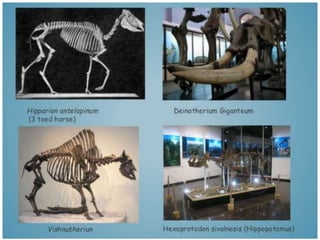
 Proboscidea : - Dinotherium, trilophodon.
 Equidae :- Hipparion
 Rhinoceratid :- Gaindatherium , aeratherium.
 Suidae :- Conohyus , sanitherium ,tetraconodon.
 Giraffidae :- Hydaspitherium , vishnutherium
 Bovidae :- Cobus ,bos ,bison , perimia.
•Fossils are disarticulated in nature.
•Most durable parts are commonly preserved as fossils of
vertebrates are their bones, teeth and footprints.
•A rich assemblage of fossil has been recovered from the Siwalik
rock which has given this system a very important status in Indian
stratigraphy. Most of the stages in Siwalik system are typically rich in
mammalian fossils.
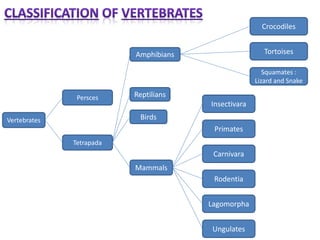
Reptilians
Persces
Insectivara
Ungulates
Lagomorpha
Rodentia
Carnivara
Primates
Squamates :
Lizard and Snake
Tortoises
Crocodiles
Mammals
Tetrapada
Vertebrates
Amphibians
Birds
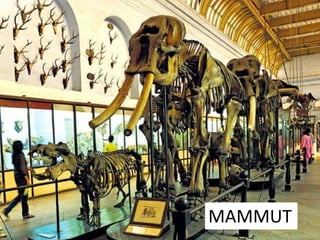
MAMMUT
PETRIFIED WOOD
• Evolution of different modern
species.
• Useful for correlation purpose in
continental region.
• Pale climatology, pale biogeography,
& pale ecology.
• History and culture.
 Vaidyanadhan R. Geology of India volume-2.
 Kumar R. 2006 Fundamental of Historical Geology & stratigraphy
of India.
 Internet ( sciencedirect.com, slideshare.net,
archaeologydataservice.ac.uk, hellotravel.com, tripadvisor.com )
 Jaitley, A.K Palaeontology & stratigraphy.
 Youtube :- https://youtu.be/8J2mWSR7RP0
Siwalik supergroup

Siwalik supergroup

  • 1.
    TOPIC – Distribution,Stratigraphy & Fossil content of Siwalik Group
  • 2.
     INTRODUCTION  ORIGIN DISTRIBUTION OF SIWALIK GROUP  STRATIGRAPHY OF SIWALIK GROUP  CLASSIFICATION OF SIWALIK GROUP  FOSSILS OF SIWALIK GROUP  SIGNIFICANCE CONTENT :
  • 3.
    Origin :- Theorigin of Siwalik system is middle Miocene to lower Pleistocene with the uplift of sediment deposited in the Tethys due to northward compression , a depression, fore-deep type of topography is believed to have come into being which started receiving sedimentation from the mountains of north the Himalaya of that time. The `fore-deep` hypothesis has , however better structural evidence in support of the origin of the Siwalik system.
  • 4.
  • 5.
    INTRODUCTION : Physiographicdivision of India divide into three parts : • Peninsular India • Indo Gangetic Plan • Extra Peninsular – Siwalik Group Siwalik Group :- The name Siwalik was originally given by Captain P.T. Cautley in the early nineteenth century to the outermost Sub-Himalayan Ranges. Under the Siwalik system are grouped rocks of low lying outermost hills of the Himalaya that had been deposited in shallow water conditions in the time from middle Miocene to lower Pleistocene in the geological history of this area. The Siwalik hills are relatively low and rarely exceed 1000m above mean sea level with conformable treads running parallel to the Himalaya.
  • 6.
    DISTRIBUTION The Siwalik systemextends from the Bramputra valley in the east to Bannu plains in Pakistan on the west. • Manchar system in sind (Pakistan) • Makran system of Blauchistan • Irrawaly system in Barma • In India (Jammu & Kashmir , Himachal Pradesh , Uttrakhand , West Bengal , Assam , Arunachal Pradesh )
  • 8.
    Siwalik Group inIndia  Jammu & Kashmir : - Complete development of Siwalik can be seen in Jammu hills.  Himachal Pradesh : - Siwalik group in Himachal Himalaya form a parallel foothill belt along the southern margin between Ravi and Yamuna river.  Uttrakhand : - Kalagarh basin  West Bengal : - In the Terai region of the northern part of Jalpaiguri and Darjleeling district of West Bengal  Assam : - Cachar hills  Arunachal Pradesh : - Mishmi hills
  • 10.
    Stratigraphy  Lithology :-The Siwalik group is composed of 5000-6000m thick succession of sediment rock of fluviatile as lacustine nature. Sandstones are hard , compact , red colored in the lower Siwalik becoming greyish and softer in the middle levels and virtually becoming masses or loosely packed coarse sand with grits in the upper region.  structure : - Rock of Siwalik system in folding and faulting indicating orosenic movement during and after their formation. Mainly thrust fault anticline and over fold are present.
  • 13.
  • 14.
    Sub-Division Stages LithologyAge Upper Siwlaik (2000-2500 m) Middle Siwlaik (2000-2500 m) Lower Siwalik (1650 m) Boulder Conglomerate Pinjor stage Tatrots stage Dhok Pathan Stage Nagri stage Chinji stage Kamlial stage Conglomerates, Loose sands, grits and clays Grits, sandstones , dirty white clays and conglomerates Soft sandstones , dirty ehile clays and conglomerates Brown sandstones , gravel beds , clays and shale's Massive compact and hard sandstones shales Red sandstones, intercalated red shales Hard red sandstones, purple shales Pseudoconglomerates Cromerian (1.5 to 0.5 m.y.) Villafranchian(2.47 m.y.) Astian (5.5 m.y.) Pontian (8.5 m.y.) Sarmatian (10.8 m.y.) Tortonian (14.3 m.y.) Helvetian ( 18.3 m.y. )
  • 15.
    Fossils of Siwalik Mostof the stages in Siwalik system are typically rich in mammalian fossils. Some important fossils genra Siwalik are mentioned below:  Carnivora :- Crocuta , canis, lutra.  Primates :- Brahmapithecus , macacus ,simia ,papio.  Proboscidea : - Dinotherium, trilophodon.  Equidae :- Hipparion  Rhinoceratid :- Gaindatherium , aeratherium.  Suidae :- Conohyus , sanitherium ,tetraconodon.  Giraffidae :- Hydaspitherium , vishnutherium  Bovidae :- Cobus ,bos ,bison , perimia.
  • 16.
    •Fossils are disarticulatedin nature. •Most durable parts are commonly preserved as fossils of vertebrates are their bones, teeth and footprints. •A rich assemblage of fossil has been recovered from the Siwalik rock which has given this system a very important status in Indian stratigraphy. Most of the stages in Siwalik system are typically rich in mammalian fossils.
  • 17.
    Reptilians Persces Insectivara Ungulates Lagomorpha Rodentia Carnivara Primates Squamates : Lizard andSnake Tortoises Crocodiles Mammals Tetrapada Vertebrates Amphibians Birds
  • 21.
  • 22.
  • 23.
    • Evolution ofdifferent modern species. • Useful for correlation purpose in continental region. • Pale climatology, pale biogeography, & pale ecology. • History and culture.
  • 24.
     Vaidyanadhan R.Geology of India volume-2.  Kumar R. 2006 Fundamental of Historical Geology & stratigraphy of India.  Internet ( sciencedirect.com, slideshare.net, archaeologydataservice.ac.uk, hellotravel.com, tripadvisor.com )  Jaitley, A.K Palaeontology & stratigraphy.  Youtube :- https://youtu.be/8J2mWSR7RP0