
ANORTHOSITE
• Anorthosites are defined as a
plutonic rocks with more than 90%
plagioclase.
• There are no known volcanic
equivalents.
• Their high felsic nature and their
location in continental areas are
characteristics they share with
granitoid rocks.
MINERALOGY
• Mainly consist of –
plagioclase(usually labradorite)>90%
Mafic minerals(mainly opx,cpx,olv rarely
amphiboles,oxides)
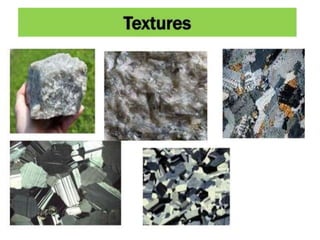
TEXTURE
• Anorthosite are leucocratic,
coarse grained and
hypidiomorphic. Some crystals
have euhedral form, some have
poorly developed faces and others
have no crystal form at all.
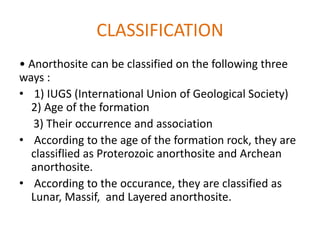
CLASSIFICATION
• Anorthosite can be classified on the following three
ways :
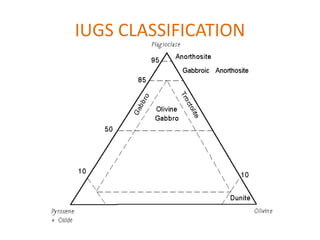
• 1) IUGS (International Union of Geological Society)
2) Age of the formation
3) Their occurrence and association
• According to the age of the formation rock, they are
classiflied as Proterozoic anorthosite and Archean
anorthosite.
• According to the occurance, they are classified as
Lunar, Massif, and Layered anorthosite.
IUGS CLASSIFICATION
AGE OF THE FORMATION
ARCHEAN ANORTHOSITE
• They are emplaced during the Archean eon.
• Anorthosites cluster in the age range of 3.2 to 2.8 Ga.
• They are typically occur in hundred of km scale with
less than 1 km thick and appear to sheet like
conformable sills.
• Form from differentiation of basaltic magma.
• There are associated with gabbroic rock.
• Archean anorthosites bodies are emplaced as shallow
sills into supercrustal rocks(a term used to indicate
rocks deposits at earth surface on the top of the
Crust, not within it.)
PROTEROZOIC ANORTHOSITES
• They are form during the proterozoic eon.
• They range in the age from 1.7 to 0.9 Ga.
• Proterozoic anorthosites indicate massif anorthosites
• They associated more with grainitoids and not
supracrustals.
• The shape of proterozoic anorthosite bodies is highly varied,
ranging from funnel shaped to lopoliths to large sheets.
• The sheets are slabs 2 to 14 km thick and some cover areas
up to 17000 km².
• Proterozoic anorthosites are almost always associated with
nearly anhydrous pyroxene-bearing granitoid
rocks(commonly called charnokites)
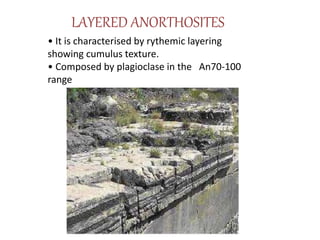
LAYERED ANORTHOSITES
• It is characterised by rythemic layering
showing cumulus texture.
• Composed by plagioclase in the An70-100
range
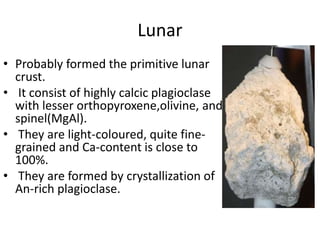
Lunar
• Probably formed the primitive lunar
crust.
• It consist of highly calcic plagioclase
with lesser orthopyroxene,olivine, and
spinel(MgAl).
• They are light-coloured, quite fine-
grained and Ca-content is close to
100%.
• They are formed by crystallization of
An-rich plagioclase.
IMPORTANCE
• Aorthosites have economic value that it has
titanium-bearing oxide ilmenite. However,
some Proterozoic anorthosite bodies have
large amounts of labradorite, which is
carried for its value as both a gemstone and
a building material.
• Anorthosite was prominently represented in
rock samples brought back from the Moon,
and is important in investigations of Mars,
Venus, and meteorites.
OCCURrENCE
• Anorthosite are occurred in different
parts of the world. Some of them are
listed below:
1. Sandford lake, New York.
2. Allard Lake, Southern Quebec.
3. Ukraine of USSR.
4. Oaxaca, Mexico.
5. Norway.
INDIAN OCCURRENCE
1.Sittampundi,Oddanchatram, Kadavur
areas of Tamil Nadu.
2. Karaput, Rambha, Banpur, Kalahandi
area of Orissa.
3.Kondapalli of Andhra Pradesh.
4. Mayurbhanj of Rajasthan.
5.Bankura of Bengal
Ansari Saahab

Anorthosite

  • 1.
    ANORTHOSITE • Anorthosites aredefined as a plutonic rocks with more than 90% plagioclase. • There are no known volcanic equivalents. • Their high felsic nature and their location in continental areas are characteristics they share with granitoid rocks.
  • 2.
    MINERALOGY • Mainly consistof – plagioclase(usually labradorite)>90% Mafic minerals(mainly opx,cpx,olv rarely amphiboles,oxides)
  • 3.
    TEXTURE • Anorthosite areleucocratic, coarse grained and hypidiomorphic. Some crystals have euhedral form, some have poorly developed faces and others have no crystal form at all.
  • 5.
    CLASSIFICATION • Anorthosite canbe classified on the following three ways : • 1) IUGS (International Union of Geological Society) 2) Age of the formation 3) Their occurrence and association • According to the age of the formation rock, they are classiflied as Proterozoic anorthosite and Archean anorthosite. • According to the occurance, they are classified as Lunar, Massif, and Layered anorthosite.
  • 6.
  • 8.
    AGE OF THEFORMATION ARCHEAN ANORTHOSITE • They are emplaced during the Archean eon. • Anorthosites cluster in the age range of 3.2 to 2.8 Ga. • They are typically occur in hundred of km scale with less than 1 km thick and appear to sheet like conformable sills. • Form from differentiation of basaltic magma. • There are associated with gabbroic rock. • Archean anorthosites bodies are emplaced as shallow sills into supercrustal rocks(a term used to indicate rocks deposits at earth surface on the top of the Crust, not within it.)
  • 9.
    PROTEROZOIC ANORTHOSITES • Theyare form during the proterozoic eon. • They range in the age from 1.7 to 0.9 Ga. • Proterozoic anorthosites indicate massif anorthosites • They associated more with grainitoids and not supracrustals. • The shape of proterozoic anorthosite bodies is highly varied, ranging from funnel shaped to lopoliths to large sheets. • The sheets are slabs 2 to 14 km thick and some cover areas up to 17000 km². • Proterozoic anorthosites are almost always associated with nearly anhydrous pyroxene-bearing granitoid rocks(commonly called charnokites)
  • 10.
    LAYERED ANORTHOSITES • Itis characterised by rythemic layering showing cumulus texture. • Composed by plagioclase in the An70-100 range
  • 11.
    Lunar • Probably formedthe primitive lunar crust. • It consist of highly calcic plagioclase with lesser orthopyroxene,olivine, and spinel(MgAl). • They are light-coloured, quite fine- grained and Ca-content is close to 100%. • They are formed by crystallization of An-rich plagioclase.
  • 12.
    IMPORTANCE • Aorthosites haveeconomic value that it has titanium-bearing oxide ilmenite. However, some Proterozoic anorthosite bodies have large amounts of labradorite, which is carried for its value as both a gemstone and a building material. • Anorthosite was prominently represented in rock samples brought back from the Moon, and is important in investigations of Mars, Venus, and meteorites.
  • 13.
    OCCURrENCE • Anorthosite areoccurred in different parts of the world. Some of them are listed below: 1. Sandford lake, New York. 2. Allard Lake, Southern Quebec. 3. Ukraine of USSR. 4. Oaxaca, Mexico. 5. Norway.
  • 14.
    INDIAN OCCURRENCE 1.Sittampundi,Oddanchatram, Kadavur areasof Tamil Nadu. 2. Karaput, Rambha, Banpur, Kalahandi area of Orissa. 3.Kondapalli of Andhra Pradesh. 4. Mayurbhanj of Rajasthan. 5.Bankura of Bengal
  • 15.