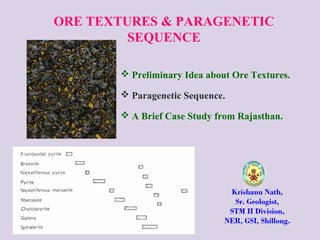
ORE TEXTURES & PARAGENETIC
SEQUENCE
 Preliminary Idea about Ore Textures.
 Paragenetic Sequence.
 A Brief Case Study from Rajasthan.
Krishanu Nath,
Sr. Geologist,
STM II Division,
NER, GSI, Shillong.
1- Understanding the timing of formation of the ore minerals
relative to the host rocks and their structures.
2- Determining the sequence of events or depositional history
within an ore body.
3- Determining the rates of cooling or of ore mineral accumulation
(in some cases).
4- Identifying the equilibrium mineral assemblages, which in turn
are necessary for understanding phase relations and the correct
interpretation of geothermometric results.
REQUIREMENTS OF STUDYING ORE TEXTURES
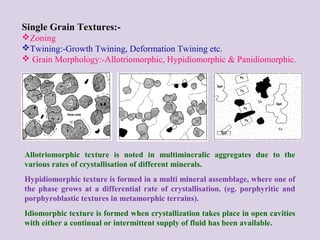
Single Grain Textures:-
Zoning
Twining:-Growth Twining, Deformation Twining etc.
 Grain Morphology:-Allotriomorphic, Hypidiomorphic & Panidiomorphic.
Allotriomorphic texture is noted in multimineralic aggregates due to the
various rates of crystallisation of different minerals.
Hypidiomorphic texture is formed in a multi mineral assemblage, where one of
the phase grows at a differential rate of crystallisation. (eg. porphyritic and
porphyroblastic textures in metamorphic terrains).
Idiomorphic texture is formed when crystallization takes place in open cavities
with either a continual or intermittent supply of fluid has been available.
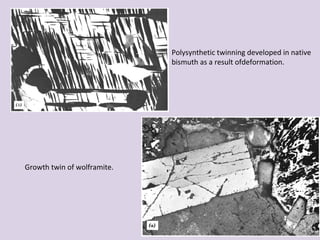
Growth twin of wolframite.
Polysynthetic twinning developed in native
bismuth as a result ofdeformation.
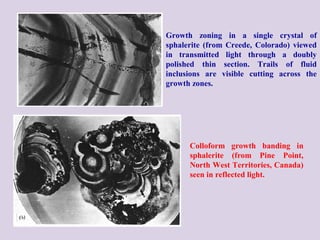
Growth zoning in a single crystal of
sphalerite (from Creede, Colorado) viewed
in transmitted light through a doubly
polished thin section. Trails of fluid
inclusions are visible cutting across the
growth zones.
Colloform growth banding in
sphalerite (from Pine Point,
North West Territories, Canada)
seen in reflected light.
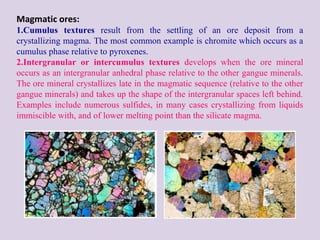
Magmatic ores:
1.Cumulus textures result from the settling of an ore deposit from a
crystallizing magma. The most common example is chromite which occurs as a
cumulus phase relative to pyroxenes.
2.Intergranular or intercumulus textures develops when the ore mineral
occurs as an intergranular anhedral phase relative to the other gangue minerals.
The ore mineral crystallizes late in the magmatic sequence (relative to the other
gangue minerals) and takes up the shape of the intergranular spaces left behind.
Examples include numerous sulfides, in many cases crystallizing from liquids
immiscible with, and of lower melting point than the silicate magma.
Open space filling textures:-
Open space filling is common at shallow depths where brittle rocks deform by fracturing
rather than by plastic flow. At these shallow depths, ore bearing fluids may circulate freely
within fractures, depositing ore and gangue minerals when sudden or abrupt changes in P
and/or T take place.
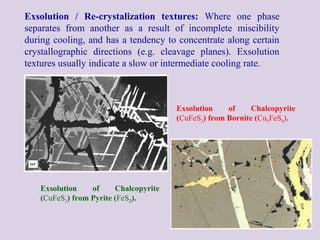
Exsolution / Re-crystalization textures: Where one phase
separates from another as a result of incomplete miscibility
during cooling, and has a tendency to concentrate along certain
crystallographic directions (e.g. cleavage planes). Exsolution
textures usually indicate a slow or intermediate cooling rate.
Exsolution of Chalcopyrite
(CuFeS2) from Bornite (Cu5FeS4).
Exsolution of Chalcopyrite
(CuFeS2) from Pyrite (FeS2).
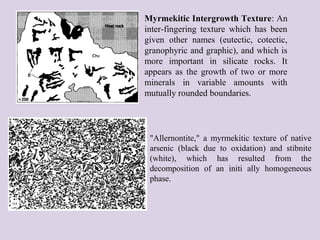
Myrmekitic Intergrowth Texture: An
inter-fingering texture which has been
given other names (eutectic, cotectic,
granophyric and graphic), and which is
more important in silicate rocks. It
appears as the growth of two or more
minerals in variable amounts with
mutually rounded boundaries.
"Allernontite," a myrmekitic texture of native
arsenic (black due to oxidation) and stibnite
(white), which has resulted from the
decomposition of an initi ally homogeneous
phase.
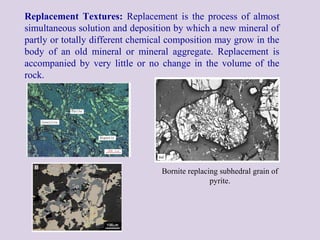
Replacement Textures: Replacement is the process of almost
simultaneous solution and deposition by which a new mineral of
partly or totally different chemical composition may grow in the
body of an old mineral or mineral aggregate. Replacement is
accompanied by very little or no change in the volume of the
rock.
Bornite replacing subhedral grain of
pyrite.
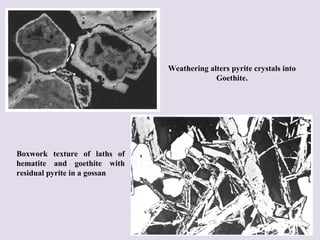
Weathering alters pyrite crystals into
Goethite.
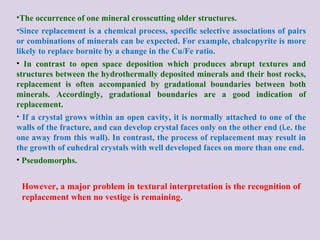
Boxwork texture of laths of
hematite and goethite with
residual pyrite in a gossan
However, a major problem in textural interpretation is the recognition of
replacement when no vestige is remaining.
•The occurrence of one mineral crosscutting older structures.
•Since replacement is a chemical process, specific selective associations of pairs
or combinations of minerals can be expected. For example, chalcopyrite is more
likely to replace bornite by a change in the Cu/Fe ratio.
• In contrast to open space deposition which produces abrupt textures and
structures between the hydrothermally deposited minerals and their host rocks,
replacement is often accompanied by gradational boundaries between both
minerals. Accordingly, gradational boundaries are a good indication of
replacement.
• If a crystal grows within an open cavity, it is normally attached to one of the
walls of the fracture, and can develop crystal faces only on the other end (i.e. the
one away from this wall). In contrast, the process of replacement may result in
the growth of euhedral crystals with well developed faces on more than one end.
• Pseudomorphs.
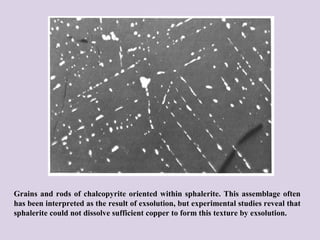
Grains and rods of chalcopyrite oriented within sphalerite. This assemblage often
has been interpreted as the result of exsolution, but experimental studies reveal that
sphalerite could not dissolve sufficient copper to form this texture by exsolution.
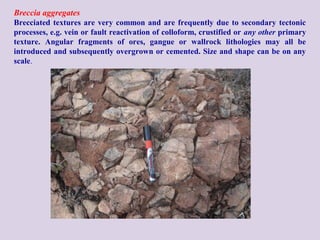
Breccia aggregates
Brecciated textures are very common and are frequently due to secondary tectonic
processes, e.g. vein or fault reactivation of colloform, crustified or any other primary
texture. Angular fragments of ores, gangue or wallrock lithologies may all be
introduced and subsequently overgrown or cemented. Size and shape can be on any
scale.
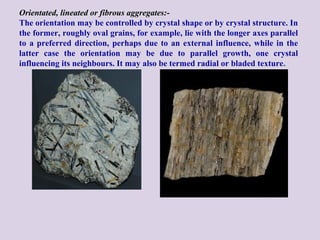
Orientated, lineated or fibrous aggregates:-
The orientation may be controlled by crystal shape or by crystal structure. In
the former, roughly oval grains, for example, lie with the longer axes parallel
to a preferred direction, perhaps due to an external influence, while in the
latter case the orientation may be due to parallel growth, one crystal
influencing its neighbours. It may also be termed radial or bladed texture.
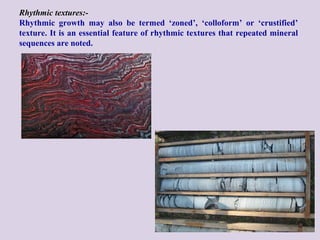
Rhythmic textures:-
Rhythmic growth may also be termed ‘zoned’, ‘colloform’ or ‘crustified’
texture. It is an essential feature of rhythmic textures that repeated mineral
sequences are noted.
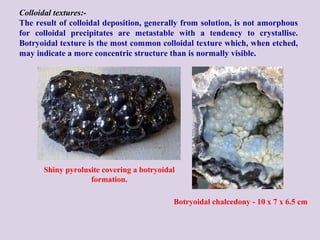
Colloidal textures:-
The result of colloidal deposition, generally from solution, is not amorphous
for colloidal precipitates are metastable with a tendency to crystallise.
Botryoidal texture is the most common colloidal texture which, when etched,
may indicate a more concentric structure than is normally visible.
 Botryoidal chalcedony - 10 x 7 x 6.5 cm
Shiny pyrolusite covering a botryoidal
formation.
Some other textural terminologies used to describe ore textures:-
 Oolitic texture & spheroidal texture
 Poikilitic & porphyritic texture
 Layered (sedimentary ores)
 Exsolution blebs & lamallae
 Embayment texture
 Spherultic & radial
 Fibrous & acicular
Crystal Shape:-
Euhedral crystals suggest the first
generation of crystalization.
Relict (Pseudomorphic) Complexities
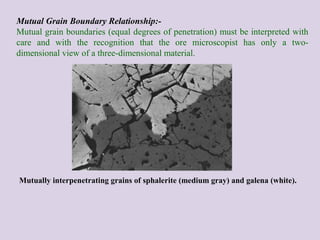
Mutual Grain Boundary Relationship:-
Mutual grain boundaries (equal degrees of penetration) must be interpreted with
care and with the recognition that the ore microscopist has only a two-
dimensional view of a three-dimensional material.
Mutually interpenetrating grains of sphalerite (medium gray) and galena (white).
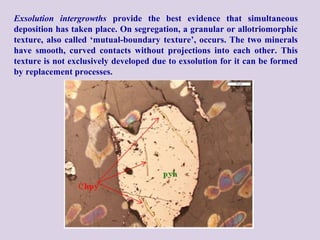
Exsolution intergrowths provide the best evidence that simultaneous
deposition has taken place. On segregation, a granular or allotriomorphic
texture, also called ‘mutual-boundary texture’, occurs. The two minerals
have smooth, curved contacts without projections into each other. This
texture is not exclusively developed due to exsolution for it can be formed
by replacement processes.
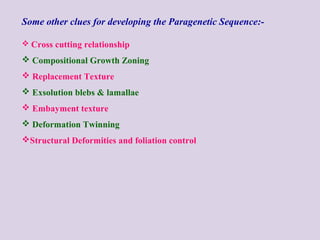
Some other clues for developing the Paragenetic Sequence:-
 Cross cutting relationship
 Compositional Growth Zoning
 Replacement Texture
 Exsolution blebs & lamallae
 Embayment texture
 Deformation Twinning
Structural Deformities and foliation control
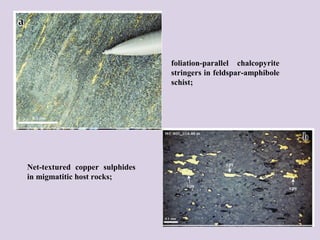
Net-textured copper sulphides
in migmatitic host rocks;
foliation-parallel chalcopyrite
stringers in feldspar-amphibole
schist;
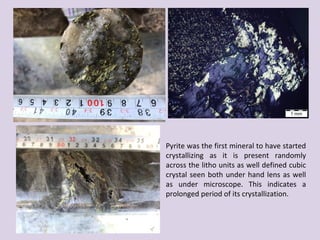
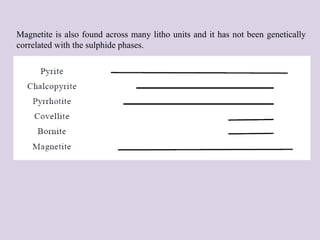
Pyrite was the first mineral to have started
crystallizing as it is present randomly
across the litho units as well defined cubic
crystal seen both under hand lens as well
as under microscope. This indicates a
prolonged period of its crystallization.
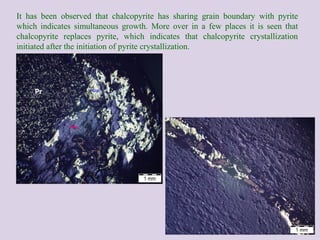
It has been observed that chalcopyrite has sharing grain boundary with pyrite
which indicates simultaneous growth. More over in a few places it is seen that
chalcopyrite replaces pyrite, which indicates that chalcopyrite crystallization
initiated after the initiation of pyrite crystallization.
Pr
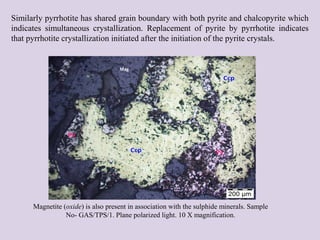
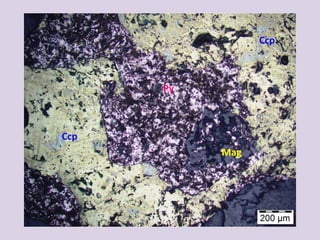
Similarly pyrrhotite has shared grain boundary with both pyrite and chalcopyrite which
indicates simultaneous crystallization. Replacement of pyrite by pyrrhotite indicates
that pyrrhotite crystallization initiated after the initiation of the pyrite crystals.
Mag
Magnetite (oxide) is also present in association with the sulphide minerals. Sample
No- GAS/TPS/1. Plane polarized light. 10 X magnification.
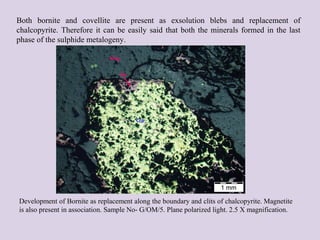
Both bornite and covellite are present as exsolution blebs and replacement of
chalcopyrite. Therefore it can be easily said that both the minerals formed in the last
phase of the sulphide metalogeny.
Development of Bornite as replacement along the boundary and clits of chalcopyrite. Magnetite
is also present in association. Sample No- G/OM/5. Plane polarized light. 2.5 X magnification.
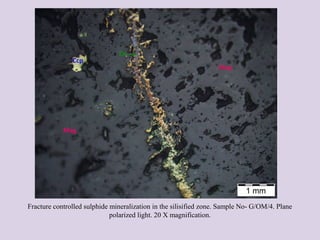
Fracture controlled sulphide mineralization in the silisified zone. Sample No- G/OM/4. Plane
polarized light. 20 X magnification.
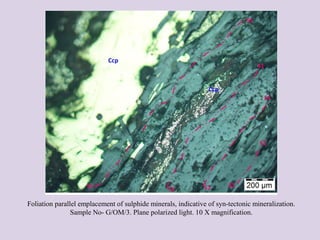
Foliation parallel emplacement of sulphide minerals, indicative of syn-tectonic mineralization.
Sample No- G/OM/3. Plane polarized light. 10 X magnification.
Magnetite is also found across many litho units and it has not been genetically
correlated with the sulphide phases.
Ore texture and paragenesis krishanu

Ore texture and paragenesis krishanu

  • 1.
    ORE TEXTURES &PARAGENETIC SEQUENCE  Preliminary Idea about Ore Textures.  Paragenetic Sequence.  A Brief Case Study from Rajasthan. Krishanu Nath, Sr. Geologist, STM II Division, NER, GSI, Shillong.
  • 2.
    1- Understanding thetiming of formation of the ore minerals relative to the host rocks and their structures. 2- Determining the sequence of events or depositional history within an ore body. 3- Determining the rates of cooling or of ore mineral accumulation (in some cases). 4- Identifying the equilibrium mineral assemblages, which in turn are necessary for understanding phase relations and the correct interpretation of geothermometric results. REQUIREMENTS OF STUDYING ORE TEXTURES
  • 3.
    Single Grain Textures:- Zoning Twining:-GrowthTwining, Deformation Twining etc.  Grain Morphology:-Allotriomorphic, Hypidiomorphic & Panidiomorphic. Allotriomorphic texture is noted in multimineralic aggregates due to the various rates of crystallisation of different minerals. Hypidiomorphic texture is formed in a multi mineral assemblage, where one of the phase grows at a differential rate of crystallisation. (eg. porphyritic and porphyroblastic textures in metamorphic terrains). Idiomorphic texture is formed when crystallization takes place in open cavities with either a continual or intermittent supply of fluid has been available.
  • 4.
    Growth twin ofwolframite. Polysynthetic twinning developed in native bismuth as a result ofdeformation.
  • 5.
    Growth zoning ina single crystal of sphalerite (from Creede, Colorado) viewed in transmitted light through a doubly polished thin section. Trails of fluid inclusions are visible cutting across the growth zones. Colloform growth banding in sphalerite (from Pine Point, North West Territories, Canada) seen in reflected light.
  • 6.
    Magmatic ores: 1.Cumulus texturesresult from the settling of an ore deposit from a crystallizing magma. The most common example is chromite which occurs as a cumulus phase relative to pyroxenes. 2.Intergranular or intercumulus textures develops when the ore mineral occurs as an intergranular anhedral phase relative to the other gangue minerals. The ore mineral crystallizes late in the magmatic sequence (relative to the other gangue minerals) and takes up the shape of the intergranular spaces left behind. Examples include numerous sulfides, in many cases crystallizing from liquids immiscible with, and of lower melting point than the silicate magma.
  • 7.
    Open space fillingtextures:- Open space filling is common at shallow depths where brittle rocks deform by fracturing rather than by plastic flow. At these shallow depths, ore bearing fluids may circulate freely within fractures, depositing ore and gangue minerals when sudden or abrupt changes in P and/or T take place.
  • 8.
    Exsolution / Re-crystalizationtextures: Where one phase separates from another as a result of incomplete miscibility during cooling, and has a tendency to concentrate along certain crystallographic directions (e.g. cleavage planes). Exsolution textures usually indicate a slow or intermediate cooling rate. Exsolution of Chalcopyrite (CuFeS2) from Bornite (Cu5FeS4). Exsolution of Chalcopyrite (CuFeS2) from Pyrite (FeS2).
  • 9.
    Myrmekitic Intergrowth Texture:An inter-fingering texture which has been given other names (eutectic, cotectic, granophyric and graphic), and which is more important in silicate rocks. It appears as the growth of two or more minerals in variable amounts with mutually rounded boundaries. "Allernontite," a myrmekitic texture of native arsenic (black due to oxidation) and stibnite (white), which has resulted from the decomposition of an initi ally homogeneous phase.
  • 10.
    Replacement Textures: Replacementis the process of almost simultaneous solution and deposition by which a new mineral of partly or totally different chemical composition may grow in the body of an old mineral or mineral aggregate. Replacement is accompanied by very little or no change in the volume of the rock. Bornite replacing subhedral grain of pyrite.
  • 11.
    Weathering alters pyritecrystals into Goethite. Boxwork texture of laths of hematite and goethite with residual pyrite in a gossan
  • 12.
    However, a majorproblem in textural interpretation is the recognition of replacement when no vestige is remaining. •The occurrence of one mineral crosscutting older structures. •Since replacement is a chemical process, specific selective associations of pairs or combinations of minerals can be expected. For example, chalcopyrite is more likely to replace bornite by a change in the Cu/Fe ratio. • In contrast to open space deposition which produces abrupt textures and structures between the hydrothermally deposited minerals and their host rocks, replacement is often accompanied by gradational boundaries between both minerals. Accordingly, gradational boundaries are a good indication of replacement. • If a crystal grows within an open cavity, it is normally attached to one of the walls of the fracture, and can develop crystal faces only on the other end (i.e. the one away from this wall). In contrast, the process of replacement may result in the growth of euhedral crystals with well developed faces on more than one end. • Pseudomorphs.
  • 13.
    Grains and rodsof chalcopyrite oriented within sphalerite. This assemblage often has been interpreted as the result of exsolution, but experimental studies reveal that sphalerite could not dissolve sufficient copper to form this texture by exsolution.
  • 14.
    Breccia aggregates Brecciated texturesare very common and are frequently due to secondary tectonic processes, e.g. vein or fault reactivation of colloform, crustified or any other primary texture. Angular fragments of ores, gangue or wallrock lithologies may all be introduced and subsequently overgrown or cemented. Size and shape can be on any scale.
  • 15.
    Orientated, lineated orfibrous aggregates:- The orientation may be controlled by crystal shape or by crystal structure. In the former, roughly oval grains, for example, lie with the longer axes parallel to a preferred direction, perhaps due to an external influence, while in the latter case the orientation may be due to parallel growth, one crystal influencing its neighbours. It may also be termed radial or bladed texture.
  • 16.
    Rhythmic textures:- Rhythmic growthmay also be termed ‘zoned’, ‘colloform’ or ‘crustified’ texture. It is an essential feature of rhythmic textures that repeated mineral sequences are noted.
  • 17.
    Colloidal textures:- The resultof colloidal deposition, generally from solution, is not amorphous for colloidal precipitates are metastable with a tendency to crystallise. Botryoidal texture is the most common colloidal texture which, when etched, may indicate a more concentric structure than is normally visible.  Botryoidal chalcedony - 10 x 7 x 6.5 cm Shiny pyrolusite covering a botryoidal formation.
  • 18.
    Some other texturalterminologies used to describe ore textures:-  Oolitic texture & spheroidal texture  Poikilitic & porphyritic texture  Layered (sedimentary ores)  Exsolution blebs & lamallae  Embayment texture  Spherultic & radial  Fibrous & acicular
  • 20.
    Crystal Shape:- Euhedral crystalssuggest the first generation of crystalization. Relict (Pseudomorphic) Complexities
  • 21.
    Mutual Grain BoundaryRelationship:- Mutual grain boundaries (equal degrees of penetration) must be interpreted with care and with the recognition that the ore microscopist has only a two- dimensional view of a three-dimensional material. Mutually interpenetrating grains of sphalerite (medium gray) and galena (white).
  • 22.
    Exsolution intergrowths providethe best evidence that simultaneous deposition has taken place. On segregation, a granular or allotriomorphic texture, also called ‘mutual-boundary texture’, occurs. The two minerals have smooth, curved contacts without projections into each other. This texture is not exclusively developed due to exsolution for it can be formed by replacement processes.
  • 23.
    Some other cluesfor developing the Paragenetic Sequence:-  Cross cutting relationship  Compositional Growth Zoning  Replacement Texture  Exsolution blebs & lamallae  Embayment texture  Deformation Twinning Structural Deformities and foliation control
  • 24.
    Net-textured copper sulphides inmigmatitic host rocks; foliation-parallel chalcopyrite stringers in feldspar-amphibole schist;
  • 27.
    Pyrite was thefirst mineral to have started crystallizing as it is present randomly across the litho units as well defined cubic crystal seen both under hand lens as well as under microscope. This indicates a prolonged period of its crystallization.
  • 28.
    It has beenobserved that chalcopyrite has sharing grain boundary with pyrite which indicates simultaneous growth. More over in a few places it is seen that chalcopyrite replaces pyrite, which indicates that chalcopyrite crystallization initiated after the initiation of pyrite crystallization. Pr
  • 29.
    Similarly pyrrhotite hasshared grain boundary with both pyrite and chalcopyrite which indicates simultaneous crystallization. Replacement of pyrite by pyrrhotite indicates that pyrrhotite crystallization initiated after the initiation of the pyrite crystals. Mag Magnetite (oxide) is also present in association with the sulphide minerals. Sample No- GAS/TPS/1. Plane polarized light. 10 X magnification.
  • 31.
    Both bornite andcovellite are present as exsolution blebs and replacement of chalcopyrite. Therefore it can be easily said that both the minerals formed in the last phase of the sulphide metalogeny. Development of Bornite as replacement along the boundary and clits of chalcopyrite. Magnetite is also present in association. Sample No- G/OM/5. Plane polarized light. 2.5 X magnification.
  • 32.
    Fracture controlled sulphidemineralization in the silisified zone. Sample No- G/OM/4. Plane polarized light. 20 X magnification.
  • 33.
    Foliation parallel emplacementof sulphide minerals, indicative of syn-tectonic mineralization. Sample No- G/OM/3. Plane polarized light. 10 X magnification.
  • 34.
    Magnetite is alsofound across many litho units and it has not been genetically correlated with the sulphide phases.