




TEAR FILM AND DYNAMICS
SIVA TEJA CHALLA
THE TEAR FILM
 The main role of lacrimal system is to
establish & maintain a continuous tear
film over the ocular surface.
 The presence of the pre-corneal tear film
was 1st demonstrated: by Fischer in 1928.
 Rollet described it as the most superficial
6th layer of cornea.
STRUCTURE OF THE TEAR FILM
 Wolff was the 1st to describe in detail the
structure of the tear film.
 Coined the term ‘PRE-CORNEAL FILM’.
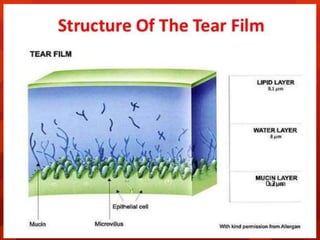
 Tear film consists of 3 layers.
1)Outer Lipid layer
2)Intermediate Aqueous layer &
3)Inner mucin layer
LIPID LAYER
 Outer most layer.
 0.1um thick
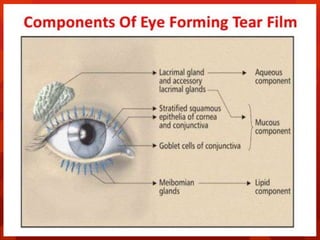
 Formed from the secretions of Meibomian,
Zeiss & Moll glands.
 Contents:-1)low polarity lipids-wax &
cholesterol esters 2)high polarity lipids-TG,
FFA ,phospholipids.
 Functions:-1)prevents the overflow of tears.
2)prevents evaporation.
AQUEOUS LAYER
 Middle layer.
 Formed by secretions from the main & accessory lacrimal
glands of Krause & Wolfring.
 Constitutes the main bulk of tear film.
 thickness over the cornea 10um.
 Film covering the cornea is thinner than over the conjunctiva.
 Contents:- inorganic salts, glucose, urea, enzymes, proteins &
glycoproteins.
 Buffering capacity of the tear film is d/t HCO3 ions & protein
 Functions: 1)provides O2 to corneal epithelium.
2)washes away debris & irritants.
3)contains antibacterial sub- lysozyme & betalysin.
MUCOUS LAYER
 Innermost layer.
 Secreted mainly by the conjunctival goblet cells
 30um thick.can be demo in living eye by alician blue drops
 Functions:-
1)plays a vital role in the stability of the tear film.
2)converts the hydrophobic corneal epithelium to a hydrophilic one.
3)lubricates the ocular & palpebral surfaces.
4)provides a slippery coating over the foreign bodies; thereby
protecting the cornea & conjunctiva against the abrasive effects of such
particles as they move about with blinking.
5)absorps various organic compounds in tears
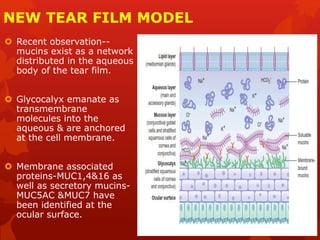
NEW TEAR FILM MODEL
 Recent observation--
mucins exist as a network
distributed in the aqueous
body of the tear film.
 Glycocalyx emanate as
transmembrane
molecules into the
aqueous & are anchored
at the cell membrane.
 Membrane associated
proteins-MUC1,4&16 as
well as secretory mucins-
MUC5AC &MUC7 have
been identified at the
ocular surface.
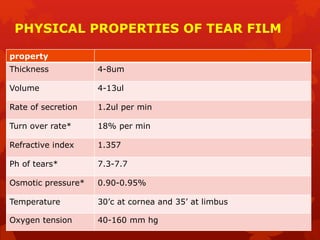
PHYSICAL PROPERTIES OF TEAR FILM
property
Thickness 4-8um
Volume 4-13ul
Rate of secretion 1.2ul per min
Turn over rate* 18% per min
Refractive index 1.357
Ph of tears* 7.3-7.7
Osmotic pressure* 0.90-0.95%
Temperature 30’c at cornea and 35’ at limbus
Oxygen tension 40-160 mm hg
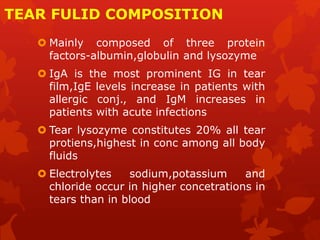
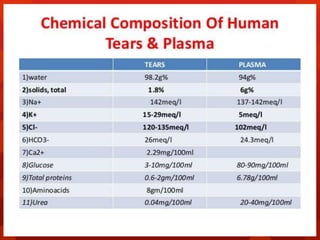
TEAR FULID COMPOSITION
 Mainly composed of three protein
factors-albumin,globulin and lysozyme
 IgA is the most prominent IG in tear
film,IgE levels increase in patients with
allergic conj., and IgM increases in
patients with acute infections
 Tear lysozyme constitutes 20% all tear
protiens,highest in conc among all body
fluids
 Electrolytes sodium,potassium and
chloride occur in higher concetrations in
tears than in blood
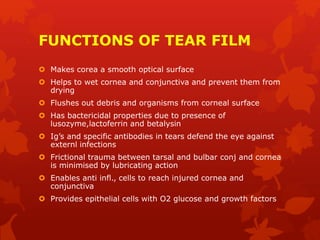
FUNCTIONS OF TEAR FILM
 Makes corea a smooth optical surface
 Helps to wet cornea and conjunctiva and prevent them from
drying
 Flushes out debris and organisms from corneal surface
 Has bactericidal properties due to presence of
lusozyme,lactoferrin and betalysin
 Ig’s and specific antibodies in tears defend the eye against
externl infections
 Frictional trauma between tarsal and bulbar conj and cornea
is minimised by lubricating action
 Enables anti infl., cells to reach injured cornea and
conjunctiva
 Provides epithelial cells with O2 glucose and growth factors
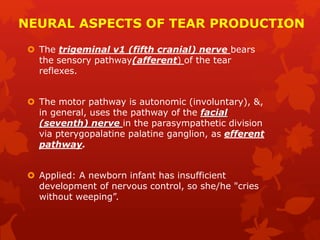
NEURAL ASPECTS OF TEAR PRODUCTION
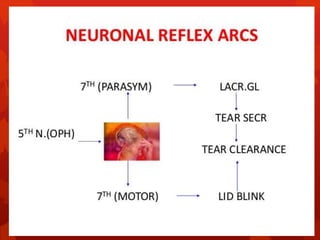
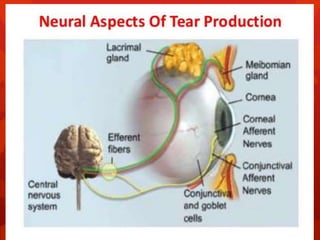
 The trigeminal v1 (fifth cranial) nerve bears
the sensory pathway(afferent) of the tear
reflexes.
 The motor pathway is autonomic (involuntary), &,
in general, uses the pathway of the facial
(seventh) nerve in the parasympathetic division
via pterygopalatine palatine ganglion, as efferent
pathway.
 Applied: A newborn infant has insufficient
development of nervous control, so she/he "cries
without weeping”.
APPLIED ASPECTS
 Crocodile tears syndrome/ Bogorad's
syndrome" is an uncommon consequence of nerve
regeneration subsequent to Bell's palsy or other damage
to the facial nerve in which efferent fibers from the
superior salivary nucleus become improperly connected
to nerve axons projecting to the lacrimal glands (tear
ducts), causing one to shed tears (lacrimate) during
salivation while smelling foods or eating.
 It is presumed that one would also salivate while crying
due to the inverse improper connection of the lacrimal
nucleus to the salivary glands, but this would be less
noticeable.
TEAR FILM DYNAMICS
 Secretion of tears
 Formation of tear film
 Retention & redistribution of tear film
 Displacement phenomenon
 Evaporation from the tear film
 Drying & break up of tear film
 Dynamic events during blinking
 Elimination of tears
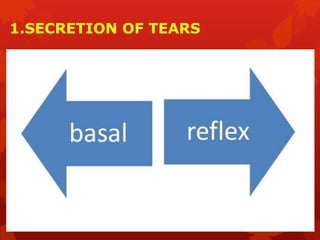
1.SECRETION OF TEARS
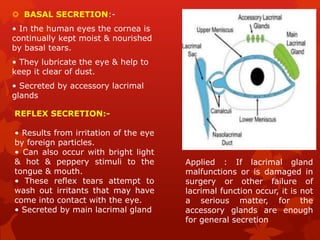
 BASAL SECRETION:-
• In the human eyes the cornea is
continually kept moist & nourished
by basal tears.
• They lubricate the eye & help to
keep it clear of dust.
• Secreted by accessory lacrimal
glands
REFLEX SECRETION:-
• Results from irritation of the eye
by foreign particles.
• Can also occur with bright light
& hot & peppery stimuli to the
tongue & mouth.
• These reflex tears attempt to
wash out irritants that may have
come into contact with the eye.
• Secreted by main lacrimal gland
Applied : If lacrimal gland
malfunctions or is damaged in
surgery or other failure of
lacrimal function occur, it is not
a serious matter, for the
accessory glands are enough
for general secretion
2.FORMATION OF PRE OCULAR TEAR FILM
 Conjunctival mucus spreads on to the cornea
by the action of the lids.
 On this new surface- aqueous layer is spread
spontaneously.
 Over this the superficial lipid layer spreads;
probably contributing to its stability &
retarding evaporation b/w blinks.
3.RETENTION & REDISTRIBUTION
 The outer most layer of corneal
epithelium+ mucopolysaccharides leads
to retention.
 Precorneal film is stagnant.Redistribution
occurs in the form of bringing of new
tear fluid by way of marginal strip where
there is constant flow of tears
4.DISPLACEMENT PHENOMENON
 Demonstrate that cornea is covered by a
film which has stability, compressibility,
elasticity & unaffected by gravity
 Demonstrated by upward movement of
particles in the film on displacing lower
eyelid upwards over eyeball
 This phenomenon is possible due to
presence of thin monomolecular layer on
the surface of cornea
5.EVAPORATION FROM THE TEAR FILM
 All lipid films including wax esters &
cholesterol esters retard evaporation of
water
 Important in low humidity & turbulent air
flow near cornea, such as exists in a
windy & arid climate
 Evaporation from tear film = 10% of
production rate, so, evaporation =
0.12ul/min (as tear production =
1.2ul/min)
6.STABILITY, DRYING & RUPTURE OF TEAR FILM
 Tears has to cover entire preocular surface to
function properly
 It is re-established completely after a blink ,
but has short lived stability
 It takes 15-40 secs for tear film to rupture &
dry spots to appear, when blinking is prevented
 Drying of corneal surface cannot be a result of
evaporation of water alone, as it takes at least
10 mins to eliminate whole tear film by drying
alone.
7.ELIMINATION OF TEAR FILM
HOLLY & LEMP’S MECHANISM
 1st described by Holly in 1973.
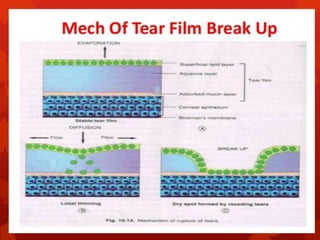
 Initially all the tear film thins uniformly by evaporation.
 When thinned out to some critical thickness, some lipid molecules
begin to be attracted by the mucin layer & migrate down to this layer.
 When the mucin layer is sufficiently contaminated by lipid from the
top, the mucin becomes hydrophobic & the tear film ruptures
 Blinking can repair this and restore aqueous layer
8.DYNAMIC EVENTS DURING BLINKING
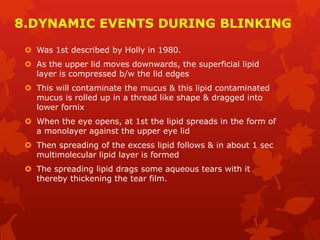
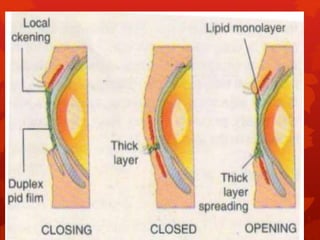
 Was 1st described by Holly in 1980.
 As the upper lid moves downwards, the superficial lipid
layer is compressed b/w the lid edges
 This will contaminate the mucus & this lipid contaminated
mucus is rolled up in a thread like shape & dragged into
lower fornix
 When the eye opens, at 1st the lipid spreads in the form of
a monolayer against the upper eye lid
 Then spreading of the excess lipid follows & in about 1 sec
multimolecular lipid layer is formed
 The spreading lipid drags some aqueous tears with it
thereby thickening the tear film.
9.ELIMINATION OF TEARS
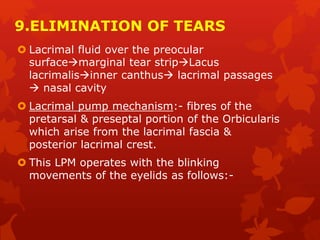
 Lacrimal fluid over the preocular
surfacemarginal tear stripLacus
lacrimalisinner canthus lacrimal passages
 nasal cavity
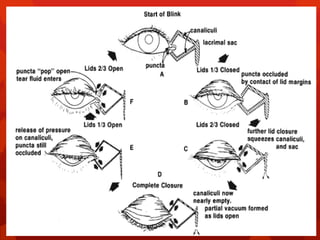
 Lacrimal pump mechanism:- fibres of the
pretarsal & preseptal portion of the Orbicularis
which arise from the lacrimal fascia &
posterior lacrimal crest.
 This LPM operates with the blinking
movements of the eyelids as follows:-
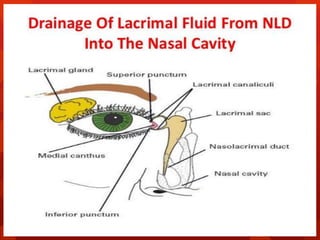
DRAINAGE OF LACRIMAL FLUID FROM NLD
INTO NASAL CAVITY
 Gravity helps downward flow.
 Air currents in nose induce negative
pressure within NLD draw the fluid down
the potential lumen of the duct into the
nose.
 Hasner’s valve present at lower end of
NLD, remains open as long as the
pressure within nose is less than the NLD,
allows the tears to flow from NLD to nose
THANK YOU

Tear film and dynamics

  • 1.
    TEAR FILM ANDDYNAMICS SIVA TEJA CHALLA
  • 2.
    THE TEAR FILM The main role of lacrimal system is to establish & maintain a continuous tear film over the ocular surface.  The presence of the pre-corneal tear film was 1st demonstrated: by Fischer in 1928.  Rollet described it as the most superficial 6th layer of cornea.
  • 3.
    STRUCTURE OF THETEAR FILM  Wolff was the 1st to describe in detail the structure of the tear film.  Coined the term ‘PRE-CORNEAL FILM’.  Tear film consists of 3 layers. 1)Outer Lipid layer 2)Intermediate Aqueous layer & 3)Inner mucin layer
  • 6.
    LIPID LAYER  Outermost layer.  0.1um thick  Formed from the secretions of Meibomian, Zeiss & Moll glands.  Contents:-1)low polarity lipids-wax & cholesterol esters 2)high polarity lipids-TG, FFA ,phospholipids.  Functions:-1)prevents the overflow of tears. 2)prevents evaporation.
  • 7.
    AQUEOUS LAYER  Middlelayer.  Formed by secretions from the main & accessory lacrimal glands of Krause & Wolfring.  Constitutes the main bulk of tear film.  thickness over the cornea 10um.  Film covering the cornea is thinner than over the conjunctiva.  Contents:- inorganic salts, glucose, urea, enzymes, proteins & glycoproteins.  Buffering capacity of the tear film is d/t HCO3 ions & protein  Functions: 1)provides O2 to corneal epithelium. 2)washes away debris & irritants. 3)contains antibacterial sub- lysozyme & betalysin.
  • 8.
    MUCOUS LAYER  Innermostlayer.  Secreted mainly by the conjunctival goblet cells  30um thick.can be demo in living eye by alician blue drops  Functions:- 1)plays a vital role in the stability of the tear film. 2)converts the hydrophobic corneal epithelium to a hydrophilic one. 3)lubricates the ocular & palpebral surfaces. 4)provides a slippery coating over the foreign bodies; thereby protecting the cornea & conjunctiva against the abrasive effects of such particles as they move about with blinking. 5)absorps various organic compounds in tears
  • 9.
    NEW TEAR FILMMODEL  Recent observation-- mucins exist as a network distributed in the aqueous body of the tear film.  Glycocalyx emanate as transmembrane molecules into the aqueous & are anchored at the cell membrane.  Membrane associated proteins-MUC1,4&16 as well as secretory mucins- MUC5AC &MUC7 have been identified at the ocular surface.
  • 10.
    PHYSICAL PROPERTIES OFTEAR FILM property Thickness 4-8um Volume 4-13ul Rate of secretion 1.2ul per min Turn over rate* 18% per min Refractive index 1.357 Ph of tears* 7.3-7.7 Osmotic pressure* 0.90-0.95% Temperature 30’c at cornea and 35’ at limbus Oxygen tension 40-160 mm hg
  • 11.
    TEAR FULID COMPOSITION Mainly composed of three protein factors-albumin,globulin and lysozyme  IgA is the most prominent IG in tear film,IgE levels increase in patients with allergic conj., and IgM increases in patients with acute infections  Tear lysozyme constitutes 20% all tear protiens,highest in conc among all body fluids  Electrolytes sodium,potassium and chloride occur in higher concetrations in tears than in blood
  • 13.
    FUNCTIONS OF TEARFILM  Makes corea a smooth optical surface  Helps to wet cornea and conjunctiva and prevent them from drying  Flushes out debris and organisms from corneal surface  Has bactericidal properties due to presence of lusozyme,lactoferrin and betalysin  Ig’s and specific antibodies in tears defend the eye against externl infections  Frictional trauma between tarsal and bulbar conj and cornea is minimised by lubricating action  Enables anti infl., cells to reach injured cornea and conjunctiva  Provides epithelial cells with O2 glucose and growth factors
  • 14.
    NEURAL ASPECTS OFTEAR PRODUCTION  The trigeminal v1 (fifth cranial) nerve bears the sensory pathway(afferent) of the tear reflexes.  The motor pathway is autonomic (involuntary), &, in general, uses the pathway of the facial (seventh) nerve in the parasympathetic division via pterygopalatine palatine ganglion, as efferent pathway.  Applied: A newborn infant has insufficient development of nervous control, so she/he "cries without weeping”.
  • 17.
    APPLIED ASPECTS  Crocodiletears syndrome/ Bogorad's syndrome" is an uncommon consequence of nerve regeneration subsequent to Bell's palsy or other damage to the facial nerve in which efferent fibers from the superior salivary nucleus become improperly connected to nerve axons projecting to the lacrimal glands (tear ducts), causing one to shed tears (lacrimate) during salivation while smelling foods or eating.  It is presumed that one would also salivate while crying due to the inverse improper connection of the lacrimal nucleus to the salivary glands, but this would be less noticeable.
  • 18.
    TEAR FILM DYNAMICS Secretion of tears  Formation of tear film  Retention & redistribution of tear film  Displacement phenomenon  Evaporation from the tear film  Drying & break up of tear film  Dynamic events during blinking  Elimination of tears
  • 19.
  • 20.
     BASAL SECRETION:- •In the human eyes the cornea is continually kept moist & nourished by basal tears. • They lubricate the eye & help to keep it clear of dust. • Secreted by accessory lacrimal glands REFLEX SECRETION:- • Results from irritation of the eye by foreign particles. • Can also occur with bright light & hot & peppery stimuli to the tongue & mouth. • These reflex tears attempt to wash out irritants that may have come into contact with the eye. • Secreted by main lacrimal gland Applied : If lacrimal gland malfunctions or is damaged in surgery or other failure of lacrimal function occur, it is not a serious matter, for the accessory glands are enough for general secretion
  • 21.
    2.FORMATION OF PREOCULAR TEAR FILM  Conjunctival mucus spreads on to the cornea by the action of the lids.  On this new surface- aqueous layer is spread spontaneously.  Over this the superficial lipid layer spreads; probably contributing to its stability & retarding evaporation b/w blinks.
  • 22.
    3.RETENTION & REDISTRIBUTION The outer most layer of corneal epithelium+ mucopolysaccharides leads to retention.  Precorneal film is stagnant.Redistribution occurs in the form of bringing of new tear fluid by way of marginal strip where there is constant flow of tears
  • 23.
    4.DISPLACEMENT PHENOMENON  Demonstratethat cornea is covered by a film which has stability, compressibility, elasticity & unaffected by gravity  Demonstrated by upward movement of particles in the film on displacing lower eyelid upwards over eyeball  This phenomenon is possible due to presence of thin monomolecular layer on the surface of cornea
  • 24.
    5.EVAPORATION FROM THETEAR FILM  All lipid films including wax esters & cholesterol esters retard evaporation of water  Important in low humidity & turbulent air flow near cornea, such as exists in a windy & arid climate  Evaporation from tear film = 10% of production rate, so, evaporation = 0.12ul/min (as tear production = 1.2ul/min)
  • 25.
    6.STABILITY, DRYING &RUPTURE OF TEAR FILM  Tears has to cover entire preocular surface to function properly  It is re-established completely after a blink , but has short lived stability  It takes 15-40 secs for tear film to rupture & dry spots to appear, when blinking is prevented  Drying of corneal surface cannot be a result of evaporation of water alone, as it takes at least 10 mins to eliminate whole tear film by drying alone.
  • 26.
    7.ELIMINATION OF TEARFILM HOLLY & LEMP’S MECHANISM  1st described by Holly in 1973.  Initially all the tear film thins uniformly by evaporation.  When thinned out to some critical thickness, some lipid molecules begin to be attracted by the mucin layer & migrate down to this layer.  When the mucin layer is sufficiently contaminated by lipid from the top, the mucin becomes hydrophobic & the tear film ruptures  Blinking can repair this and restore aqueous layer
  • 28.
    8.DYNAMIC EVENTS DURINGBLINKING  Was 1st described by Holly in 1980.  As the upper lid moves downwards, the superficial lipid layer is compressed b/w the lid edges  This will contaminate the mucus & this lipid contaminated mucus is rolled up in a thread like shape & dragged into lower fornix  When the eye opens, at 1st the lipid spreads in the form of a monolayer against the upper eye lid  Then spreading of the excess lipid follows & in about 1 sec multimolecular lipid layer is formed  The spreading lipid drags some aqueous tears with it thereby thickening the tear film.
  • 30.
    9.ELIMINATION OF TEARS Lacrimal fluid over the preocular surfacemarginal tear stripLacus lacrimalisinner canthus lacrimal passages  nasal cavity  Lacrimal pump mechanism:- fibres of the pretarsal & preseptal portion of the Orbicularis which arise from the lacrimal fascia & posterior lacrimal crest.  This LPM operates with the blinking movements of the eyelids as follows:-
  • 32.
    DRAINAGE OF LACRIMALFLUID FROM NLD INTO NASAL CAVITY  Gravity helps downward flow.  Air currents in nose induce negative pressure within NLD draw the fluid down the potential lumen of the duct into the nose.  Hasner’s valve present at lower end of NLD, remains open as long as the pressure within nose is less than the NLD, allows the tears to flow from NLD to nose
  • 34.