LENS-ANATOMY
 AND
 PHYSIOLOGY


VISHNU NARAYANAN M.R
ANATOMY
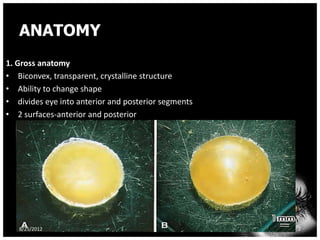
1. Gross anatomy
• Biconvex, transparent, crystalline structure
• Ability to change shape
• divides eye into anterior and posterior segments
• 2 surfaces-anterior and posterior


   8/25/2012                                         2
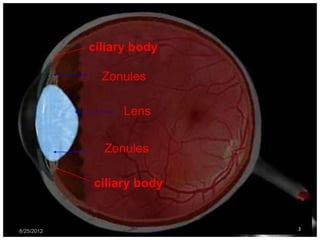
ciliary body

              Zonules

                  Lens


              Zonules

            ciliary body


8/25/2012                  3
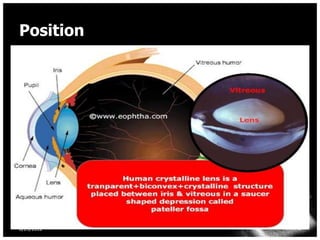
Position


8/25/2012   4
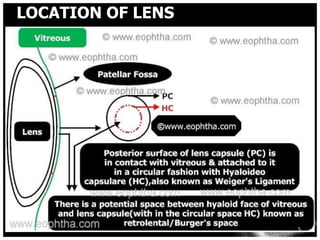
LOCATION OF LENS


8/25/2012          5
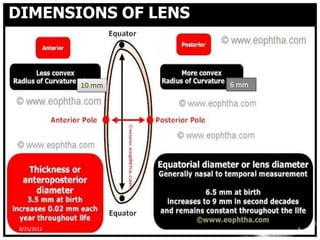
DIMENSIONS OF LENS


             10 mm   6 mm


 8/25/2012                  6
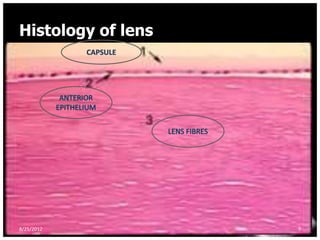
Histology of lens


8/25/2012           7
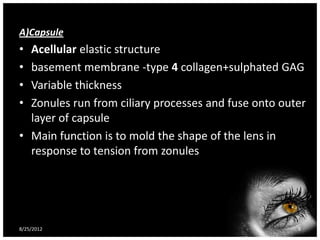
A)Capsule
• Acellular elastic structure
• basement membrane -type 4 collagen+sulphated GAG
• Variable thickness
• Zonules run from ciliary processes and fuse onto outer
  layer of capsule
• Main function is to mold the shape of the lens in
  response to tension from zonules


8/25/2012                                             8
B)Anterior epithelium

• Single layer of nucleated epithelial cells interconnected with gap
    junctions and desmosomes
• The only metabolically active part of lens
• Functionally divided into 2 zones-
i] Pre-equatorial zone- columnar cells
              Actively dividing and differentiating into lens fibers
ii]Central zone-cuboidal cells
              i) Transports solutes between lens and aqueous
              ii) Secretes capsular material
• Maintains the osmotic balance of lens

   8/25/2012                                                    9
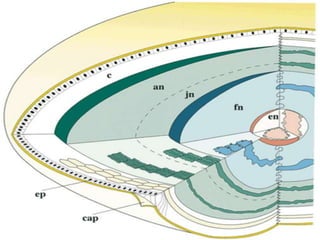
C)Lens substance

• Composed of lens fibres
• Consist of primary and secondary fibers
• Produced by mitosis of epithelial cells in the pre-
  equatorial zone
• They elongate and undergo differentiation with
  pyknocytosis and eventual loss of cell oraganelles
  and nucleus
• This is an important factor in the transparency of
  the lens

8/25/2012                                               10
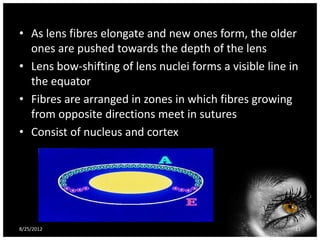
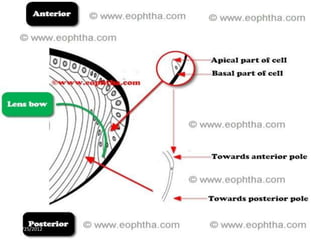
• As lens fibres elongate and new ones form, the older
  ones are pushed towards the depth of the lens
• Lens bow-shifting of lens nuclei forms a visible line in
  the equator
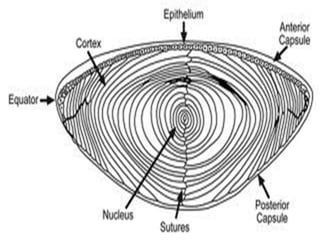
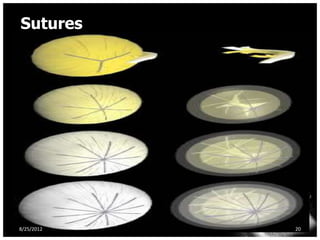
• Fibres are arranged in zones in which fibres growing
  from opposite directions meet in sutures
• Consist of nucleus and cortex


8/25/2012                                                11
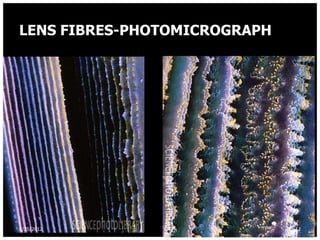
LENS FIBRES-PHOTOMICROGRAPH


8/25/2012                     12
8/25/2012   13
8/25/2012   14
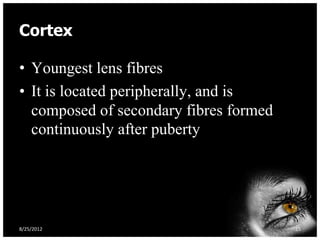
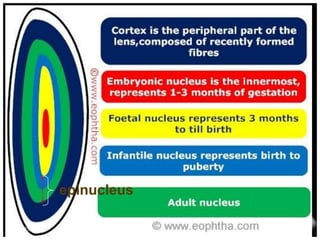
Cortex

• Youngest lens fibres
• It is located peripherally, and is
  composed of secondary fibres formed
  continuously after puberty


8/25/2012                               15
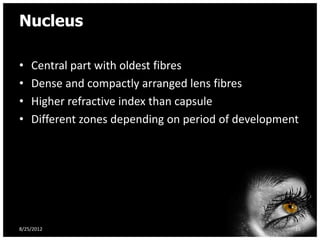
Nucleus

•   Central part with oldest fibres
•   Dense and compactly arranged lens fibres
•   Higher refractive index than capsule
•   Different zones depending on period of development


8/25/2012                                            16
epinucleus

8/25/2012                17
8/25/2012   18
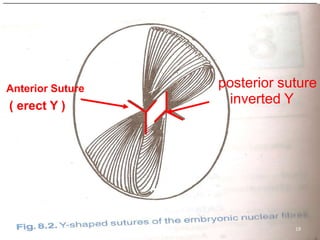
Anterior Suture   posterior suture
( erect Y )
                    inverted Y


  8/25/2012                   19
Sutures


8/25/2012   20
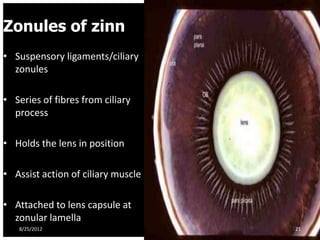
Zonules of zinn
• Suspensory ligaments/ciliary
  zonules

• Series of fibres from ciliary
  process

• Holds the lens in position

• Assist action of ciliary muscle

• Attached to lens capsule at
  zonular lamella
   8/25/2012                        21
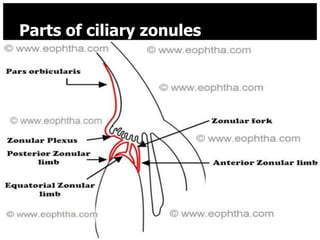
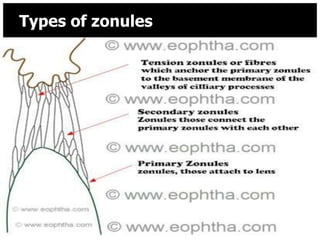
Parts of ciliary zonules


8/25/2012                  22
Types of zonules


8/25/2012          23
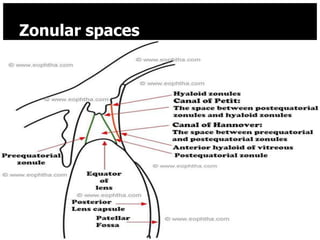
Zonular spaces


8/25/2012        24
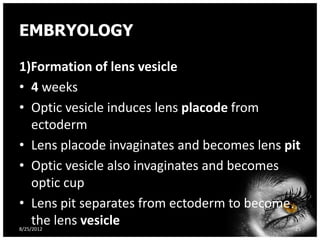
EMBRYOLOGY

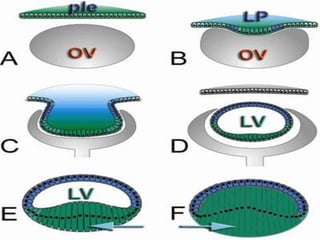
1)Formation of lens vesicle
• 4 weeks
• Optic vesicle induces lens placode from
  ectoderm
• Lens placode invaginates and becomes lens pit
• Optic vesicle also invaginates and becomes
  optic cup
• Lens pit separates from ectoderm to become
  the lens vesicle
8/25/2012                                     25
8/25/2012   26
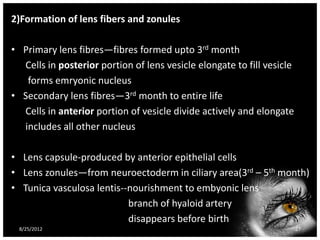
2)Formation of lens fibers and zonules

• Primary lens fibres—fibres formed upto 3rd month
  Cells in posterior portion of lens vesicle elongate to fill vesicle
   forms emryonic nucleus
• Secondary lens fibres—3rd month to entire life
  Cells in anterior portion of vesicle divide actively and elongate
  includes all other nucleus

• Lens capsule-produced by anterior epithelial cells
• Lens zonules—from neuroectoderm in ciliary area(3rd – 5th month)
• Tunica vasculosa lentis--nourishment to embyonic lens
                           branch of hyaloid artery
                           disappears before birth
 8/25/2012                                                              27
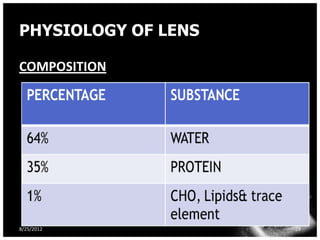
PHYSIOLOGY OF LENS

COMPOSITION


8/25/2012            28
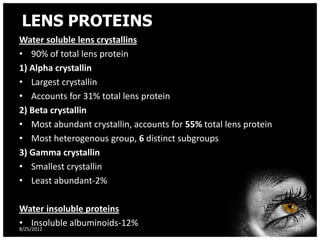
LENS PROTEINS
Water soluble lens crystallins
• 90% of total lens protein
1) Alpha crystallin
• Largest crystallin
• Accounts for 31% total lens protein
2) Beta crystallin
• Most abundant crystallin, accounts for 55% total lens protein
• Most heterogenous group, 6 distinct subgroups
3) Gamma crystallin
• Smallest crystallin
• Least abundant-2%

Water insoluble proteins
• Insoluble albuminoids-12%
8/25/2012                                                         29
WATER

• Lens –dehydrated state
• Unique arrangement of proteins within lens fibres
• Low protein osmotic activity within lens
• Tightly packed fibres with minimum extracellular spaces
• Lens epithelium transports water into the fibre mass
• Half of the water -protein hydration
• Water excreted via aquaporin in the equator into
  aqueous
• Important factor maintaining lens transparency

8/25/2012                                                   30
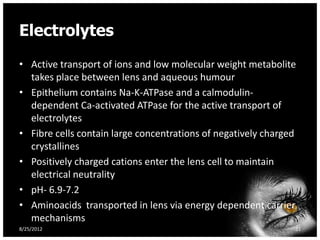
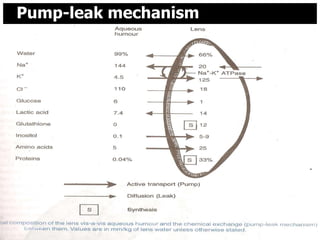
Electrolytes
• Active transport of ions and low molecular weight metabolite
  takes place between lens and aqueous humour
• Epithelium contains Na-K-ATPase and a calmodulin-
  dependent Ca-activated ATPase for the active transport of
  electrolytes
• Fibre cells contain large concentrations of negatively charged
  crystallines
• Positively charged cations enter the lens cell to maintain
  electrical neutrality
• pH- 6.9-7.2
• Aminoacids transported in lens via energy dependent carrier
  mechanisms
8/25/2012                                                      31
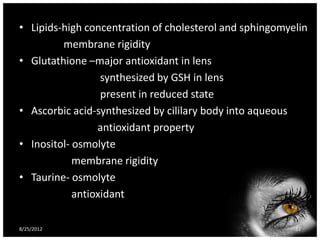
• Lipids-high concentration of cholesterol and sphingomyelin
         membrane rigidity
• Glutathione –major antioxidant in lens
                  synthesized by GSH in lens
                  present in reduced state
• Ascorbic acid-synthesized by cililary body into aqueous
                 antioxidant property
• Inositol- osmolyte
            membrane rigidity
• Taurine- osmolyte
            antioxidant

8/25/2012                                                32
Pump-leak mechanism


8/25/2012             33
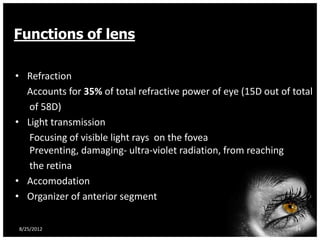
Functions of lens

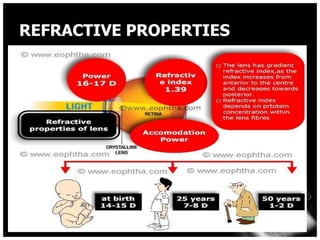
• Refraction
  Accounts for 35% of total refractive power of eye (15D out of total
   of 58D)
• Light transmission
   Focusing of visible light rays on the fovea
   Preventing, damaging- ultra-violet radiation, from reaching
   the retina
• Accomodation
• Organizer of anterior segment

8/25/2012                                                       34
REFRACTIVE PROPERTIES


8/25/2012               35
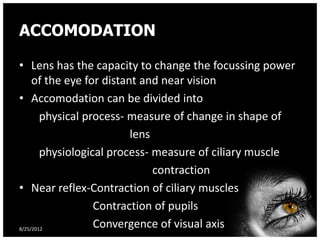
ACCOMODATION

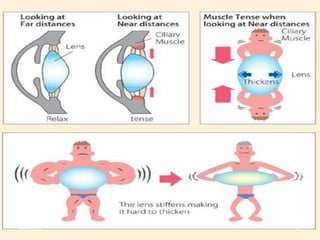
• Lens has the capacity to change the focussing power
     of the eye for distant and near vision
• Accomodation can be divided into
        physical process- measure of change in shape of
                          lens
        physiological process- measure of ciliary muscle
                               contraction
• Near reflex-Contraction of ciliary muscles
                   Contraction of pupils
8/25/2012
                   Convergence of visual axis            36
8/25/2012   37
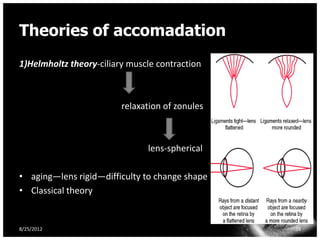
Theories of accomadation
1)Helmholtz theory-ciliary muscle contraction


                         relaxation of zonules


                               lens-spherical

• aging—lens rigid—difficulty to change shape
• Classical theory


8/25/2012                                        38
2) Schachar’s theory– ciliary muscle contraction


                        equatorial zonules tensed


                        shape changes in lens

Aging—diameter of lens grow—less space for proper functioning of
ciliary muscles

3) Coleman’s theory—
• Lens and zonules—diaphragm
• Shape altered by pressure difference b/w aqueous and vitreous
• Ciliary muscle-alters pressure gradient
8/25/2012                                                          39
Maintenance of transparency

•   Thin epithelium
•   Regular arrangement of lens fibers
•   Little cellular organelles
•   Little extracellular space
•   Orderly arrangement of lens proteins
•   Relative dehydration
•   Semipermeable character of lens capsule
•   Avascularity
•   Antioxidants
8/25/2012                                     40
LENTICULAR METABOLISM

• Continous supply of ATP required for-
1.     Transport of ions and aminoacids
2.     Maintanence of lens dehydration
3.     Continous protein synthesis
4.     GSH synthesis
• Major site – epithelium
• Source of nutrient supply-aqueous humour


     8/25/2012                               41
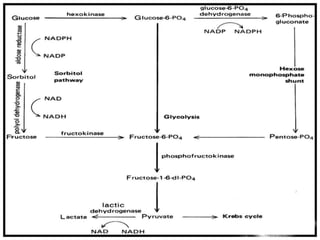
Glucose metabolism

• Energy production entirely dependent on glucose
  metabolism
• Glucose enters lens by simple diffusion and
  facilitated diffusion
• Epithelial cells- GLUT-1
• Lens fibre cells-GLUT-3
• Glucose is rapidly metabolized via glycolysis so that
  level of free glucose in lens < 1/10 level in aqueous


8/25/2012                                                 42
8/25/2012   43
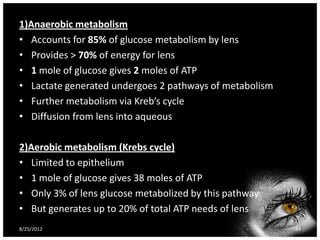
1)Anaerobic metabolism
• Accounts for 85% of glucose metabolism by lens
• Provides > 70% of energy for lens
• 1 mole of glucose gives 2 moles of ATP
• Lactate generated undergoes 2 pathways of metabolism
• Further metabolism via Kreb’s cycle
• Diffusion from lens into aqueous

2)Aerobic metabolism (Krebs cycle)
• Limited to epithelium
• 1 mole of glucose gives 38 moles of ATP
• Only 3% of lens glucose metabolized by this pathway
• But generates up to 20% of total ATP needs of lens
8/25/2012                                                44
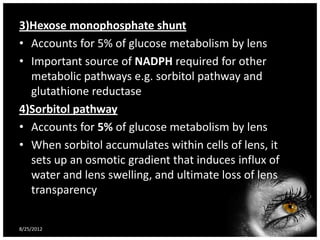
3)Hexose monophosphate shunt
• Accounts for 5% of glucose metabolism by lens
• Important source of NADPH required for other
  metabolic pathways e.g. sorbitol pathway and
  glutathione reductase
4)Sorbitol pathway
• Accounts for 5% of glucose metabolism by lens
• When sorbitol accumulates within cells of lens, it
  sets up an osmotic gradient that induces influx of
  water and lens swelling, and ultimate loss of lens
  transparency

8/25/2012                                              45
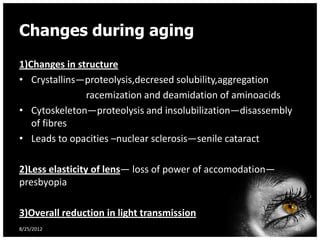
Changes during aging
1)Changes in structure
• Crystallins—proteolysis,decresed solubility,aggregation
               racemization and deamidation of aminoacids
• Cytoskeleton—proteolysis and insolubilization—disassembly
   of fibres
• Leads to opacities –nuclear sclerosis—senile cataract

2)Less elasticity of lens— loss of power of accomodation—
presbyopia

3)Overall reduction in light transmission
8/25/2012                                                     46
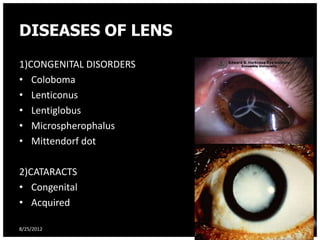
DISEASES OF LENS
1)CONGENITAL DISORDERS
• Coloboma
• Lenticonus
• Lentiglobus
• Microspherophalus
• Mittendorf dot

2)CATARACTS
• Congenital
• Acquired

8/25/2012                47
3) Miscellaneous disorders
• Posterior capsular opacification
• Aphakia
• Pseudophakia
• Exfoliation of capsule
• Psuedoexfoliation and psuedoexfoliation glaucoma
• Lens induced glaucoma
• Ectopia lentis
• Lens induced uveatits
• Loss of accomodation-aging,cataract,surgery

4)Several systemic diseases are also associated with disorders of
the lens
8/25/2012                                                       48
Lens

Lens

  • 1.
  • 2.
    ANATOMY 1. Gross anatomy •Biconvex, transparent, crystalline structure • Ability to change shape • divides eye into anterior and posterior segments • 2 surfaces-anterior and posterior 8/25/2012 2
  • 3.
    ciliary body Zonules Lens Zonules ciliary body 8/25/2012 3
  • 4.
  • 5.
  • 6.
    DIMENSIONS OF LENS 10 mm 6 mm 8/25/2012 6
  • 7.
  • 8.
    A)Capsule • Acellular elasticstructure • basement membrane -type 4 collagen+sulphated GAG • Variable thickness • Zonules run from ciliary processes and fuse onto outer layer of capsule • Main function is to mold the shape of the lens in response to tension from zonules 8/25/2012 8
  • 9.
    B)Anterior epithelium • Singlelayer of nucleated epithelial cells interconnected with gap junctions and desmosomes • The only metabolically active part of lens • Functionally divided into 2 zones- i] Pre-equatorial zone- columnar cells Actively dividing and differentiating into lens fibers ii]Central zone-cuboidal cells i) Transports solutes between lens and aqueous ii) Secretes capsular material • Maintains the osmotic balance of lens 8/25/2012 9
  • 10.
    C)Lens substance • Composedof lens fibres • Consist of primary and secondary fibers • Produced by mitosis of epithelial cells in the pre- equatorial zone • They elongate and undergo differentiation with pyknocytosis and eventual loss of cell oraganelles and nucleus • This is an important factor in the transparency of the lens 8/25/2012 10
  • 11.
    • As lensfibres elongate and new ones form, the older ones are pushed towards the depth of the lens • Lens bow-shifting of lens nuclei forms a visible line in the equator • Fibres are arranged in zones in which fibres growing from opposite directions meet in sutures • Consist of nucleus and cortex 8/25/2012 11
  • 12.
  • 13.
  • 14.
  • 15.
    Cortex • Youngest lensfibres • It is located peripherally, and is composed of secondary fibres formed continuously after puberty 8/25/2012 15
  • 16.
    Nucleus • Central part with oldest fibres • Dense and compactly arranged lens fibres • Higher refractive index than capsule • Different zones depending on period of development 8/25/2012 16
  • 17.
  • 18.
  • 19.
    Anterior Suture posterior suture ( erect Y ) inverted Y 8/25/2012 19
  • 20.
  • 21.
    Zonules of zinn •Suspensory ligaments/ciliary zonules • Series of fibres from ciliary process • Holds the lens in position • Assist action of ciliary muscle • Attached to lens capsule at zonular lamella 8/25/2012 21
  • 22.
    Parts of ciliaryzonules 8/25/2012 22
  • 23.
  • 24.
  • 25.
    EMBRYOLOGY 1)Formation of lensvesicle • 4 weeks • Optic vesicle induces lens placode from ectoderm • Lens placode invaginates and becomes lens pit • Optic vesicle also invaginates and becomes optic cup • Lens pit separates from ectoderm to become the lens vesicle 8/25/2012 25
  • 26.
  • 27.
    2)Formation of lensfibers and zonules • Primary lens fibres—fibres formed upto 3rd month Cells in posterior portion of lens vesicle elongate to fill vesicle forms emryonic nucleus • Secondary lens fibres—3rd month to entire life Cells in anterior portion of vesicle divide actively and elongate includes all other nucleus • Lens capsule-produced by anterior epithelial cells • Lens zonules—from neuroectoderm in ciliary area(3rd – 5th month) • Tunica vasculosa lentis--nourishment to embyonic lens branch of hyaloid artery disappears before birth 8/25/2012 27
  • 28.
  • 29.
    LENS PROTEINS Water solublelens crystallins • 90% of total lens protein 1) Alpha crystallin • Largest crystallin • Accounts for 31% total lens protein 2) Beta crystallin • Most abundant crystallin, accounts for 55% total lens protein • Most heterogenous group, 6 distinct subgroups 3) Gamma crystallin • Smallest crystallin • Least abundant-2% Water insoluble proteins • Insoluble albuminoids-12% 8/25/2012 29
  • 30.
    WATER • Lens –dehydratedstate • Unique arrangement of proteins within lens fibres • Low protein osmotic activity within lens • Tightly packed fibres with minimum extracellular spaces • Lens epithelium transports water into the fibre mass • Half of the water -protein hydration • Water excreted via aquaporin in the equator into aqueous • Important factor maintaining lens transparency 8/25/2012 30
  • 31.
    Electrolytes • Active transportof ions and low molecular weight metabolite takes place between lens and aqueous humour • Epithelium contains Na-K-ATPase and a calmodulin- dependent Ca-activated ATPase for the active transport of electrolytes • Fibre cells contain large concentrations of negatively charged crystallines • Positively charged cations enter the lens cell to maintain electrical neutrality • pH- 6.9-7.2 • Aminoacids transported in lens via energy dependent carrier mechanisms 8/25/2012 31
  • 32.
    • Lipids-high concentrationof cholesterol and sphingomyelin membrane rigidity • Glutathione –major antioxidant in lens synthesized by GSH in lens present in reduced state • Ascorbic acid-synthesized by cililary body into aqueous antioxidant property • Inositol- osmolyte membrane rigidity • Taurine- osmolyte antioxidant 8/25/2012 32
  • 33.
  • 34.
    Functions of lens •Refraction Accounts for 35% of total refractive power of eye (15D out of total of 58D) • Light transmission Focusing of visible light rays on the fovea Preventing, damaging- ultra-violet radiation, from reaching the retina • Accomodation • Organizer of anterior segment 8/25/2012 34
  • 35.
  • 36.
    ACCOMODATION • Lens hasthe capacity to change the focussing power of the eye for distant and near vision • Accomodation can be divided into physical process- measure of change in shape of lens physiological process- measure of ciliary muscle contraction • Near reflex-Contraction of ciliary muscles Contraction of pupils 8/25/2012 Convergence of visual axis 36
  • 37.
  • 38.
    Theories of accomadation 1)Helmholtztheory-ciliary muscle contraction relaxation of zonules lens-spherical • aging—lens rigid—difficulty to change shape • Classical theory 8/25/2012 38
  • 39.
    2) Schachar’s theory–ciliary muscle contraction equatorial zonules tensed shape changes in lens Aging—diameter of lens grow—less space for proper functioning of ciliary muscles 3) Coleman’s theory— • Lens and zonules—diaphragm • Shape altered by pressure difference b/w aqueous and vitreous • Ciliary muscle-alters pressure gradient 8/25/2012 39
  • 40.
    Maintenance of transparency • Thin epithelium • Regular arrangement of lens fibers • Little cellular organelles • Little extracellular space • Orderly arrangement of lens proteins • Relative dehydration • Semipermeable character of lens capsule • Avascularity • Antioxidants 8/25/2012 40
  • 41.
    LENTICULAR METABOLISM • Continoussupply of ATP required for- 1. Transport of ions and aminoacids 2. Maintanence of lens dehydration 3. Continous protein synthesis 4. GSH synthesis • Major site – epithelium • Source of nutrient supply-aqueous humour 8/25/2012 41
  • 42.
    Glucose metabolism • Energyproduction entirely dependent on glucose metabolism • Glucose enters lens by simple diffusion and facilitated diffusion • Epithelial cells- GLUT-1 • Lens fibre cells-GLUT-3 • Glucose is rapidly metabolized via glycolysis so that level of free glucose in lens < 1/10 level in aqueous 8/25/2012 42
  • 43.
  • 44.
    1)Anaerobic metabolism • Accountsfor 85% of glucose metabolism by lens • Provides > 70% of energy for lens • 1 mole of glucose gives 2 moles of ATP • Lactate generated undergoes 2 pathways of metabolism • Further metabolism via Kreb’s cycle • Diffusion from lens into aqueous 2)Aerobic metabolism (Krebs cycle) • Limited to epithelium • 1 mole of glucose gives 38 moles of ATP • Only 3% of lens glucose metabolized by this pathway • But generates up to 20% of total ATP needs of lens 8/25/2012 44
  • 45.
    3)Hexose monophosphate shunt •Accounts for 5% of glucose metabolism by lens • Important source of NADPH required for other metabolic pathways e.g. sorbitol pathway and glutathione reductase 4)Sorbitol pathway • Accounts for 5% of glucose metabolism by lens • When sorbitol accumulates within cells of lens, it sets up an osmotic gradient that induces influx of water and lens swelling, and ultimate loss of lens transparency 8/25/2012 45
  • 46.
    Changes during aging 1)Changesin structure • Crystallins—proteolysis,decresed solubility,aggregation racemization and deamidation of aminoacids • Cytoskeleton—proteolysis and insolubilization—disassembly of fibres • Leads to opacities –nuclear sclerosis—senile cataract 2)Less elasticity of lens— loss of power of accomodation— presbyopia 3)Overall reduction in light transmission 8/25/2012 46
  • 47.
    DISEASES OF LENS 1)CONGENITALDISORDERS • Coloboma • Lenticonus • Lentiglobus • Microspherophalus • Mittendorf dot 2)CATARACTS • Congenital • Acquired 8/25/2012 47
  • 48.
    3) Miscellaneous disorders •Posterior capsular opacification • Aphakia • Pseudophakia • Exfoliation of capsule • Psuedoexfoliation and psuedoexfoliation glaucoma • Lens induced glaucoma • Ectopia lentis • Lens induced uveatits • Loss of accomodation-aging,cataract,surgery 4)Several systemic diseases are also associated with disorders of the lens 8/25/2012 48

Editor's Notes

  • #8 Anterior thickness greaterInverted basmnt membrane
  • #9 Thiker anteriorlyThiker in pre equatorial regions
  • #11 Fibre cell cycle stops-CDK INHIBITORS AND Rb geneElongation—microtubuleesFibredifferensiation—fibroblast gf and insulin likgfOrganelle degradation-15 lipoxygenase
  • #13 Adhesive junctions by microtubules—early stagesBall and socket junctions– on reaching the sutures—membrane intact during accomodation
  • #23 •Pars orbicularis –The part of the zonules which lie over pars plana.•Zonular plexus- part of the zonules that lie between the cilliary processes.•Zonular fork¬- the point of angulation of the zonule, which lies at the mid zone of cilliary valleys.•Zonular limbs- consists of◦Anterior zonular limb: passes from pars plana to preequatorial part of the lens.◦Posterior zonular limb: passes from pars plicata to postequatorial part of the lens.◦Equatorial Zonular limb: passes from pars pliacata to lens equator.Pars orbicularis –The part of the zonules which lie over pars plana.Zonular plexus- part of the zonules that lie between the cilliary processes.Zonular fork¬- the point of angulation of the zonule, which lies at the mid zone of cilliary valleys.Zonular limbs- consists ofAnterior zonular limb: passes from pars plana to preequatorial part of the lens.Posterior zonular limb: passes from pars plicata to postequatorial part of the lens.Equatorial Zonular limb: passes from pars pliacata to lens equator.
  • #25 Hyaloidzonules are the single layers of fibers which connect the anterior hyaloid of vitreous at the border of the patellar fossa to pars plana and pars plicata.
  • #30 Alpha-chaperone activity-heat shock protein-prevent protein aggregation and precipitationBeta gamma—buffering of calcium in lens fiber cell cytoplasm
  • #31 The composition enables the lens to have a refractive index considerably greater than its fluid environment and yet remain sufficiently hydrated to be deformable during the process of accommodation
  • #33 Ascorbic acid also is pro-oxidant
  • #35 Lens if not formed– absence of corneal endothelium abnormaldifferensiation of corneal stroma absence of iris,ciliarybody,anterior chamber
  • #41 CatarcatNuclera sclerosis
  • #47 Insoluble esp alpha crystallins—bind to hydrophobic domains of misfolded proteins