by Getachew.k
Gondar, Ethiopia
 The eyelids are mobile tissue curtains placed in front of the
eyeballs .
 Act as shutters protecting the eyes from injuries and excessive
light.
 perform an important function of spreading the tear film over
the cornea and conjunctiva and also help in drainage of tears
by lacrimal pump system.
The tissues of the lids from anterior (cutancous) to
posterior conjunctival aspects as follows:-
 skin
 subcutaneous areolar tissue
 layer of striated muscle (orbicularis oculi)
 sub muscular areolar tissue
 layer of non striated muscle
 the fibrous layer—including tarsal plate
 conjunctiva
The skin consists of the epidermis, dermis and related
structures (adnexa).
1,Epidermis
The epidermis is comprised of four layers of keratin-
producing cells (keratinocytes).
contains melanocytes, Langerhans cells and Merkel cells.
The layers of the epidermis around the eye are described
below; cells migrate superficially, undergoing maturation
and differentiation through successive layers.
 Keratin layer (stratum corneum or horny layer) consists of flat
cells devoid of nuclei.
 Granular cell layer (stratum granulosum) typically consists of one
or two layers of flattened cells containing kerato-hyaline granules.
 Prickle cell layer (stratum spinosum) is approximately five cells
deep. polygonal in cross-section and have abundant eosinophilic
cytoplasm.
Their free borders are united by spiny-appearing desmosomes (cellular
junctions).
 Basal cell layer (stratum basale) comprises a single row of
columnar-shaped proliferating cells containing melanin derived from
adjacent melanocytes.
2,Dermis:- much thicker than the epidermis.
 composed of connective tissue and contains blood vessels,
lymphatics and nerve fibres in addition to fibroblasts, macrophages
and mast cells; upward dermal extensions (papillae) interdigitate
with downward epidermal projections (rete ridges).
 In the eyelid the dermis lies on the orbicularis muscle.
 Adnexa lie deep in the dermis or within the tarsal plates.
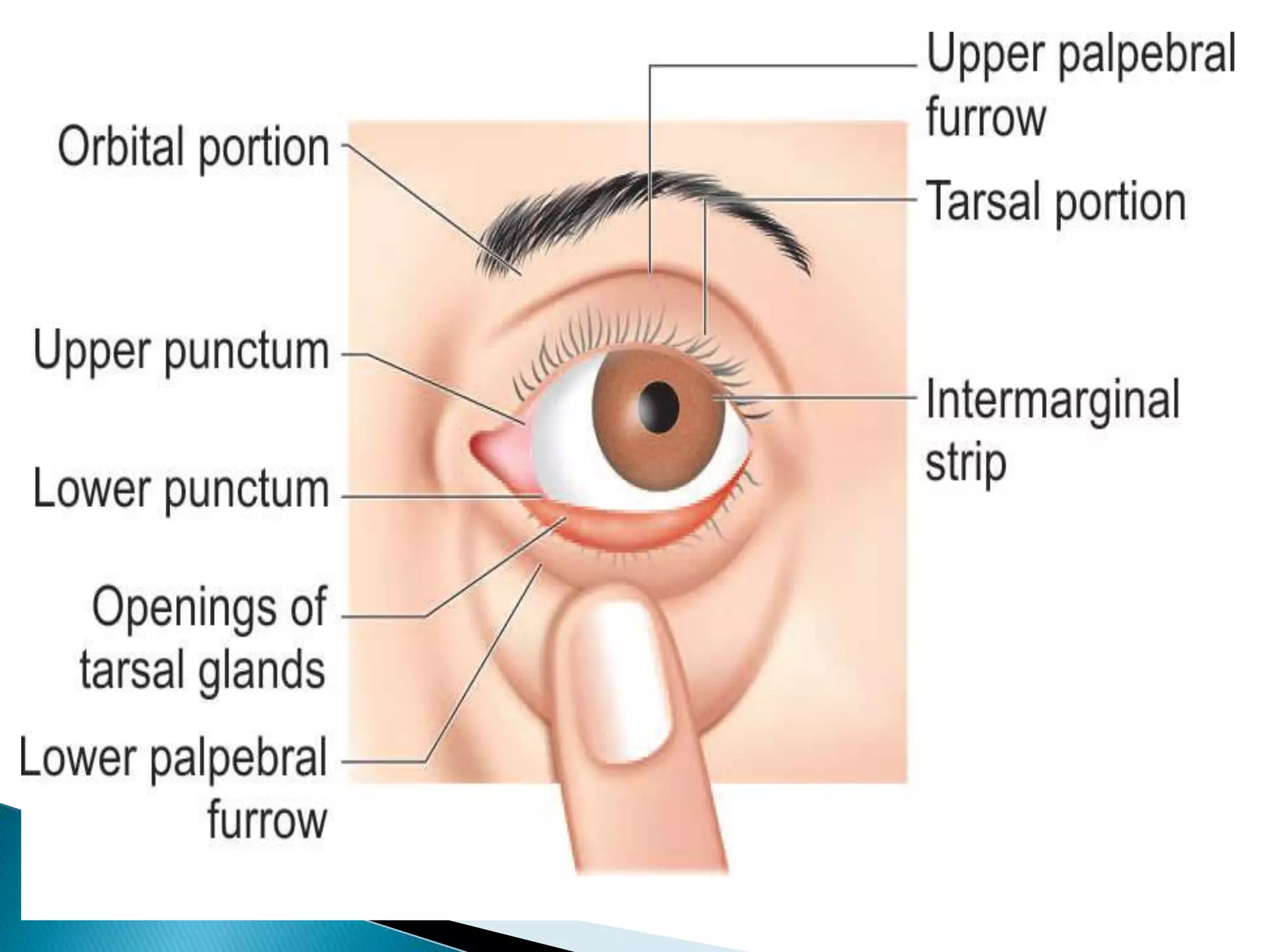
Parts of eyelid. Each eyelid is divided by a horizontal furrow
(sulcus) into an orbital and tarsal part.
Position of lids. When the eye is open, the upper lid covers about
one-sixth of the cornea and the lower
lid just touches the limbus.
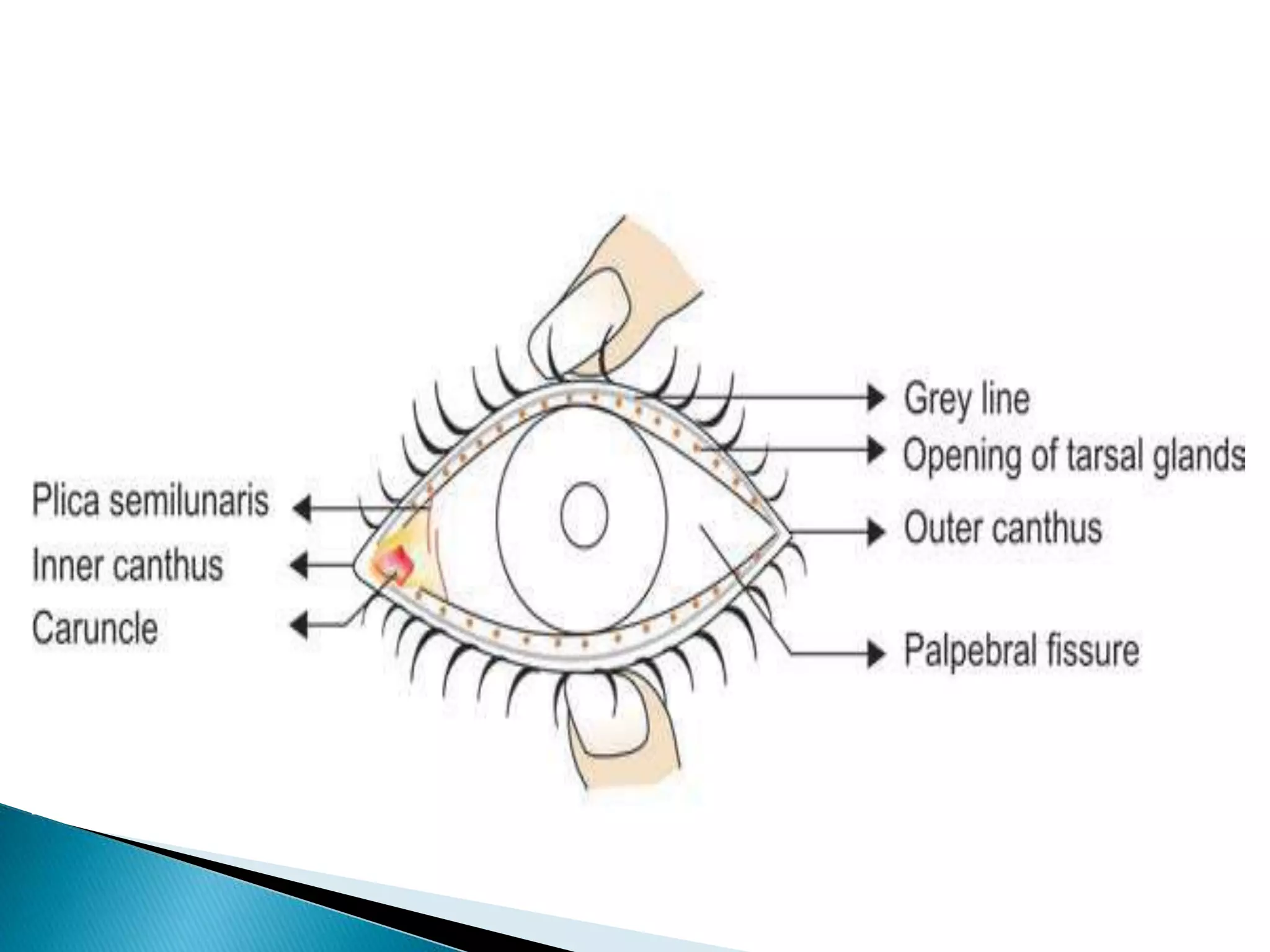
Canthi. The two lids meet each other at medial and lateral angles (or
outer and inner canthi).
Palpebral aperture. It is the elliptical space between
the upper and the lower lid.
When the eyes are open it measures about 10–11 mm vertically in the
centre and about 28–30 mm horizontally.
Lid margin. 2mm thick and 30mm long and contains
eyelashes and just posterior to it are the meibomian glands
orifices.
 The medial, lacrimal portion is rounded and devoid of lashes or
glands.
 The lateral, ciliary portion consists of a rounded anterior border, a
sharp posterior border (placed against the globe) and an inter-
marginal strip (between the two borders).
 The grey line (which marks junction of skin and conjunctiva)
divides the inter-marginal strip into an anterior strip bearing 2–3
rows of lashes and a posterior strip on which openings of
meibomian glands are arranged in a row.
 The splitting of the eyelids when required in operations is done at
the level of grey line.
 100 in upper lid
 50 in lower lid
 Originate from anterior lamella in two or three irregular
rows.
 The upper lid lashes are directed upward, and outwards
 The lower lid lashed are directed downward and
outwards
 It is a loose connective tissue containing no fat.
 It is absent at medial and lateral angles, ciliary margin
and at sulci.
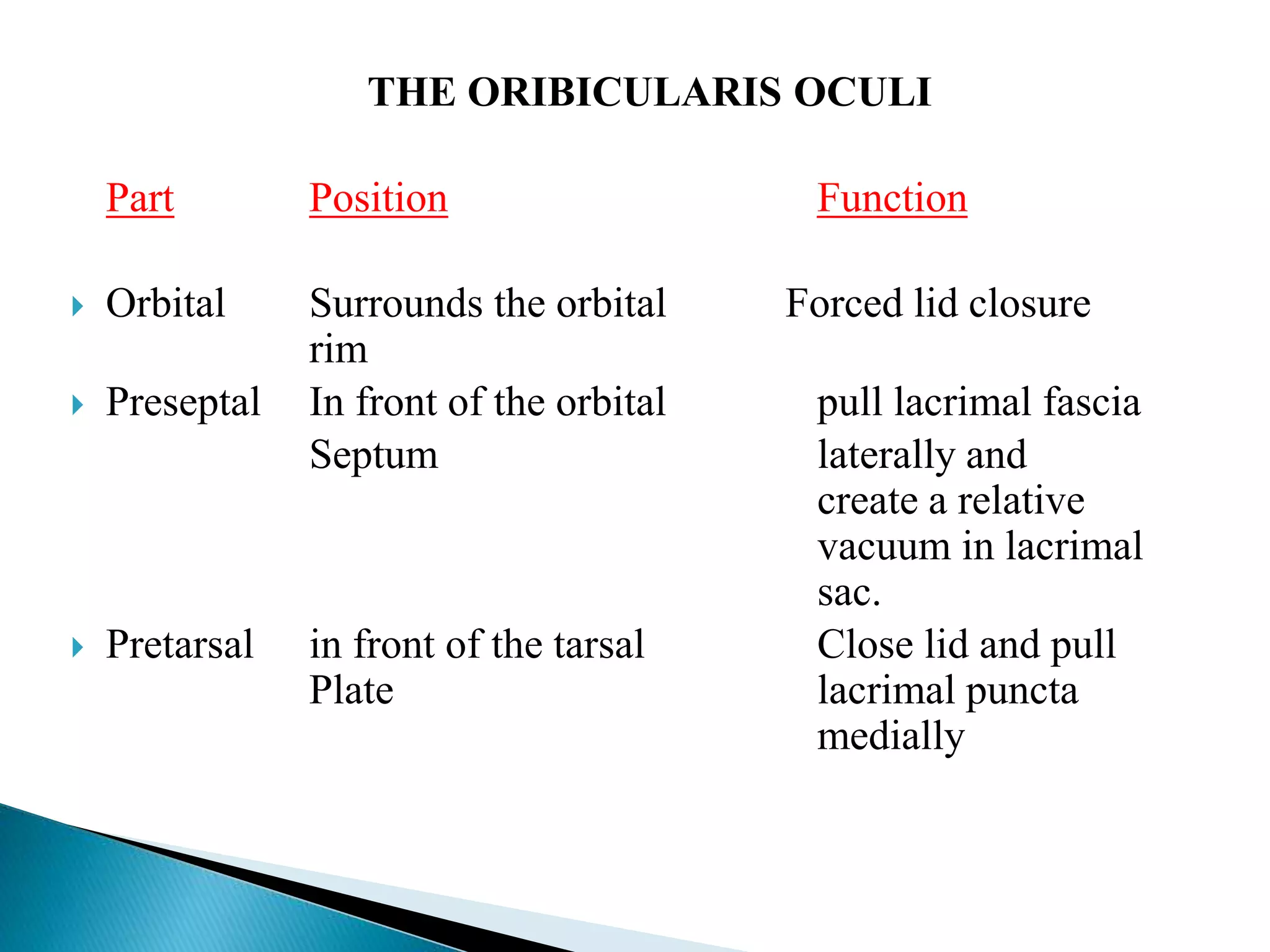
THE ORIBICULARIS OCULI
Part Position Function
 Orbital Surrounds the orbital Forced lid closure
rim
 Preseptal In front of the orbital pull lacrimal fascia
Septum laterally and
create a relative
vacuum in lacrimal
sac.
 Pretarsal in front of the tarsal Close lid and pull
Plate lacrimal puncta
medially
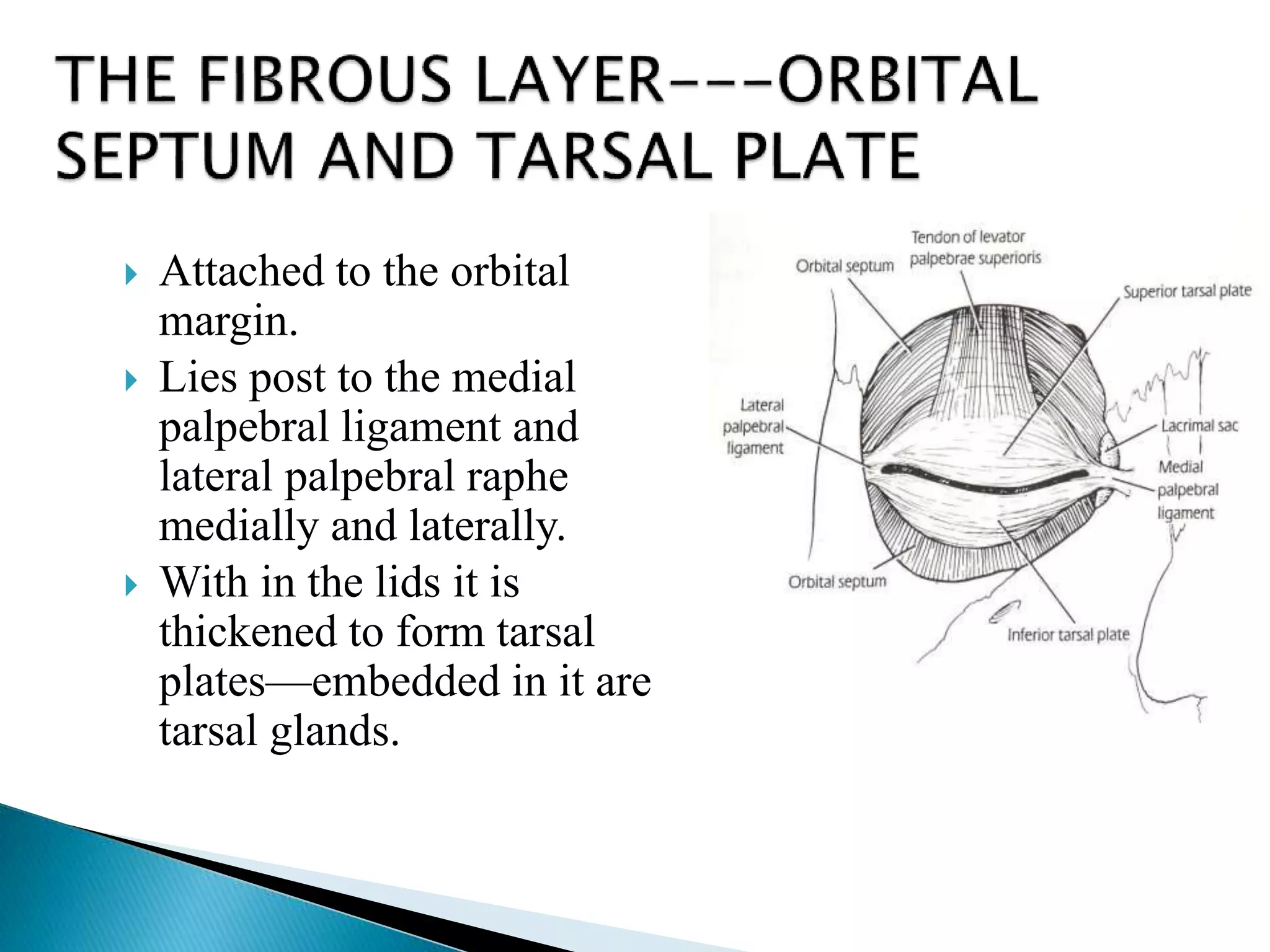
 Attached to the orbital
margin.
 Lies post to the medial
palpebral ligament and
lateral palpebral raphe
medially and laterally.
 With in the lids it is
thickened to form tarsal
plates—embedded in it are
tarsal glands.
 The medial palpebral ligament attaches the medial end
of tarsi to lacrimal crest and frontal process of maxilla.
 The lateral palpebral ligament attach the lateral end of
tarsi to margin tubercle on marginal tubercle of
zygomatic bone.
 The upper lid retractors consist of levator palpebra
superior muscle and its aponeurosis and the superior
tarsal muscle (Muller’s muscle)
 The lower lid retractors arise from the sheat of the
inferior rectus muscle and are similarly composed of
aponeurosis and the inferior tarsal muscle
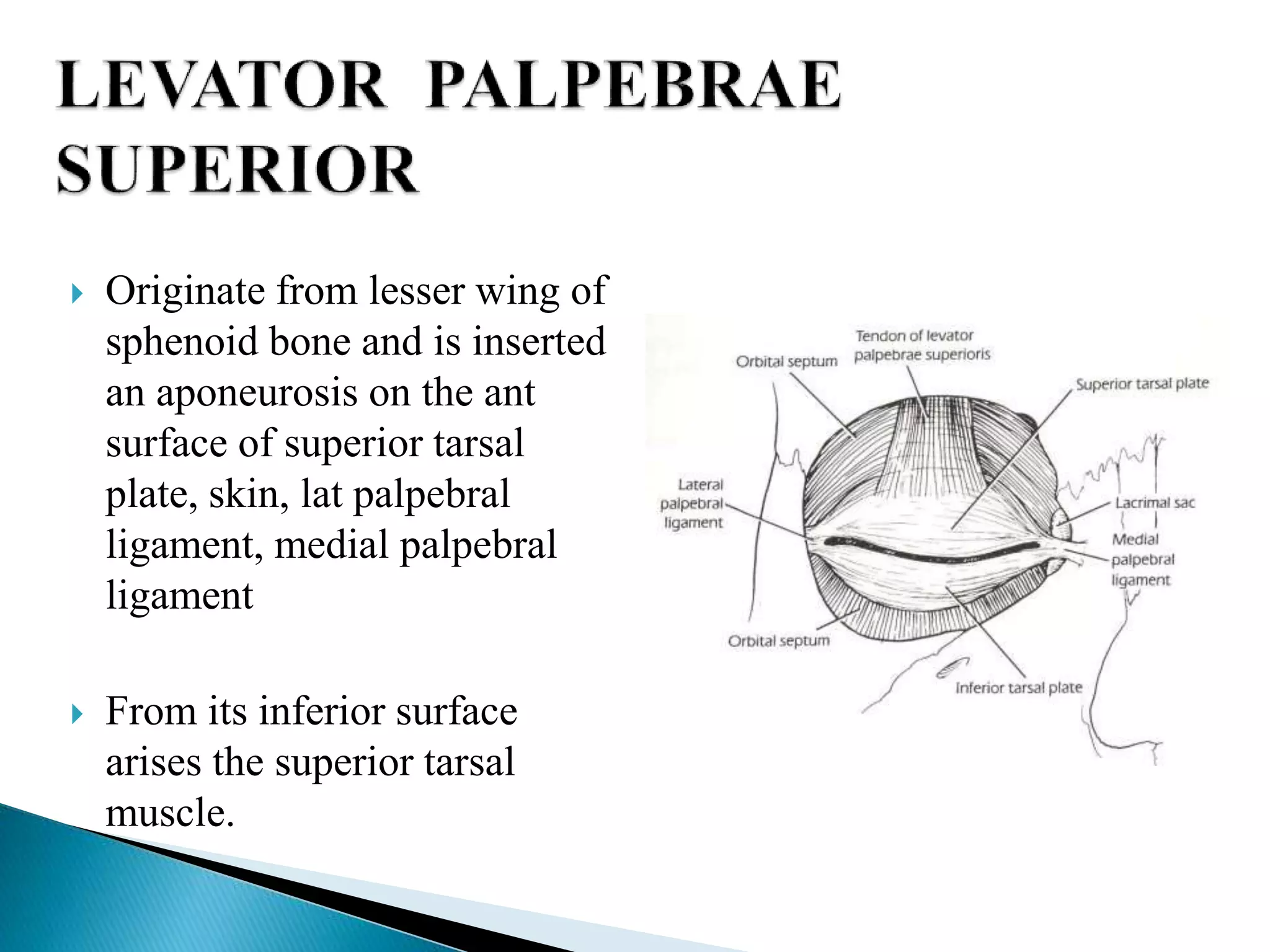
 Originate from lesser wing of
sphenoid bone and is inserted
an aponeurosis on the ant
surface of superior tarsal
plate, skin, lat palpebral
ligament, medial palpebral
ligament
 From its inferior surface
arises the superior tarsal
muscle.
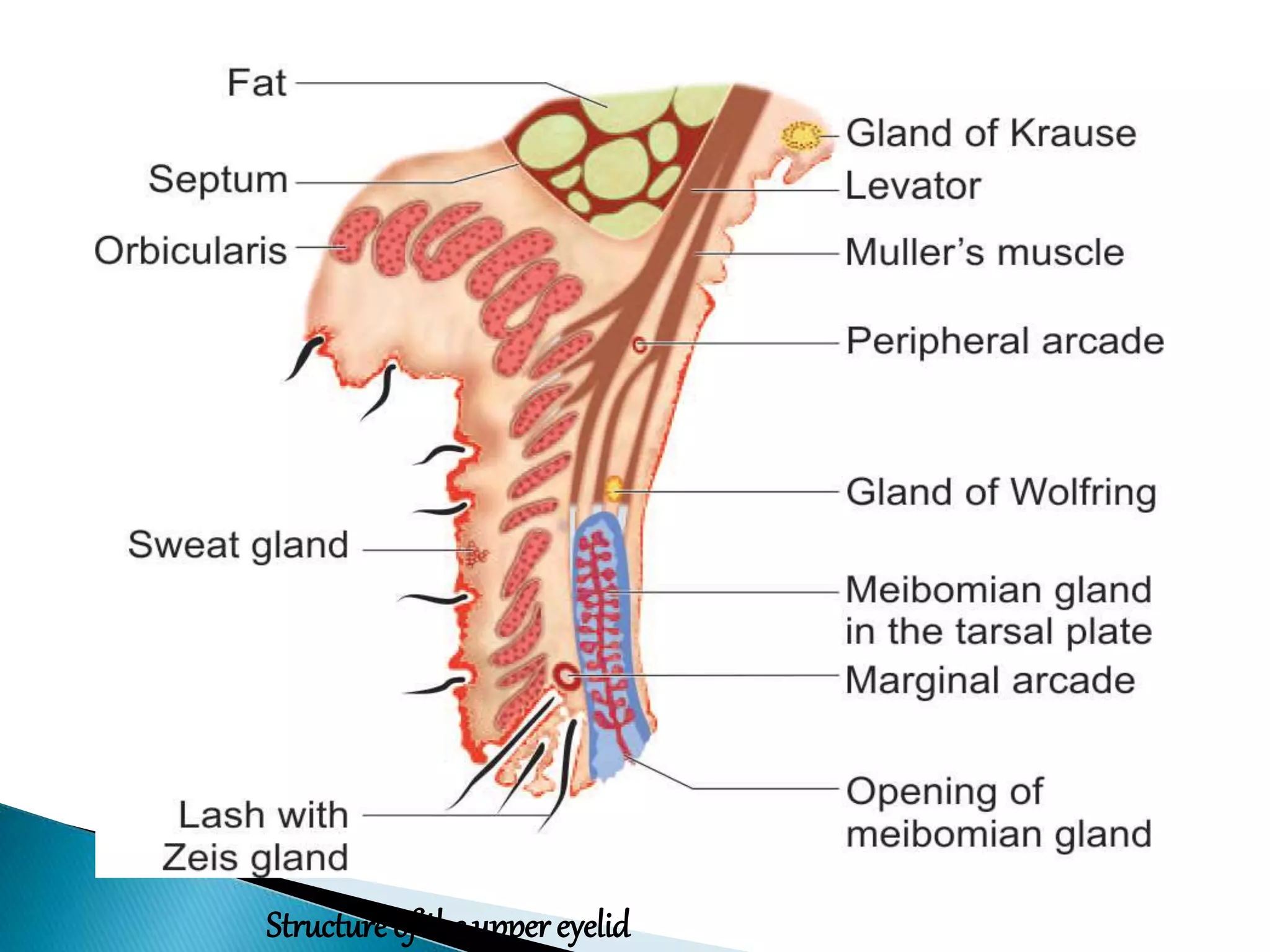
Structure of the upper eyelid
1. Meibomian glands. also known as tarsal glands and are present in
the stroma of tarsal plate arranged vertically.
 30–40 in the upper lid and about 20–30 in the lower lid.
 are modified sebaceous glands.
 Their ducts open at the lid margin.
 Their secretion constitutes the oily layer of tear film.
2. Glands of Zeis. These are also sebaceous glands which open into
the follicles of eyelashes.
3. Glands of Moll. These are modified sweat glands situated near the
hair follicle. They open into the hair follicles or into the ducts of Zeis
glands. They do not open directly onto the skin surface as elsewhere.
 4. Accessory lacrimal glands of Wolfring.
near the upper border of the tarsal plate.
 Sebaceous glands are located in the caruncle and within
eyebrow hairs. Tiny sebaceous glands are associated with the
thin (vellus) hairs covering periocular skin.
 Eccrine sweat glands are distributed throughout eyelid skin
and are not confined to the lid margin, in contrast to glands of Moll.
• Pilosebaceous units comprise hair follicles and their sebaceous
glands
Glands of eyelids
Glands Tear Film Layer Location
of glands
 Meibomian gland Oily layer Tarsal
plate
 Glands of Zei’s Oily layer Eyelashes
 Glands of Wolfring Aqueous layer Tarsal plate
 Glands of Krause Aqueous layer Fornix
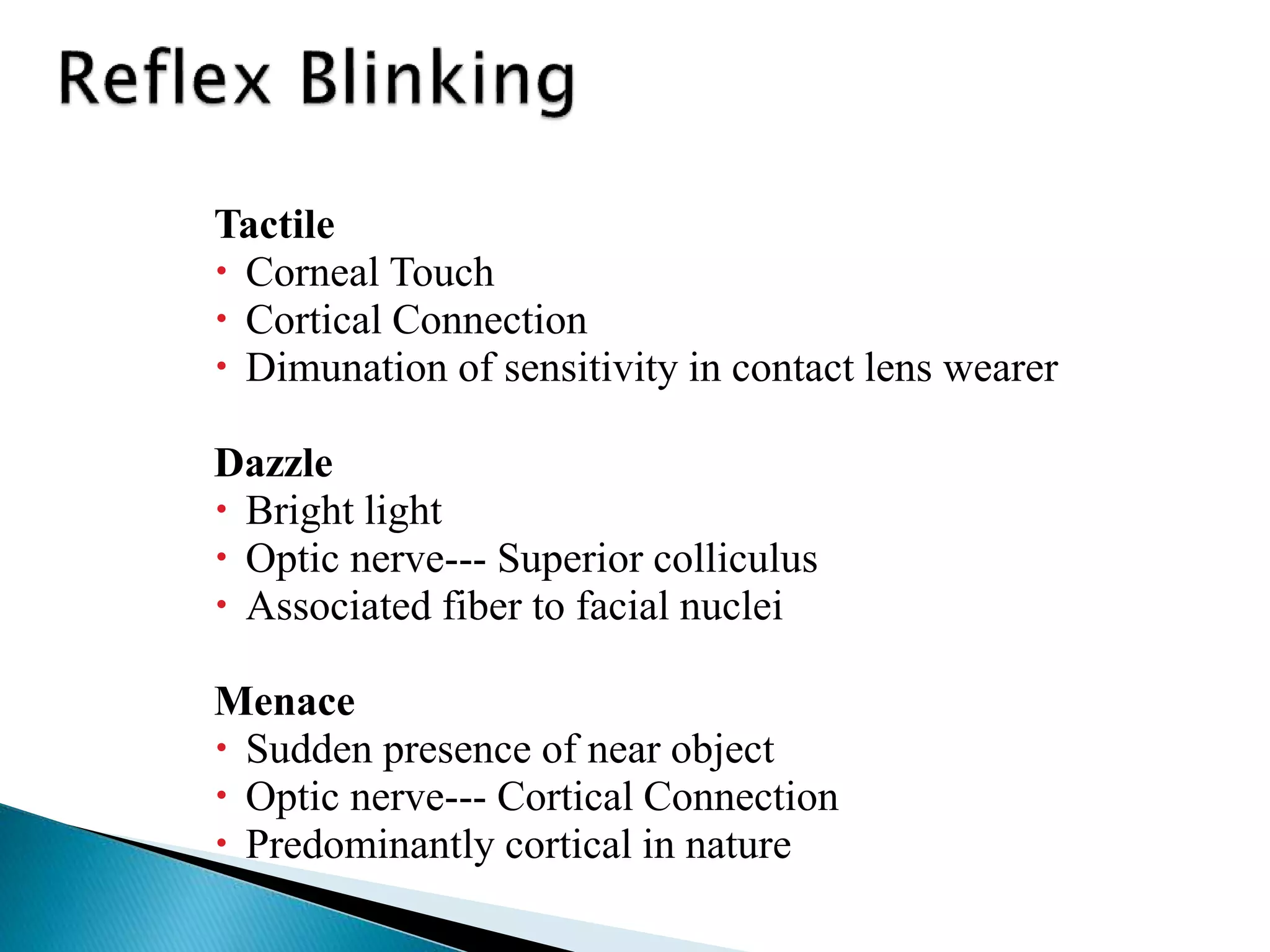
There are two main types of blinking
 Reflex blinking
 Spontaneous Blinking
Tactile
 Corneal Touch
 Cortical Connection
 Dimunation of sensitivity in contact lens wearer
Dazzle
 Bright light
 Optic nerve--- Superior colliculus
 Associated fiber to facial nuclei
Menace
 Sudden presence of near object
 Optic nerve--- Cortical Connection
 Predominantly cortical in nature
◦ Occurs at regular basis without an apparent external stimuli.
◦ Mechanics facilitates the drainage of tear film.
◦ Present in blind as no retinal stimuli are required.
 Simultaneous forcible contraction of orbicularis oculi.
 Forcible closure of the lids.
 Its role in surgical procedures.
 Anterior segment injury.
Arteries of the lids (medial and lateral palpebral) form marginal
arterial arcades which lie in the submuscular plane in front of the
tarsal plate, 2 mm away from the lid margin, in the upper lid and
about 4 mm away in the lower lid.
In the upper lid another arcade (superior arterial arcade) is
formed which lies near the upper border of the tarsal plate.
Branches go forward and backward from these arches to supply
various structures.
Veins. arranged in two plexuses:
a, posttarsal which drains into ophthalmic veins and
b. pretarsal opening into subcutaneous veins.
Lymphatics. arranged in two sets: the pre-tarsal and
the post-tarsal.
Those from lateral half of the lids drain into preauricular lymph
nodes and those from the medial half of the eyelids drain into
submandibular lymph nodes.
Motor nerves are facial (which supplies orbicularis
muscle), oculomotor (which supplies LPS muscle) and
sympathetic fibres (which supply the Muller’s muscle).
Sensory nerve supply is derived from branches of the
trigeminal nerve such as lacrimal, supraorbital and
supratrochlear nerves for upper lid; and the infraorbital
nerve
1.protect the eye from injury. Reflex closure of the lids
occurs when the conjunctiva, cornea or eyelashes are
touched, which is called the conjunctival or corneal reflex.
2. Regular blinking spreads tears and meibomian gland’s
secretions over the cornea which prevents drying of the
cornea and conjunctiva.
3. The eyes close when the orbicularis oculi muscle
contracts.
The eyelids open when the levator palpebrae muscle
contracts.
eyelid anatomy slideshare

eyelid anatomy slideshare

  • 1.
  • 2.
     The eyelidsare mobile tissue curtains placed in front of the eyeballs .  Act as shutters protecting the eyes from injuries and excessive light.  perform an important function of spreading the tear film over the cornea and conjunctiva and also help in drainage of tears by lacrimal pump system.
  • 3.
    The tissues ofthe lids from anterior (cutancous) to posterior conjunctival aspects as follows:-  skin  subcutaneous areolar tissue  layer of striated muscle (orbicularis oculi)  sub muscular areolar tissue  layer of non striated muscle  the fibrous layer—including tarsal plate  conjunctiva
  • 4.
    The skin consistsof the epidermis, dermis and related structures (adnexa). 1,Epidermis The epidermis is comprised of four layers of keratin- producing cells (keratinocytes). contains melanocytes, Langerhans cells and Merkel cells. The layers of the epidermis around the eye are described below; cells migrate superficially, undergoing maturation and differentiation through successive layers.
  • 5.
     Keratin layer(stratum corneum or horny layer) consists of flat cells devoid of nuclei.  Granular cell layer (stratum granulosum) typically consists of one or two layers of flattened cells containing kerato-hyaline granules.  Prickle cell layer (stratum spinosum) is approximately five cells deep. polygonal in cross-section and have abundant eosinophilic cytoplasm. Their free borders are united by spiny-appearing desmosomes (cellular junctions).  Basal cell layer (stratum basale) comprises a single row of columnar-shaped proliferating cells containing melanin derived from adjacent melanocytes.
  • 6.
    2,Dermis:- much thickerthan the epidermis.  composed of connective tissue and contains blood vessels, lymphatics and nerve fibres in addition to fibroblasts, macrophages and mast cells; upward dermal extensions (papillae) interdigitate with downward epidermal projections (rete ridges).  In the eyelid the dermis lies on the orbicularis muscle.  Adnexa lie deep in the dermis or within the tarsal plates.
  • 8.
    Parts of eyelid.Each eyelid is divided by a horizontal furrow (sulcus) into an orbital and tarsal part. Position of lids. When the eye is open, the upper lid covers about one-sixth of the cornea and the lower lid just touches the limbus. Canthi. The two lids meet each other at medial and lateral angles (or outer and inner canthi). Palpebral aperture. It is the elliptical space between the upper and the lower lid. When the eyes are open it measures about 10–11 mm vertically in the centre and about 28–30 mm horizontally.
  • 10.
    Lid margin. 2mmthick and 30mm long and contains eyelashes and just posterior to it are the meibomian glands orifices.  The medial, lacrimal portion is rounded and devoid of lashes or glands.  The lateral, ciliary portion consists of a rounded anterior border, a sharp posterior border (placed against the globe) and an inter- marginal strip (between the two borders).  The grey line (which marks junction of skin and conjunctiva) divides the inter-marginal strip into an anterior strip bearing 2–3 rows of lashes and a posterior strip on which openings of meibomian glands are arranged in a row.  The splitting of the eyelids when required in operations is done at the level of grey line.
  • 11.
     100 inupper lid  50 in lower lid  Originate from anterior lamella in two or three irregular rows.  The upper lid lashes are directed upward, and outwards  The lower lid lashed are directed downward and outwards
  • 13.
     It isa loose connective tissue containing no fat.  It is absent at medial and lateral angles, ciliary margin and at sulci.
  • 14.
    THE ORIBICULARIS OCULI PartPosition Function  Orbital Surrounds the orbital Forced lid closure rim  Preseptal In front of the orbital pull lacrimal fascia Septum laterally and create a relative vacuum in lacrimal sac.  Pretarsal in front of the tarsal Close lid and pull Plate lacrimal puncta medially
  • 16.
     Attached tothe orbital margin.  Lies post to the medial palpebral ligament and lateral palpebral raphe medially and laterally.  With in the lids it is thickened to form tarsal plates—embedded in it are tarsal glands.
  • 18.
     The medialpalpebral ligament attaches the medial end of tarsi to lacrimal crest and frontal process of maxilla.  The lateral palpebral ligament attach the lateral end of tarsi to margin tubercle on marginal tubercle of zygomatic bone.
  • 19.
     The upperlid retractors consist of levator palpebra superior muscle and its aponeurosis and the superior tarsal muscle (Muller’s muscle)  The lower lid retractors arise from the sheat of the inferior rectus muscle and are similarly composed of aponeurosis and the inferior tarsal muscle
  • 20.
     Originate fromlesser wing of sphenoid bone and is inserted an aponeurosis on the ant surface of superior tarsal plate, skin, lat palpebral ligament, medial palpebral ligament  From its inferior surface arises the superior tarsal muscle.
  • 21.
    Structure of theupper eyelid
  • 22.
    1. Meibomian glands.also known as tarsal glands and are present in the stroma of tarsal plate arranged vertically.  30–40 in the upper lid and about 20–30 in the lower lid.  are modified sebaceous glands.  Their ducts open at the lid margin.  Their secretion constitutes the oily layer of tear film. 2. Glands of Zeis. These are also sebaceous glands which open into the follicles of eyelashes. 3. Glands of Moll. These are modified sweat glands situated near the hair follicle. They open into the hair follicles or into the ducts of Zeis glands. They do not open directly onto the skin surface as elsewhere.
  • 23.
     4. Accessorylacrimal glands of Wolfring. near the upper border of the tarsal plate.  Sebaceous glands are located in the caruncle and within eyebrow hairs. Tiny sebaceous glands are associated with the thin (vellus) hairs covering periocular skin.  Eccrine sweat glands are distributed throughout eyelid skin and are not confined to the lid margin, in contrast to glands of Moll. • Pilosebaceous units comprise hair follicles and their sebaceous glands
  • 24.
  • 25.
    Glands Tear FilmLayer Location of glands  Meibomian gland Oily layer Tarsal plate  Glands of Zei’s Oily layer Eyelashes  Glands of Wolfring Aqueous layer Tarsal plate  Glands of Krause Aqueous layer Fornix
  • 26.
    There are twomain types of blinking  Reflex blinking  Spontaneous Blinking
  • 27.
    Tactile  Corneal Touch Cortical Connection  Dimunation of sensitivity in contact lens wearer Dazzle  Bright light  Optic nerve--- Superior colliculus  Associated fiber to facial nuclei Menace  Sudden presence of near object  Optic nerve--- Cortical Connection  Predominantly cortical in nature
  • 28.
    ◦ Occurs atregular basis without an apparent external stimuli. ◦ Mechanics facilitates the drainage of tear film. ◦ Present in blind as no retinal stimuli are required.
  • 29.
     Simultaneous forciblecontraction of orbicularis oculi.  Forcible closure of the lids.  Its role in surgical procedures.  Anterior segment injury.
  • 30.
    Arteries of thelids (medial and lateral palpebral) form marginal arterial arcades which lie in the submuscular plane in front of the tarsal plate, 2 mm away from the lid margin, in the upper lid and about 4 mm away in the lower lid. In the upper lid another arcade (superior arterial arcade) is formed which lies near the upper border of the tarsal plate. Branches go forward and backward from these arches to supply various structures. Veins. arranged in two plexuses: a, posttarsal which drains into ophthalmic veins and b. pretarsal opening into subcutaneous veins. Lymphatics. arranged in two sets: the pre-tarsal and the post-tarsal. Those from lateral half of the lids drain into preauricular lymph nodes and those from the medial half of the eyelids drain into submandibular lymph nodes.
  • 31.
    Motor nerves arefacial (which supplies orbicularis muscle), oculomotor (which supplies LPS muscle) and sympathetic fibres (which supply the Muller’s muscle). Sensory nerve supply is derived from branches of the trigeminal nerve such as lacrimal, supraorbital and supratrochlear nerves for upper lid; and the infraorbital nerve
  • 32.
    1.protect the eyefrom injury. Reflex closure of the lids occurs when the conjunctiva, cornea or eyelashes are touched, which is called the conjunctival or corneal reflex. 2. Regular blinking spreads tears and meibomian gland’s secretions over the cornea which prevents drying of the cornea and conjunctiva. 3. The eyes close when the orbicularis oculi muscle contracts. The eyelids open when the levator palpebrae muscle contracts.