PARTH VORA
T.Y. B. OPTOM
 The tear film
constitutes Three
layers :-
 An
outermost lipid (oily)
layer
 An aqueous (watery)
layer that makes up
90% of the tear film
volume; and
 A mucin layer that
coats the corneal
surface.
 To form smooth optical surface on cornea.
 To keep the surface of cornea & conjunctiva
moist
 It serve as lubricant
 It transfer oxygen
 Provide antibacterial action
 Wash debris out
 It provides a pathway for WBC in case of
injury
Functions of lipid layer
 Retards evaporation of tear film
 Prevents the overflow of tears
Function of Aqueous Layer
 Flushes, buffers and lubricates the corneal
surface
 Delivers oxygen and other nutrients to the
corneal surface
 Wash out debris
 Delivers antibacterial enzymes and
antibodies such as lysozyme.
Functions of Mucin Layer
 Spreads tears over corneal surface.
 Protects the cornea against foreign
substances .
 Makes corneal surface smooth by filling
in surface irregularities.
 Secretion of tears
 Formation of tear film
 Retention & redistribution of tear film
 Displacement phenomenon
 Evaporation form of tear film
 Drying & breakup of tear film
 Dynamic events during blinking
 Elimination of tears
 Two types:-
 Basal and Reflex Secretion.
 Tears are continuously secreted through
out the day by Accessory lacrimal gland
basal secretion.
 The reflex tears is caused due to irritation of
a foreign particle or an external stimulus.
They are secreted by main lacrimal glands.
 The reflex tears attempt to wash out irritants
that may have come in contact with the eye.
 Lids surfacing cornea with thin layer of
mucus
 on this new surface aqueous component of
tear now spread spontaneously
 Then the superficial lipid layer spreads over
aqueous film, probably contributing to it’s
stability & retarding evaporation between
blink.
 Retained at a uniform thickness over the
corneal surface against gravitational force-
positioned vertically.
 Redistribution occurs in the form of
bringing of new tear fluid by way of
marginal strip where there is constant tear
flow.
 If with a finger the lower lid is carefully
displaced upwards over eyeball , the
particles in the film are seen to move up the
cornea.(IN SLE)
 Based on this , it has been concluded that
the cornea is covered by a film of certain
stability , compressibility and elasticity.
 All lipid films including wax esters &
cholesterol esters retard evaporation of
water.
 Important low humidity & turbulent air flow
near cornea like windy & arid climate.
 Evaporation estimated to be about 10% of
production rate 0.12 μl/min.(1.2μl/min
production)
 In the normal human eye the precorneal tear
film has a short lived stability.
 When blinking is present after time internal of
15-40 second tear film rupture & dry spot
appear on various part of cornea.
 Drying of corneal surface – not only because
of evaporation but also due to break up tear
film.
 Holly has described a mechanism of tear film
rupture – Holly & Lemp’s mechanism.
 Dry spots occur twice more in temporal side
than nasal side - nasal areas are more
protected against air currents & have
comparatively higher temperature.
 Tear film thins uniformly by evaporation
 When thinned out to some critical thickness,
significant number of lipid molecules begin
to be attracted by mucin layer & migrate down
 This migration enhanced if there is any
spontaneous local thinning
 After contamination of mucin layer by lipid
migration from top surface of tear film mucin
becomes hydrophobic & tear film rupture
 Blinking repair rupture by removing lipid
contaminant from mucin layer & restoring
thick layer
 As upper lid moves downwards, the
superficial layer is compressed.
 The compressed lipid layer has a thickness of
0.1 μm.
 The lipid contaminated mucus is rolled up in
a thread like shape and dragged into lower
fornix.
 When eye opens, lipids spread as a monolayer
against the upper eyelid.
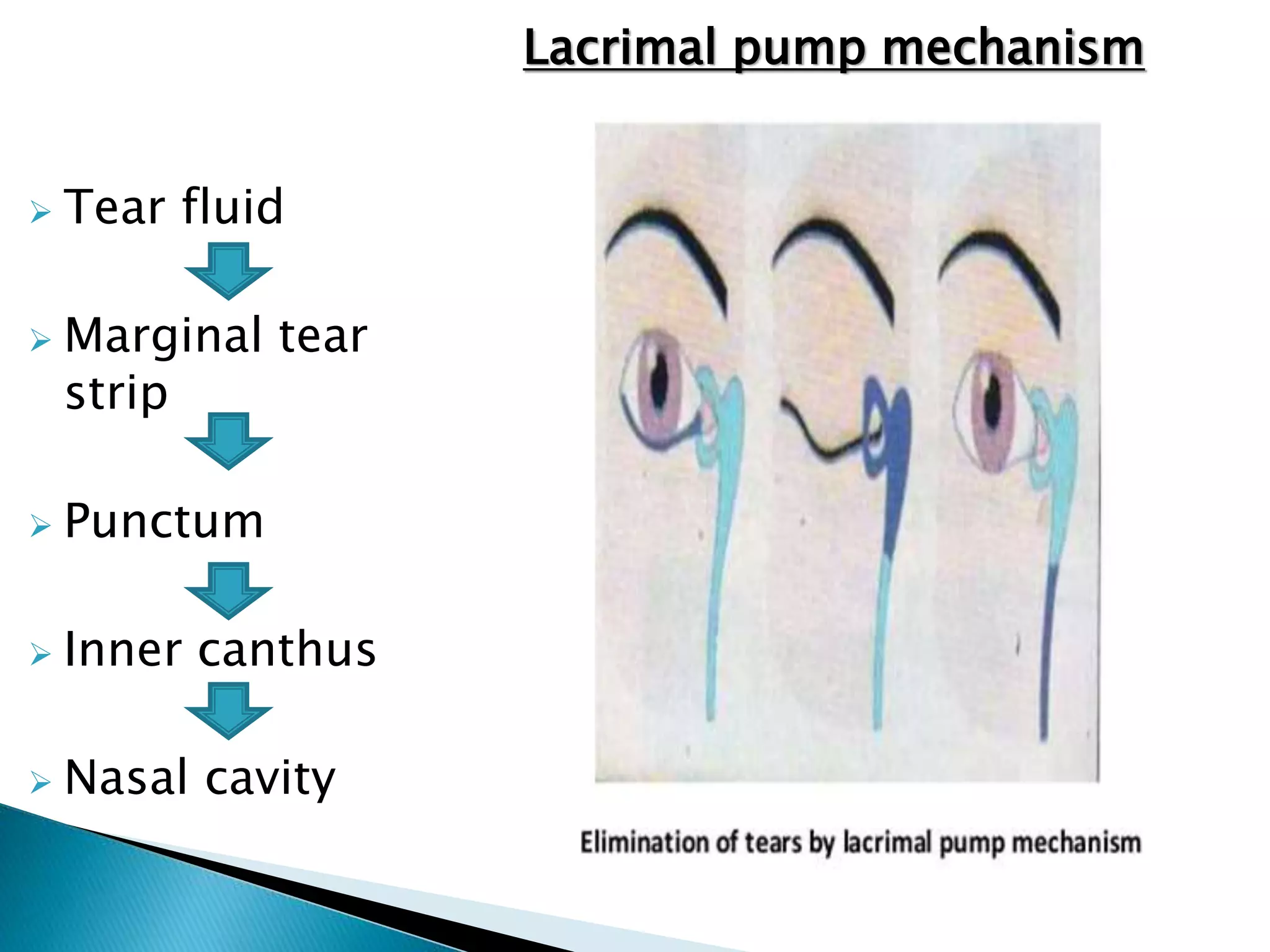
Fluid flows over preocular surface & reaches
ciliary margin of each eyelid and collects in
the inner canthus.
Fluid is drained by lacrimal passage into nasal
cavity [“active lacrimal pump mechanism”]
 Tear fluid
 Marginal tear
strip
 Punctum
 Inner canthus
 Nasal cavity
Lacrimal pump mechanism
Contraction of pretarsal fiber of orbicularis
Compress the punctum & shortens canaliculi
Fluid present in punctum & horizontal part of
canaliculi toward lacrimal sac
Contraction of preseptal fiber of orbicular pulls
lacrimal fascia & lacrimal wall laterally - opening
of lacrimal sac
Produce the negative pressure & draws tear into
lacrimal sac
Relaxation of pretarsal fibers of orbicularis
allows canaliculi to expand & reopen.
Draw the fluid through puncti into canaliculi.
Relaxation of preseptal fibers-lacrimal sac
collapse.
Expels the fluid downwards into open naso
lacrimal duct. (NLD)
After entering into NLD,influence of eyelid
movement on it’s further downward flow ends
Gravity help in downward flow
Air current movement within nose : Air current
passing (inward & outward)Include negative
pressure within NLD & draw fluid down into nose
Hasner’s valve present at lower end of the NLD
remain open till the pressure within nose is less
than NLD & allows fluid flow in to nose from NLD
From nose tears pass posteriorly with nasal mucus
secretion
 Anatomy and physiology – A.K. khurana – pg.
378 to 389
 www.wikipedia.com
 www.eyepedia.co.uk
 www.slideshare.com
anatomy And Physiology of tear film

anatomy And Physiology of tear film

  • 1.
  • 2.
     The tearfilm constitutes Three layers :-  An outermost lipid (oily) layer  An aqueous (watery) layer that makes up 90% of the tear film volume; and  A mucin layer that coats the corneal surface.
  • 3.
     To formsmooth optical surface on cornea.  To keep the surface of cornea & conjunctiva moist  It serve as lubricant  It transfer oxygen  Provide antibacterial action  Wash debris out  It provides a pathway for WBC in case of injury
  • 4.
    Functions of lipidlayer  Retards evaporation of tear film  Prevents the overflow of tears
  • 5.
    Function of AqueousLayer  Flushes, buffers and lubricates the corneal surface  Delivers oxygen and other nutrients to the corneal surface  Wash out debris  Delivers antibacterial enzymes and antibodies such as lysozyme.
  • 6.
    Functions of MucinLayer  Spreads tears over corneal surface.  Protects the cornea against foreign substances .  Makes corneal surface smooth by filling in surface irregularities.
  • 7.
     Secretion oftears  Formation of tear film  Retention & redistribution of tear film  Displacement phenomenon  Evaporation form of tear film  Drying & breakup of tear film  Dynamic events during blinking  Elimination of tears
  • 8.
     Two types:- Basal and Reflex Secretion.  Tears are continuously secreted through out the day by Accessory lacrimal gland basal secretion.  The reflex tears is caused due to irritation of a foreign particle or an external stimulus. They are secreted by main lacrimal glands.  The reflex tears attempt to wash out irritants that may have come in contact with the eye.
  • 9.
     Lids surfacingcornea with thin layer of mucus  on this new surface aqueous component of tear now spread spontaneously  Then the superficial lipid layer spreads over aqueous film, probably contributing to it’s stability & retarding evaporation between blink.
  • 10.
     Retained ata uniform thickness over the corneal surface against gravitational force- positioned vertically.  Redistribution occurs in the form of bringing of new tear fluid by way of marginal strip where there is constant tear flow.
  • 11.
     If witha finger the lower lid is carefully displaced upwards over eyeball , the particles in the film are seen to move up the cornea.(IN SLE)  Based on this , it has been concluded that the cornea is covered by a film of certain stability , compressibility and elasticity.
  • 12.
     All lipidfilms including wax esters & cholesterol esters retard evaporation of water.  Important low humidity & turbulent air flow near cornea like windy & arid climate.  Evaporation estimated to be about 10% of production rate 0.12 μl/min.(1.2μl/min production)
  • 13.
     In thenormal human eye the precorneal tear film has a short lived stability.  When blinking is present after time internal of 15-40 second tear film rupture & dry spot appear on various part of cornea.  Drying of corneal surface – not only because of evaporation but also due to break up tear film.
  • 14.
     Holly hasdescribed a mechanism of tear film rupture – Holly & Lemp’s mechanism.  Dry spots occur twice more in temporal side than nasal side - nasal areas are more protected against air currents & have comparatively higher temperature.
  • 15.
     Tear filmthins uniformly by evaporation  When thinned out to some critical thickness, significant number of lipid molecules begin to be attracted by mucin layer & migrate down  This migration enhanced if there is any spontaneous local thinning  After contamination of mucin layer by lipid migration from top surface of tear film mucin becomes hydrophobic & tear film rupture  Blinking repair rupture by removing lipid contaminant from mucin layer & restoring thick layer
  • 17.
     As upperlid moves downwards, the superficial layer is compressed.  The compressed lipid layer has a thickness of 0.1 μm.  The lipid contaminated mucus is rolled up in a thread like shape and dragged into lower fornix.  When eye opens, lipids spread as a monolayer against the upper eyelid.
  • 19.
    Fluid flows overpreocular surface & reaches ciliary margin of each eyelid and collects in the inner canthus. Fluid is drained by lacrimal passage into nasal cavity [“active lacrimal pump mechanism”]
  • 20.
     Tear fluid Marginal tear strip  Punctum  Inner canthus  Nasal cavity Lacrimal pump mechanism
  • 21.
    Contraction of pretarsalfiber of orbicularis Compress the punctum & shortens canaliculi Fluid present in punctum & horizontal part of canaliculi toward lacrimal sac Contraction of preseptal fiber of orbicular pulls lacrimal fascia & lacrimal wall laterally - opening of lacrimal sac Produce the negative pressure & draws tear into lacrimal sac
  • 22.
    Relaxation of pretarsalfibers of orbicularis allows canaliculi to expand & reopen. Draw the fluid through puncti into canaliculi. Relaxation of preseptal fibers-lacrimal sac collapse. Expels the fluid downwards into open naso lacrimal duct. (NLD)
  • 23.
    After entering intoNLD,influence of eyelid movement on it’s further downward flow ends Gravity help in downward flow Air current movement within nose : Air current passing (inward & outward)Include negative pressure within NLD & draw fluid down into nose Hasner’s valve present at lower end of the NLD remain open till the pressure within nose is less than NLD & allows fluid flow in to nose from NLD From nose tears pass posteriorly with nasal mucus secretion
  • 24.
     Anatomy andphysiology – A.K. khurana – pg. 378 to 389  www.wikipedia.com  www.eyepedia.co.uk  www.slideshare.com