Peripheral fundus & its disorders
Presented by Dr Rohit Rao
References
• Peripheral Ocular Fundus 3rd edition by
William L. Jones
• Ophthalmology 3rd edition.by Yanoff, Duker
• Clinical ophthalmology 7th Edition - Jack
Kanski
• Wolff's Anatomy of the Eye and Orbit 8th by
Bron, Tripathi.
• Retina by Stephen.J .Ryan
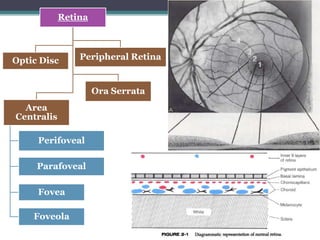
Retina

Optic Disc

Peripheral Retina

Ora Serrata
Area
Centralis
Perifoveal
Parafoveal
Fovea
Foveola
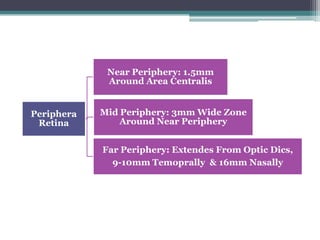
Near Periphery: 1.5mm
Around Area Centralis

Periphera
Retina

Mid Periphery: 3mm Wide Zone
Around Near Periphery

Far Periphery: Extendes From Optic Dics,
9-10mm Temoprally & 16mm Nasally
N

T
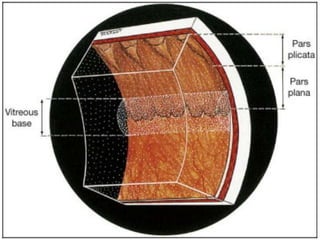
Pars plana
• Ciliary body starts 1 mm from the limbus and
extends posteriorly for about 6 mm.
• First 2 mm pars plicata and 4 mm pars plana.
• Width is about 4.0-4.5 mm.
Vitreous base
• Vitreous base is a 3–4 mm wide zone straddling
the ora serrata.
• Vitreous is strongly attached at base, so that
following PVD, posterior hyaloids face remains
intact.
• Pre-existing retinal holes within the vitreous
base do not lead to RD.
• Severe blunt trauma may cause tearing of nonpigmented epithelium of pars plana & of retina.
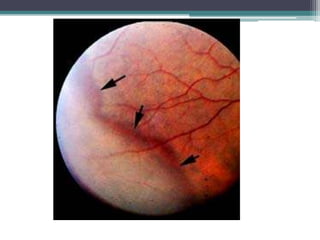
Ora Serrata
• Retina becomes opalescent and often is marked
by small rows of cystoid cavities.
• Extensive cystoid changes do not represent
pathology.
• Neural retina stops abruptly at ora serrata and is
continued by nonpigmented ciliary epithelium
• Pars plana is more deeply pigmented, so
choroidal pattern not seen.
0.7-0.8
mm

N

2.1 mm

7.0 mm

T
N

6.0 mm

7.0 mm

7.0 mm

T
• Dentate processes are teeth-like extensions of
retina onto the pars plana.
• Oral bays are the scalloped edges of the pars
plana epithelium in between the dentate
processes.
• Enclosed oral bay is a small island of pars
plana surrounded by retina as a result of
meeting of two adjacent dentate processes.
▫ Not be mistaken for a retinal hole

• Granular tissue characterized by multiple
white opacities within the vitreous base
▫ Can be mistaken for small peripheral opercula.
Enclosed
oral bay

Granular
tissue
Meridional fold
• Small radial fold of thickened retinal tissue in line
with a dentate process,
• It bigns at ora serrata and runs posteriorly &
perpendicularly to it in a meridional fashion
• Superonasal quadrant .
• Small retinal hole at its apex
• Found in approximately 20% of all eyes
• Meridional complex is composed of an enlarged
dentate and ciliary process associated with a
meridional fold
• Vitreous traction on meridional folds and
complexes may result in the formation of retinal
breaks.
• Meridional folds are not a common cause of
RD, may be because these are found at vitreous
base.
• Because of anterior location , cryopexy is
Pars plana cyst
• Pars plana cysts are clear cystoid spaces between the
pigmented and nonpigmented epithelia.
• Scleral depression
• Fluid contains hyaluronic acid.
• Mostly acquired; few are congenital.
• idiopathic or secondary to ocular disease.
▫ Retinal detachment, may be the result of traction by
the shrinking vitreous base.
▫ Posterior uveitis.
▫ Multiple myeloma
Congenital Hypertrophy of the
Retinal Pigment Epithelium
• Common benign lesion.
• Congenital and not a degenerative condition.
• Flat round or oval lesion, well defined, dark grey
or black in colour and up to three disc diameters
in size.
• Outer retina change and does not affect the
vitreo-retinal interface; so does not predispose
to RD.
• Can lose pigment over time
• When occur in groups, known as bear
track, Familial Adenomatous Polyposis.
Pavingstone(Cobblestone degeneration
or Chorioretinal Atrophy)
• 25% of the population
• Well defined yellow white patches between the
equator and the ora serrata.
• Absence of the outer layers of the retina, in
particular the choroid, which permits an
uninterrupted view of the sclera.
• Congenital and not be considered a
degeneration.
• No predisposition to break formation
Microcystoid degeneration
• Tiny vesicles with indistinct boundaries.
• Always starts adjacent to ora serrata and extends
circumferentially and posteriorly with a smooth
undulating posterior border.
• Present in all adult eyes,
• Increasing in severity with age
• Although it may give rise to retinoschisis.
• Do not give rise to RD
Honeycomb (reticular) degeneration
• Age-related change
• Fine network of
perivascular
pigmentation which
may extend posterior
to equator.
• Caused by RPE
degeneration
• More prominent in
nasal quadrant
Snowflake Vitreoretinal Degeneration
• Snowflake vitreoretinal degeneration appears as
tiny yellow-white spots in the far peripheral
retina
• Superior temporal quadrant
• Lattice degeneration
• Vitreous shows fibrillar degeneration &
liquefaction.
Lattice degeneration
•
•
•
•
•
•
•
•
•
•

An Area with Absence of ILM
Overlying Area of Liquefied Vitreous
Condensation & Adherence of Vit Gel
Inner Retinal Layer Atrophy
More common superiorly
Arranged parallel to the ora serrata.
Incidence- 8% to 10%
RRD :: Lattice account for 20%
Symmetric and bilateral,
Horse shoe Tears &Atrophic holes
Complications
(A) Atypical
radial lattice
without
breaks;
(B) U-tears
(C) Linear tear
along
posterior
margin.
(D) multiple
small holes
within
islands of
lattice
Management of Lattice Degeneration
•
•
•
•

Lattice without Retinal Breaks - No Rx
Lattice with Atrophic Holes - No Rx
Lattice + Holes+ Sub clinical RD – Treat
Lattice+ Traction Tear - Treat : If Fellow eye has
RD,Strong Family History of RD,Aphakic Eyes
• Asymptomatic Traction Tear - No Rx
• Acute Symptomatic Tears - Treat in Phakics &
Aphakics
Vitreoretinal Tufts
• Small Peripheral Retinal Elevation
• Focal Vitreous Traction
• Operculated or flap tears when strong vitreous
traction is applied
• Rarely cause retinal detachments.
• Treatment is rarely indicated
• Cryopexy or photocoagulation.
Snailtrack degeneration
• Snailtrack degeneration is characterized by
sharply demarcated bands of tightly packed
‘snowflakes’ which give the peripheral retina a
white frost-like appearance.
• Longer than in lattice degeneration
• Overlying vitreous liquefaction.
Degenerative retinoschisis
• 5% of the population over the age of 20 years and
is particularly prevalent in hypermetropes.
• Bilateral
• Coalescence of cystic lesions
• Results in separation or splitting of the NSR into an
inner (vitreous) layer and an outer (choroidal).
• Typical retinoschisis split is in outer plexiform layer,
• Reticular retinoschisis, less common, splitting occurs
at level of NFL.
• Early retinoschisis seen in inferotemporal with a
smooth immobile elevation of retina.
• Progress circumferentially
• Snowflakes , sheathing or ‘silver-wiring’ of blood
vessels.
• Microaneurysms and small telangiectases ,
• Complications are very rare,
• Breaks, RD in the presence of PVD, Vitreous
haemorrhage
White with pressure
• Translucent grey appearance of the
retina, induced by indention.
• It does not move when indenter is moved.
• Normal eyes and may have abnormally strong
vitreous attachment.
• It is also observed along the posterior border of
islands of lattice degeneration, snailtrack
degeneration and the outer layer of acquired
retinoschisis.
White without pressure
• Has the same appearance but is present without scleral
indentation.
• May be mistaken for a flat retinal hole.
• Giant tears occasionally develop along the posterior
border of ‘white without pressure’.
• For this reason, if ‘white without pressure’ is found in the
fellow eye of a patient with a spontaneous giant retinal
tear, prophylactic therapy should be performed.
• It is advisable to treat all fellow eyes of non-traumatic
giant retinal tears prophylactically by 360° cryotherapy
or indirect argon laser photocoagulation, irrespective of
the presence of ‘white without pressure’, if they have not
developed a PVD.
TREATMENT
• Upon the discovery of a retinal break, the initial decision
is whether the benefits of treatment (to prevent retinal
detachment) outweigh the risks and cost of treatment

• The factors under consideration in each case include
▫
▫
▫
▫
▫
▫

Presence or absence of symptoms;
Age and systemic health of the patient;
Refractive error of the eye;
Location, age, type, and size of the break;
Status of the fellow eye;
Whether the patient is aphakic, pseudophakic, or will soon
undergo cataract surgery
• Retinopexy
• Cryopexy and laser photocoagulation.
• Cryotherapy
▫ Delivered transconjunctivally.
▫ It destroys the choriocapillaris, RPE, and outer retina
to provide a chorioretinal adhesion
▫ It is not immediate; 1 week for partial adhesion and up
to 3 weeks for the complete.

• Laser photocoagulation
▫ Argon green, argon blue-green, krypton red, or diode
laser.

▫ Slit lamp and the indirect ophthalmoscope.
▫ Instant, but maximal adhesion occurs 7–10 days later.
• Cryopexy has the advantage of not requiring
clear media
• In general, retinal cryopexy and indirect
ophthalmoscopic laser photocoagulation are
preferred for anterior retinal breaks
• Similarly, posterior breaks managed with the
slit lamp or an indirect laser delivery system.
• Retinal tear with persistent traction and
recurrent vitreous Hemorrhage requires scleral
buckling or vitrectomy
Cryopexy
• Indirect ophthalmoscopic visualization,
• Cryoprobe is placed on the conjunctiva that overlies
the break until the retina adjacent to the tear
becomes gray-white.
• Approximately 2 mm of retinal whitening around
the entire break
• Multiple applications are placed until the break is
surrounded completely with confluent treatment.
• Do not to treat the choroid and RPE directly beneath
the break, can lead to macular pucker and
proliferative vitreoretinopathy.
Photocoagulation
• Goldmann three-mirror lens or panfundoscope lens
with the slit-lamp delivery system.
• Tear should be surrounded completely by three to
four rows of laser burns.
• Settings are 200–500 mm spot size and 0.1–0.2
seconds
• Indirect laser delivery system can also be used
• Advantage is simultaneous scleral depression
allows treatment of anterior tears and even dialysis.
Thank you

Peripheral fundus & its disorders

  • 1.
    Peripheral fundus &its disorders Presented by Dr Rohit Rao
  • 2.
    References • Peripheral OcularFundus 3rd edition by William L. Jones • Ophthalmology 3rd edition.by Yanoff, Duker • Clinical ophthalmology 7th Edition - Jack Kanski • Wolff's Anatomy of the Eye and Orbit 8th by Bron, Tripathi. • Retina by Stephen.J .Ryan
  • 3.
    Retina Optic Disc Peripheral Retina OraSerrata Area Centralis Perifoveal Parafoveal Fovea Foveola
  • 4.
    Near Periphery: 1.5mm AroundArea Centralis Periphera Retina Mid Periphery: 3mm Wide Zone Around Near Periphery Far Periphery: Extendes From Optic Dics, 9-10mm Temoprally & 16mm Nasally
  • 5.
  • 6.
    Pars plana • Ciliarybody starts 1 mm from the limbus and extends posteriorly for about 6 mm. • First 2 mm pars plicata and 4 mm pars plana. • Width is about 4.0-4.5 mm.
  • 7.
    Vitreous base • Vitreousbase is a 3–4 mm wide zone straddling the ora serrata. • Vitreous is strongly attached at base, so that following PVD, posterior hyaloids face remains intact. • Pre-existing retinal holes within the vitreous base do not lead to RD. • Severe blunt trauma may cause tearing of nonpigmented epithelium of pars plana & of retina.
  • 9.
    Ora Serrata • Retinabecomes opalescent and often is marked by small rows of cystoid cavities. • Extensive cystoid changes do not represent pathology. • Neural retina stops abruptly at ora serrata and is continued by nonpigmented ciliary epithelium • Pars plana is more deeply pigmented, so choroidal pattern not seen.
  • 11.
  • 12.
    • Dentate processesare teeth-like extensions of retina onto the pars plana. • Oral bays are the scalloped edges of the pars plana epithelium in between the dentate processes. • Enclosed oral bay is a small island of pars plana surrounded by retina as a result of meeting of two adjacent dentate processes. ▫ Not be mistaken for a retinal hole • Granular tissue characterized by multiple white opacities within the vitreous base ▫ Can be mistaken for small peripheral opercula.
  • 13.
  • 14.
    Meridional fold • Smallradial fold of thickened retinal tissue in line with a dentate process, • It bigns at ora serrata and runs posteriorly & perpendicularly to it in a meridional fashion • Superonasal quadrant . • Small retinal hole at its apex • Found in approximately 20% of all eyes • Meridional complex is composed of an enlarged dentate and ciliary process associated with a meridional fold
  • 15.
    • Vitreous tractionon meridional folds and complexes may result in the formation of retinal breaks. • Meridional folds are not a common cause of RD, may be because these are found at vitreous base. • Because of anterior location , cryopexy is
  • 17.
    Pars plana cyst •Pars plana cysts are clear cystoid spaces between the pigmented and nonpigmented epithelia. • Scleral depression • Fluid contains hyaluronic acid. • Mostly acquired; few are congenital. • idiopathic or secondary to ocular disease. ▫ Retinal detachment, may be the result of traction by the shrinking vitreous base. ▫ Posterior uveitis. ▫ Multiple myeloma
  • 19.
    Congenital Hypertrophy ofthe Retinal Pigment Epithelium • Common benign lesion. • Congenital and not a degenerative condition. • Flat round or oval lesion, well defined, dark grey or black in colour and up to three disc diameters in size. • Outer retina change and does not affect the vitreo-retinal interface; so does not predispose to RD. • Can lose pigment over time
  • 20.
    • When occurin groups, known as bear track, Familial Adenomatous Polyposis.
  • 23.
    Pavingstone(Cobblestone degeneration or ChorioretinalAtrophy) • 25% of the population • Well defined yellow white patches between the equator and the ora serrata. • Absence of the outer layers of the retina, in particular the choroid, which permits an uninterrupted view of the sclera. • Congenital and not be considered a degeneration. • No predisposition to break formation
  • 26.
    Microcystoid degeneration • Tinyvesicles with indistinct boundaries. • Always starts adjacent to ora serrata and extends circumferentially and posteriorly with a smooth undulating posterior border. • Present in all adult eyes, • Increasing in severity with age • Although it may give rise to retinoschisis. • Do not give rise to RD
  • 28.
    Honeycomb (reticular) degeneration •Age-related change • Fine network of perivascular pigmentation which may extend posterior to equator. • Caused by RPE degeneration • More prominent in nasal quadrant
  • 29.
    Snowflake Vitreoretinal Degeneration •Snowflake vitreoretinal degeneration appears as tiny yellow-white spots in the far peripheral retina • Superior temporal quadrant • Lattice degeneration • Vitreous shows fibrillar degeneration & liquefaction.
  • 31.
    Lattice degeneration • • • • • • • • • • An Areawith Absence of ILM Overlying Area of Liquefied Vitreous Condensation & Adherence of Vit Gel Inner Retinal Layer Atrophy More common superiorly Arranged parallel to the ora serrata. Incidence- 8% to 10% RRD :: Lattice account for 20% Symmetric and bilateral, Horse shoe Tears &Atrophic holes
  • 34.
    Complications (A) Atypical radial lattice without breaks; (B)U-tears (C) Linear tear along posterior margin. (D) multiple small holes within islands of lattice
  • 35.
    Management of LatticeDegeneration • • • • Lattice without Retinal Breaks - No Rx Lattice with Atrophic Holes - No Rx Lattice + Holes+ Sub clinical RD – Treat Lattice+ Traction Tear - Treat : If Fellow eye has RD,Strong Family History of RD,Aphakic Eyes • Asymptomatic Traction Tear - No Rx • Acute Symptomatic Tears - Treat in Phakics & Aphakics
  • 36.
    Vitreoretinal Tufts • SmallPeripheral Retinal Elevation • Focal Vitreous Traction • Operculated or flap tears when strong vitreous traction is applied • Rarely cause retinal detachments. • Treatment is rarely indicated • Cryopexy or photocoagulation.
  • 38.
    Snailtrack degeneration • Snailtrackdegeneration is characterized by sharply demarcated bands of tightly packed ‘snowflakes’ which give the peripheral retina a white frost-like appearance. • Longer than in lattice degeneration • Overlying vitreous liquefaction.
  • 40.
    Degenerative retinoschisis • 5%of the population over the age of 20 years and is particularly prevalent in hypermetropes. • Bilateral • Coalescence of cystic lesions • Results in separation or splitting of the NSR into an inner (vitreous) layer and an outer (choroidal).
  • 41.
    • Typical retinoschisissplit is in outer plexiform layer, • Reticular retinoschisis, less common, splitting occurs at level of NFL. • Early retinoschisis seen in inferotemporal with a smooth immobile elevation of retina. • Progress circumferentially • Snowflakes , sheathing or ‘silver-wiring’ of blood vessels. • Microaneurysms and small telangiectases , • Complications are very rare, • Breaks, RD in the presence of PVD, Vitreous haemorrhage
  • 44.
    White with pressure •Translucent grey appearance of the retina, induced by indention. • It does not move when indenter is moved. • Normal eyes and may have abnormally strong vitreous attachment. • It is also observed along the posterior border of islands of lattice degeneration, snailtrack degeneration and the outer layer of acquired retinoschisis.
  • 46.
    White without pressure •Has the same appearance but is present without scleral indentation. • May be mistaken for a flat retinal hole. • Giant tears occasionally develop along the posterior border of ‘white without pressure’. • For this reason, if ‘white without pressure’ is found in the fellow eye of a patient with a spontaneous giant retinal tear, prophylactic therapy should be performed. • It is advisable to treat all fellow eyes of non-traumatic giant retinal tears prophylactically by 360° cryotherapy or indirect argon laser photocoagulation, irrespective of the presence of ‘white without pressure’, if they have not developed a PVD.
  • 48.
    TREATMENT • Upon thediscovery of a retinal break, the initial decision is whether the benefits of treatment (to prevent retinal detachment) outweigh the risks and cost of treatment • The factors under consideration in each case include ▫ ▫ ▫ ▫ ▫ ▫ Presence or absence of symptoms; Age and systemic health of the patient; Refractive error of the eye; Location, age, type, and size of the break; Status of the fellow eye; Whether the patient is aphakic, pseudophakic, or will soon undergo cataract surgery
  • 49.
    • Retinopexy • Cryopexyand laser photocoagulation. • Cryotherapy ▫ Delivered transconjunctivally. ▫ It destroys the choriocapillaris, RPE, and outer retina to provide a chorioretinal adhesion ▫ It is not immediate; 1 week for partial adhesion and up to 3 weeks for the complete. • Laser photocoagulation ▫ Argon green, argon blue-green, krypton red, or diode laser. ▫ Slit lamp and the indirect ophthalmoscope. ▫ Instant, but maximal adhesion occurs 7–10 days later.
  • 50.
    • Cryopexy hasthe advantage of not requiring clear media • In general, retinal cryopexy and indirect ophthalmoscopic laser photocoagulation are preferred for anterior retinal breaks • Similarly, posterior breaks managed with the slit lamp or an indirect laser delivery system. • Retinal tear with persistent traction and recurrent vitreous Hemorrhage requires scleral buckling or vitrectomy
  • 51.
    Cryopexy • Indirect ophthalmoscopicvisualization, • Cryoprobe is placed on the conjunctiva that overlies the break until the retina adjacent to the tear becomes gray-white. • Approximately 2 mm of retinal whitening around the entire break • Multiple applications are placed until the break is surrounded completely with confluent treatment. • Do not to treat the choroid and RPE directly beneath the break, can lead to macular pucker and proliferative vitreoretinopathy.
  • 52.
    Photocoagulation • Goldmann three-mirrorlens or panfundoscope lens with the slit-lamp delivery system. • Tear should be surrounded completely by three to four rows of laser burns. • Settings are 200–500 mm spot size and 0.1–0.2 seconds • Indirect laser delivery system can also be used • Advantage is simultaneous scleral depression allows treatment of anterior tears and even dialysis.
  • 53.