Krebs Cycle
Krebs Cycle
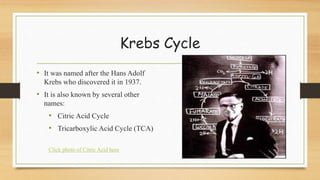
‱ It was named after the Hans Adolf
Krebs who discovered it in 1937.

‱ It is also known by several other
names:

‱ Citric Acid Cycle
‱ Tricarboxylic Acid Cycle (TCA)
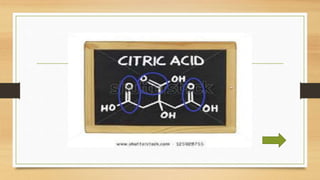
Click photo of Citric Acid here
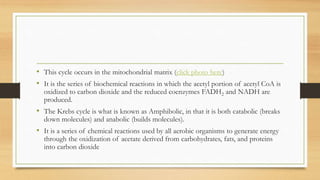
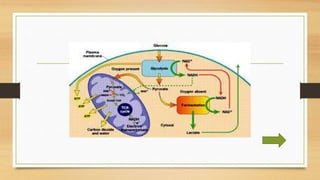
‱ This cycle occurs in the mitochondrial matrix (click photo here)
‱ It is the series of biochemical reactions in which the acetyl portion of acetyl CoA is
oxidized to carbon dioxide and the reduced coenzymes FADH2 and NADH are
produced.

‱ The Krebs cycle is what is known as Amphibolic, in that it is both catabolic (breaks
down molecules) and anabolic (builds molecules).

‱ It is a series of chemical reactions used by all aerobic organisms to generate energy

through the oxidization of acetate derived from carbohydrates, fats, and proteins
into carbon dioxide
‱ Each stage in the cycle (and in the link reaction—pyruvate conversion into
acetyl CoA) occurs twice for every glucose molecule that enters glycolysis,
because 2 pyruvate molecules are produced for each glucose.

‱ The eight steps of the citric acid cycle are a series of redox, dehydration,
hydration, and decarboxylation reactions.

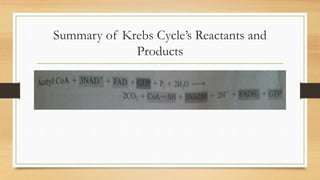
‱ Each turn of the cycle forms one GTP or ATP as well as three NADH

molecules and one FADH2 molecule, which will be used in further steps of
cellular respiration to produce ATP for the cell.
Unlocking of Terms
‱ Oxidation – removal of electrons from a molecule. This subsequently
lowers the energy content of a molecule.

‱ Most biological oxidations involve the loss of hydrogen atoms. This type of
oxidation is referred to as a dehydrogenation. The enzymes that catalyzes
these reactions are called dehydrogenases.

‱ Gain of oxygen atoms
‱ Reduction – opposite of oxidation. It is the addition of electrons to a
molecule.

‱ When a molecule is oxidized, the liberated hyrdride ions (H-) do not remain
free in the cell. In order to harness the energy of these electrons, they are
immediately transferred to another compound by coenzymes.

‱ Loss of oxygen atoms
‱ Phosphorylation - accomplished by transferring a phosphate group to ADP
‱ Decarboxylation – carbon chain is shortened by the removal of a carbon
atom (COO-) as CO2

‱ Isomerization - is the process by which one molecule is transformed into
another molecule which has exactly the same atoms

‱ Dehydration – removing of water molecules
‱ Hydration – addition of water molecules
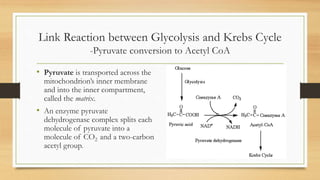
Link Reaction between Glycolysis and Krebs Cycle
-Pyruvate conversion to Acetyl CoA
‱ Pyruvate is transported across the
mitochondrion’s inner membrane
and into the inner compartment,
called the matrix.

‱ An enzyme pyruvate

dehydrogenase complex splits each
molecule of pyruvate into a
molecule of CO2 and a two-carbon
acetyl group.
‱ The CO2 diffuses out of the cell, and the acetyl group combines with a

molecule called coenzyme A (abbreviated as CoA). The product of this
reaction is acetyl-CoA.

‱ NAD+ is changed to its reduced form, NADH that will enter the Electron
Transport Chain.
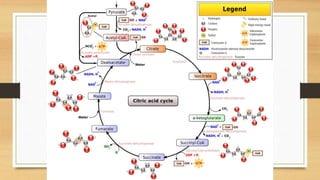
Reactions of the Citric Acid Cycle
Step 1: Formation of Citrate
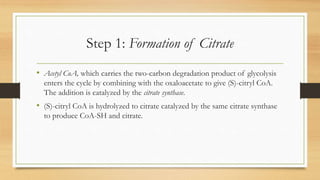
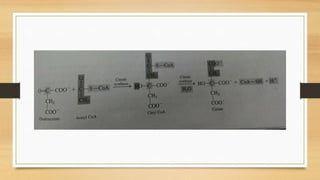
‱ Acetyl CoA, which carries the two-carbon degradation product of glycolysis
enters the cycle by combining with the oxaloacetate to give (S)-citryl CoA.
The addition is catalyzed by the citrate synthase.

‱ (S)-citryl CoA is hydrolyzed to citrate catalyzed by the same citrate synthase
to produce CoA-SH and citrate.
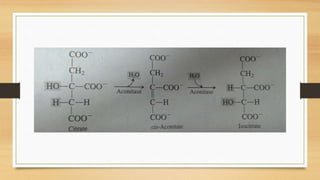
Step 2. Formation of Isocitrate
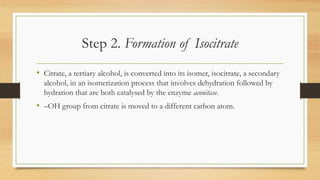
‱ Citrate, a tertiary alcohol, is converted into its isomer, isocitrate, a secondary
alcohol, in an isomerization process that involves dehydration followed by
hydration that are both catalysed by the enzyme aconitase.

‱ –OH group from citrate is moved to a different carbon atom.
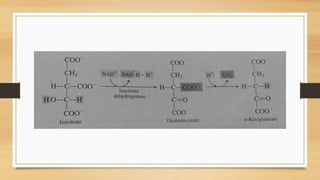
Step 3. Oxidation of Isocitrate and Formation of
CO2
‱ This step involves oxidation-reduction (the first of four redox reactions in the
Krebs Cycle) and decarboxylation.

‱ The reaction catalyzed by isocitrate dehydrogenase is complex: (1) Isocitrate is oxidized
to oxalosuccinate by NAD+, releasing 2 hydrogen atoms. (2) One hydrogen and two
electrons are transferred to NAD+ to form NADH; the remaining hydrogen ion is
released. (3) the oxalosuccinate remains bound to the enzyme and undergoes
decarboxylation, which produces the 5-carbon species α-ketoglutarate.

‱ This step yields the first molecules of CO2 and NADH in the cycle.
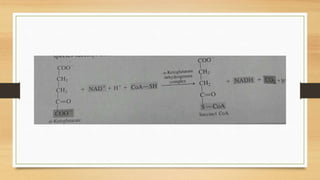
Step 4: Oxidation of α-ketoglutarate and Formation
of CO2
‱ This second redox reaction of the cycle involves one molecule each of
NAD+, CoA-SH, and α-ketoglurate.

‱ The catalyst is an aggregate of three enzymes called the α-ketoglutarate
dehydrogenase complex.

‱ Both redox reaction and decarboxylation occur.
‱ Three products: CO2, NADH, and the 4-carbon species succinyl CoA.
‱ This step yields the second molecule of CO2 and NADH in the cycle.
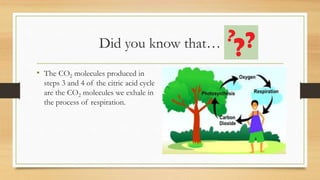
Did you know that

‱ The CO2 molecules produced in

steps 3 and 4 of the citric acid cycle
are the CO2 molecules we exhale in
the process of respiration.
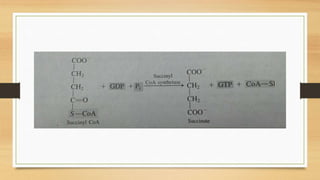
Step 5: Thioester bond cleavage in Succinyl CoA and
Phosphorylation of GDP
‱ Two molecules react with succinyl CoA—a molecule of GDP (similar to
ADP) and a free phosphate group (Pi).

‱ The enzyme succinyl CoA synthetase removes coenzyme A by thioester
bond cleavage.

‱ The energy released is used to combine GDP and Pi to give GTP.
‱ Succinyl CoA has been converted to succinate.
Step 6: Oxidation of Succinate
‱ This is the third redox reaction of the cycle.
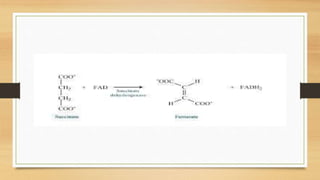
‱ Succinate is dehydrogenated by FAD catalyzed by succinate dehydrogenase to
produce fumarate, a 4-carbon species with trans double bond.

‱ FAD is reduced to FADH2.
Step 7: Hydration of Fumarate
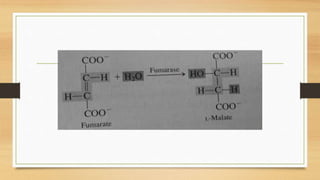
‱ The enzyme fumarase catalyzes the addition of water (nucleophilic addition)
to the double bond of fumarate.

‱ The enzyme is stereospecific, so only the L-isomer of the product malate is
produced.
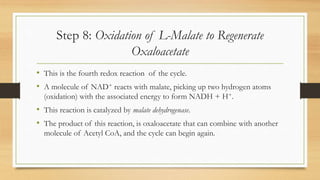
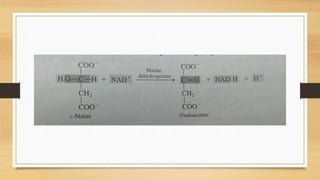
Step 8: Oxidation of L-Malate to Regenerate
Oxaloacetate
‱ This is the fourth redox reaction of the cycle.
‱ A molecule of NAD+ reacts with malate, picking up two hydrogen atoms
(oxidation) with the associated energy to form NADH + H+.

‱ This reaction is catalyzed by malate dehydrogenase.
‱ The product of this reaction, is oxaloacetate that can combine with another
molecule of Acetyl CoA, and the cycle can begin again.
Summary of Krebs Cycle’s Reactants and
Products
Learning Check
A term that is used to describe the process that is both catabolic and anabolic.
Amphibolic

Amphoteric
Metameric
In what part of the eukaryotic cell does the Krebs Cycle occurs?
Cytoplasm

Lysosome
Mitochondrial Matrix
The compound that links the process of Glycolysis and Citric Acid Cycle.
Oxaloacetate

Pyruvate
Acetyl CoA
It is the compound which reacts with the Acetyl CoA that enters the Krebs
Cycle in step 1, and it is also the product when L-Malate is oxidized in step 8.

α-ketoglutarate
Succinyl CoA
Oxaloacetate
Which of the following alcohols is not readily oxidized?
Primary alcohol

Secondary alcohol
Tertiary alcohol
THANK YOU!!! 

Krebs cycle

  • 1.
  • 2.
    Krebs Cycle ‱ Itwas named after the Hans Adolf Krebs who discovered it in 1937. ‱ It is also known by several other names: ‱ Citric Acid Cycle ‱ Tricarboxylic Acid Cycle (TCA) Click photo of Citric Acid here
  • 4.
    ‱ This cycleoccurs in the mitochondrial matrix (click photo here) ‱ It is the series of biochemical reactions in which the acetyl portion of acetyl CoA is oxidized to carbon dioxide and the reduced coenzymes FADH2 and NADH are produced. ‱ The Krebs cycle is what is known as Amphibolic, in that it is both catabolic (breaks down molecules) and anabolic (builds molecules). ‱ It is a series of chemical reactions used by all aerobic organisms to generate energy through the oxidization of acetate derived from carbohydrates, fats, and proteins into carbon dioxide
  • 6.
    ‱ Each stagein the cycle (and in the link reaction—pyruvate conversion into acetyl CoA) occurs twice for every glucose molecule that enters glycolysis, because 2 pyruvate molecules are produced for each glucose. ‱ The eight steps of the citric acid cycle are a series of redox, dehydration, hydration, and decarboxylation reactions. ‱ Each turn of the cycle forms one GTP or ATP as well as three NADH molecules and one FADH2 molecule, which will be used in further steps of cellular respiration to produce ATP for the cell.
  • 7.
    Unlocking of Terms ‱Oxidation – removal of electrons from a molecule. This subsequently lowers the energy content of a molecule. ‱ Most biological oxidations involve the loss of hydrogen atoms. This type of oxidation is referred to as a dehydrogenation. The enzymes that catalyzes these reactions are called dehydrogenases. ‱ Gain of oxygen atoms
  • 8.
    ‱ Reduction –opposite of oxidation. It is the addition of electrons to a molecule. ‱ When a molecule is oxidized, the liberated hyrdride ions (H-) do not remain free in the cell. In order to harness the energy of these electrons, they are immediately transferred to another compound by coenzymes. ‱ Loss of oxygen atoms
  • 9.
    ‱ Phosphorylation -accomplished by transferring a phosphate group to ADP ‱ Decarboxylation – carbon chain is shortened by the removal of a carbon atom (COO-) as CO2 ‱ Isomerization - is the process by which one molecule is transformed into another molecule which has exactly the same atoms ‱ Dehydration – removing of water molecules ‱ Hydration – addition of water molecules
  • 10.
    Link Reaction betweenGlycolysis and Krebs Cycle -Pyruvate conversion to Acetyl CoA ‱ Pyruvate is transported across the mitochondrion’s inner membrane and into the inner compartment, called the matrix. ‱ An enzyme pyruvate dehydrogenase complex splits each molecule of pyruvate into a molecule of CO2 and a two-carbon acetyl group.
  • 11.
    ‱ The CO2diffuses out of the cell, and the acetyl group combines with a molecule called coenzyme A (abbreviated as CoA). The product of this reaction is acetyl-CoA. ‱ NAD+ is changed to its reduced form, NADH that will enter the Electron Transport Chain.
  • 13.
    Reactions of theCitric Acid Cycle
  • 14.
    Step 1: Formationof Citrate ‱ Acetyl CoA, which carries the two-carbon degradation product of glycolysis enters the cycle by combining with the oxaloacetate to give (S)-citryl CoA. The addition is catalyzed by the citrate synthase. ‱ (S)-citryl CoA is hydrolyzed to citrate catalyzed by the same citrate synthase to produce CoA-SH and citrate.
  • 16.
    Step 2. Formationof Isocitrate ‱ Citrate, a tertiary alcohol, is converted into its isomer, isocitrate, a secondary alcohol, in an isomerization process that involves dehydration followed by hydration that are both catalysed by the enzyme aconitase. ‱ –OH group from citrate is moved to a different carbon atom.
  • 18.
    Step 3. Oxidationof Isocitrate and Formation of CO2 ‱ This step involves oxidation-reduction (the first of four redox reactions in the Krebs Cycle) and decarboxylation. ‱ The reaction catalyzed by isocitrate dehydrogenase is complex: (1) Isocitrate is oxidized to oxalosuccinate by NAD+, releasing 2 hydrogen atoms. (2) One hydrogen and two electrons are transferred to NAD+ to form NADH; the remaining hydrogen ion is released. (3) the oxalosuccinate remains bound to the enzyme and undergoes decarboxylation, which produces the 5-carbon species α-ketoglutarate. ‱ This step yields the first molecules of CO2 and NADH in the cycle.
  • 20.
    Step 4: Oxidationof α-ketoglutarate and Formation of CO2 ‱ This second redox reaction of the cycle involves one molecule each of NAD+, CoA-SH, and α-ketoglurate. ‱ The catalyst is an aggregate of three enzymes called the α-ketoglutarate dehydrogenase complex. ‱ Both redox reaction and decarboxylation occur. ‱ Three products: CO2, NADH, and the 4-carbon species succinyl CoA. ‱ This step yields the second molecule of CO2 and NADH in the cycle.
  • 22.
    Did you knowthat
 ‱ The CO2 molecules produced in steps 3 and 4 of the citric acid cycle are the CO2 molecules we exhale in the process of respiration.
  • 23.
    Step 5: Thioesterbond cleavage in Succinyl CoA and Phosphorylation of GDP ‱ Two molecules react with succinyl CoA—a molecule of GDP (similar to ADP) and a free phosphate group (Pi). ‱ The enzyme succinyl CoA synthetase removes coenzyme A by thioester bond cleavage. ‱ The energy released is used to combine GDP and Pi to give GTP. ‱ Succinyl CoA has been converted to succinate.
  • 25.
    Step 6: Oxidationof Succinate ‱ This is the third redox reaction of the cycle. ‱ Succinate is dehydrogenated by FAD catalyzed by succinate dehydrogenase to produce fumarate, a 4-carbon species with trans double bond. ‱ FAD is reduced to FADH2.
  • 27.
    Step 7: Hydrationof Fumarate ‱ The enzyme fumarase catalyzes the addition of water (nucleophilic addition) to the double bond of fumarate. ‱ The enzyme is stereospecific, so only the L-isomer of the product malate is produced.
  • 29.
    Step 8: Oxidationof L-Malate to Regenerate Oxaloacetate ‱ This is the fourth redox reaction of the cycle. ‱ A molecule of NAD+ reacts with malate, picking up two hydrogen atoms (oxidation) with the associated energy to form NADH + H+. ‱ This reaction is catalyzed by malate dehydrogenase. ‱ The product of this reaction, is oxaloacetate that can combine with another molecule of Acetyl CoA, and the cycle can begin again.
  • 31.
    Summary of KrebsCycle’s Reactants and Products
  • 32.
    Learning Check A termthat is used to describe the process that is both catabolic and anabolic. Amphibolic Amphoteric Metameric
  • 35.
    In what partof the eukaryotic cell does the Krebs Cycle occurs? Cytoplasm Lysosome Mitochondrial Matrix
  • 38.
    The compound thatlinks the process of Glycolysis and Citric Acid Cycle. Oxaloacetate Pyruvate Acetyl CoA
  • 41.
    It is thecompound which reacts with the Acetyl CoA that enters the Krebs Cycle in step 1, and it is also the product when L-Malate is oxidized in step 8. α-ketoglutarate Succinyl CoA Oxaloacetate
  • 44.
    Which of thefollowing alcohols is not readily oxidized? Primary alcohol Secondary alcohol Tertiary alcohol
  • 47.