TCA
cycle
Specific Learning Objectives
At the end of the lecture, the students will be
able to
• Explain the TCA cycle.
Introduction
• The second stage of cellular respiration is called the
citric acid cycle. It is also known as the Krebs cycle or
Citric acid cycle or Tricarboxylic acid (TCA cycle).
• It is the most important metabolic pathway for the
energy supply to the body.
• Enzymes play an important role in the citric acid cycle.
Each step is catalyzed by a very specific enzyme.
Cont….
• Krebs cycle – It was proposed by Hans Adolf Krebs
in 1937, based on the studies of oxygen consumption
in pigeon breast muscle.
• Citric Acid Cycle – OAA (oxaloacetate acid ) reacts
with Acetyl CoA to produce citric acid and the cycle
begins.
Cont.…
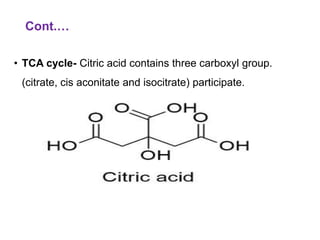
• TCA cycle- Citric acid contains three carboxyl group.
(citrate, cis aconitate and isocitrate) participate.
Cont.…
• About 65-70% of the ATP is synthesized in Krebs
cycle.
• Citric acid cycle essentially involves the oxidation of
acetyl CoA to CO2 and H2O.
• This cycle utilizes about two thirds of total oxygen
consumed by the body.
Cont.…
• In eukaryotes, the Krebs cycle uses a molecule of
acetyl CoA to generate 1 ATP, 3 NADH, 1 FADH2, 2
CO2, and 3 H+.
• Two molecules of acetyl CoA are produced in
glycolysis so the total number of molecules produced in
the citric acid cycle is doubled (2 ATP, 6 NADH, 2
FADH2, 4 CO2, and 6 H+).
• Both the NADH and FADH2 molecules made in the
Krebs cycle are sent to the electron transport chain,
the last stage of cellular respiration.
TCA cycle- the central metabolic pathway.
• The citric acid cycle is the final common oxidative
pathway for carbohydrates, fats and amino acids.
• This cycle not only supplies energy but also
provides many intermediates required for the
synthesis of amino acids, glucose, heme etc.
• Krebs cycle is the most important central pathway
connecting almost all the individual metabolic
pathways (either directly or indirectly).
Location of TCA cycle
• In eukaryotic cells- This process occurs in the matrix
of the mitochondrion
• In prokaryotic cells, this reaction occurs in the cytosol.
TCA cycle- an overview
• Krebs cycle basically involves the combination of a
two carbon acetyl CoA with a four carbon
oxaloacetate to produce a six carbon tricarboxylic
acid, citrate.
• In the reactions that follow, the two carbons are
oxidized to CO2 and oxaloacetate is regenerated
and recycled.
• Oxaloacetate is considered to play a catalytic role in
citric acid cycle.
Reactions of citric acid cycle
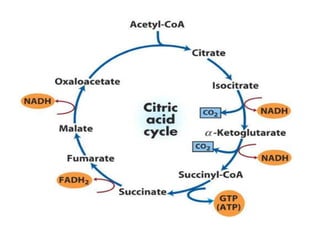
1. Formation of citrate
In the first step of the citric acid cycle,
acetyl CoA joins with a four-carbon molecule,
oxaloacetate, releasing the CoA group and forming
a six-carbon molecule called citrate. Catalysed by
the enzyme citrate synthase.
Cont….
• 2. and 3. Citrate is isomerized to isocitrate by the
enzyme aconitase. This is achieved in a two stage
reaction of dehydration followed by hydration (removal
and then the addition of a water molecule) through the
formation of an intermediate—cis-aconitate.
Cont….
• 4. and 5. Formation of alfa -ketoglutarate : The
enzyme isocitrate dehydrogenase (ICD) catalyses the
conversion (oxidative decarboxylation) of isocitrate to
oxalosuccinate and then to Alfa -ketoglutarate. The
formation of NADH and the liberation of CO2 occur
at this stage.
Cont…
• In the third step, isocitrate is oxidized and releases a
molecule of carbon dioxide, leaving behind a five-
carbon molecule—α-ketoglutarate. During this
step, NAD + is reduced to form NADH. The enzyme
catalyzing this step, isocitrate dehydrogenase, is
important in regulating the speed of the citric acid
cycle.
Cont….
6. Conversion of alfa -ketoglutarate to succinyl CoA
occurs through oxidative decarboxylation, catalysed by
alfa -ketoglutarate dehydrogenase complex. This
enzyme is dependent on five cofactors—TPP, lipoamide,
NAD+, FAD and CoA. The mechanism of the reaction is
analogous to the conversion of pyruvate to acetyl CoA
Cont….
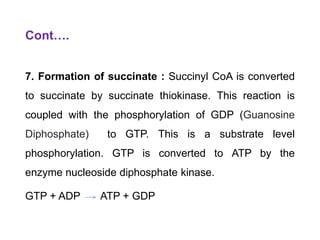
7. Formation of succinate : Succinyl CoA is converted
to succinate by succinate thiokinase. This reaction is
coupled with the phosphorylation of GDP (Guanosine
Diphosphate) to GTP. This is a substrate level
phosphorylation. GTP is converted to ATP by the
enzyme nucleoside diphosphate kinase.
GTP + ADP ATP + GDP
Cont….
• 8. Conversion of succinate to fumarate : Succinate
is oxidized by succinate dehydrogenase to fumarate.
This reaction results in the production of FADH2 and
not NADH.
9. Formation of malate : The enzyme fumarase
catalyses the conversion of fumarate to malate with the
addition of H2O.
Cont….
10. Conversion of malate to oxaloacetate : Malate is
then oxidized to oxaloacetate by malate dehydrogenase.
The third and final synthesis of NADH occurs at this
stage. The oxaloacetate is regenerated which can
combine with another molecule of acetyl CoA, and
continue the cycle.
Requirement of O2 by TCA cycle
• There is no direct participation of oxygen in Krebs cycle.
• Cycle operates only under aerobic conditions.
• This is due to the fact that NAD+ and FAD (form NADH and FADH2,
respectively) required for the operation of the cycle can be
regenerated in the ETC only in the presence of O2.
• Therefore, citric acid cycle is strictly aerobic in contrast to
glycolysis which operates in both aerobic and anaerobic conditions.
Energetics of citric acid cycle
• During the process of oxidation of acetyl CoA via citric acid cycle,
4 reducing equivalents (3 as NADH and one as FADH2) are
produced.
• Oxidation of 3 NADH by electron transport chain coupled with
oxidative phosphorylation results in the synthesis of 9 ATP,
whereas FADH2 leads to the formation of 2 ATP and 1 GTP (1
ATP).
• Besides, there is one substrate level phosphorylation. Thus, a total
of twelve ATP are produced from one acetyl CoA.
Cont.…
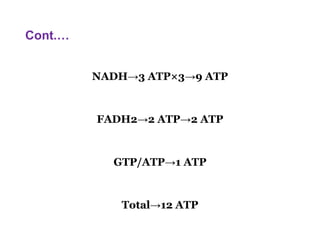
NADH→3 ATP×3→9 ATP
FADH2→2 ATP→2 ATP
GTP/ATP→1 ATP
Total→12 ATP
Role of vitamins in TCA cycle
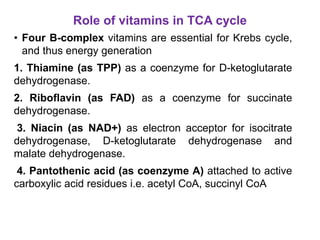
• Four B-complex vitamins are essential for Krebs cycle,
and thus energy generation
1. Thiamine (as TPP) as a coenzyme for D-ketoglutarate
dehydrogenase.
2. Riboflavin (as FAD) as a coenzyme for succinate
dehydrogenase.
3. Niacin (as NAD+) as electron acceptor for isocitrate
dehydrogenase, D-ketoglutarate dehydrogenase and
malate dehydrogenase.
4. Pantothenic acid (as coenzyme A) attached to active
carboxylic acid residues i.e. acetyl CoA, succinyl CoA
Mnemonics of TCA Cycle
Citrate Is Krebs Starting
Substrate for Making OAA
Difference between
Glycolysis and
TCA cycle
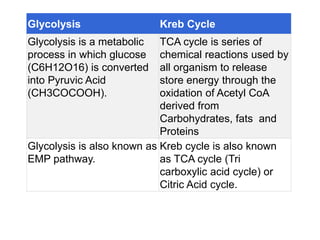
Glycolysis Kreb Cycle
Glycolysis is a metabolic
process in which glucose
(C6H12O16) is converted
into Pyruvic Acid
(CH3COCOOH).
TCA cycle is series of
chemical reactions used by
all organism to release
store energy through the
oxidation of Acetyl CoA
derived from
Carbohydrates, fats and
Proteins
Glycolysis is also known as
EMP pathway.
Kreb cycle is also known
as TCA cycle (Tri
carboxylic acid cycle) or
Citric Acid cycle.
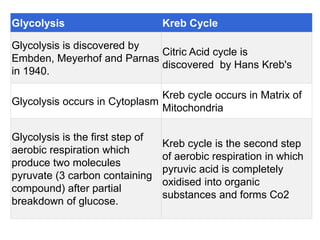
Glycolysis Kreb Cycle
Glycolysis is discovered by
Embden, Meyerhof and Parnas
in 1940.
Citric Acid cycle is
discovered by Hans Kreb's
Glycolysis occurs in Cytoplasm
Kreb cycle occurs in Matrix of
Mitochondria
Glycolysis is the first step of
aerobic respiration which
produce two molecules
pyruvate (3 carbon containing
compound) after partial
breakdown of glucose.
Kreb cycle is the second step
of aerobic respiration in which
pyruvic acid is completely
oxidised into organic
substances and forms Co2
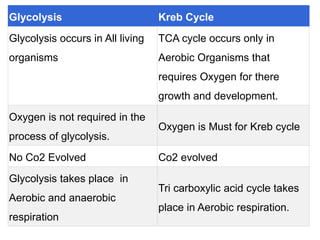
Glycolysis Kreb Cycle
Glycolysis occurs in All living
organisms
TCA cycle occurs only in
Aerobic Organisms that
requires Oxygen for there
growth and development.
Oxygen is not required in the
process of glycolysis.
Oxygen is Must for Kreb cycle
No Co2 Evolved Co2 evolved
Glycolysis takes place in
Aerobic and anaerobic
respiration
Tri carboxylic acid cycle takes
place in Aerobic respiration.
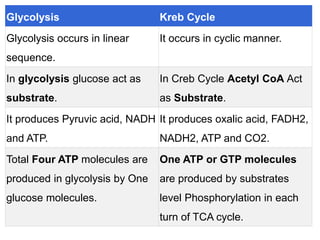
Glycolysis Kreb Cycle
Glycolysis occurs in linear
sequence.
It occurs in cyclic manner.
In glycolysis glucose act as
substrate.
In Creb Cycle Acetyl CoA Act
as Substrate.
It produces Pyruvic acid, NADH
and ATP.
It produces oxalic acid, FADH2,
NADH2, ATP and CO2.
Total Four ATP molecules are
produced in glycolysis by One
glucose molecules.
One ATP or GTP molecules
are produced by substrates
level Phosphorylation in each
turn of TCA cycle.
Expected Questions
Essay/ Situational Type
• Explain the TCA Cycle.
THANK YOU

TCA cycle.pptx

  • 1.
  • 2.
    Specific Learning Objectives Atthe end of the lecture, the students will be able to • Explain the TCA cycle.
  • 3.
    Introduction • The secondstage of cellular respiration is called the citric acid cycle. It is also known as the Krebs cycle or Citric acid cycle or Tricarboxylic acid (TCA cycle). • It is the most important metabolic pathway for the energy supply to the body. • Enzymes play an important role in the citric acid cycle. Each step is catalyzed by a very specific enzyme.
  • 4.
    Cont…. • Krebs cycle– It was proposed by Hans Adolf Krebs in 1937, based on the studies of oxygen consumption in pigeon breast muscle. • Citric Acid Cycle – OAA (oxaloacetate acid ) reacts with Acetyl CoA to produce citric acid and the cycle begins.
  • 5.
    Cont.… • TCA cycle-Citric acid contains three carboxyl group. (citrate, cis aconitate and isocitrate) participate.
  • 6.
    Cont.… • About 65-70%of the ATP is synthesized in Krebs cycle. • Citric acid cycle essentially involves the oxidation of acetyl CoA to CO2 and H2O. • This cycle utilizes about two thirds of total oxygen consumed by the body.
  • 7.
    Cont.… • In eukaryotes,the Krebs cycle uses a molecule of acetyl CoA to generate 1 ATP, 3 NADH, 1 FADH2, 2 CO2, and 3 H+. • Two molecules of acetyl CoA are produced in glycolysis so the total number of molecules produced in the citric acid cycle is doubled (2 ATP, 6 NADH, 2 FADH2, 4 CO2, and 6 H+). • Both the NADH and FADH2 molecules made in the Krebs cycle are sent to the electron transport chain, the last stage of cellular respiration.
  • 8.
    TCA cycle- thecentral metabolic pathway. • The citric acid cycle is the final common oxidative pathway for carbohydrates, fats and amino acids. • This cycle not only supplies energy but also provides many intermediates required for the synthesis of amino acids, glucose, heme etc. • Krebs cycle is the most important central pathway connecting almost all the individual metabolic pathways (either directly or indirectly).
  • 9.
    Location of TCAcycle • In eukaryotic cells- This process occurs in the matrix of the mitochondrion • In prokaryotic cells, this reaction occurs in the cytosol.
  • 10.
    TCA cycle- anoverview • Krebs cycle basically involves the combination of a two carbon acetyl CoA with a four carbon oxaloacetate to produce a six carbon tricarboxylic acid, citrate. • In the reactions that follow, the two carbons are oxidized to CO2 and oxaloacetate is regenerated and recycled. • Oxaloacetate is considered to play a catalytic role in citric acid cycle.
  • 11.
    Reactions of citricacid cycle 1. Formation of citrate In the first step of the citric acid cycle, acetyl CoA joins with a four-carbon molecule, oxaloacetate, releasing the CoA group and forming a six-carbon molecule called citrate. Catalysed by the enzyme citrate synthase.
  • 12.
    Cont…. • 2. and3. Citrate is isomerized to isocitrate by the enzyme aconitase. This is achieved in a two stage reaction of dehydration followed by hydration (removal and then the addition of a water molecule) through the formation of an intermediate—cis-aconitate.
  • 13.
    Cont…. • 4. and5. Formation of alfa -ketoglutarate : The enzyme isocitrate dehydrogenase (ICD) catalyses the conversion (oxidative decarboxylation) of isocitrate to oxalosuccinate and then to Alfa -ketoglutarate. The formation of NADH and the liberation of CO2 occur at this stage.
  • 14.
    Cont… • In thethird step, isocitrate is oxidized and releases a molecule of carbon dioxide, leaving behind a five- carbon molecule—α-ketoglutarate. During this step, NAD + is reduced to form NADH. The enzyme catalyzing this step, isocitrate dehydrogenase, is important in regulating the speed of the citric acid cycle.
  • 15.
    Cont…. 6. Conversion ofalfa -ketoglutarate to succinyl CoA occurs through oxidative decarboxylation, catalysed by alfa -ketoglutarate dehydrogenase complex. This enzyme is dependent on five cofactors—TPP, lipoamide, NAD+, FAD and CoA. The mechanism of the reaction is analogous to the conversion of pyruvate to acetyl CoA
  • 16.
    Cont…. 7. Formation ofsuccinate : Succinyl CoA is converted to succinate by succinate thiokinase. This reaction is coupled with the phosphorylation of GDP (Guanosine Diphosphate) to GTP. This is a substrate level phosphorylation. GTP is converted to ATP by the enzyme nucleoside diphosphate kinase. GTP + ADP ATP + GDP
  • 17.
    Cont…. • 8. Conversionof succinate to fumarate : Succinate is oxidized by succinate dehydrogenase to fumarate. This reaction results in the production of FADH2 and not NADH. 9. Formation of malate : The enzyme fumarase catalyses the conversion of fumarate to malate with the addition of H2O.
  • 18.
    Cont…. 10. Conversion ofmalate to oxaloacetate : Malate is then oxidized to oxaloacetate by malate dehydrogenase. The third and final synthesis of NADH occurs at this stage. The oxaloacetate is regenerated which can combine with another molecule of acetyl CoA, and continue the cycle.
  • 19.
    Requirement of O2by TCA cycle • There is no direct participation of oxygen in Krebs cycle. • Cycle operates only under aerobic conditions. • This is due to the fact that NAD+ and FAD (form NADH and FADH2, respectively) required for the operation of the cycle can be regenerated in the ETC only in the presence of O2. • Therefore, citric acid cycle is strictly aerobic in contrast to glycolysis which operates in both aerobic and anaerobic conditions.
  • 20.
    Energetics of citricacid cycle • During the process of oxidation of acetyl CoA via citric acid cycle, 4 reducing equivalents (3 as NADH and one as FADH2) are produced. • Oxidation of 3 NADH by electron transport chain coupled with oxidative phosphorylation results in the synthesis of 9 ATP, whereas FADH2 leads to the formation of 2 ATP and 1 GTP (1 ATP). • Besides, there is one substrate level phosphorylation. Thus, a total of twelve ATP are produced from one acetyl CoA.
  • 21.
    Cont.… NADH→3 ATP×3→9 ATP FADH2→2ATP→2 ATP GTP/ATP→1 ATP Total→12 ATP
  • 22.
    Role of vitaminsin TCA cycle • Four B-complex vitamins are essential for Krebs cycle, and thus energy generation 1. Thiamine (as TPP) as a coenzyme for D-ketoglutarate dehydrogenase. 2. Riboflavin (as FAD) as a coenzyme for succinate dehydrogenase. 3. Niacin (as NAD+) as electron acceptor for isocitrate dehydrogenase, D-ketoglutarate dehydrogenase and malate dehydrogenase. 4. Pantothenic acid (as coenzyme A) attached to active carboxylic acid residues i.e. acetyl CoA, succinyl CoA
  • 23.
    Mnemonics of TCACycle Citrate Is Krebs Starting Substrate for Making OAA
  • 25.
  • 26.
    Glycolysis Kreb Cycle Glycolysisis a metabolic process in which glucose (C6H12O16) is converted into Pyruvic Acid (CH3COCOOH). TCA cycle is series of chemical reactions used by all organism to release store energy through the oxidation of Acetyl CoA derived from Carbohydrates, fats and Proteins Glycolysis is also known as EMP pathway. Kreb cycle is also known as TCA cycle (Tri carboxylic acid cycle) or Citric Acid cycle.
  • 27.
    Glycolysis Kreb Cycle Glycolysisis discovered by Embden, Meyerhof and Parnas in 1940. Citric Acid cycle is discovered by Hans Kreb's Glycolysis occurs in Cytoplasm Kreb cycle occurs in Matrix of Mitochondria Glycolysis is the first step of aerobic respiration which produce two molecules pyruvate (3 carbon containing compound) after partial breakdown of glucose. Kreb cycle is the second step of aerobic respiration in which pyruvic acid is completely oxidised into organic substances and forms Co2
  • 28.
    Glycolysis Kreb Cycle Glycolysisoccurs in All living organisms TCA cycle occurs only in Aerobic Organisms that requires Oxygen for there growth and development. Oxygen is not required in the process of glycolysis. Oxygen is Must for Kreb cycle No Co2 Evolved Co2 evolved Glycolysis takes place in Aerobic and anaerobic respiration Tri carboxylic acid cycle takes place in Aerobic respiration.
  • 29.
    Glycolysis Kreb Cycle Glycolysisoccurs in linear sequence. It occurs in cyclic manner. In glycolysis glucose act as substrate. In Creb Cycle Acetyl CoA Act as Substrate. It produces Pyruvic acid, NADH and ATP. It produces oxalic acid, FADH2, NADH2, ATP and CO2. Total Four ATP molecules are produced in glycolysis by One glucose molecules. One ATP or GTP molecules are produced by substrates level Phosphorylation in each turn of TCA cycle.
  • 30.
    Expected Questions Essay/ SituationalType • Explain the TCA Cycle.
  • 31.