An Introduction to System on Chip based
Smartphone Processors , working , and
their Architecture.
SoC Based SmartPhone Processors
Ankush Kumar
Electronics And
Communication
Contents
 Introduction to Soc
 SoC vs. CPU
 SoC Based Android Processors
 Architecture of Processors
 SoC vs. CPU
 The World Of ARM
 GPU
 Understanding “Clock Speed” , And “Cores”
 Multi – Threading and HyperThreading
 References
What is a SoC?
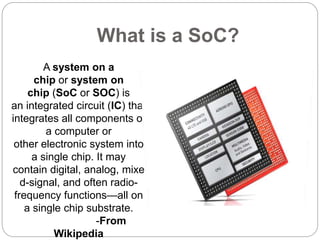
A system on a
chip or system on
chip (SoC or SOC) is
an integrated circuit (IC) that
integrates all components of
a computer or
other electronic system into
a single chip. It may
contain digital, analog, mixe
d-signal, and often radio-
frequency functions—all on
a single chip substrate.
-From
Wikipedia
Structure of SoC
 A microcontroller, microprocessor or digital signal
processor (DSP) core – multiprocessor SoCs
(MPSoC) having more than one processor core
 Memory blocks including a selection
of ROM, RAM, EEPROM and flash memory
 Timing sources including oscillators and phase-
locked loops
 Peripherals including counter-timers, real-
time timers and power-on reset generators
 External interfaces, including industry standards such
as USB , Ethernet, USART, SPI
 Analog interfaces including ADCs and DACs
 Voltage regulators and power management circuits
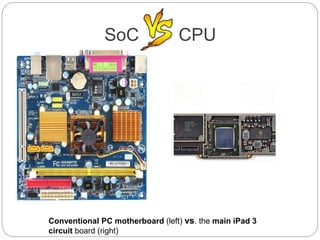
Conventional PC motherboard (left) vs. the main iPad 3
circuit board (right)
SoC CPU
SoC CPU
 Advantage of an SoC is its size: An SoC is only a little
bit larger than a CPU, and yet it contains a lot more
functionality. If you use a CPU, it’s very hard to make a
computer that’s smaller than 10cm (4 inches) squared,
purely because of the number of individual chips that you
need to squeeze in. Using SoCs, we can put complete
computers in smartphones and tablets, and still have
plenty of space for batteries.
 Due to its very high level of integration and much
shorter wiring, an SoC also uses considerably less
power — again, this is a big bonus when it comes to
mobile computing. Cutting down on the number of
physical chips means that it’s much cheaper to build a
computer using an SoC.
 The only real disadvantage of an SoC is a complete
lack of flexibility. With your PC, you can put in a new
CPU, GPU, or RAM at any time — you cannot do the
same for your smartphone.
 Ultimately, SoCs are the next step after CPUs.
Eventually, SoCs will almost completely consume
CPUs. We are already seeing this with AMD’s Llano
and Intel’s Ivy Bridge CPUs, which integrate a
memory controller, PCI Express, and a graphics
processor onto the same chip.
SoC CPU
Why do we use Soc In
Smartphone Processors?
 Smart phones are smaller computers, they
require almost the same components we see
in laptops in order to offer us Apps, music and
video playing, 3D gaming support, advanced
wireless features, etc
 Smartphones do not offer the same amount of
internal space as laptops for the various
components needed such as the logic board, the
processor, the RAM, the graphics card, etc
 Thanks to the wonders of miniaturization, SoC
manufacturers, like Qualcomm, Nvidia or Texas
Instruments, can place some of those
components on a single chip, the System on a
Chip
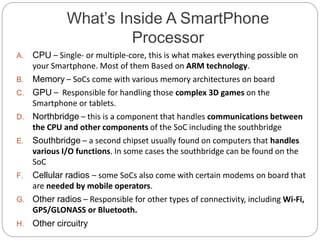
What’s Inside A SmartPhone
Processor
A. CPU – Single- or multiple-core, this is what makes everything possible on
your Smartphone. Most of them Based on ARM technology.
B. Memory – SoCs come with various memory architectures on board
C. GPU – Responsible for handling those complex 3D games on the
Smartphone or tablets.
D. Northbridge – this is a component that handles communications between
the CPU and other components of the SoC including the southbridge
E. Southbridge – a second chipset usually found on computers that handles
various I/O functions. In some cases the southbridge can be found on the
SoC
F. Cellular radios – some SoCs also come with certain modems on board that
are needed by mobile operators.
G. Other radios – Responsible for other types of connectivity, including Wi-Fi,
GPS/GLONASS or Bluetooth.
H. Other circuitry
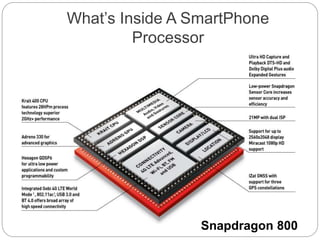
What’s Inside A SmartPhone
Processor
Snapdragon 800
Understanding the world of ARM
 “ARM Holdings plc is the British-based company that,
since 1983, has developed the ARM microprocessor
instruction architecture which is used inside their ARM
processor cores.”
 ARM has dominated the mobile space for many years,
largely thanks to the lower power consumption of its
processors (and improved battery life) when compared to
the opposition. Intel has been attempting to make inroads
into the markets in recent years with the x86 that is popular
on the desktop, but with limited success.
 CPUs are based on ARM architecture.
 This is created by ARM Holdings and includes an
instruction set that controls how the CPU works.
This is licensed to the various SoC manufacturers who
incorporate it into their products.
WHAT IS AN INSTRUCTION SET ?
 An instruction set, or instruction set
architecture (ISA), is the part of the computer
architecture related to programming, including the
native data types,
instructions, registers, addressing modes, memory
architecture, interrupt and exception handling, and
external I/O. An ISA includes a specification of the set
of opcodes (machine language), and the native
commands implemented by a particular processor.
 An instruction set is the interface between a
computer's software and its hardware, and thereby
enables the independent development of these two
computing realms.
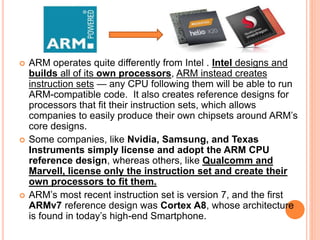
 ARM operates quite differently from Intel . Intel designs and
builds all of its own processors, ARM instead creates
instruction sets — any CPU following them will be able to run
ARM-compatible code. It also creates reference designs for
processors that fit their instruction sets, which allows
companies to easily produce their own chipsets around ARM’s
core designs.
 Some companies, like Nvidia, Samsung, and Texas
Instruments simply license and adopt the ARM CPU
reference design, whereas others, like Qualcomm and
Marvell, license only the instruction set and create their
own processors to fit them.
 ARM’s most recent instruction set is version 7, and the first
ARMv7 reference design was Cortex A8, whose architecture
is found in today’s high-end Smartphone.
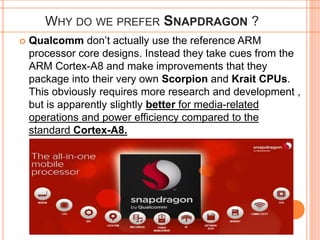
WHY DO WE PREFER SNAPDRAGON ?
 Qualcomm don’t actually use the reference ARM
processor core designs. Instead they take cues from the
ARM Cortex-A8 and make improvements that they
package into their very own Scorpion and Krait CPUs.
This obviously requires more research and development ,
but is apparently slightly better for media-related
operations and power efficiency compared to the
standard Cortex-A8.
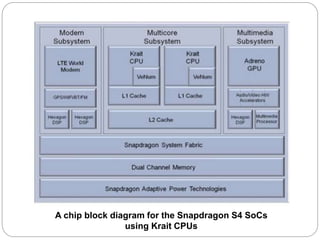
A chip block diagram for the Snapdragon S4 SoCs
using Krait CPUs
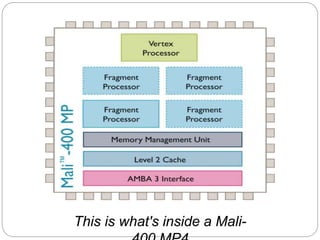
Understanding GPU
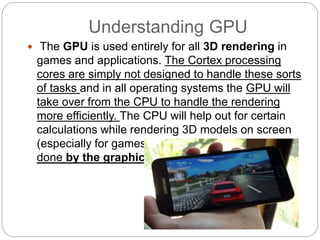
 The GPU is used entirely for all 3D rendering in
games and applications. The Cortex processing
cores are simply not designed to handle these sorts
of tasks and in all operating systems the GPU will
take over from the CPU to handle the rendering
more efficiently. The CPU will help out for certain
calculations while rendering 3D models on screen
(especially for games), but the main grunt will be
done by the graphics chip.
This is what's inside a Mali-
Cores and ClockSpeed
 If computing is a car then the CPU is the engine. The
higher the clock speed, the faster the car (system)
will go. Clock speed is measured in GHz (gigahertz),
a higher number means a faster clock speed . To run
your apps, your CPU must continually
complete calculations, if you have a higher clock
speed, you can compute these calculations quicker
and applications will run faster and smoother as a
result of this.
 A core is a single processing unit, multi core
processors have multiple processing units. So a dual
core 3.0GHz processor has 2 processing units each
with a clock speed of 3.0GHz. A 6 core 3.0GHz
processor has 6 processing units each with a clock
speed of 3.0GHz.
MultiThreading vs. Hyperthreading
 Multi-threading is the
ability of an application or
operating system to
utilize multiple cores for
processing. When apps
are written with multi-
threading in mind they
can benefit from the
plethora of cores
available in modern
CPUs and see huge
performance increases
over using a single core
 Hyper-threading is a
proprietary Intel
technology that allows
a single core to split
into a virtual and a
logical core and share
workload between
the two. Hyper-
threading is especially
useful when apps are
well optimised for
multi-threading.
Intel as A Smartphone Processor
ASUS was The First
Smartphone Brand In
INDIA to use Intel
processors and
Hyper Threading
Technology.
Intel has just announced ducking out of the mobile
processor market.
Intel is working on ultra-high end Core m5 and m7
processors, which are designed for the high performance
tablet and lower end notebook market. The company claims
that its latest Core m processors offer 40 percent boosts to
graphics and CPU performance and will be targeting at 2-in-
1 convertible devices and notebooks.
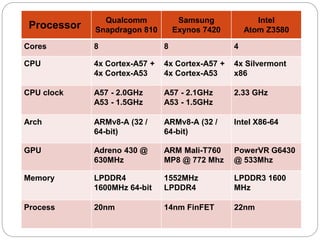
Processor
Qualcomm
Snapdragon 810
Samsung
Exynos 7420
Intel
Atom Z3580
Cores 8 8 4
CPU 4x Cortex-A57 +
4x Cortex-A53
4x Cortex-A57 +
4x Cortex-A53
4x Silvermont
x86
CPU clock A57 - 2.0GHz
A53 - 1.5GHz
A57 - 2.1GHz
A53 - 1.5GHz
2.33 GHz
Arch ARMv8-A (32 /
64-bit)
ARMv8-A (32 /
64-bit)
Intel X86-64
GPU Adreno 430 @
630MHz
ARM Mali-T760
MP8 @ 772 Mhz
PowerVR G6430
@ 533Mhz
Memory LPDDR4
1600MHz 64-bit
1552MHz
LPDDR4
LPDDR3 1600
MHz
Process 20nm 14nm FinFET 22nm
Refrences
 Wikipedia
 Makeuseof.com
 AndroidAuthority.com
 Neowin.net
 Gsmarena.com
 Techautos.com
 ExtremeTech.com
 Kamyasuraj.blogspot.com
 Greenbot.com
 .
THANK YOU

SoC based smartphone processors

  • 1.
    An Introduction toSystem on Chip based Smartphone Processors , working , and their Architecture. SoC Based SmartPhone Processors Ankush Kumar Electronics And Communication
  • 2.
    Contents  Introduction toSoc  SoC vs. CPU  SoC Based Android Processors  Architecture of Processors  SoC vs. CPU  The World Of ARM  GPU  Understanding “Clock Speed” , And “Cores”  Multi – Threading and HyperThreading  References
  • 3.
    What is aSoC? A system on a chip or system on chip (SoC or SOC) is an integrated circuit (IC) that integrates all components of a computer or other electronic system into a single chip. It may contain digital, analog, mixe d-signal, and often radio- frequency functions—all on a single chip substrate. -From Wikipedia
  • 4.
    Structure of SoC A microcontroller, microprocessor or digital signal processor (DSP) core – multiprocessor SoCs (MPSoC) having more than one processor core  Memory blocks including a selection of ROM, RAM, EEPROM and flash memory  Timing sources including oscillators and phase- locked loops  Peripherals including counter-timers, real- time timers and power-on reset generators  External interfaces, including industry standards such as USB , Ethernet, USART, SPI  Analog interfaces including ADCs and DACs  Voltage regulators and power management circuits
  • 5.
    Conventional PC motherboard(left) vs. the main iPad 3 circuit board (right) SoC CPU
  • 6.
    SoC CPU  Advantageof an SoC is its size: An SoC is only a little bit larger than a CPU, and yet it contains a lot more functionality. If you use a CPU, it’s very hard to make a computer that’s smaller than 10cm (4 inches) squared, purely because of the number of individual chips that you need to squeeze in. Using SoCs, we can put complete computers in smartphones and tablets, and still have plenty of space for batteries.  Due to its very high level of integration and much shorter wiring, an SoC also uses considerably less power — again, this is a big bonus when it comes to mobile computing. Cutting down on the number of physical chips means that it’s much cheaper to build a computer using an SoC.
  • 7.
     The onlyreal disadvantage of an SoC is a complete lack of flexibility. With your PC, you can put in a new CPU, GPU, or RAM at any time — you cannot do the same for your smartphone.  Ultimately, SoCs are the next step after CPUs. Eventually, SoCs will almost completely consume CPUs. We are already seeing this with AMD’s Llano and Intel’s Ivy Bridge CPUs, which integrate a memory controller, PCI Express, and a graphics processor onto the same chip. SoC CPU
  • 8.
    Why do weuse Soc In Smartphone Processors?  Smart phones are smaller computers, they require almost the same components we see in laptops in order to offer us Apps, music and video playing, 3D gaming support, advanced wireless features, etc  Smartphones do not offer the same amount of internal space as laptops for the various components needed such as the logic board, the processor, the RAM, the graphics card, etc  Thanks to the wonders of miniaturization, SoC manufacturers, like Qualcomm, Nvidia or Texas Instruments, can place some of those components on a single chip, the System on a Chip
  • 9.
    What’s Inside ASmartPhone Processor A. CPU – Single- or multiple-core, this is what makes everything possible on your Smartphone. Most of them Based on ARM technology. B. Memory – SoCs come with various memory architectures on board C. GPU – Responsible for handling those complex 3D games on the Smartphone or tablets. D. Northbridge – this is a component that handles communications between the CPU and other components of the SoC including the southbridge E. Southbridge – a second chipset usually found on computers that handles various I/O functions. In some cases the southbridge can be found on the SoC F. Cellular radios – some SoCs also come with certain modems on board that are needed by mobile operators. G. Other radios – Responsible for other types of connectivity, including Wi-Fi, GPS/GLONASS or Bluetooth. H. Other circuitry
  • 10.
    What’s Inside ASmartPhone Processor Snapdragon 800
  • 11.
    Understanding the worldof ARM  “ARM Holdings plc is the British-based company that, since 1983, has developed the ARM microprocessor instruction architecture which is used inside their ARM processor cores.”  ARM has dominated the mobile space for many years, largely thanks to the lower power consumption of its processors (and improved battery life) when compared to the opposition. Intel has been attempting to make inroads into the markets in recent years with the x86 that is popular on the desktop, but with limited success.  CPUs are based on ARM architecture.  This is created by ARM Holdings and includes an instruction set that controls how the CPU works. This is licensed to the various SoC manufacturers who incorporate it into their products.
  • 12.
    WHAT IS ANINSTRUCTION SET ?  An instruction set, or instruction set architecture (ISA), is the part of the computer architecture related to programming, including the native data types, instructions, registers, addressing modes, memory architecture, interrupt and exception handling, and external I/O. An ISA includes a specification of the set of opcodes (machine language), and the native commands implemented by a particular processor.  An instruction set is the interface between a computer's software and its hardware, and thereby enables the independent development of these two computing realms.
  • 13.
     ARM operatesquite differently from Intel . Intel designs and builds all of its own processors, ARM instead creates instruction sets — any CPU following them will be able to run ARM-compatible code. It also creates reference designs for processors that fit their instruction sets, which allows companies to easily produce their own chipsets around ARM’s core designs.  Some companies, like Nvidia, Samsung, and Texas Instruments simply license and adopt the ARM CPU reference design, whereas others, like Qualcomm and Marvell, license only the instruction set and create their own processors to fit them.  ARM’s most recent instruction set is version 7, and the first ARMv7 reference design was Cortex A8, whose architecture is found in today’s high-end Smartphone.
  • 14.
    WHY DO WEPREFER SNAPDRAGON ?  Qualcomm don’t actually use the reference ARM processor core designs. Instead they take cues from the ARM Cortex-A8 and make improvements that they package into their very own Scorpion and Krait CPUs. This obviously requires more research and development , but is apparently slightly better for media-related operations and power efficiency compared to the standard Cortex-A8.
  • 15.
    A chip blockdiagram for the Snapdragon S4 SoCs using Krait CPUs
  • 16.
    Understanding GPU  TheGPU is used entirely for all 3D rendering in games and applications. The Cortex processing cores are simply not designed to handle these sorts of tasks and in all operating systems the GPU will take over from the CPU to handle the rendering more efficiently. The CPU will help out for certain calculations while rendering 3D models on screen (especially for games), but the main grunt will be done by the graphics chip.
  • 17.
    This is what'sinside a Mali-
  • 18.
    Cores and ClockSpeed If computing is a car then the CPU is the engine. The higher the clock speed, the faster the car (system) will go. Clock speed is measured in GHz (gigahertz), a higher number means a faster clock speed . To run your apps, your CPU must continually complete calculations, if you have a higher clock speed, you can compute these calculations quicker and applications will run faster and smoother as a result of this.  A core is a single processing unit, multi core processors have multiple processing units. So a dual core 3.0GHz processor has 2 processing units each with a clock speed of 3.0GHz. A 6 core 3.0GHz processor has 6 processing units each with a clock speed of 3.0GHz.
  • 19.
    MultiThreading vs. Hyperthreading Multi-threading is the ability of an application or operating system to utilize multiple cores for processing. When apps are written with multi- threading in mind they can benefit from the plethora of cores available in modern CPUs and see huge performance increases over using a single core  Hyper-threading is a proprietary Intel technology that allows a single core to split into a virtual and a logical core and share workload between the two. Hyper- threading is especially useful when apps are well optimised for multi-threading.
  • 20.
    Intel as ASmartphone Processor ASUS was The First Smartphone Brand In INDIA to use Intel processors and Hyper Threading Technology. Intel has just announced ducking out of the mobile processor market. Intel is working on ultra-high end Core m5 and m7 processors, which are designed for the high performance tablet and lower end notebook market. The company claims that its latest Core m processors offer 40 percent boosts to graphics and CPU performance and will be targeting at 2-in- 1 convertible devices and notebooks.
  • 21.
    Processor Qualcomm Snapdragon 810 Samsung Exynos 7420 Intel AtomZ3580 Cores 8 8 4 CPU 4x Cortex-A57 + 4x Cortex-A53 4x Cortex-A57 + 4x Cortex-A53 4x Silvermont x86 CPU clock A57 - 2.0GHz A53 - 1.5GHz A57 - 2.1GHz A53 - 1.5GHz 2.33 GHz Arch ARMv8-A (32 / 64-bit) ARMv8-A (32 / 64-bit) Intel X86-64 GPU Adreno 430 @ 630MHz ARM Mali-T760 MP8 @ 772 Mhz PowerVR G6430 @ 533Mhz Memory LPDDR4 1600MHz 64-bit 1552MHz LPDDR4 LPDDR3 1600 MHz Process 20nm 14nm FinFET 22nm
  • 22.
    Refrences  Wikipedia  Makeuseof.com AndroidAuthority.com  Neowin.net  Gsmarena.com  Techautos.com  ExtremeTech.com  Kamyasuraj.blogspot.com  Greenbot.com  .
  • 23.

Editor's Notes

  • #5 Eeprom - a read-only memory whose contents can be erased and reprogrammed using a pulsed voltage. USART - (Universal Synchronous/Asynchronous Receiver/Transmitter) SPI - In a computer, a serial peripheral interface (SPI) is an interface that enables the serial (one bit at a time) exchange of data between two devices, one called a master and the other called a slave . An SPI operates in full duplex mode. This means that data can be transferred in both directions at the same time.
  • #10 GlOANASS - Global Navigation Satellite System. GLONASS is Russia's version of GPS (Global Positioning System)