Internal Combustion Engine
Supercharging
PARMAR ASHISH
PARMAR DINESH
PARMAR SAGAR
PARMAR UMANG
PATEL HARSH
PATEL JAY
130150119073
130150119074
130150119075
130150119076
130150119077
130150119078
Enrollment No.
 The Process of Increasing the inlet air
or charge density in order to increase the
power output of the engine is called
supercharging.
 The device used for increasing the
pressure of air above atmospheric
pressure is called supercharger.
 The include charge by the supercharge during
suction helps in better mixing of fuel and air
during its compression stroke due to the turbulent
effect created by the supercharger and the increased
temperature helps in vaporization of fuel.
 The increase in temperature of charge, however,
reduces the charge density and it is detrimental in
case of S.I. engine since it develops the tendency to
detonation
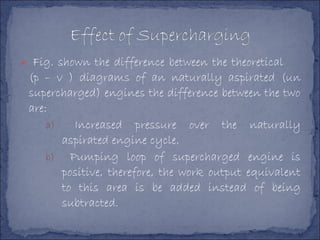
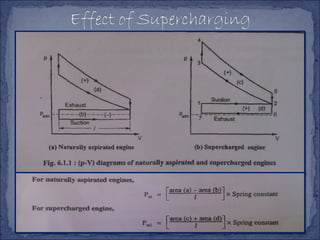
 Fig. shown the difference between the theoretical
(p – v ) diagrams of an naturally aspirated (un
supercharged) engines the difference between the two
are:
a) Increased pressure over the naturally
aspirated engine cycle.
b) Pumping loop of supercharged engine is
positive, therefore, the work output equivalent
to this area is be added instead of being
subtracted.
 To increase the power output of the engine by
increasing the density of charge at intake.
 To reduce the weight to power ratio. It is very useful in
case of aircraft, racing cars and marine applications.
 To overcome the loss of power at high altitude either in
case of static engines or in case of aircraft applications.
The loss of power of an engine is estimated to be 1% per
100 metre of altitude.
 To reduce the bulk of the engine where weight and space
are important considerations like in case if locomotives
and marine engines.
Centrifugal Supercharger
Rootes Supercharger
Vane Supercharger
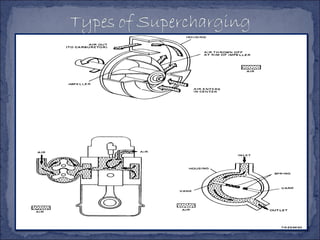
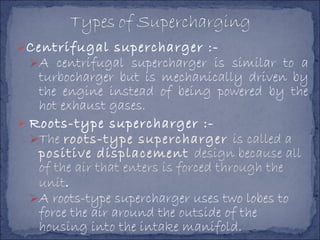
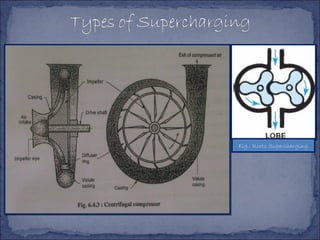
Centrifugal supercharger :-
A centrifugal supercharger is similar to a
turbocharger but is mechanically driven by
the engine instead of being powered by the
hot exhaust gases.
 Roots-type supercharger :-
The roots-type supercharger is called a
positive displacement design because all
of the air that enters is forced through the
unit.
A roots-type supercharger uses two lobes to
force the air around the outside of the
housing into the intake manifold.
Fig.: Roots Supercharging
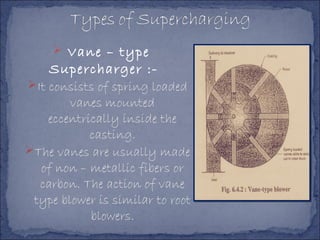
 Vane – type
Supercharger :-
It consists of spring loaded
vanes mounted
eccentrically inside the
casting.
The vanes are usually made
of non – metallic fibers or
carbon. The action of vane
type blower is similar to root
blowers.
 Advantages :-
1. Power required is less for given pressure ratio.
2. Can handle small to large volumes of air.
3. Initial cost and maintenance cost is low.
4. Weight / of air handle is low.
Disadvantages :-
1. Space requirement is high.
2. Increased temperature of fuel/air mixture
increases risk of detonation.
3
m
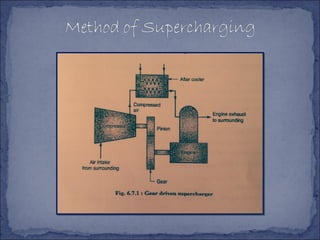
1. Gear Driven Supercharger :-
 The arrangement of compressor (supercharger)
driven by engine shaft through gearing to
increase the speed of the compressor.
 In this method, the power required to drive the
compressor is supplied from the engine output.
Therefore, net power output of the supercharged
engine is equal to the difference of power output
of engine and power required to drive the
compressor.
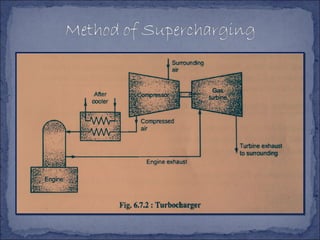
2. Turbocharger :-
 In this arrangement the exhaust energy if
engine is utilized to run a gas turbine. The
output of the gas turbine is used to drive the
compressor directly coupled to it.
 Therefore, the gas turbine and compressor
used are independent of the engine and the
total engine output is enhanced.
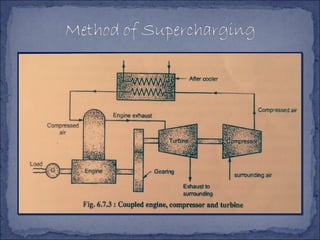
3. Coupled Engine, Compressor and
Turbine Supercharger :-
 In this method, the turbine is coupled to
engine through step up gearing which drives
the compressor mounted on the same shaft.
 The advantage of this system is that if the
turbine output is not sufficient to run the
compressor particularly at part load running
of the engine, the extra power required to run
the compressor is taken from the engine.
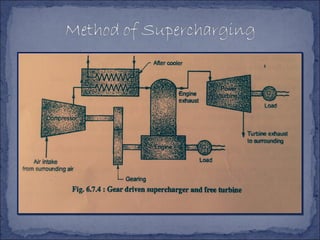
4. Gear Driven Supercharger and Free
Turbine :-
 In this method, the compressor is driven through
step up gearing by the engine and the engine
exhaust gases drive the power turbine separately.
Such plants are also called as free piston engine.
 The thermal efficiency of the plant depends on the
boost pressure ratio.
 Due to this its thermal efficiency is reduced at part
loads. Also, at low loads the engine exhaust has to be
blown off to surroundings since the power turbine
cannot run below certain compressor pressures.
Supercharging | Internal Combustion Engine

Supercharging | Internal Combustion Engine

  • 1.
  • 2.
    PARMAR ASHISH PARMAR DINESH PARMARSAGAR PARMAR UMANG PATEL HARSH PATEL JAY 130150119073 130150119074 130150119075 130150119076 130150119077 130150119078 Enrollment No.
  • 3.
     The Processof Increasing the inlet air or charge density in order to increase the power output of the engine is called supercharging.  The device used for increasing the pressure of air above atmospheric pressure is called supercharger.
  • 4.
     The includecharge by the supercharge during suction helps in better mixing of fuel and air during its compression stroke due to the turbulent effect created by the supercharger and the increased temperature helps in vaporization of fuel.  The increase in temperature of charge, however, reduces the charge density and it is detrimental in case of S.I. engine since it develops the tendency to detonation
  • 5.
     Fig. shownthe difference between the theoretical (p – v ) diagrams of an naturally aspirated (un supercharged) engines the difference between the two are: a) Increased pressure over the naturally aspirated engine cycle. b) Pumping loop of supercharged engine is positive, therefore, the work output equivalent to this area is be added instead of being subtracted.
  • 7.
     To increasethe power output of the engine by increasing the density of charge at intake.  To reduce the weight to power ratio. It is very useful in case of aircraft, racing cars and marine applications.  To overcome the loss of power at high altitude either in case of static engines or in case of aircraft applications. The loss of power of an engine is estimated to be 1% per 100 metre of altitude.  To reduce the bulk of the engine where weight and space are important considerations like in case if locomotives and marine engines.
  • 8.
  • 10.
    Centrifugal supercharger :- Acentrifugal supercharger is similar to a turbocharger but is mechanically driven by the engine instead of being powered by the hot exhaust gases.  Roots-type supercharger :- The roots-type supercharger is called a positive displacement design because all of the air that enters is forced through the unit. A roots-type supercharger uses two lobes to force the air around the outside of the housing into the intake manifold.
  • 11.
  • 12.
     Vane –type Supercharger :- It consists of spring loaded vanes mounted eccentrically inside the casting. The vanes are usually made of non – metallic fibers or carbon. The action of vane type blower is similar to root blowers.
  • 13.
     Advantages :- 1.Power required is less for given pressure ratio. 2. Can handle small to large volumes of air. 3. Initial cost and maintenance cost is low. 4. Weight / of air handle is low. Disadvantages :- 1. Space requirement is high. 2. Increased temperature of fuel/air mixture increases risk of detonation. 3 m
  • 14.
    1. Gear DrivenSupercharger :-  The arrangement of compressor (supercharger) driven by engine shaft through gearing to increase the speed of the compressor.  In this method, the power required to drive the compressor is supplied from the engine output. Therefore, net power output of the supercharged engine is equal to the difference of power output of engine and power required to drive the compressor.
  • 16.
    2. Turbocharger :- In this arrangement the exhaust energy if engine is utilized to run a gas turbine. The output of the gas turbine is used to drive the compressor directly coupled to it.  Therefore, the gas turbine and compressor used are independent of the engine and the total engine output is enhanced.
  • 18.
    3. Coupled Engine,Compressor and Turbine Supercharger :-  In this method, the turbine is coupled to engine through step up gearing which drives the compressor mounted on the same shaft.  The advantage of this system is that if the turbine output is not sufficient to run the compressor particularly at part load running of the engine, the extra power required to run the compressor is taken from the engine.
  • 20.
    4. Gear DrivenSupercharger and Free Turbine :-  In this method, the compressor is driven through step up gearing by the engine and the engine exhaust gases drive the power turbine separately. Such plants are also called as free piston engine.  The thermal efficiency of the plant depends on the boost pressure ratio.  Due to this its thermal efficiency is reduced at part loads. Also, at low loads the engine exhaust has to be blown off to surroundings since the power turbine cannot run below certain compressor pressures.