Forced induction is the process of
delivering compressed air to the
intake of an internal combustion
engine. A forced induction engine
uses a gas compressor to increase
the pressure and temperature of
the air. An engine without forced
induction is considered a naturally
aspirated engine.
A naturally aspirated engine is an
internal combustion engine in which
oxygen intake depends solely on
atmospheric pressure and which
does not rely on forced induction
through a turbocharger or a
supercharger.
Since the invention of the internal
combustion engine, automotive
engineers, and racecar designers
have been searching for ways to
boost its power. One way to add
power is to build a bigger engine. But
bigger engines, which weigh more
and cost more to build and maintain,
are not always better.
Another way to add power is to make a
normal-sized engine more efficient. You
can accomplish this by forcing more air
into the combustion chamber. More air
means more fuel can be added, and
more fuel means a bigger explosion and
greater horsepower. Adding a
supercharger or a turbocharger is a great
way to achieve forced air induction
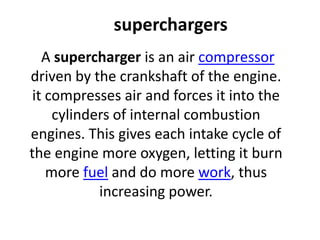
superchargers
A supercharger is an air compressor
driven by the crankshaft of the engine.
it compresses air and forces it into the
cylinders of internal combustion
engines. This gives each intake cycle of
the engine more oxygen, letting it burn
more fuel and do more work, thus
increasing power.
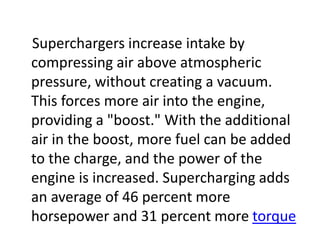
Superchargers increase intake by
compressing air above atmospheric
pressure, without creating a vacuum.
This forces more air into the engine,
providing a "boost." With the additional
air in the boost, more fuel can be added
to the charge, and the power of the
engine is increased. Supercharging adds
an average of 46 percent more
horsepower and 31 percent more torque
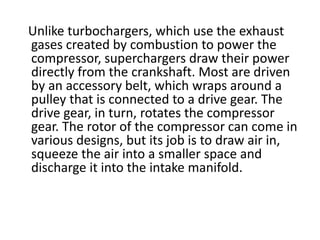
Unlike turbochargers, which use the exhaust
gases created by combustion to power the
compressor, superchargers draw their power
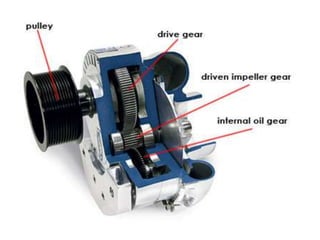
directly from the crankshaft. Most are driven
by an accessory belt, which wraps around a
pulley that is connected to a drive gear. The
drive gear, in turn, rotates the compressor
gear. The rotor of the compressor can come in
various designs, but its job is to draw air in,
squeeze the air into a smaller space and
discharge it into the intake manifold.
• to pressurize the air, a supercharger must spin
rapidly -- more rapidly than the engine itself.
Making the drive gear larger than the compressor
gear causes the compressor to spin faster.
Superchargers can spin at speeds as high as
50,000 to 65,000 rotations per minute (RPM).
• A compressor spinning at 50,000 RPM translates
to a boost of about six to nine pounds per square
inch (psi). That's six to nine additional psi over
the atmospheric pressure at a particular
elevation. Atmospheric pressure at sea level is
14.7 psi, so a typical boost from a supercharger
places about 50 percent more air into the engine.
As the air is compressed, it gets hotter, which
means that it loses its density and can not
expand as much during the explosion. This
means that it can't create as much power
when it's ignited by the spark plug. For a
supercharger to work at peak efficiency, the
compressed air exiting the discharge unit must
be cooled before it enters the intake manifold.
The intercooler is responsible for this cooling
process. Intercoolers come in two basic
designs: air-to-air intercoolers and air-to-
water intercoolers. Both work just like a
radiator, with cooler air or water sent through
a system of pipes or tubes. As the hot air
exiting the supercharger encounters the
cooler pipes, it also cools down. The reduction
in air temperature increases the density of the
air, which makes for a denser charge entering
the combustion chamber
Advantages of supercharging
• Higher power output. adding a supercharger to any engine is
a quick solution to boosting power.
• Reduced smoke from exhaust gases. The extra air pushed
into cylinder, helps the air to complete combust leading to
lesser smoke generation.
• Quicker acceleration of vehicle. Supercharger starts working
as soon as the engine starts running. This way the engine gets
a boost even at the beginning leading to quicker acceleration.
• Cheaper than turbocharger.
• No lag: the supercharger’s biggest advantage over a
turbocharger is that it does not have any lag. Power delivery is
immediate because the supercharger is driven by the engine’s
crankshaft.
• Low RPM boost: good power at low RPM in comparison with
turbochargers.
Limitations
• Less efficient: the biggest disadvantage of
superchargers is that they suck engine power
simply to produce engine power. They’re run off
an engine belt connected to the crankshaft.
Because of this, superchargers are significantly
less efficient than turbochargers.
• Increased heat generation. The engine should
have proper heat dissipation systems as well as it
should be able to withstand thermal stresses !
• Induces stress. The engine must hold up against
the high pressure & bigger explosions generated
in the cylinder. If the engine is not designed
considering these stresses, it may damage the
piston head.
turbochargers
Turbocharger is an air compressor driven
by exhaust gas turbine to increase the
amount of air entering into the
combustion chamber. More air into the
combustion chamber means more
amount of fuel will be admitted into the
cylinder and as a result more power.
Turbochargers were originally known
as turbosuperchargers when all
forced induction devices were
classified as superchargers. Today the
term "supercharger" is typically
applied only to mechanically driven
forced induction devices.
The key difference between a turbocharger and
a conventional supercharger is that a
supercharger is mechanically driven by the
engine, often through a belt connected to the
crankshaft, whereas a turbocharger is
powered by a turbine driven by the engine's
exhaust gas. Compared with a mechanically
driven supercharger, turbochargers tend to be
more efficient, but less responsive.
Twincharger refers to an engine with both a
supercharger and a turbocharger.
Many people confuses between the
TURBOCHARGER and SUPERCHARGER. The
function of the supercharger is same as that of
turbocharger but the supercharger is driven
mechanically by the engine, often with the
help of belt connected to the crankshaft,
whereas turbocharger is powered by a turbine
driven by the engine’s exhaust gases.
Turbocharger is considered more efficient
than the superchargers as they are using the
wasted energy of exhaust gases for its power
source.
main components
The turbocharger has three main components
• The turbine, which is almost a radial inflow
turbine.
• The compressor which is almost a centrifugal
compressor.
• The centre hub rotating assembly.
Operation
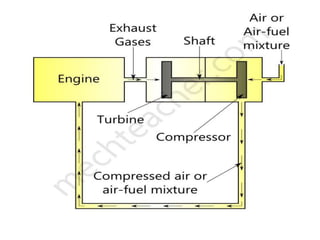
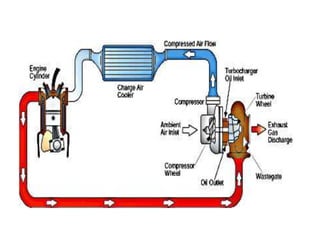
A turbocharger contains a gas turbine coupled
to a compressor. Both the turbine and the
compressor are keyed to the same shaft.
Whenever the turbine rotates, the compressor
is operated.
Exhaust gases from the engine is allowed to fall
on the gas turbine. The kinetic energy of the
exhaust gases gets converted into the
mechanical after striking the turbine blades
which then rotates. This makes the
compressor work.
The compressor compresses air from the
surroundings (in case of diesel engines) or air-
fuel mixture (in case of petrol engines) that is
to be fed to the engine. Since compressed air
includes more oxygen in one volume unit, it is
possible to create better conditions for the
combustion process. Increased oxygen
amount with additional amount of fuel can be
used to increase engine power, facilitates
more complete combustion, reducing the
amount of emissions and boosting efficiency..
Increasing air compression leads to temperature
increase. Higher temperature is connected
with lower density, which means that
cylinders receive the amount of oxygen
smaller than if the air temperature were
lower. Therefore, a charging air radiator
(intercooler) is used to cool the air. Most
frequently, this is an air exchanger of air-air
type or (seldom) air-water.
Benefits of using a turbocharger:
• Turbocharger increases the volumetric
efficiency of the engine.
• It increases the output power produced.
• No extra power supply is needed for
operating the turbocharger unit because
it utilize the waste energy of exhaust
gases.
• Since a turbo compressor supplies
considerably more air to the engine, there is
more efficient and complete combustion in
the cylinder chamber, and as a result cleaner
emissions. Today`s turbo diesel engines
generate approx. 50% less NOx and CO2 than
traditional engines.
• Compared with a naturally aspirated engine of
identical power output, the fuel consumption
of a turbocharger engine is lower, as some of
the normally wasted exhaust energy
contributes to the engine's efficiency.
Turbo lag is the time between mashing the
throttle and feeling the rush of torque from a
turbocharged engine. The lag comes from the
time it takes the engine to create enough
exhaust pressure to spin the turbo and pump
compressed intake air into the engine and is
longest when the engine is in a low-rpm,
Disadvantages of turbo
o Turbo lag: turbochargers, especially large
turbochargers, take time to spool up and provide
useful boost.
o Boost threshold: for traditional turbochargers,
they are often sized for a certain RPM range
where the exhaust gas flow is adequate to
provide additional boost for the engine. They
typically do not operate across as wide an RPM
range as superchargers.
o Oil requirement: turbochargers get very hot and
often tap into the engine’s oil supply. This calls for
additional plumbing, and is more demanding on
the engine oil. Superchargers typically do not
require engine oil lubrication.
Where will things head in the future?
Electric turbos will likely be more
common in future vehicles, where an
electric motor spools up the turbo at low
RPMs, producing useful boost until the
exhaust gases are sufficient enough to
power the turbo. This is exactly what’s
happening in Formula 1 with the ERS
system, and it’s the solution to the
turbo’s biggest disadvantage - turbo lag.

Forced induction

  • 1.
    Forced induction isthe process of delivering compressed air to the intake of an internal combustion engine. A forced induction engine uses a gas compressor to increase the pressure and temperature of the air. An engine without forced induction is considered a naturally aspirated engine.
  • 2.
    A naturally aspiratedengine is an internal combustion engine in which oxygen intake depends solely on atmospheric pressure and which does not rely on forced induction through a turbocharger or a supercharger.
  • 3.
    Since the inventionof the internal combustion engine, automotive engineers, and racecar designers have been searching for ways to boost its power. One way to add power is to build a bigger engine. But bigger engines, which weigh more and cost more to build and maintain, are not always better.
  • 4.
    Another way toadd power is to make a normal-sized engine more efficient. You can accomplish this by forcing more air into the combustion chamber. More air means more fuel can be added, and more fuel means a bigger explosion and greater horsepower. Adding a supercharger or a turbocharger is a great way to achieve forced air induction
  • 5.
    superchargers A supercharger isan air compressor driven by the crankshaft of the engine. it compresses air and forces it into the cylinders of internal combustion engines. This gives each intake cycle of the engine more oxygen, letting it burn more fuel and do more work, thus increasing power.
  • 7.
    Superchargers increase intakeby compressing air above atmospheric pressure, without creating a vacuum. This forces more air into the engine, providing a "boost." With the additional air in the boost, more fuel can be added to the charge, and the power of the engine is increased. Supercharging adds an average of 46 percent more horsepower and 31 percent more torque
  • 8.
    Unlike turbochargers, whichuse the exhaust gases created by combustion to power the compressor, superchargers draw their power directly from the crankshaft. Most are driven by an accessory belt, which wraps around a pulley that is connected to a drive gear. The drive gear, in turn, rotates the compressor gear. The rotor of the compressor can come in various designs, but its job is to draw air in, squeeze the air into a smaller space and discharge it into the intake manifold.
  • 9.
    • to pressurizethe air, a supercharger must spin rapidly -- more rapidly than the engine itself. Making the drive gear larger than the compressor gear causes the compressor to spin faster. Superchargers can spin at speeds as high as 50,000 to 65,000 rotations per minute (RPM). • A compressor spinning at 50,000 RPM translates to a boost of about six to nine pounds per square inch (psi). That's six to nine additional psi over the atmospheric pressure at a particular elevation. Atmospheric pressure at sea level is 14.7 psi, so a typical boost from a supercharger places about 50 percent more air into the engine.
  • 10.
    As the airis compressed, it gets hotter, which means that it loses its density and can not expand as much during the explosion. This means that it can't create as much power when it's ignited by the spark plug. For a supercharger to work at peak efficiency, the compressed air exiting the discharge unit must be cooled before it enters the intake manifold.
  • 11.
    The intercooler isresponsible for this cooling process. Intercoolers come in two basic designs: air-to-air intercoolers and air-to- water intercoolers. Both work just like a radiator, with cooler air or water sent through a system of pipes or tubes. As the hot air exiting the supercharger encounters the cooler pipes, it also cools down. The reduction in air temperature increases the density of the air, which makes for a denser charge entering the combustion chamber
  • 12.
    Advantages of supercharging •Higher power output. adding a supercharger to any engine is a quick solution to boosting power. • Reduced smoke from exhaust gases. The extra air pushed into cylinder, helps the air to complete combust leading to lesser smoke generation. • Quicker acceleration of vehicle. Supercharger starts working as soon as the engine starts running. This way the engine gets a boost even at the beginning leading to quicker acceleration. • Cheaper than turbocharger. • No lag: the supercharger’s biggest advantage over a turbocharger is that it does not have any lag. Power delivery is immediate because the supercharger is driven by the engine’s crankshaft. • Low RPM boost: good power at low RPM in comparison with turbochargers.
  • 13.
    Limitations • Less efficient:the biggest disadvantage of superchargers is that they suck engine power simply to produce engine power. They’re run off an engine belt connected to the crankshaft. Because of this, superchargers are significantly less efficient than turbochargers. • Increased heat generation. The engine should have proper heat dissipation systems as well as it should be able to withstand thermal stresses ! • Induces stress. The engine must hold up against the high pressure & bigger explosions generated in the cylinder. If the engine is not designed considering these stresses, it may damage the piston head.
  • 14.
    turbochargers Turbocharger is anair compressor driven by exhaust gas turbine to increase the amount of air entering into the combustion chamber. More air into the combustion chamber means more amount of fuel will be admitted into the cylinder and as a result more power.
  • 15.
    Turbochargers were originallyknown as turbosuperchargers when all forced induction devices were classified as superchargers. Today the term "supercharger" is typically applied only to mechanically driven forced induction devices.
  • 16.
    The key differencebetween a turbocharger and a conventional supercharger is that a supercharger is mechanically driven by the engine, often through a belt connected to the crankshaft, whereas a turbocharger is powered by a turbine driven by the engine's exhaust gas. Compared with a mechanically driven supercharger, turbochargers tend to be more efficient, but less responsive. Twincharger refers to an engine with both a supercharger and a turbocharger.
  • 17.
    Many people confusesbetween the TURBOCHARGER and SUPERCHARGER. The function of the supercharger is same as that of turbocharger but the supercharger is driven mechanically by the engine, often with the help of belt connected to the crankshaft, whereas turbocharger is powered by a turbine driven by the engine’s exhaust gases. Turbocharger is considered more efficient than the superchargers as they are using the wasted energy of exhaust gases for its power source.
  • 18.
    main components The turbochargerhas three main components • The turbine, which is almost a radial inflow turbine. • The compressor which is almost a centrifugal compressor. • The centre hub rotating assembly.
  • 20.
    Operation A turbocharger containsa gas turbine coupled to a compressor. Both the turbine and the compressor are keyed to the same shaft. Whenever the turbine rotates, the compressor is operated. Exhaust gases from the engine is allowed to fall on the gas turbine. The kinetic energy of the exhaust gases gets converted into the mechanical after striking the turbine blades which then rotates. This makes the compressor work.
  • 21.
    The compressor compressesair from the surroundings (in case of diesel engines) or air- fuel mixture (in case of petrol engines) that is to be fed to the engine. Since compressed air includes more oxygen in one volume unit, it is possible to create better conditions for the combustion process. Increased oxygen amount with additional amount of fuel can be used to increase engine power, facilitates more complete combustion, reducing the amount of emissions and boosting efficiency..
  • 22.
    Increasing air compressionleads to temperature increase. Higher temperature is connected with lower density, which means that cylinders receive the amount of oxygen smaller than if the air temperature were lower. Therefore, a charging air radiator (intercooler) is used to cool the air. Most frequently, this is an air exchanger of air-air type or (seldom) air-water.
  • 24.
    Benefits of usinga turbocharger: • Turbocharger increases the volumetric efficiency of the engine. • It increases the output power produced. • No extra power supply is needed for operating the turbocharger unit because it utilize the waste energy of exhaust gases.
  • 25.
    • Since aturbo compressor supplies considerably more air to the engine, there is more efficient and complete combustion in the cylinder chamber, and as a result cleaner emissions. Today`s turbo diesel engines generate approx. 50% less NOx and CO2 than traditional engines. • Compared with a naturally aspirated engine of identical power output, the fuel consumption of a turbocharger engine is lower, as some of the normally wasted exhaust energy contributes to the engine's efficiency.
  • 26.
    Turbo lag isthe time between mashing the throttle and feeling the rush of torque from a turbocharged engine. The lag comes from the time it takes the engine to create enough exhaust pressure to spin the turbo and pump compressed intake air into the engine and is longest when the engine is in a low-rpm,
  • 27.
    Disadvantages of turbo oTurbo lag: turbochargers, especially large turbochargers, take time to spool up and provide useful boost. o Boost threshold: for traditional turbochargers, they are often sized for a certain RPM range where the exhaust gas flow is adequate to provide additional boost for the engine. They typically do not operate across as wide an RPM range as superchargers. o Oil requirement: turbochargers get very hot and often tap into the engine’s oil supply. This calls for additional plumbing, and is more demanding on the engine oil. Superchargers typically do not require engine oil lubrication.
  • 28.
    Where will thingshead in the future? Electric turbos will likely be more common in future vehicles, where an electric motor spools up the turbo at low RPMs, producing useful boost until the exhaust gases are sufficient enough to power the turbo. This is exactly what’s happening in Formula 1 with the ERS system, and it’s the solution to the turbo’s biggest disadvantage - turbo lag.